Paper commentary
Terminal-style Mathematical Modeling Bench: The First Agentic and Verifiable Benchmark for Mathematical Modeling
TB-MathModel benchmarks modeling agents with terminal tasks and feasibility checks
- Problem Existing modeling benchmarks either score solver fragments or let an LLM judge grade reports, so the numbers in plausible answers go unchecked. Scoring against a single reference paper also penalises valid answers that differ from it.
- Method TB-MathModel runs each contest problem in a containerized terminal and has the agent return one JSON artifact. The artifact is checked for physical feasibility and scored against a panel of Outstanding-award papers rather than one anchor.
- Results GPT-6 Astra with codex scored 64.58% O-EVAL, compared with 59.81% for DeepSeek V4.1 Flash with opencode, which cost about 1/100 as much.
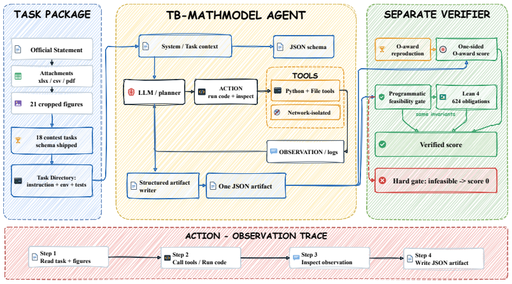
Figure 2 : The TB-MathModel construction and evaluation pipeline.Build: official statements, attachments, and PDF figures are compiled into a task directory.Run: the agent works inside a network-isolated terminal container and writes one JSON artifact.Evaluate: the artifact is scored by a direction-aware, one-sided panel against an O-award reproduction, and independently checked by a programmatic feasibility gate plus a Lean 4 certificate layer; a failed gate zeroes the task.
Original paper · CC BY 4.0 · Xiaojun Wu, Cehao Yang, Xuhui Jiang, Chengjin Xu, Jia Li, Jian Guo · Terminal-style Mathematical Modeling Bench: The First Agentic and Verifiable Benchmark for Mathematical Modeling · Original paper figure · Extracted the figure area from page 5 of the original PDF.Why current modeling benchmarks miss the numbers
A modeling contest answer is a whole chain of reasoning, not a single figure. Existing benchmarks cover nearby ground, such as repository edits, deduction and solver-ready formulations. Code and terminal benchmarks score repository edits and command-line competence, but they never score a modeling artifact. The closest modeling benchmarks fall into two camps, and neither is agentic, verifiable, terminal and multimodal at once.
Mamo checks one formal artifact with a solver, which is precise but narrow. ModelingBench and MM-Bench grade a full report with an LLM judge, so fluent prose can earn credit without the numbers being checked.
Scoring against one paper brings its own problems, because different teams make different assumptions. A model that beats the paper can still score worse than one that copies it, because distance to one anchor penalises improvement. A plausible answer can break the physics yet still match a reference on one field. An anchor comparison alone won't catch that failure, so TB-MathModel adds an independent feasibility layer.
One paper becomes one vote, with a gate in front
The benchmark replaces a single reference with a panel of outstanding papers, and each paper gets one vote. For each task, the authors extracted the final-question values reported by all available Outstanding-award papers. Because each paper scores its own fields against itself, the reproduction reproduces the panel exactly. The score therefore reflects closeness to many accepted answers rather than to one team's choices.
Each paper that cannot supply the scored quantity carries a machine-readable exclusion_reason, so no paper is silently dropped. Disagreement among humans stays visible, because the panel is not hidden behind one anchor. On mcm-2024-c-tennis-momentum, 10 of 11 outstanding papers conclude momentum is supported, while the anchor concludes it is not.
The authors mark such literature-split tasks and keep them out of headline rankings, but keep them in the panel.
Each metric carries a direction, and a directional metric never drops below full credit once it matches or beats the anchor. Bands narrower than 2% of the value magnitude are widened to 5%, which changed one cell, stair-wear from 72.67 to 73.52. Out-of-domain values, such as a correlation outside [−1,1], score zero with the reason recorded.
The feasibility check is a two-layer design that doesn't rely on the score alone. A programmatic gate covers 18/18 tasks through six decidable invariant forms. The Lean layer uses no Mathlib, so the propositions are decided on exact integers.
What the agent receives and what it must return
A task starts with a build script that assembles four parts from the official contest material. The parts are an instruction file, an agent container, a separate verifier container, and an oracle that reproduces the Outstanding-award paper. The agent gets the statement, figures and attachments, and it must return one structured JSON artifact.
Only that JSON is scored, because extra CSV, XLSX or PNG files aren't scored. The schema shipped to the agent gives field names and types only, so the agent still has to decide which numbers matter.
Runs happen in Docker containers with 2 CPUs, 8 GB of memory, no GPU, and a 4-hour timeout.
Each task is anchored to one Outstanding-award paper, re-implemented as a script that emits the same JSON. The reproduction sets the normalisation endpoint, so O-EVAL equals 100% for it. Provenance is recorded for each anchor, including paper id, PDF or OCR source, and reproduction scope, so any reference can be re-derived. Scoring then runs through a per-metric panel, each metric carrying an anchor value, a direction, and a weight.
Two layers check whether an answer is admissible
Closeness to an anchor doesn't show that an answer is physically admissible. The programmatic gate covers all 18 tasks through six decidable forms of invariant. Some forms are structural bounds on rates, correlations, probabilities and non-negative counts. Other forms replay constraints, such as heliostat rated power of at least 60 MW and an installation height of 2 to 6 m.
The dragon-dance check requires head speed times amplification ratio to stay at or below 2 m/s.
The gate itself has to be trusted, so the authors keep three contracts to honour it. Coverage means a task can't ship ungated, and oracle self-consistency means the O-award reference must pass its own check. Discrimination requires synthetic and real-field violations to be rejected, while an empty artifact only warns. Four constraints that need an independent replay are recorded as whole-task penalties instead of field checks.
Ten mutations across all six forms are rejected.
The two layers don't decide whether a reported value matches physical truth, such as whether a field really produces 60 MW. That property is a fact about the world, so the benchmark checks it only where an independent replay exists. Where evidence is absent, an obligation is reported as a witnessed gap rather than silently satisfied. This keeps the audit from claiming more than it has actually proved.
How the multimodal board ranks
The board compares seven multimodal entries on 18 tasks, and each entry is a three-seed mean. GPT-6 Astra with codex reaches 64.58±2.93 O-EVAL, while DeepSeek-Flash with opencode reaches 59.81±1.25 at $2.54 per 18-task pass. The two leaders cost $246–$273 per run, so the cheapest strong entry sits about 4.8 points behind the top at roughly 1/100 the cost.
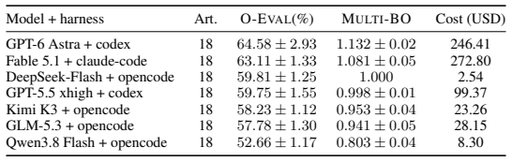
Table 2 : Main results: the seven multimodal entries, 18 tasks, sorted by O-EVAL. “Art.”: tasks with a scoreable artifact; cost: USD per 18-task pass. O-EVALis the multi-reference panel score (%) and MULTI-BO the same score relative to the DeepSeek V4.1 Flash baseline (1.000= level with Flash), both three-seed means (±std).
Original paper · CC BY 4.0MULTI-BO reads the same score against the DeepSeek V4.1 Flash baseline, so 1.000 means level with Flash.
Per-seed deviations reach 2.93 pp, so the roughly 1.5 pp gap between the two leaders sits inside one standard deviation. The authors report the order but don't claim a significant difference between adjacent rows.
Harness changes barely move the board, because holding DeepSeek-Flash fixed and swapping four harnesses shifts O-EVAL by at most 0.07 pp. The scores run from 59.81 to 59.88, which is far inside the per-seed deviation. DeepSeek's native harness gives the highest value, 59.88 with MULTI-BO 1.092, but the gap is small. Running DeepSeek-Flash at its maximum reasoning tier dropped O-EVAL to 48.11% and MULTI-BO to 0.864.
A larger deliberative budget doesn't simply buy accuracy on these tasks.
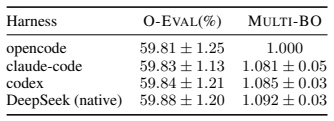
Table 3 : Harness sensitivity, holding the model fixed (DeepSeek-Flash, 18 tasks, three seeds). Multi-BO is 1.000 for the opencode reference harness by definition.
Original paper · CC BY 4.0The strongest entries narrow that gap only slightly, with GPT-6 at 82.9 on CUMCM and 46.2 on MCM. The authors attribute the remaining MCM difficulty to more open problems with more contestable anchors.
When the anchor was wrong and the models were right
Dragon-dance is the clearest case where the benchmark's own reference failed the feasibility check. The paper's isolated value of 1.406276 m/s is infeasible, because a handle would reach 2.2568 m/s. The exact identity head speed times ratio equals 2 m/s is what exposes that value. Because the programmatic gate and the Lean layer both check this identity, the paper value stands out as infeasible.
The authors corrected the anchor to the continuous-time value 1.246266 m/s and set the metric direction to target_value.

Table 9 : Dragon-dance (CUMCM 2024 A, Q5). All three roles agree; the paper value is the outlier and is infeasible.
Original paper · CC BY 4.0All three roles agree on the dragon-dance answers, with max head speed at 1.24626636 for GPT-5.5 and DeepSeek V4.1. The oracle, GPT-5.5 and DeepSeek V4.1 all report a max speed ratio of 1.604793, so the paper value is the lone outlier. The authors conclude that the models were right and the anchor was wrong, which shows the value of checking feasibility independently.
The feasibility gate also hard-invalidated 7 cells, concentrated on heliostat. Single cells were invalidated for smoke-screen, Juneau and Olympic. The authors treat that shift as a systematic scoring effect rather than a model difference. Literature-split tasks, such as tennis momentum, are marked and kept out of headline rankings.
What the verification layers and the evidence do not cover
The two verification layers check units, value ranges, and internal consistency, not external physical truth. Whether a field really produces 60 MW is therefore outside what the gate and the Lean layer can settle. Any obligation whose evidence is missing is reported as a witnessed gap rather than silently passed.
Modeling admits no single correct answer, so the authors build a panel from every available Outstanding-award paper. Panel size runs from 1 to 18 papers per task, with a median of 4, so some tasks rest on very few human answers. Where a paper can't supply the scored quantity, it is excluded with a machine-readable reason rather than silently dropped.
The authors mark such literature-split tasks and keep them out of headline rankings. Scores are three-seed means, and per-seed deviations reach 2.93 percentage points. The authors don't claim significant differences between adjacent rows of the board.
The authors state that the task shell can carry over to engineering and cross-disciplinary problems. The paper doesn't report any such test, so that transfer stays a claim without evidence. The harness sensitivity test covers only DeepSeek-Flash across four harnesses, so other models aren't checked this way.
Paper info
- Authors
- Xiaojun Wu, Cehao Yang, Xuhui Jiang, Chengjin Xu, Jia Li, Jian Guo
- Venue
- arXiv · Preprint
- First published
- 2026-11-5
- Added
- 2026-11-7
- Updated
- 2026-11-5
- Version
- v1
- arXiv
- 2611.08237
- Category
- cs.CL
- Original paper terms
- CC BY 4.0
- What we show
- Paper info, commentary and permitted figures from the original paper
AI commentary is a separate explanation from the original paper and may contain errors. The original paper and figures follow each source's terms of use and any rights noted separately.
Abstract
Mathematical modeling turns an open-ended real-world problem into assumptions, a model, a solution, and a defended recommendation, and its answers matter only if they are both close to a credible reference and physically feasible; existing benchmarks either score solver fragments or grade reports with an LLM judge, leaving those numbers unchecked. We introduce TB-MathModel (the Terminal-style Mathematical Modeling Bench), the first benchmark to make complete contest-style modeling problems agentic, verifiable, and terminal at once, over 18 real CUMCM and MCM problems (2023--2025). Each task ships the verbatim statement, official attachments, and figures in a containerized terminal; the agent returns one JSON artifact, scored on the numeric core of the final question against a reproduction of the Outstanding-award paper. Two design choices distinguish it: direction-aware, one-sided scoring, which never penalises beating the anchor, and two-layer feasibility verification---a programmatic gate over six decidable invariant forms plus 624 Lean~4 obligations---with a hard gate that zeroes infeasible answers. Each task is scored against a panel of human outstanding papers rather than one, so a model must be close to many accepted answers; across seven multimodal entries (three seeds each) the strongest reach a multi-reference O-Eval of 64.58\%, while the \$2.54 open model holds 59.81\% at $1/100$ the cost. TB-MathModel turns the numeric core of modeling into a reproducible, machine-checkable signal for measuring long-horizon modeling competence and for collecting agent trajectories. The source code is available at https://github.com/wxj630/terminal-bench-math-modeling.
Quote from the paper
Xiaojun Wu, Cehao Yang, Xuhui Jiang, Chengjin Xu, Jia Li, Jian Guo (2026). Terminal-style Mathematical Modeling Bench: The First Agentic and Verifiable Benchmark for Mathematical Modeling. arXiv:2611.08237v1. https://arxiv.org/abs/2611.08237v1
BibTeX
@misc{wu2026terminal,
  title = {{Terminal-style Mathematical Modeling Bench: The First Agentic and Verifiable Benchmark for Mathematical Modeling}},
  author = {Xiaojun Wu and Cehao Yang and Xuhui Jiang and Chengjin Xu and Jia Li and Jian Guo},
  year = {2026},
  eprint = {2611.08237},
  archivePrefix = {arXiv},
  url = {https://arxiv.org/abs/2611.08237v1}
}