Paper commentary
How many sorted projections determine n points in k dimensions?
Almost every set of sorted projections in higher dimensions determines the points
- Problem Sorted projections onto a few directions were only known to determine point multisets in the plane. Whether a similar bound holds in higher dimensions was left open, and the known bounds gap widely as n grows.
- Method The authors tighten two lemmas of Hair and Sahai, originally written for list recovery of random linear codes. They keep constants the proof drops, so almost every choice of about (4k−2) ln(2n) ln(k log2 2n) directions suffices.
- Results For multisets of 1000 points in the plane, 144 directions suffice, and an exact computation lowers this to 133. The bound beats the linear bound once n is larger than about 100 for k up to 10.
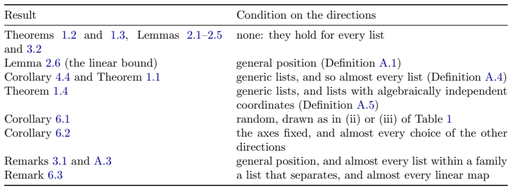
Table 2 : The conditions that each result puts on the directions.
Original paper · CC BY 4.0 · Christopher Gorham Lester, Raymond Hau Sørensen · How many sorted projections determine n points in k dimensions? · Original paper figure · Extracted the figure area from page 23 of the original PDF.Why higher dimensions are harder
Sorting-based embeddings turn an unordered set of vectors into a fixed-length vector by sorting its projections onto a list of directions. For that to be useful the map has to be injective, so two different multisets of n points must never produce the same output. The fewest directions that achieve this is written \(m_k(n)\), the smallest m for which some list of m directions separates multisets of size n.
The hard part is the order of quantifiers. Random directions work for one fixed multiset with probability one, but a single list must work for every multiset of that size at once.
Two bounds are known in every dimension. A list is always too short when \(\lceil m/(k-1)\rceil \le \log_2 n + 1\) holds, which gives a logarithmic lower bound. A list of \((k-1)n+1\) directions in general position always works, which gives a linear upper bound. So the gap between the two grows with n, because one bound is logarithmic and the other linear.
In the plane the picture is fuller: almost every list of m directions separates multisets up to size \(2^{cm/\log m}\), for an absolute constant c > 0. Dym et al. asked whether this planar behaviour extends to higher dimensions, and left the question open.
Figure 2 shows the best bounds on \(m_k(n)\) known before this paper for k = 2 to 5. For each k, the true value lies in the shaded band between the upper and lower bounds. Before this paper, the higher-dimensional picture was the linear upper bound and the logarithmic lower bound.
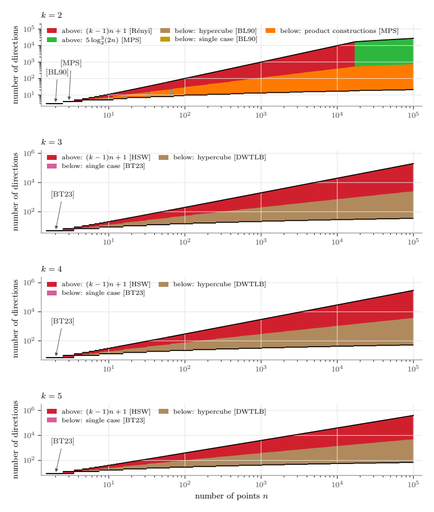
Figure 2 : The best bounds onm k(n) known before this paper, fork= 2, . . . ,5, including those for single values ofn.m k(n) lies in the shaded range between the upper and lower bounds (black). Each half of the shading has the colour of the bound credited on its side, named in the legend, and where the two meet a label names the reference credited withm k(n). The credits follow fixed rules from a database of what each reference states (bounds.tomlin the accompanying code): a bound goes to the earliest reference that states it. The figures show only results that come with a proof a reader can check; findings made in floating point are acknowledged in the text instead (Remark 3.1 and the provenance note).
Original paper · CC BY 4.0Reusing two lemmas about codes
The key idea is to reuse a counting argument that Hair and Sahai built for list recovery of random linear codes. Their lemmas were written for codes, yet they apply to sorted projections with almost no extra work. The argument starts from a confusable pair: two different multisets of the same size with equal projections on every direction.
Each direction gives a perfect matching between the two multisets, and the union of these matchings, one colour per direction, is the matching graph.
A rigidity lemma turns a pinning pattern in the matching graph into a polynomial equation in the coordinates of the directions. That polynomial isn't identically zero, so the set of lists it vanishes on has measure zero. Only finitely many matching graphs and patterns exist for a given n, so almost every list avoids all of them. What remains is to show that a matching graph with enough colours always contains a pinning pattern.
That is a graph-theory statement, and the randomised argument of Hair and Sahai needs about 8k ln N (ln ln N + ln k) colours as written. Keeping the constants that the proof gives away reduces this to about (4k−2) ln N ln(k log2 N). Here N counts the vertices, which is 2n for a pair of multisets of size at most n. The tightened bound gives m♯k(n) directions in terms of the sum over T colours per tree, which is the form used in the proof of Theorem 1.1.
Where the constants come from
The authors tighten Hair and Sahai's proof at four points, marked (i) to (iv) in their lemma, and the first change keeps a term that Hair and Sahai drop from the cut estimate. Hair and Sahai drop the second term of the cut count, which leaves ρ ln(w/a) crossing colours instead of the fuller bound. The second change is in the component count, where the authors use m − j for the remaining colours and Hair and Sahai replace m − j by m.
The third change keeps the factor x ln x in the bound on the number of small components, where Hair and Sahai have x/2 ln x. The fourth change concerns the block condition: each block needn't connect W with probability at least 1 − 1/(2d), since the d failure probabilities only have to sum to less than one. Keeping all four changes gives m♯2(n) = 134 at n = 1000, compared to 558 for Hair and Sahai's lemma as written.
The authors also let some blocks fail, which is a second source of savings beyond the constants. The colours are split into q ≥ d blocks, and only d of them need to connect W. The expected number of failing blocks is below q − d + 1, so some outcome has at most q − d failures. Sharing the m colours as evenly as possible across the blocks gives the balanced bound m♭2,bal(1000) = 133.
For k = 20 and n = 100 the three bounds are 2040 for m♯, 1752 for the equal-block bound and 1751 for the balanced bound, so the savings grow with k.
Taking q = 2k in the equal-block bound gives a simpler high-dimensional bound. That bound, mHD, has no log k factor, so it gives O(k log n log log n) uniformly in k and n. It scales better when k is large relative to n, and a quick bound takes the smaller of mCF and mHD.
Do the numbers beat the linear bound?
For k = 2 and n = 1000 the closed form gives 144 directions, against 558 from the lemma of Hair and Sahai as written. The paper's exact computation lowers the balanced bound to 133 directions for the same case. For k up to 10 the bound beats the linear bound once n is larger than about 100. The closed form is only slightly larger than the balanced bound, because it trades a little accuracy for a formula with no iteration.
For k = 2 the balanced-block bound improves on the linear bound for all n ≥ 76.
The lower-bound side is separate from the upper bound, and it asks whether the logarithmic bound is tight. Any 2k − 1 directions in R^k never separate multisets of three points, so mk(3) is at least 2k. The same result gives mk(3) at most 3k − 2, so the answer for three points is pinned between these two values. Exact certificates give m3(3) = 6 and m4(3) = 8, so the lower bound is attained in those cases.
In the plane, every m directions fail on some pair of multisets of size O(1.7783m), a result that improves on the earlier O(1.7996m) bound.
The authors also note that a list printed by Dym et al. for m3(3) does not separate. The small-case values come from exact tests, since the directions are rational. The figures show only results with a checkable proof, and floating-point findings appear in the text instead.
What is still open after the bound
The upper bound covers almost every list, so Theorem 1.1 doesn't name a single list that works. Random draws need care, because the guarantee holds only for drawings that give each direction a density. Rounded coordinates, or a finite set of lists, carry no guarantee at all in Table 1. A list with algebraically independent coordinates also behaves like almost every list.
The authors still call such a list hardly simple, and they point to Holub's question as the motivating case.
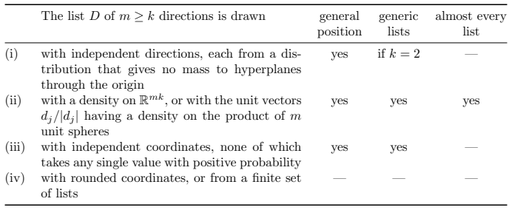
Table 1 : Ways of drawing random directions, and what holds with probability one (Lemma A.7). “Yes” under “generic lists” or “almost every list” means that every property of the paper that holds for generic lists, or for almost every list, then holds with probability one. A dash means that nothing is guaranteed. Independent standard normal coordinates satisfy (i)–(iii); independent directions uniform on the unit sphere satisfy (i) and (ii); independent directions uniform on a small circle of the unit sphere ofR 3 satisfy only (i).
Original paper · CC BY 4.0The authors don't know whether lists exist that separate multisets with fewer directions than almost every list requires. For n below 76 with k = 2, the linear bound (k − 1)n + 1 stays smaller than the new bound. Theorem 1.4 says that, for fixed k, m and n, either almost every list separates multisets of size n or almost none does.
For Holub's question about the directions (1,1), (1,2), up to (1, m) in the plane, neither the authors' methods nor theirs improve on the linear bound. The distortion of Φ D is also left open when D has only O(k polylog n) directions. With about kn² log n directions drawn uniformly from the unit sphere, the distortion is O(n²) up to logarithmic factors.
A dense linear map used for compression costs more to apply than Φ D itself, which the authors flag as a drawback.
Paper info
- Authors
- Christopher Gorham Lester, Raymond Hau Sørensen
- Venue
- arXiv · Preprint
- First published
- 2026-11-4
- Added
- 2026-11-6
- Updated
- 2026-11-4
- Version
- v1
- arXiv
- 2611.06470
- Category
- math.CO · cs.DM · cs.IT · cs.LG
- Original paper terms
- CC BY 4.0
- What we show
- Paper info, commentary and permitted figures from the original paper
AI commentary is a separate explanation from the original paper and may contain errors. The original paper and figures follow each source's terms of use and any rights noted separately.
Abstract
Let $d_1,\dots,d_m$ be directions in $\mathbb{R}^k$, where $k\ge 2$. A multiset $X$ of $n$ points of $\mathbb{R}^k$ projects to the $m$ multisets of numbers $\{\{x\cdot d_j : x\in X\}\}$, or equivalently to the $m$ sorted lists of these numbers. How many directions are needed for these projections to determine every multiset of $n$ points? Two simple bounds are known in every dimension: more than $(k-1)\log_2 n$ directions are always needed, and $(k-1)n+1$ directions in general position always suffice. In the plane much more is known: Matousek, Privetivy and Skovron showed that almost every choice of $O(\log n \log\log n)$ directions suffices. Whether anything similar holds in higher dimensions was left open by Dym, Wellershoff, Tsoukanis, Levy and Balan. We observe that two lemmas of Hair and Sahai, proved for list recovery of random linear codes, answer that question, and by tightening their argument we show that in every dimension almost every choice of $(4k-2)\ln(2n)\ln(k\log_2 2n)+k+1$ directions suffices. For $k\le 10$ this beats the linear bound once $n$ is larger than about 100: for example, 144 directions suffice for multisets of 1000 points in the plane, and an exact computation lowers this to 133. Letting some of the random blocks in their argument fail removes a factor $\log k$: almost every choice of $O(k\log n\log\log n)$ directions suffices, uniformly in $k$ and $n$. We also show that $2k-1$ directions never determine three points, so that the logarithmic lower bound is not tight; that every $m$ directions in the plane fail on some pair of multisets of size $O(1.78^m)$, improving the bound $O(1.80^m)$ of Matousek, Privetivy and Skovron; and that for each $k$, $m$ and $n$, either almost every choice of $m$ directions works or almost none does.
Quote from the paper
Christopher Gorham Lester, Raymond Hau Sørensen (2026). How many sorted projections determine n points in k dimensions?. arXiv:2611.06470v1. https://arxiv.org/abs/2611.06470v1
BibTeX
@misc{lester2026many,
  title = {{How many sorted projections determine n points in k dimensions?}},
  author = {Christopher Gorham Lester and Raymond Hau Sørensen},
  year = {2026},
  eprint = {2611.06470},
  archivePrefix = {arXiv},
  url = {https://arxiv.org/abs/2611.06470v1}
}