Paper commentary
The Look-Elsewhere Effect in Searches for New Physics: from Classical Methods to Machine Learning
The look-elsewhere effect needs different corrections in classical and ML physics searches
- Problem Scanning many locations inflates the best local excess, so the local p-value overstates evidence. Classical shortcuts do not carry over to ML searches, which have an implicit selection bias.
- Method The authors match each correction to the search's structure and calibration cost. Pseudo-experiments are exact for ML but need full retraining for each toy.
- Results The authors show BH identifies 4.9 signal classes on average, compared with 3.4 for Bonferroni.
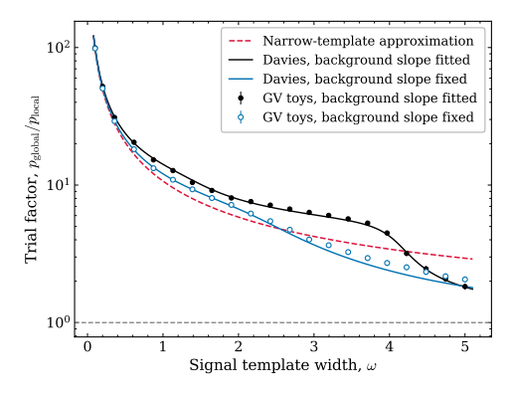
Fig. 4 : Trial factor atc=10 as a function of the widthωof the signal template used in the fit, from the GV procedure withc 0 =0.5 applied to 1000 background-only pseudo-experiments on a grid of 350 mass points, with the background slope fitted (filled points) or fixed to its true value (open points). The red dashed line shows the narrow-template approximation of Eq. (29). The solid lines show the analytical Davies prediction with the correlation of Eq. (41), with the background slope fitted (black) or fixed (blue). The grey dashed line marks a trial factor of one. The solid lines and the open points are discussed in Appendix A.3.
Original paper · CC BY 4.0 · Grosso, Gaia, Rodriguez-Benitez, Sergio, Lyons, Louis · The Look-Elsewhere Effect in Searches for New Physics: from Classical Methods to Machine Learning · Original paper figure · Extracted the figure area from page 37 of the original PDF.Why scanning inflates significance
When the location of a new effect is unknown, the analyst scans many candidate values and reports the most significant excess. The local p-value at that location overstates the evidence, because scanning many locations makes a small p-value likely even under the null. The global p-value corrects for this by asking how often an excess this strong appears anywhere in the scan range under the null.
Physicists call this the look-elsewhere effect and express the correction as a trial factor, the ratio of the global to the local p-value.
The stakes are visible in the Higgs discovery, where ATLAS and CMS reported local significances of 5.9σ and 5.0σ. The global correction was reported alongside these numbers rather than folded into the headline figure. The authors argue that the correction is still not fully settled, for three reasons. The first is what counts as elsewhere, the second is the structure the classical tools assume, and the third is machine learning.
The Davies and Gross-Vitells correction
The key idea is to count how often the test statistic crosses a given significance level as the scan parameter moves. Davies bounded the global p-value this way, but the bound assumes the test statistic behaves as a Gaussian or χ² process. Gross and Vitells turned the bound into a recipe that needs only a modest number of pseudo-experiments.
The expected number of upcrossings takes the form \(\langle N(c)\rangle = N e^{-c/2}\), where c is the squared significance threshold. N depends only on the correlation of the signed significance Z(m) across masses, through its curvature ρ11 at coincident masses. The Gross-Vitells step estimates ⟨N(c0)⟩ at a low reference level and extrapolates analytically to higher significance.
This extrapolation is what makes the classical correction cheap, and it relies on the χ² scaling of the test statistic.
A Bayesian route to the trial factor
Bayer and Seljak use the Bayesian evidence to set the trial factor of a frequentist statistic. Its global p-value can be written down directly, with no pseudo-experiments.
Each marginal likelihood averages the likelihood over the prior, so a parameter present only under the signal hypothesis leaves a penalty. For a flat prior of width Δ and a peak of width σ, the log Bayes factor becomes \(\ln B_{10} \approx \frac{Z^2}{2} - \ln\frac{\Delta}{\sqrt{2\pi}\,\sigma}\). The first term rewards the better fit, and the second, the Occam factor, penalises the spread of the prior.
In a resonance search the signal location is the parameter, so the Occam factor becomes \(N_B = \frac{U-L}{\sqrt{2\pi}\,\sigma_\theta}\). N_B counts the peak widths that fit in the scan range, and the global p-value then follows as \(p_{\rm global} \approx 1-\exp(-N_B\,p_{\rm local})\). Combining the two into one statistic gives \(q_S \equiv -2\ln(N_B\,p_{\rm local})\), so the global p-value becomes \(1-\exp(-e^{-q_S/2})\).
Because the null distribution of q_S is the same in every search, the global p-value follows from the observed q_S alone. This depends on the Laplace approximation, which assumes a smooth, approximately Gaussian peak. For non-Gaussian peaks, Robnik and Seljak integrate the evidence numerically, and their p-values agree with simulations.
A follow-up study goes further and calibrates the trial factor from the heights of lower peaks in the same dataset. That shortcut carries a statistical uncertainty of 10–20% on the global p-value, from counting noise peaks in one dataset.
Why ML searches break the shortcut
A signal-agnostic ML search fits a flexible model to the whole phase space in one pass. That flexibility can overfit fluctuations anywhere in the data, which creates an implicit look-elsewhere effect inside the optimisation rather than in an explicit scan.
The honest calibration is pseudo-experiments, but each toy needs a full retraining of the model. The Gross-Vitells trick fails here, because the null distribution of an ML test statistic is generally not χ².
The cost of each toy depends on the dimensionality of the search. For a low-dimensional test, toys can be drawn by resampling a fitted background, as in a classical bump hunt. In high dimensions, each toy needs a full synthetic sample through the simulation chain, and the same dimensionality also enlarges the trial factor.
Measure, reduce or avoid the implicit LEE
The authors sort the options into three moves: measure and correct, reduce the model's resolution, or keep the test data out of the search. Pseudo-experiment calibration is exact, because the null distribution absorbs the whole implicit LEE by construction. Its price is the retraining cost discussed above.
Regularisation constrains model capacity, which limits how many independent fluctuations the model can capture. In the NPLM framework, weight clipping enforces Lipschitz continuity of the learned density ratio. Sparse models, such as an ensemble of a few Gaussian kernels, cannot resolve more regions than they have kernels. The cost is a loss of sensitivity to signals finer than the regularised resolution, and the best strength depends on the signal, which is unknown in a signal-agnostic search.
Train/test splitting and k-folding keep the search data separate from the scoring data. The k-fold p-values stay slightly biased, and the cited study corrects this residual bias with an empirical calibration fit. Splitting and k-folding do not reduce the LEE; they keep it from contaminating the evaluation.
Weight clipping and pseudo-experiments can be combined, because clipping makes the tail fall faster and so needs fewer toys. The choice between routes depends on retraining cost: pseudo-experiments for lightweight models, and k-folding with bias correction for expensive ones.
Screening 50 classes: BH against Bonferroni
A general search is mainly a screening tool, so a false lead only costs a follow-up study. The authors therefore argue that the false discovery rate is the natural criterion here, rather than the family-wise error rate. They test this with 50 classes, 10 of them carrying an injected narrow resonance at m=3. Each comparison uses 3000 pseudo-experiments at α=0.05, with the classes treated as independent.
Bonferroni keeps the family-wise error rate at 4% and identifies 3.4 of the 10 signal classes on average. BH identifies 4.9 signal classes on average, which is 42% more, but its family-wise error rate reaches 22%. A discovery claim still needs the family-wise criterion, so the selected classes go to a dedicated analysis.
The gap is widest for weak signals: a 2.5σ class is identified in 15% of pseudo-experiments by BH and 7% by Bonferroni. Even the strongest 4.5σ signals are identified in 80% of pseudo-experiments by BH and 66% by Bonferroni. This follows from the correction itself, since a Bonferroni-corrected discovery at α=0.05 needs a local significance of about 4.1σ.
Open problems
No analytical shortcut exists yet for ML test statistics, so calibration depends on full retraining. Developing such shortcuts, or designing models that are cheap to calibrate, is an open problem.
The screening comparison treats classes as independent, although real classes share systematic uncertainties and can anti-correlate. Its results are averages over 3000 pseudo-experiments for one simulated setup.
The mixed regime, partly continuous and partly discrete, is not fully covered by the Davies/GV framework or standard multiple testing corrections.
Paper info
- Authors
- Grosso, Gaia, Rodriguez-Benitez, Sergio, Lyons, Louis
- Venue
- arXiv · Preprint
- First published
- 2026-11-25
- Added
- 2026-11-27
- Updated
- 2026-11-25
- Version
- v1
- arXiv
- 2611.34888
- Category
- hep-ph · hep-ex · physics.data-an · stat.AP · stat.ML
- Original paper terms
- CC BY 4.0
- What we show
- Paper info, commentary and permitted figures from the original paper
AI commentary is a separate explanation from the original paper and may contain errors. The original paper and figures follow each source's terms of use and any rights noted separately.
Abstract
The look-elsewhere effect (LEE) arises when the location of an effect in parameter space is not specified in advance: scanning many locations inflates the significance of the largest excess, and the local $p$-value must be corrected into a global one. A well-established framework, rooted in the work of Davies and operationalised for particle physics by Gross and Vitells, provides this correction for scans over continuous parameters. Some aspects, however, remain unsettled. The definition of "elsewhere" is ambiguous and ranges from a single distribution to an entire experimental programme. Moreover, the analytical shortcuts of the classical framework do not carry over to searches based on machine learning (ML), which are affected by an implicit post-selection bias that depends on the model's resolution and expressiveness. This review covers the LEE in searches for new physics at colliders, from its statistical foundations to these modern challenges. We discuss the corrections for continuous scans and for multiple discrete tests, illustrated with simple numerical examples, and the interaction between ML and the LEE, which we connect to the broader literature on selective inference. We highlight open problems, including the computational cost of empirical calibration for complex models and the development of analytical shortcuts for ML test statistics, and offer recommendations for reporting discovery significance in both classical and ML-based searches in particle physics.
Quote from the paper
Grosso, Gaia, Rodriguez-Benitez, Sergio, Lyons, Louis (2026). The Look-Elsewhere Effect in Searches for New Physics: from Classical Methods to Machine Learning. arXiv:2611.34888v1. https://arxiv.org/abs/2611.34888v1
BibTeX
@misc{gaia2026look,
  title = {{The Look-Elsewhere Effect in Searches for New Physics: from Classical Methods to Machine Learning}},
  author = {Grosso, Gaia and Rodriguez-Benitez, Sergio and Lyons, Louis},
  year = {2026},
  eprint = {2611.34888},
  archivePrefix = {arXiv},
  url = {https://arxiv.org/abs/2611.34888v1}
}