Paper commentary
From AutoResearch to Continual AutoResearch: Do Agents Learn Across Tasks?
Persistent agents find strong solutions sooner
- Problem Most agent evaluations reset the agent before each new ML problem, so whether it can reuse lessons from earlier tasks goes unmeasured. Resets also make these evaluations costly and hide whether carried-over experience helps or misleads.
- Method CONTINUAL AUTORESEARCH runs the same agent on one ordered stream of tasks twice. One run keeps its session and workspace, while the other starts every task fresh, with the budget and evaluation held equal.
- Results Persistent state raised time-convergence gain for all five frontier agents, from +3.0 for GPT-5.4 to +21.3 for Kimi K3. These gains did not consistently carry into better final solutions.
Why reset-per-task evaluations miss transfer
Autoresearch loops let an agent edit code, run candidates and keep what helps. Most evaluations, though, restart the agent from scratch before each new problem. That reset throws away what the agent learned about experimental design, modeling choices and execution failures. Because each task is isolated, these evaluations cannot assess whether such lessons apply to related tasks.
A reset also hides whether that experience helps, since irrelevant or misleading carry-over is possible.
Transfer only makes sense when tasks share structure, such as common data-generating factors or modeling principles. Experience helps only to the extent that the tasks really share this transferable structure. Whether agents can find and adapt that shared structure has stayed largely unmeasured. Earlier autoresearch work measures progress inside a single research problem.
That focus means it can't answer whether experience moves across ML tasks.
The authors study this setting without updating model weights, so experience moves only through the state accumulated during execution. A stateful session also carries transcript history, code reuse, and procedural familiarity, so the source of gains is mixed.
A stateful and a stateless run on one stream
The idea is simple: run the same agent twice on the same ordered tasks, once keeping its session and once starting fresh. Inside that budget the agent can experiment freely, submit several solutions and choose one before time runs out. Intermediate test scores stay hidden, because showing them would let the agent reward hack.
In the stateful setting the same native session and workspace carry across the stream, so transcripts, files and execution traces remain visible. The harness adds no separate memory or summary, so whatever carries over comes from the agent's own CLI environment. Stateless runs start every task with a new session and a clean workspace, but keep the task, model, budget and evaluation the same.
Because the first task has no earlier sessions, transfer is measured only on T2 to TK.
Figure 1 shows the loop from task activation, through the inner autoresearch steps, to hidden evaluation and the transition to the next task. Both arms run the same inner loop, so the only difference is whether the next task inherits state.
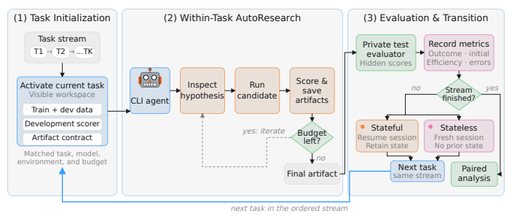
Figure 1 :Overview of CONTINUALAUTORESEARCH.Stateful and stateless agents process the same ordered task stream under matched environments, and per-task budgets. Each task consists of an autoresearch loop, but only the stateful agent retains experience across tasks. Private evaluation of final artifacts enables paired measurement of cross-task gains in performance, and efficiency.
Original paper · CC BY 4.0 · Jeremy Qin, Ruizhi Deng, Mohamed Osama Ahmed, Frederick Tung, Leo Feng · From AutoResearch to Continual AutoResearch: Do Agents Learn Across Tasks? · Original paper figure · Extracted the figure area from page 2 of the original PDF.How raw scores become comparable gains
Each task family reports its own metric, so raw scores can't be averaged directly across families. The framework maps every metric onto a reward between 0 and 1 before any aggregation takes place. The authors standardize RMSE with the standard deviation of each channel's training set before this transform. R2 is higher-is-better and unbounded below, so the transform (2 - min{m, 1})^-1 maps one to one and very negative values toward zero.
The authors define a paired gain as Delta = 100 times the stateful value minus the stateless value, in normalized reward points. A positive gain means that stateful execution performed better on that task. They report this gain for three metrics: final selected reward, first-solution reward, and fixed-horizon search utility. Aggregate results average gains within each task stream first, and then average across the streams.
Search utility is the normalized area under the best-so-far curve, integrated over the task budget B_i. The curve stays at zero before the first valid submission, and a run that ends early keeps its last value. Higher utility means that better solutions appear earlier, so the metric captures both quality and timing. The time-convergence gain is the paired difference of these utilities, and its mean over tasks 2 to K is the primary transfer metric.
The curve is built only after the run, so the agent never sees it and can't reward hack against it.
Four settings with shared structure
Synthetic AutoML reuses one underlying dataset across three streams with five classification tasks. The streams differ in whether the shared part is recurring latent factors, a sparse feature pool, or a regime variable. In the shared-regime stream, agents must retest regime-dependent interactions rather than rely purely on previous solutions.
Its equations become simpler after a change of variables such as centering, rescaling, or a radial coordinate. Agents submit an explicit expression, scored by mean R2 on private interpolation and extrapolation samples. Time-series forecasting offers three levels of similarity, starting with the ETT cross-resolution stream. ETT varies station and sampling frequency, so periods and context lengths must be recalibrated.
The PEMS stream keeps domain-level seasonality while changing channel relationships across traffic sensor networks. The energy-system stream spans broader sources and sampling rates, which allows more open-ended transfer. Forecasts run on hidden test splits and are scored by RMSE.
Tabular AutoML uses a five-task subset of SELA's evaluation datasets and a three-task slice of MLE-Bench Lite. Agents receive neutral identifiers rather than public dataset names, so they can't shortcut by recognizing a dataset. These streams test whether agents transfer research practices across datasets while adapting to each new task.
Persistent state finds strong solutions sooner
Stateful execution has a positive time-convergence gain for all five agents, ranging from +3.0 for GPT-5.4 to +21.3 for Kimi K3. This metric rewards a solution more when its reward is higher and when it appears earlier. Figure 2 plots the mean best hidden reward against normalized task-budget elapsed for Opus 5, GPT-5.6-Sol and Kimi K3. Each family's best-so-far curve is averaged within the family, and the families then receive equal weight.
The stateful lead is largest early, at +24.0 points at 25% of the budget. By the deadline, the lead shrinks to +1.2 points, and only two agents remain positive.
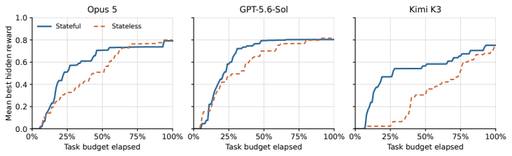
Figure 2 :Persistent-state search advantage over time.Mean best hidden reward as a function of normalized task-budget elapsed. Task-level best-so-far curves are constructed post hoc, averaged within each family, and then averaged with equal family weight. Persistent execution generally finds useful solutions earlier, although the size and duration of the advantage vary across agents.
Original paper · CC BY 4.0Stateful runs reach their first valid solution sooner for every agent. The largest cut is 9.2 minutes for Kimi K3, while Sonnet 4.6 drops by 8.6 minutes. Sonnet 4.6 also gains +6.8 points in first-solution quality, and GPT-5.4 gains +3.7.
Matching candidate counts shrinks the gain for every agent. Sonnet 4.6 keeps a +6.5-point advantage, while Opus 5 and GPT-5.6-Sol fall near zero. Subtracting each run's first-valid reward makes the gain negative for every agent. Persistence therefore helps either by yielding a valid solution sooner or by yielding a stronger first solution.
They don't find a general improvement in optimization after initialization.
Faster search doesn't guarantee better final solutions
Only Sonnet 4.6 has a substantial mean final outcome gain, at +7.6 points. Opus 5 and GPT-5.6-Sol slip to -0.9 and -0.8 points, while Kimi K3 and GPT-5.4 stay near zero at +0.4 and +0.2.
Faster search can still end with a weaker final pick, because an agent may select a candidate that overfits. The stateful-minus-reset difference ranges from -0.7 to +1.3 points across agents. It stays within ±0.8 points for four of the five agents. Selection failures can be severe on single tasks, but they don't explain the aggregate gap between search efficiency and final outcomes.
Sonnet 4.6 gains +7.0 on initialization and +7.6 on outcome, compared to +1.3 and -0.9 for Opus 5. The authors suggest that stronger reset models may already produce good solutions, which leaves less room for persistence to help. Model capability doesn't consistently predict time-convergence gain, though.
Once each run's first-solution reward is subtracted, no agent keeps an advantage, so process gains don't carry into final performance. Benefits from persistence vary by agent, task, and metric, so no single gain holds everywhere. The logs show two failure modes: an agent applies an earlier lesson too broadly, or it swaps a robust candidate for an overfitted one.
Longer budgets shrink the persistence advantage
GPT-5.6-Sol runs on the Shared Regime stream at three per-task budgets: 15, 30, and 60 minutes. Each budget is a separate run, so the 60-minute case is not a checkpoint from a longer run. As the budget grows, the mean final outcome gain gets smaller in this comparison. The mean initialization gain grows over the same range of budgets. The time-convergence gain also falls as the budget increases.
The authors read this drop as reset runs closing an early stateful lead through their own within-task exploration.
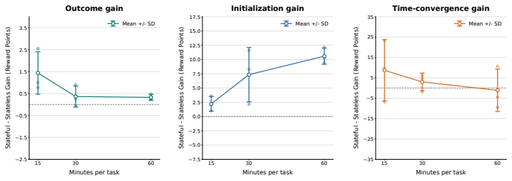
Figure 3 :Effect of per-task wall-clock budget on Shared Regime.Stateful-minus-reset final- outcome, initialization, and time-convergence gains over transfer tasks (positions 2–5), in normalized reward points. Points show matched repetitions; markers and bars show their mean and sample standard deviation across three repetitions. Each budget is a separate run, rather than a checkpoint taken from a longer run.
Original paper · CC BY 4.0Longer preceding tasks could also give the stateful agent more experience to carry into its first solution. These gains are averaged over transfer tasks at positions 2 to 5, with each point showing one matched repetition. Run-to-run variation stays small, because outcome and initialization gains moved by at most 0.75 points across repeats.
Time-convergence gains varied by at most 7.14 points across the same repeats. Repeating the full benchmark is costly, so the authors ran the repeat check only for GPT-5.6-Sol.
The authors conclude that persistence is most valuable when budgets are tight, since its advantage narrows as budgets grow. This budget sweep covers one agent on one stream, so the trend isn't shown across other agents or task families.
Insight cards shift search but not final results
The memory ablation separates explicit knowledge transfer from session continuity on the Energy-systems stream. Every task starts in a fresh agent session, so insight cards are the only channel for carrying information across tasks. The matched condition gives the agent every card from earlier tasks in the same stream, while the shuffled condition draws cards from an unrelated stream.
The no-memory condition gives the agent no cards, which isolates the effect of providing cards at all.
Matched cards raise initialization over shuffled cards for Opus 5 by 2.6 points, for GPT-5.4 by 5.9 and for GPT-5.6-Sol by 3.9. Time-convergence drops for all three agents under the same comparison, so the cards change the start more than the search. Sonnet shows the reverse pattern, with initialization down 2.9 points while time-convergence rises 25.6.
Final outcome effects of matched versus shuffled cards stay small for Sonnet, Opus and GPT-5.4. GPT-5.6-Sol is the one agent where matched cards come out negative on final outcome. Matched and shuffled cards produce comparable final gains over no cards for Sonnet and GPT-5.4. So relevant prior results shape initialization and search, but they don't reliably improve the final solution.
They didn't test whether other card designs would change this pattern, and the authors list separate tests of insights as future work.
Limitations and open questions
The authors name streams of hundreds of tasks and post-training workloads of the order of 10 hours as open directions. Such longer horizons would test mechanisms the paper doesn't study, such as compaction. Multi-agent research is the other open direction, where knowledge spreads between agents across a team's topology. In that setting, cross-task improvement is harder to attribute and evaluate than for a single agent.
Each model runs through its native CLI scaffold, so cross-agent differences may reflect the scaffold as well as the model. The ablations don't yet separate insights, code, transcripts and execution state. Future work should also test explicit mechanisms for selecting or forgetting memories. Adversarial manipulation of carried-over state wasn't tested, although the authors flag it as a risk.
Most comparisons rest on a single matched run pair, because repeating the full benchmark is costly. Only GPT-5.6-Sol was repeated three times, and its outcome and initialization gains varied by at most 0.75 points.
These limits leave the central finding open to re-testing at larger scale. Persistence advantages shrink by the deadline, with only two agents remaining positive at 100% of the budget. Retaining experience and leveraging it well are separate capabilities, so longer tests must measure both.
Paper info
- Authors
- Jeremy Qin, Ruizhi Deng, Mohamed Osama Ahmed, Frederick Tung, Leo Feng
- Venue
- arXiv · Preprint
- First published
- 2026-11-3
- Added
- 2026-11-6
- Updated
- 2026-11-3
- Version
- v1
- arXiv
- 2611.05108
- Category
- cs.AI
- Original paper terms
- CC BY 4.0
- What we show
- Paper info, commentary and permitted figures from the original paper
AI commentary is a separate explanation from the original paper and may contain errors. The original paper and figures follow each source's terms of use and any rights noted separately.
Abstract
Autoresearch has shown that agents can autonomously write code, run experiments, and iteratively improve machine learning solutions. Yet most evaluations start a new agent session from scratch for each new problem, making them costly and leaving unclear whether agents can retain and apply prior insights when adapting to new tasks. We introduce CONTINUAL AUTORESEARCH, an open-ended environment that compares persistent and reset instances of the same agent under matched task streams, data, and time budget. Continual AutoResearch covers nine task families, spanning synthetic tasks, symbolic regression, time-series forecasting, and tabular AutoML. Across five frontier agents, we measure first-solution quality, research efficiency, and final held-out performance. To distinguish insight transfer from session continuity, we run a memory ablation that vary what information agents retain from prior tasks. We show that persistent state improves research efficiency of all five agents, allowing them to find stronger solutions sooner. However, these gains do not consistently translate into better final solutions. Overall, our findings suggest that retaining experience and utilizing it effectively are distinct capabilities.
Quote from the paper
Jeremy Qin, Ruizhi Deng, Mohamed Osama Ahmed, Frederick Tung, Leo Feng (2026). From AutoResearch to Continual AutoResearch: Do Agents Learn Across Tasks?. arXiv:2611.05108v1. https://arxiv.org/abs/2611.05108v1
BibTeX
@misc{qin2026from,
  title = {{From AutoResearch to Continual AutoResearch: Do Agents Learn Across Tasks?}},
  author = {Jeremy Qin and Ruizhi Deng and Mohamed Osama Ahmed and Frederick Tung and Leo Feng},
  year = {2026},
  eprint = {2611.05108},
  archivePrefix = {arXiv},
  url = {https://arxiv.org/abs/2611.05108v1}
}