Paper commentary
Do sEMG Foundation Models Improve Cross-Subject Generalisation?
Pretraining helps sEMG models within sessions but not across subjects
- Problem Existing sEMG foundation models are mostly tested on intra-session splits, which hide cross-subject overfitting. It is unclear whether pretraining alone helps models generalise to unseen people.
- Method The authors compare three sEMG foundation models under intra-session and inter-subject splits. They use three fine-tuning strategies, including From-Scratch, to isolate what pretraining adds.
- Results Pretraining helps within a session, but the benefit largely disappears under inter-subject evaluation. The largest pretraining gain under inter-subject evaluation on EPN-612 is 2.32%.
Why cross-subject results are hard to read
Surface EMG carries useful information about motor output, but noise and person-to-person variation make decoding hard. Supervised models need large labelled datasets across many subjects to limit overfitting, and those datasets are often out of reach in clinical work. Foundation models try to close that gap by pretraining on unlabelled data, then fine-tuning on small labelled tasks.
TinyMyo, PhysioWave and NeuroRVQ borrow masked modelling or tokenisation ideas from EEG work. The open question is whether their strong downstream scores come from pretraining or from extra model capacity. Most of these evaluations use intra-session splits, so they never test unseen subjects or electrode setups. An intra-session split trains and tests on different repetitions drawn from one recording session.
In this paper, an intra-session split shares both the session and the subject between training and test samples. An inter-subject split instead draws training and test sets from entirely different subjects.
Many of these works also skip a from-scratch baseline, so the pretraining effect can't be read off directly. Without that baseline, a gain could come from pretraining or from simply larger model capacity. Preprocessing, prediction heads and data pipelines also differ between papers, which confounds direct comparison. The authors therefore compare three models under both split types, using three fine-tuning strategies that separate pretraining from model capacity.
Their main finding is that pretraining helps within a session, but the benefit largely disappears between subjects. So a strong within-session score can look impressive while saying little about performance on new people. Each dataset is split into train, validation and test partitions at roughly 7:1:2 for both split types.
Three fine-tuning strategies as controls
The three fine-tuning strategies keep one architecture fixed and change only how the backbone starts and whether it keeps learning. Full Fine-tuning starts from pretrained weights and updates the full model end-to-end. From-Scratch starts from a randomly initialised backbone and also updates every weight, so it isolates the pretraining step.
Linear Probing starts from pretrained weights but freezes the backbone, so only the head learns. Linear Probing tests how linearly separable the pretrained features already are for gesture classification. If Full Fine-tuning and From-Scratch score similarly, the authors read this as the pretrained representations not having transferred, even though the architecture may still suit supervised learning.
Each window passes through the encoder to give per-patch embeddings. Mean pooling averages those embeddings into one vector per window. A single linear layer maps that vector to the target space, and the loss is cross-entropy for classification. Gradients flow into whichever backbone layers are unfrozen, so the same head serves all three strategies.
The published preprocessing steps didn't reproduce the reported results, so the authors ran an ablation and picked a pipeline for each model. NeuroRVQ uses a 20 to 90 Hz band-pass filter, resamples to 1000 Hz and applies min-max scaling to the range of minus one to one. PhysioWave applies no filter, resamples to 2000 Hz and uses the same min-max scaling.
TinyMyo applies a 20 to 90 Hz band-pass with a notch filter, resamples to 2000 Hz and uses a global z-score.
All runs use AdamW with a weight decay of 0.001, a 5-epoch linear warmup and cosine annealing decay. Early stopping with a patience of 8 epochs ends each run once it converges. Each experiment is repeated with three random seeds, and the reported standard deviations serve as error bounds. The classical reference models are linear discriminant analysis, support vector machine and random forest, trained on Hudgins time-domain features.
A simple supervised CNN with two 1D convolution layers serves as a supervised reference that needs no pretraining.
Datasets and split design
The two split types differ in what the test set may share with the training set. An intra-session split draws training and test samples from the same session and the same subject. An inter-subject split places training and test sets on entirely different subjects, which tests generalisation to unseen individuals. Each dataset is partitioned into train, validation and test sets at roughly 7:1:2.
The authors' primary evaluation uses inter-subject splits, while the published TinyMyo and PhysioWave results use intra-session splits.
NinaPro DB5 has 10 subjects, and each subject performs 6 repetitions of 52 gestures. Two 8-channel Thalmic Myo armbands record its sEMG at 200 Hz, with the distal band rotated 22.5° from the proximal band. Its recordings are cut into 1 s windows with a stride of 250 ms. EPN612 contains 612 subjects, each performing 50 repetitions per gesture across six gestures, including rest.
Each EPN612 recording spans roughly 5 s, so the authors keep only one 1 s window per recording. They centre that window on the peak of a smoothed RMS envelope, because gesture onset labels are unreliable.
UCI EMG Gestures nominally has 7 classes, but gesture 7 was not performed by every subject, so it is excluded. That leaves 6 classes across 36 subjects, recorded at 200 Hz with an 8-channel Thalmic Myo armband. The raw recordings were oversampled during collection, so duplicate samples are removed first. Nearest-neighbour label interpolation and linear signal interpolation then bring the data back to a uniform 200 Hz grid.
Training windows get a random amplitude scale, sampled between 0.9 and 1.1, to improve generalisation. A 5% channel dropout probability simulates dead channels during training. A random temporal jitter shifts the start time of each training window, so windows vary across epochs.
Within-session gains
Table 3 asks whether pretraining helps when test repetitions come from the same session as training. Here, models are finetuned and evaluated on different repetitions from one session, so only the repetitions differ. Pretrained initialisation generally beat random initialisation across models and datasets in this setting.
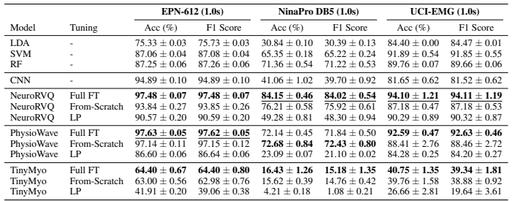
Table 3 : Intra-session gesture classification accuracy and F1 score.Boldindicates the best result per model per dataset;bold underline indicates the best overall per dataset.
Original paper · CC BY 4.0On EPN-612, NeuroRVQ with full fine-tuning reached 97.48 accuracy, compared to 93.84 when trained from scratch. The pretrained start gives a clear lift on this dataset even though the whole backbone is updated. With its backbone frozen, NeuroRVQ linear probing still scored 90.57 on EPN-612. The authors call this the clearest evidence of representation quality among the three evaluated models.
TinyMyo with full fine-tuning scored 64.40 on EPN-612. The SVM on the same split scored 87.06, so the handcrafted baseline clearly beat TinyMyo. The authors attribute the gap possibly to TinyMyo's smaller embedding dimensionality and resulting linear head. Their pooling ablation in Appendix B lifts TinyMyo, but it stays the weakest model.
Within a session, pretraining looks useful across most model and dataset pairs. Those within-session gains are the ones that the inter-subject split tests next.
Across-subject results
Under inter-subject splits, the picture on NinaPro DB5 and UCI-EMG changes sharply from the intra-session results.
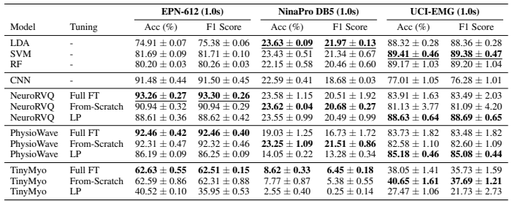
Table 4 : Inter-subject gesture classification accuracy and F1 score.Boldindicates the best result per model per dataset;bold underline indicates the best overall per dataset.
Original paper · CC BY 4.0 · William Raftery, Dario Farina · Do sEMG Foundation Models Improve Cross-Subject Generalisation? · Original paper figure · Extracted the figure area from page 4 of the original PDF.EPN-612 behaves differently, because full fine-tuning still beats training from scratch for NeuroRVQ. The largest pretraining gain on EPN-612 under inter-subject evaluation is 2.32%.
The authors attribute this failure to reconstruction-based pretraining objectives, which don't push models to drop subject-specific features. They argue that with few training subjects, models still overfit downstream data after pretraining. Their conclusion is that pretraining helps inside a session but doesn't carry over to unseen subjects on small datasets.
They recommend making inter-subject evaluation the primary setting and always including a from-scratch baseline.
Limits of this comparison
The reported numbers differ from the original papers for several reasons, and the authors list them directly. So the numbers aren't directly comparable to that work, since the window length changes the signal each model sees. The main evaluation uses inter-subject splits, but the released TinyMyo and PhysioWave implementations publish results on intra-session splits.
TinyMyo also includes rest periods between gestures as an extra class on NinaPro DB5.
Pooling is a further difference, because NeuroRVQ and TinyMyo partly concatenate patch embeddings. This pipeline instead uses mean pooling throughout, and Appendix B ablates the pooling strategy. The authors' main claim does not depend on this choice, since the Appendix B tables are provided to contextualise the lower TinyMyo results.
Two questions stay open after these comparisons. Whether more training subjects would help is unresolved, since NinaPro DB5 may simply not have enough subjects for inter-subject generalisation. They didn't test how the number of training subjects affects fine-tuning, so that effect remains unmeasured. Whether alternative pretraining objectives would transfer better across subjects was not tested.
The authors only note that future work should explore them, because the EPN-612 gain is just 2.32%.
The authors close by asking future evaluations to prioritise inter-subject generalisation as the primary setting.
Why reconstruction pretraining may not help across subjects
The authors argue that reconstruction-based pretraining gives the model no reason to discard subject-specific features. They frame this as a finding that is not entirely unexpected, rather than a surprise from their experiments. Their conclusion is that pretraining alone is not sufficient to prevent cross-subject overfitting on data-limited downstream tasks.
The authors separate two kinds of downstream goals, since subject-specific information is not always unwanted. Retaining subject-specific features may help with predicting clinical biomarkers. For gesture classification and pose regression, however, the authors argue that learning subject-invariant representations would help reduce overfitting.
This reasoning ties the pretraining objective to the target task, which is why the gesture results in Table 4 matter so much.
The mechanism behind this argument is that a reconstruction loss rewards capturing whatever signal the masked patches contain, including each subject's own signal characteristics. The authors don't test a subject-invariant pretraining objective in this paper. Instead, they point to new fine-tuning strategies and alternative pretraining objectives as the directions to explore.
They also note that even on EPN-612, the largest downstream dataset, pretraining provides a maximum accuracy gain of just 2.32%.
The authors draw two practical recommendations from this reasoning for future sEMG foundation model work. First, evaluations should treat inter-subject generalisation as the primary setting. Second, every evaluation should include a from-scratch baseline, so the contribution of pretraining can be isolated.
Paper info
- Authors
- William Raftery, Dario Farina
- Venue
- arXiv · Preprint
- First published
- 2026-11-5
- Added
- 2026-11-7
- Updated
- 2026-11-5
- Version
- v1
- arXiv
- 2611.08199
- Category
- cs.LG · q-bio.NC
- Original paper terms
- CC BY 4.0
- What we show
- Paper info, commentary and permitted figures from the original paper
AI commentary is a separate explanation from the original paper and may contain errors. The original paper and figures follow each source's terms of use and any rights noted separately.
Abstract
sEMG Foundation Models aim to learn general purpose representations over diverse subjects and recording conditions that boost performance on a variety of downstream tasks. However, existing evaluations make it difficult to discern whether pretraining alone is sufficient to combat the cross-subject overfitting which makes machine learning on sEMG so challenging. We conduct a systematic evaluation of three sEMG foundation models across three gesture classification datasets under both intra-session and inter-subject splits, using three fine-tuning strategies designed to isolate the contribution of pretraining. We find that pretraining boosts performance when train and test samples are drawn from the same recording session, but this benefit largely disappears under inter-subject evaluation. In low subject count datasets, pretraining provides little to no benefit and classical ML baselines match or exceed foundation model performance.
Quote from the paper
William Raftery, Dario Farina (2026). Do sEMG Foundation Models Improve Cross-Subject Generalisation?. arXiv:2611.08199v1. https://arxiv.org/abs/2611.08199v1
BibTeX
@misc{raftery2026semg,
  title = {{Do sEMG Foundation Models Improve Cross-Subject Generalisation?}},
  author = {William Raftery and Dario Farina},
  year = {2026},
  eprint = {2611.08199},
  archivePrefix = {arXiv},
  url = {https://arxiv.org/abs/2611.08199v1}
}