Paper commentary
Regret Bounds for Profit Maximization in Bilateral Trade: Learning the Best Posted-Price Mechanism
Posted-price learning in bilateral trade gets a square-root-T regret rate under MHR
- Problem A broker sees only whether a trade happened, so profit is hard to learn. Naive grid search over price pairs costs about T^{3/4} regret, which the MHR case needs to beat.
- Method The authors minimize the negative log of expected profit with a convex bandit. A filtering phase first narrows the price region, and a tree of sampled prices estimates trade probabilities.
- Results Under MHR valuations, regret is of order sqrt(T) up to polylogarithmic factors. Under regular distributions, the minimax rate is T^{3/5}.
Why one-bit feedback makes profit hard
In each round the broker posts one price to the seller and one to the buyer, and trade happens only when both accept. The learner gets back one bit saying whether both offers were accepted, and nothing more. Lower bounds still hold when the learner sees the seller's and buyer's decisions separately, so the one-bit setting is the harder one for upper bounds.
A natural first step is a uniform grid of mesh 1/K, which has Theta(K^2) price pairs. Raising the seller's price and lowering the buyer's price keeps every accepted trade accepted but lowers profit in proportion to the displacement. Because of this one-sided Lipschitzness, discretizing the grid costs at most about T/K. Treating each grid pair as an independent arm gives regret of order T^{3/4} when K is tuned to order T^{1/4}.
This naive route is tight for one-sided pricing, where the buyer alone is learned. Off-the-shelf dimension-based refinements therefore don't help here, so the authors need a different tool. Their approach uses a stochastic convex bandit routine applied to a proxy for profit, preceded by a filtering step that well-conditions the convex problem.
Turning MHR profit into a convex loss
The MHR assumption makes the negative logarithm of expected profit convex, which lets a convex bandit routine work on the pricing problem. Expected profit itself is neither concave nor convex, so the log transform is what makes the convex bandit applicable. The loss L(p,q) = -log mu(p,q) is continuous and convex in the interior of the price triangle under MHR.
The loss is unbounded near the boundary of the triangle, and the naive one-round estimate of it is unusable.
The authors first narrow the search with a filtering phase, so the loss has a bounded range on the region that remains. The filtering phase tries decreasing guesses 1, 1/2, 1/4, and so on, of the optimal profit scale. At each guess it probes about K prices, up to polylogarithmic factors, each roughly 1/eps times. When some grid price's estimate is comparable to the current guess, the phase stops and returns the convex hull of nearby prices.
Every price in that region has expected profit at least c times the guess, and the guess is within constant factors of the optimum.
Estimating each of the K^2 grid prices directly would be costly, so the filtering phase samples a tree of prices instead. By independence, the trade probability of a price (i/K, j/K) is recovered from three sampled points that share a midpoint l/K. The identity is P(i/K,j/K) = P(i/K,l/K) P(l/K,j/K) / P(l/K,l/K), and the estimates replace each probability on the right.
A small denominator can make this unstable, and the analysis handles it with a tweaked denominator.
Instead of one trading round per convex step, the algorithm posts a price repeatedly until the first trade. If N is the number of attempts until that trade, the estimate H_{N-1} - log(q-p) is unbiased for the loss, where H_i is the i-th harmonic number. The psi2-norm of the noise is of order sqrt(log K), because the success probability is at least the guess.
The stochastic convex bandit routine gives expected regret of order (1+gamma) sqrt(n) log^2 n over n queries. Running it on these estimates, and then converting loss regret back into profit regret, gives a bound of order sqrt(T) log^{5/2} T. Choosing K of order sqrt(T) in that bound is what yields the MHR rate. This is the main result for independent MHR distributions.
Regular distributions need a family of convex objectives
Under regularity the negative log-profit is no longer guaranteed to be convex, so the authors build a family of convex problems instead. Each auxiliary profit r_lambda(p,q) is built from the seller and buyer acceptance probabilities and a parameter lambda, and its reciprocal is convex. At any interior price pair, a balancing parameter lambda_x equal to the square root of F_s(p) over (1 - F_b(q)) makes the auxiliary profit equal the expected profit there.
Because each price pair has its own balancing parameter, optimizing over the whole family recovers the optimal profit.
The balancing parameters depend on unknown marginals, so the algorithm can't read them off directly. Instead it estimates the log-ratio of two balancing parameters from trade bits at crossed prices, using half the log-ratio of two trade probabilities. Pairs with high estimated profit and similar parameters are grouped around roots, and each group's convex hull becomes a candidate region.
Each hull and offset pair defines one candidate with parameter lambda_i = e^{theta_i} lambda_{w_i}, so the candidates stay fixed after initialization.
The routine Initialize regular reuses Initialize mhr to find the profit scale, and it returns no trigger when that routine does or when delta is below 2^16/K. For each hull, it discretizes the offsets on [-D, D] into equal intervals of length at most 12 sqrt(eta)/delta and creates one candidate per offset. Lemma 6.4 states that the candidates keep auxiliary profit at least 0.99 times mu star throughout each hull.
Successive Opt calibrates a multiplier rho for each candidate from fresh trade bits at crossed prices. It then runs convex optimizers in repeated phases and eliminates candidates whose estimated auxiliary profit falls more than 10(eta + eps_j) below the best one. Each calibration costs regret of order log(T)/eta, as Lemma 6.5 states. Choosing eta = T^{-2/5} gives total regret of order T^{3/5} up to logarithmic factors.
Why regular distributions cost more than MHR
Regularity pushes the minimax rate for bilateral trade from the sqrt(T) of MHR up to T^{3/5}, a gap the paper calls a separation. The lower bound in Theorem 7.1 holds for any learning algorithm, with a universal constant c and a product distribution with regular marginals. The proof covers even algorithms that receive two bits of feedback, one for the seller's and one for the buyer's acceptance.
Since the agents are i.i.d., it is enough to build a mixture of i.i.d. instances that is hard for any deterministic algorithm. Conditioning on the algorithm's random seed and averaging then extends the hardness to randomized algorithms.
The baseline distribution D0 has a uniform seller and a buyer whose survival function S0 is piecewise defined. Its virtual valuation phi0 is increasing, so the buyer marginal is regular but not MHR. The function rho(u) = 16u^2(1-u)^2 on [0,1] peaks at 1 and vanishes at 0 and 1, which makes it a smooth bump shape. The authors split [1/4, 1/2] into K subintervals I_1 to I_K and attach one bump to each of them.
Each bump is scaled by 12 w^2 with w = 1/(4K), so the perturbed survival function Y_j stays convex. The scaling is the source of the constraint: the second derivative of the bump carries a 1/w^2 factor that the scale must cancel. As a result, the bump can change the expected profit by only order 1/K^2. Claim 7.3 confirms that every perturbed buyer distribution D_j remains well defined and regular.
Under D_j, the best buyer price is the midpoint q*_j of I_j, and it beats every price outside I_j by a gap of at least Delta. Claim 3.6 bounds the difference between how often an algorithm posts buyer prices in I_j under D_j and under D0. Summing these bounds over the K intervals gives the T^{3/5} lower bound of Theorem 7.1.
What the bounds cover and what remains open
Table 1 places the three rates side by side, and each one is stated up to polylogarithmic factors. The adversarial rate of O(T^{2/3}) matches the lower bound of Omega(T^{2/3}) for one-sided pricing. The adversarial algorithm combines a localized estimation procedure with an information-based minimax construction. Under independent MHR valuations, the algorithm's regret is O(sqrt(T) log^{5/2} T), which is nearly tight.
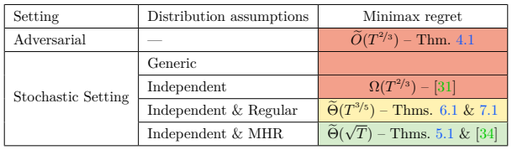
Table 1 : Minimax regret rates for profit maximization with posted prices in bilateral trade. Entries with the same color share the same minimax rate. The adversarial positive result applies to all other settings, while the lower bound for i.i.d. distributions with independent marginals also applies to the generic stochastic setting and the adversarial one.
Original paper · CC BY 4.0 · Johannes Brüstle, Simone Di Gregorio, Federico Fusco, Stefano Leonardi · Regret Bounds for Profit Maximization in Bilateral Trade: Learning the Best Posted-Price Mechanism · Original paper figure · Extracted the figure area from page 4 of the original PDF.Regularity and MHR give the same sqrt(T) rate for one-sided pricing, so bilateral trade separates them. For independent regular distributions, the rate is T^{3/5} with a matching lower bound, so the regular case is slower than the MHR case. The MHR case rests on making the negative logarithm of expected profit convex, while regularity yields auxiliary profit functions with convex reciprocals.
Their separation is proved with a lower bound built from a mixture of i.i.d. instances, which any deterministic algorithm fails on.
The MHR lower bound is taken from Leme et al. and needs a limiting argument, because MHR assumes densities and so prevents atoms at zero.
Paper info
- Authors
- Johannes Brüstle, Simone Di Gregorio, Federico Fusco, Stefano Leonardi
- Venue
- arXiv · Preprint
- First published
- 2026-11-5
- Added
- 2026-11-7
- Updated
- 2026-11-5
- Version
- v1
- arXiv
- 2611.08173
- Category
- cs.GT · cs.DS · cs.LG
- Original paper terms
- CC BY 4.0
- What we show
- Paper info, commentary and permitted figures from the original paper
AI commentary is a separate explanation from the original paper and may contain errors. The original paper and figures follow each source's terms of use and any rights noted separately.
Abstract
Bilateral trade models the task of intermediating between two strategic agents, a seller and a buyer, willing to trade a good for which they hold private valuations. We study this problem from the perspective of a profit-maximizing broker in a regret minimization framework. At each time step, a new seller and buyer arrive and the broker proposes a trading price to each agent. The trade happens if both agents accept, and the profit of the broker is the difference between the price received from the buyer and the one paid to the seller. At the end of each interaction, the learner only observes whether the trade occurred, and its goal is to achieve sublinear regret relative to the best fixed pair of prices in hindsight. We start by investigating the adversarial version of the problem, where buyer and seller valuations are generated by an adversary. In this setting, we construct a polynomial-time learning algorithm with a $\tilde O(T^{\frac 23})$ regret rate, which is nearly tight even if the valuations are drawn i.i.d. from independent distributions, thus matching the rate for one-sided pricing. Our adversarial algorithm combines a localized estimation procedure with an information-based minimax construction. We then consider valuations drawn i.i.d. from independent distributions satisfying the monotone-hazard-rate (MHR) property and provide a learning algorithm with nearly tight $\tilde{O}(\sqrt{T})$ regret. The algorithm combines localized estimation with a stochastic convex bandit routine applied to the negative logarithm of expected profit. Finally, we complement this result by showing a separation between MHR and regular distributions, proving that the minimax regret rate in the latter setting is $\tilde Θ(T^{\frac 35})$. This last result contrasts with the $\tilde{O}(\sqrt{T})$ regret bound that can be obtained for one-sided pricing with regular distributions.
Quote from the paper
Johannes Brüstle, Simone Di Gregorio, Federico Fusco, Stefano Leonardi (2026). Regret Bounds for Profit Maximization in Bilateral Trade: Learning the Best Posted-Price Mechanism. arXiv:2611.08173v1. https://arxiv.org/abs/2611.08173v1
BibTeX
@misc{brstle2026regret,
  title = {{Regret Bounds for Profit Maximization in Bilateral Trade: Learning the Best Posted-Price Mechanism}},
  author = {Johannes Brüstle and Simone Di Gregorio and Federico Fusco and Stefano Leonardi},
  year = {2026},
  eprint = {2611.08173},
  archivePrefix = {arXiv},
  url = {https://arxiv.org/abs/2611.08173v1}
}