Paper commentary
FewStepRL: Fine-tuning Few-step Diffusion Models with Reinforcement Learning
Few-step diffusion models can be fine-tuned with existing RL objectives after adaptation
- Problem Few-step diffusion models need RL objectives built for average velocity, not instantaneous velocity.
- Method FewStepRL adapts RL objectives in three phases. It maps each objective to x-space, splits its gradient into self-regression toward an anchor plus reward augmentation, and computes each anchor from the few-step model itself.
- Results Across image experiments, the adapted objectives gave a lower best GenEval2 score than the unadapted baselines in each of three cases. The reported margins are small, from 0.003 to 0.005, and each comparison comes from one run.
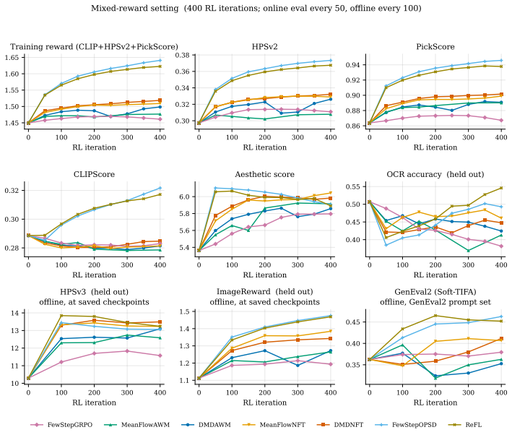
Figure 4 : Mixed-reward setting: the evaluated dimensions against the iteration, over the first400 iterations. The first panel is the training reward; OCR accuracy, HPSv3, ImageReward and GenEval2 are held out. Online evaluation every50iterations, offline evaluation at saved checkpoints every100.
Original paper · CC BY 4.0 · Haitao Lin, Minsi Ren, Yang Li, Xingtong Ge, Zheyuan Hu, Peiyan Hu, Tailin Wu · FewStepRL: Fine-tuning Few-step Diffusion Models with Reinforcement Learning · Original paper figure · Extracted the figure area from page 43 of the original PDF.Why RL stalls on few-step generators
Applied directly, they leave three choices open: which network evaluation to differentiate, how to evaluate the reference policy, and which parts of the interval to train.
Figure 1 shows the cost of leaving these choices unresolved in held-out GenEval2 curves. The gaps are +0.005 for FewStepGRPO versus FlowGRPO, +0.003 for MeanFlowAWM versus AWM, and +0.005 for MeanFlowNFT versus DiffusionNFT at the best checkpoint.
The authors respond with three phases: a transformation, a decomposition and an adaptation. The transformation maps each objective to x-space, where a linear noise schedule makes a velocity an affine map between noise levels. The adaptation extends those anchors to few-step models, which is the step that addresses the average-velocity mismatch.
One loss form for every objective
The key move is to express every objective in x-space, where a clean-end prediction serves as the shared currency. Under a linear noise schedule, a velocity gives an affine map between noise levels, so a prediction at the clean end can stand in for the state at any level. Once objectives are comparable, their gradients can be split into parts that a single template covers.
Each gradient is written as a self-regression term, which keeps the policy near an anchor, plus a reward-augmentation term, which pushes the prediction along the difference between a rewarded anchor and a baseline anchor. The total loss is a weighted sum of two squared terms, a self-regression term with weight W_reg and a reward term with weight W_rwd, where the reward displacement is the signed coefficient ω times the difference of the two anchors.
A method is therefore specified by its anchors and weights.
The existing methods fit this template with different choices. AWM sets W_reg to zero, so it drops the self-regression term and uses the detached current prediction as its baseline anchor. DiffusionNFT instead places both anchors at the old policy's clean prediction, and its weight saturates because of the clip.
Computing the anchors from a few-step network
The few-step policy outputs an average velocity, so the instantaneous velocity has to be recovered before the anchors can be formed. The MeanFlow identity provides this step, because adding a correction J to the average velocity gives a self-induced instantaneous velocity. Because the correction is computed from the network itself, no second network is needed.
The self-induced velocity v_ind and its clean prediction x̃_ind are both detached, and both fields are now instantaneous.
The correction is estimated as a directional difference of the old policy along the conditional velocity, with step size ε_cd. Because of this sharing, the correction cancels in the self-regression difference x̃_θ − x̃_reg, which is why some variants can drop it. The variant VInd(cd=False) drops J where it cancels, and Appendix C establishes when dropping J is admissible.
The fit uses x̃_t = AddNoise(x̂, t) with the target v_cond, and runs n_fm steps per outer iteration before the policy update. In the runs, v_φ is fitted with n_fm = 5 steps per outer iteration. For the clean-end anchor, DMD sets x̃_base = x̃_aux at x̃′_t, whereas MeanFlow sets x̃_base = x̃_ind,r.
Each training query draws t from a selectable law and draws r below t. A fixed fraction of each batch is set to r = t, where the interval has zero length and J is zero. The rest of the queries cover the intervals in between, so the network learns the average velocity across the range of r. In the image runs, half of each batch is set to r = t and a quarter to r = 0, with n_ts = 4 queries per member.
Seven trainers in one codebase
The seven trainers share one training step, and each method overrides only the hooks where it differs. The methods split into group-advantage methods, which score a group of members per prompt, and reward-gradient methods, which take their update direction from the reward gradient. FewStepGRPO is the exception on the sampling side, since it replays stored trajectories with the stochastic sampler.
The advantage uses the per-prompt mean in the numerator, while the denominator uses the standard deviation over the current global batch. The advantage is then compressed into a mixing weight between 0 and 1 for the NFT and OPSD families, with cadv set to 5. FewStepGRPO and FewStepAWM instead use the clipped advantage as a signed multiplier.
In code, ReFL overrides the advantage hook so that the mixing weight is fixed to 1.
The training query draws t from a selectable law, and r is drawn uniformly between 0 and t at every inner iteration. A fixed fraction of each batch is set to r equal to t, and another fraction to r equal to 0. For r equal to t the interval has zero length, so J vanishes and the loss reduces to its instantaneous-velocity form.
The image experiments fix the policy, sampler and optimiser shared by the trainers. The policy is the average-velocity network initialised from SD3.5-Medium and distilled with AnyFlow. Every method except FewStepGRPO uses the deterministic sampler, while FewStepGRPO requires the stochastic one.
Image results against the unadapted baselines
The question is whether the adapted objectives beat the unadapted baselines on held-out image scores. Substituting the average velocity of a distilled few-step model for the instantaneous velocity gave a lower best GenEval2 in each of the three cases. The baselines are FlowGRPO, AWM and DiffusionNFT, run on the pre-RL few-step model with the average velocity in place of the instantaneous one.
Each is compared with its adaptation, FewStepGRPO, MeanFlowAWM or MeanFlowNFT, while the other settings stay the same.
In the mixed-reward runs, the best-or-final gap of FewStepGRPO over FlowGRPO on GenEval2 is 0.005. MeanFlowAWM leads AWM by 0.003 on the same measure. MeanFlowNFT leads DiffusionNFT by 0.005 at the baseline's best checkpoint and by 0.013 at iteration 400. These margins are small, and each comparison comes from one run. They show a consistent direction for the adaptation, but they don't establish a large gain.
The mixed reward sums CLIPScore, HPSv2 and PickScore on the PickScore prompt set. In the mixed-reward setting, FewStepOPSD and ReFL reached the two highest training rewards. They also improved all three reward summands, and the authors read this as evidence that the reward gradient was the most effective choice in their image experiments.
In the OCR setting, FewStepGRPO reached OCR accuracy 0.776 by iteration 200. MeanFlowAWM reached 0.802 at the same iteration, and both are online values on the OCR prompt set. The AnyFlow initialisation, the shared starting point, stays below every fine-tuned model at four steps on HPSv3 and ImageReward.
Video runs and the reward-gradient limits
The runs match in outer iterations but not in samples, so the quality comparison needs that caveat. GPU-hours stay comparable across runs, while s/iter isn't comparable when world sizes differ.
The training reward is an unweighted sum of four components, following the LongCat and MeanFlowNFT video setup. VideoAlign's motion quality and text alignment are z-normalised before entering the sum, but the VideoAlign reward decodes videos in its own pipeline. That leaves no differentiable path from the latents to the VideoAlign terms, so FewStepOPSD and ReFL use only the HPSv3 gradients.
They still get evaluated on all four terms, and the paper's Section D.5 quantifies this asymmetry, which the image setting doesn't have.
The video backbone adds three constraints on the reward gradient that the image setting doesn't face. The reward model runs in fp32 with the sdpa attention backend, because the bfloat16 weights change the gradient direction substantially while the reward value moves by only about 0.003. Since the gradient is normalised to unit length, that direction error feeds straight into the update.
Do more sampling steps help a few-step fine-tuned model
The fine-tuned models were sampled at 4 to 32 steps without retraining, and the held-out scores were tracked at each count. The figure plots each evaluated score against the sampling steps, for every fine-tuned model and for the AnyFlow initialisation as a dashed reference. Trainer labels follow Table 5, and the training checkpoints are listed in Table S3.
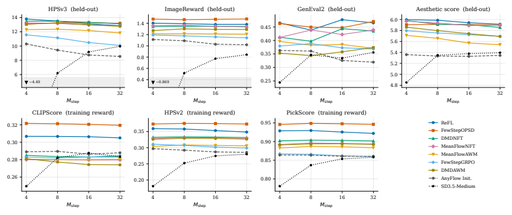
Figure 7 : Absolute value of each evaluated dimension againstMstep, one line per fine-tuned model, with the AnyFlow initialisation (dashed) and the pretrained SD3.5-Medium sampled with classifier- free guidance (dotted) as references. For the fine-tuned models, the three training-reward summands (CLIPScore, HPSv2 and PickScore) show little systematic gain from additional steps, while the held-out HPSv3 and aesthetic score more often decline. Trainer labels are as in Table 5; the checkpoint is given in Table S3. Figure S1 and Figure S2 in Appendix D show the same results as percentage changes from the four-step value, grouped by evaluator and by model, respectively.
Original paper · CC BY 4.0The training-reward summands CLIPScore, HPSv2 and PickScore stay nearly flat as the steps increase. The AnyFlow initialisation falls by −17% over the same range, so its decline is much steeper. The authors attribute the fine-tuned decline to the initialisation rather than to RL, since the RL models start from it.
The authors therefore conclude that additional steps give no systematic aggregate gain, although selected samples improve. Whether a model fine-tuned at a small step count can gain from more steps at test time is left open.
Limits of the evidence and open problems
Every reported result comes from a single run, so the comparisons carry no repeated-seed spread. The image comparisons use one backbone, SD3.5-Medium, and one reward setting at a time. The authors also call their guidance empirical, which means it rests on these few runs rather than on a general theory.
Reward-gradient methods are restricted in two ways that the authors list explicitly.
The DMD-based variants estimate the instantaneous velocity with an auxiliary network. That auxiliary network needs extra forward and backward passes to fit it, and GPU memory to hold it. The authors leave reducing this overhead open. Whether a model fine-tuned at a small step count can gain from more steps at test time also remains open.
Paper info
- Authors
- Haitao Lin, Minsi Ren, Yang Li, Xingtong Ge, Zheyuan Hu, Peiyan Hu, Tailin Wu
- Venue
- arXiv · Preprint
- First published
- 2026-11-5
- Added
- 2026-11-7
- Updated
- 2026-11-5
- Version
- v1
- arXiv
- 2611.08240
- Category
- cs.LG · cs.CV
- Original paper terms
- CC BY 4.0
- What we show
- Paper info, commentary and permitted figures from the original paper
AI commentary is a separate explanation from the original paper and may contain errors. The original paper and figures follow each source's terms of use and any rights noted separately.
Abstract
Reinforcement learning (RL) has become a standard post-training method for diffusion models, but most RL objectives roll out the current policy at every iteration, and with a many-step sampler these rollouts typically dominate the cost of training. Few-step models cut this cost, yet they model an average velocity over an interval, whereas existing RL objectives are built for an instantaneous velocity with a many-step sampler. We adapt RL objectives to few-step models systematically in three phases, namely a transformation, a decomposition and an adaptation. The transformation to $x$-space expresses each objective we consider through a common policy prediction, at the clean end by default and at an explicitly marked level for transition or flow-map objectives, so that objectives stated over densities, velocities or rewards become comparable. The decomposition writes the gradient of each of these objectives as the sum of a self-regression toward a reference and a reward augmentation, so that a method reduces, at the gradient level, to a choice of anchors and weights. The adaptation computes each anchor from a few-step model at the end of its transport or along its tangent, with the instantaneous velocity recovered from the network itself or from an auxiliary network. This yields few-step versions of FlowGRPO, AWM, DiffusionNFT, DiffusionOPSD and ReFL in one modular codebase. In our experiments, reward-gradient-based methods are the most effective when the reward is differentiable and its gradient is affordable; otherwise DiffusionNFT-style methods generally reach high rewards in relatively few iterations despite a sometimes higher per-iteration cost. Extra inference steps show no systematic aggregate benefit in our experiments, although selected outputs visibly improve with two to four times as many sampling steps as in training.
Quote from the paper
Haitao Lin, Minsi Ren, Yang Li, Xingtong Ge, Zheyuan Hu, Peiyan Hu, Tailin Wu (2026). FewStepRL: Fine-tuning Few-step Diffusion Models with Reinforcement Learning. arXiv:2611.08240v1. https://arxiv.org/abs/2611.08240v1
BibTeX
@misc{lin2026fewsteprl,
  title = {{FewStepRL: Fine-tuning Few-step Diffusion Models with Reinforcement Learning}},
  author = {Haitao Lin and Minsi Ren and Yang Li and Xingtong Ge and Zheyuan Hu and Peiyan Hu and Tailin Wu},
  year = {2026},
  eprint = {2611.08240},
  archivePrefix = {arXiv},
  url = {https://arxiv.org/abs/2611.08240v1}
}