논문 해설
FewStepRL: Fine-tuning Few-step Diffusion Models with Reinforcement Learning
FewStepRL: 강화학습을 이용한 소수 단계 확산 모델 미세 조정
- 연구 문제 평균 속도를 모델링하는 few-step 확산 모델에 기존 RL 목적함수를 체계적으로 적응시키는 방법이 없었습니다.
- 연구 방법 RL 목적을 x-space의 공통 예측으로 옮기고, 기울기를 self-regression과 reward augmentation의 합으로 분해한 뒤, anchor를 few-step 모델로 계산합니다.
- 주요 결과 혼합 보상 이미지 실험에서 보상 기울기 기반 방법인 FewStepOPSD와 ReFL이 가장 높은 학습 보상을 보였고, 그룹 advantage 방법들은 그보다 낮았습니다.
Few-step 모델에서 RL 목적함수가 맞지 않는 문제
많은 단계로 샘플링하는 확산 모델에서 RL 미세조정은 매 반복마다 현재 정책으로 롤아웃을 수행해야 하며, 이 롤아웃이 학습 비용과 메모리의 대부분을 차지하는 것으로 원문은 설명합니다. Few-step 모델은 이 비용을 줄이지만, 구간에 대한 평균 속도(average velocity)를 모델링합니다. 반면 기존 RL 목적함수는 순간 속도(instantaneous velocity)나 많은 단계 샘플러의 전이를 기준으로 만들어져 있습니다. 따라서 평균 속도 모델에 원래 목적함수를 그대로 적용하면 어떤 네트워크 평가를 미분할지, 기준 정책을 어떻게 평가할지, 구간의 어느 부분을 학습할지가 정해지지 않습니다. 원문은 이 문제를 해결하는 체계적인 방법이 아직 없었다고 보고합니다.
x-space 변환과 기울기 분해를 통한 적응 방식
FewStepRL는 RL 목적을 세 단계로 재구성합니다. 첫째, 선형 노이즈 스케줄에서 속도가 정의하는 affine 변환 X[x_t, v, r] = x_t − (t−r)v를 사용해 각 목적을 x-space의 공통 정책 예측으로 옮깁니다. 기본 예측은 깨끗한 끝(r=0)의 값이며, 전이 또는 flow-map 목적에서는 명시적으로 표시된 레벨을 사용합니다. 둘째, 각 목적의 기울기를 reward-free self-regression 항과 reward augmentation 항의 합으로 분해합니다. 여기서 self-regression은 현재 예측을 기준 anchor 쪽으로 되돌려 보상 해킹을 제한하고, reward augmentation은 보상을 포함하는 방향 항입니다.
이 분해에서 한 방법은 anchor와 가중치의 선택으로 정해집니다. 셋째, 각 anchor를 few-step 모델의 샘플 끝 또는 궤적의 접선을 따라 계산하고, 순간 속도는 네트워크 자체 또는 보조 네트워크에서 복원합니다.
평균 속도 네트워크에서 순간 속도 복원
평균 속도 네트워크 u_θ는 그대로 순간 속도 문제에 쓸 수 없으므로 두 가지 방식으로 순간 속도를 구합니다. 첫 번째는 MeanFlow 항등식을 이용하는 self-induced 순간 속도입니다. 원문은 v_ind = u_old + J(u_old, t, r)로 정의하며, 여기서 J는 평균 속도의 총미분 보정이고 stop-gradient로 분리되어 있습니다. 이 값은 별도 네트워크 없이 평균 속도와 그 미분으로부터 계산됩니다. 두 번째는 DMD처럼 학습 중인 샘플의 속도에 맞춘 보조 네트워크 v_ϕ입니다. 원문에 따르면 v_ϕ는 정책의 롤아웃 분포에 대해 flow matching으로 적합되며, 이 값은 anchor로만 쓰입니다.
현재 예측은 u_θ에서 계산되어야 ∂x̃_θ/∂θ가 0이 되지 않습니다.
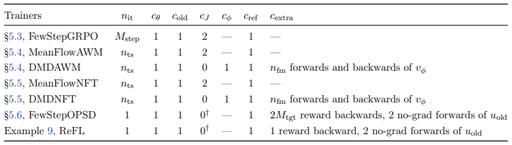
Table 4 : Network evaluations per inner iteration.nit: number of inner iterations per outer iteration, each querying every member once;cθ: forward–backward passes ofuθ; cold: no-grad forwards ofuold for the old-policy anchor;cJ: maximum extra no-grad forwards ofuold for the directional-difference estimate of J (Equation (87) orEquation (109);0where the estimator uses no J; †with J dropped because it cancels, which leaves the loss and its gradient unchanged by Appendix C);cϕ: forwards with no gradient of the auxiliary networkvϕ; cref: forwards of the frozen reference for the velocity penalty; cextra: extra cost per outer iteration, wherenfm is the number of flow-matching steps that fit vϕ. The cost of one outer iteration is thusC = Crollout + cextra + nit (cθ + cold + cJ + cϕ + cref ), whereC rollout is the plain rollout of Stage 1.
원문 · CC BY 4.0 · Haitao Lin, Minsi Ren, Yang Li, Xingtong Ge, Zheyuan Hu, Peiyan Hu, Tailin Wu · FewStepRL: Fine-tuning Few-step Diffusion Models with Reinforcement Learning · 원문 그림 인용 · 원본 PDF 38쪽에서 그림 영역을 추출했습니다.이미지와 비디오 실험 설정과 비교 기준
이미지 실험은 AnyFlow로 증류된 SD3.5-Medium 정책을 사용하며, OCR 보상과 CLIPScore·HPSv2·PickScore의 합으로 구성된 혼합 보상을 사용합니다. Mstep은 4이고, 평가는 결정적 샘플러로 수행됩니다. 원문은 이 설정에서 FewStepGRPO, MeanFlowAWM, DMDAWM, MeanFlowNFT, DMDNFT, FewStepOPSD, ReFL을 비교합니다. 기준선으로 FlowGRPO, AWM, DiffusionNFT를 평균 속도 대체 방식으로 적용한 결과도 함께 제시됩니다. 보상 기울기 기반 방법인 FewStepOPSD와 ReFL은 OCR 설정에는 적용되지 않습니다.
비디오 실험은 Wan2.1-T2V-1.3B 기반이며, VideoAlign 항목은 미분 경로가 없어 HPSv3 항만 기울기에 기여합니다.
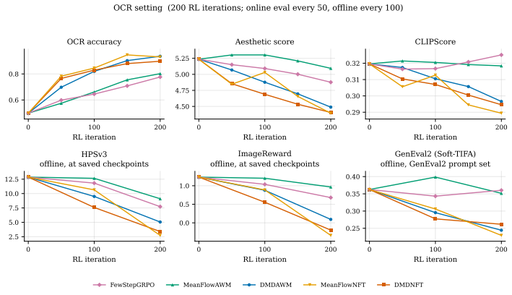
Figure 3 : OCR setting: the evaluated dimensions against the iteration, over the first200iterations. Top row: online evaluation every50iterations. Bottom row: offline evaluation at saved checkpoints,
원문 · CC BY 4.0 · Haitao Lin, Minsi Ren, Yang Li, Xingtong Ge, Zheyuan Hu, Peiyan Hu, Tailin Wu · FewStepRL: Fine-tuning Few-step Diffusion Models with Reinforcement Learning · 원문 그림 인용 · 원본 PDF 43쪽에서 그림 영역을 추출했습니다.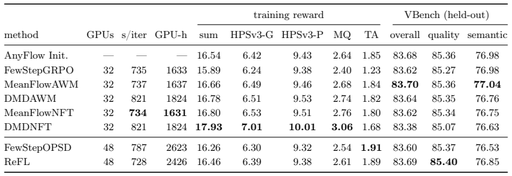
Table 8 : Main results on video generation at iteration250. Left: cost. Middle: the aggregate training reward and its four components on256held-out prompts. Right: VBench, which no method optimises. Bold: best per comparable column; s/iter is compared only among the 32-GPU rows.
원문 · CC BY 4.0 · Haitao Lin, Minsi Ren, Yang Li, Xingtong Ge, Zheyuan Hu, Peiyan Hu, Tailin Wu · FewStepRL: Fine-tuning Few-step Diffusion Models with Reinforcement Learning · 원문 그림 인용 · 원본 PDF 47쪽에서 그림 영역을 추출했습니다.이미지 생성 결과와 보상 기울기 방법의 효과
보류 평가자인 HPSv3, ImageReward, GenEval2에서도 이 두 방법이 상위권이었습니다. 원문은 보상 기울기 방법의 우위가 미분 가능한 보상과 감당 가능한 기울기 조건에서 나타난다고 정리합니다.
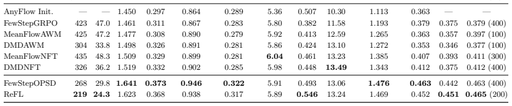
Table 6 : Main results. (a) OCR setting, restricted to the200-iteration horizon of Figure 3. (b) Mixed- reward setting at iteration400: s/iter and wall-clock hours to iteration400; the training reward and its three summands; the held-out evaluators; GenEval2 at iteration400, averaged over iterations 100–400, and at the best checkpoint. Bold: best among the trained methods per comparable column.
원문 · CC BY 4.0 · Haitao Lin, Minsi Ren, Yang Li, Xingtong Ge, Zheyuan Hu, Peiyan Hu, Tailin Wu · FewStepRL: Fine-tuning Few-step Diffusion Models with Reinforcement Learning · 원문 그림 인용 · 원본 PDF 42쪽에서 그림 영역을 추출했습니다.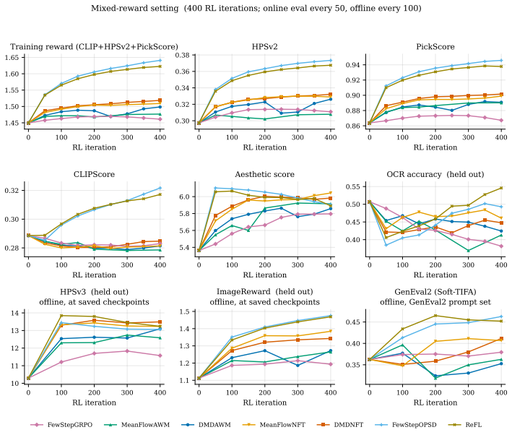
Figure 4 : Mixed-reward setting: the evaluated dimensions against the iteration, over the first400 iterations. The first panel is the training reward; OCR accuracy, HPSv3, ImageReward and GenEval2 are held out. Online evaluation every50iterations, offline evaluation at saved checkpoints every100.
원문 · CC BY 4.0 · Haitao Lin, Minsi Ren, Yang Li, Xingtong Ge, Zheyuan Hu, Peiyan Hu, Tailin Wu · FewStepRL: Fine-tuning Few-step Diffusion Models with Reinforcement Learning · 원문 그림 인용 · 원본 PDF 43쪽에서 그림 영역을 추출했습니다.비용, 미분 가능성, 적용 범위의 한계
DMD 기반 변형은 보조 네트워크를 적합하기 위해 추가 순전파와 역전파가 필요하고 GPU 메모리를 요구합니다. 보상 기울기 기반 방법은 보상이 깨끗한 샘플에 대해 미분 가능해야 하며, 비디오에서는 VideoAlign의 MQ와 TA가 기울기 경로를 제공하지 않아 FewStepOPSD와 ReFL의 기울기가 HPSv3 항에만 의존합니다. 또한 원문은 추가 추론 단계가 집계 점수에 체계적인 이득을 주지 않았으며, 일부 샘플에서만 시각적 개선이 보인다고 보고합니다. 이 결과들은 주어진 모델과 보상 설정의 범위에서 얻은 것입니다.
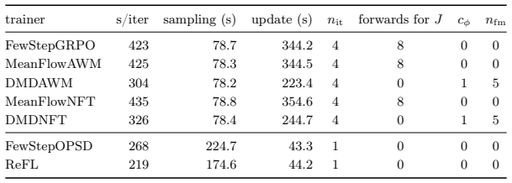
Table 7 : Cost of one outer iteration in the mixed-reward setting, split into the sampling time (rollout, reward and, for FewStepOPSD and ReFL, the reward-coupled construction ofEquation (82)) and the update time; medians over the timers in the training logs, on8H20 GPUs. The small residual between the sum of the two times and s/iter covers the refresh ofuold and logging.
원문 · CC BY 4.0 · Haitao Lin, Minsi Ren, Yang Li, Xingtong Ge, Zheyuan Hu, Peiyan Hu, Tailin Wu · FewStepRL: Fine-tuning Few-step Diffusion Models with Reinforcement Learning · 원문 그림 인용 · 원본 PDF 46쪽에서 그림 영역을 추출했습니다.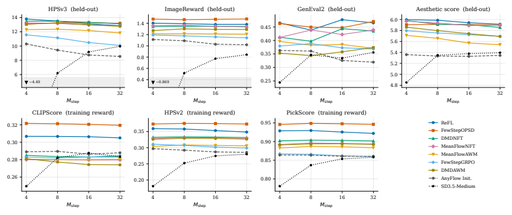
Figure 7 : Absolute value of each evaluated dimension againstMstep, one line per fine-tuned model, with the AnyFlow initialisation (dashed) and the pretrained SD3.5-Medium sampled with classifier- free guidance (dotted) as references. For the fine-tuned models, the three training-reward summands (CLIPScore, HPSv2 and PickScore) show little systematic gain from additional steps, while the held-out HPSv3 and aesthetic score more often decline. Trainer labels are as in Table 5; the checkpoint is given in Table S3. Figure S1 and Figure S2 in Appendix D show the same results as percentage changes from the four-step value, grouped by evaluator and by model, respectively.
원문 · CC BY 4.0 · Haitao Lin, Minsi Ren, Yang Li, Xingtong Ge, Zheyuan Hu, Peiyan Hu, Tailin Wu · FewStepRL: Fine-tuning Few-step Diffusion Models with Reinforcement Learning · 원문 그림 인용 · 원본 PDF 49쪽에서 그림 영역을 추출했습니다.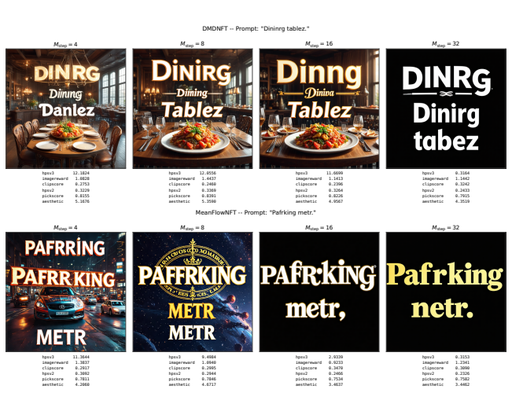
Figure 9 : Two selected OCR-sensitive text-dominance cases under test-time scaling: DMDNFT (top) and MeanFlowNFT (bottom). Within each row, the prompt and seed are fixed and onlyMstep changes; the values below each image are that image’s rewards. These are selected qualitative failure cases rather than population averages.
원문 · CC BY 4.0 · Haitao Lin, Minsi Ren, Yang Li, Xingtong Ge, Zheyuan Hu, Peiyan Hu, Tailin Wu · FewStepRL: Fine-tuning Few-step Diffusion Models with Reinforcement Learning · 원문 그림 인용 · 원본 PDF 51쪽에서 그림 영역을 추출했습니다.논문 정보
- 저자
- Haitao Lin, Minsi Ren, Yang Li, Xingtong Ge, Zheyuan Hu, Peiyan Hu, Tailin Wu
- 학회·저널
- arXiv · 프리프린트
- 최초 공개일
- 2026년 11월 5일
- 등록일
- 2026년 11월 7일
- 수정일
- 2026년 11월 5일
- 버전
- v1
- arXiv
- 2611.08240
- 분류
- cs.LG · cs.CV
- 원문 이용 조건
- CC BY 4.0
- 제공 범위
- 논문 정보, 해설, 허용된 원문 그림
AI 해설은 논문 원문과 별개의 설명이며 오류가 있을 수 있습니다. 원문과 그림은 각 출처의 이용 조건과 따로 표시된 권리를 따릅니다.
초록
Reinforcement learning (RL) has become a standard post-training method for diffusion models, but most RL objectives roll out the current policy at every iteration, and with a many-step sampler these rollouts typically dominate the cost of training. Few-step models cut this cost, yet they model an average velocity over an interval, whereas existing RL objectives are built for an instantaneous velocity with a many-step sampler. We adapt RL objectives to few-step models systematically in three phases, namely a transformation, a decomposition and an adaptation. The transformation to $x$-space expresses each objective we consider through a common policy prediction, at the clean end by default and at an explicitly marked level for transition or flow-map objectives, so that objectives stated over densities, velocities or rewards become comparable. The decomposition writes the gradient of each of these objectives as the sum of a self-regression toward a reference and a reward augmentation, so that a method reduces, at the gradient level, to a choice of anchors and weights. The adaptation computes each anchor from a few-step model at the end of its transport or along its tangent, with the instantaneous velocity recovered from the network itself or from an auxiliary network. This yields few-step versions of FlowGRPO, AWM, DiffusionNFT, DiffusionOPSD and ReFL in one modular codebase. In our experiments, reward-gradient-based methods are the most effective when the reward is differentiable and its gradient is affordable; otherwise DiffusionNFT-style methods generally reach high rewards in relatively few iterations despite a sometimes higher per-iteration cost. Extra inference steps show no systematic aggregate benefit in our experiments, although selected outputs visibly improve with two to four times as many sampling steps as in training.
원문 인용
Haitao Lin, Minsi Ren, Yang Li, Xingtong Ge, Zheyuan Hu, Peiyan Hu, Tailin Wu (2026). FewStepRL: Fine-tuning Few-step Diffusion Models with Reinforcement Learning. arXiv:2611.08240v1. https://arxiv.org/abs/2611.08240v1
BibTeX
@misc{lin2026fewsteprl,
  title = {{FewStepRL: Fine-tuning Few-step Diffusion Models with Reinforcement Learning}},
  author = {Haitao Lin and Minsi Ren and Yang Li and Xingtong Ge and Zheyuan Hu and Peiyan Hu and Tailin Wu},
  year = {2026},
  eprint = {2611.08240},
  archivePrefix = {arXiv},
  url = {https://arxiv.org/abs/2611.08240v1}
}