논문 해설
Adversarial Multiplicity: Cherry-Picked Models and the Limits of Disclosure
적대적 다중성: 체리피킹된 모델과 공개의 한계
- 연구 문제 비슷한 정확도의 모델들 사이에서 동기가 있는 행위자가 원하는 개별 예측이나 집계 추정치를 고르거나 만들 수 있는지, 그리고 현행 규제와 공개 절차가 이를 막을 수 있는지 검증합니다.
- 연구 방법 기준 모델의 파라미터를 직접 편집하는 하드 조작과 여러 학습 절차 중에서 모델을 고르는 소프트 조작을 Rashomon set 안에서 비교합니다.
- 주요 결과 하드 조작은 충분히 유연한 모델에서 개별 예측을 바꿀 수 있고, 소프트 조작은 ε 1% 기준 여러 데이터셋에서 개인 결정의 상당 부분을 뒤집을 수 있습니다. 다중 지표 평가는 이 효과를 줄이지만 제거하지는 못합니다.
예측 다중성이 조작의 여지가 되는 이유
예측 다중성은 정확도가 비슷한 모델들이 같은 개인에 대해 서로 다른 예측을 내는 현상입니다. 이 논문은 그 여유를 동기가 있는 행위자가 악용할 수 있다고 봅니다. 소비자 분쟁이나 소송에서 자동화 의사결정 도구의 결과가 쟁점이 될 때, 행위자는 정확도를 크게 잃지 않으면서 자신에게 유리한 출력을 내는 모델을 고를 수 있습니다. 논문은 이를 적대적 다중성이라 부릅니다. 핵심 구분은 두 가지입니다. 하나는 학습 절차의 하이퍼파라미터, 특징 공학 같은 무해해 보이는 선택을 탐색하는 소프트 조작입니다. 다른 하나는 모델 파라미터를 직접 편집하는 하드 조작입니다. 이 구분은 감사자가 어떤 정보를 받는지에 따라 어떤 조작이 탐지되는지를 결정합니다.
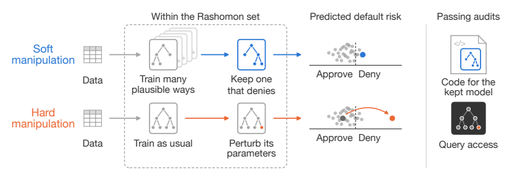
Figure 1 :Soft and hard manipulation framework and application for a loan applicant. Soft manipulation trains many plausible models and selects the model that gives the desired output for a designated target individual. It would pass any audit that requires the code for the kept model, and any audit requiring less information. Hard manipulation trains a model as usual and manually perturbs parameters such that the new model changes one target individual to the desired outcome, while maintaining all other predictions. It would pass a black-box audit that requires only query
원문 · CC BY 4.0 · Cassandra C. Chou, Benjamin Q. Huynh, Allison Koenecke, Elizabeth T. Chin · Adversarial Multiplicity: Cherry-Picked Models and the Limits of Disclosure · 원문 그림 인용 · 원본 PDF 4쪽에서 그림 영역을 추출했습니다.하드 조작의 작동 원리와 성립 조건
기준 모델 A*(D)는 학습 후 Rashomon set 안의 모델로 편집됩니다. Rashomon set은 기준 모델의 손실을 기준으로 허용 오차 ε 이내의 성능을 가진 모델들의 집합입니다. 논문의 정리 4.1은 모델 출력이 학습된 표현 ϕ(x)의 선형 함수 θᵀϕ(x)이고 최종 예측이 엄격하게 증가하는 함수 ψ를 거친다고 가정합니다. 이때 scored 데이터의 서로 다른 벡터 ϕ(x)들이 독립이면, 파라미터 θ만 바꿔 어떤 scored 예측이든 ψ가 취할 수 있는 임의의 값으로 바꿀 수 있습니다. 이 변경은 같은 ϕ(x)를 공유하는 예측을 제외하고는 다른 scored 예측을 바꾸지 않습니다. 정리는 조건이 성립하지 않으면 그 예측을 바꿀 수 없다는 방향도 함께 보입니다.
즉 ϕ(x)가 다른 벡터들의 선형결합으로 표현되면 같은 파라미터 변화로는 그 예측을 바꿀 수 없습니다. 실제 조건은 distinct 벡터를 행으로 가진 행렬 Φ가 완전 행 계수를 가져야 한다는 rank 조건입니다. 트리 모델에서는 리프 수, 신경망에서는 마지막 은닉층 유닛 수가 이 조건을 좌우합니다. 논문은 이 변경으로 조작된 모델이 손실을 ε·L* 이하로만 올리면 Rashomon set 안에 남는다고 설명합니다. 실험에서는 LightGBM 모델의 리프 값을 편집했습니다. 개별 대상의 예측을 0.5 임계값 너머로 옮기되 Brier score가 1% 허용 범위를 벗어나지 않도록 했습니다. 편집 크기는 모든 리프에 대한 유클리드 노름이 가장 작은 방향으로 선택했습니다.
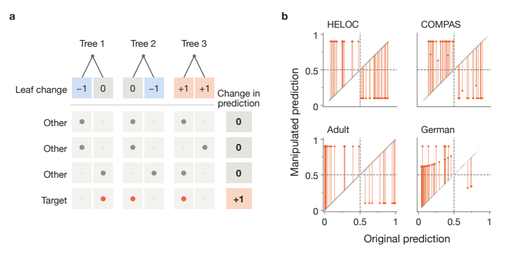
Figure 2 :Hard manipulation can change the decisions of any individual without de- tectable loss in performance. a,Toy model schematic of how hard manipulation works. Each row represents an individual, and its prediction is the sum of the leaves the individual lands in. The changes to the leaves increase the target’s prediction by +1 while canceling across the other individuals.b,Hard manipulation on four fair machine learning datasets. Grey line indicates the original predictions; if no predictions were changed after manipulation, we would only observe this y =x. Each orange point represents the changed prediction from a target individual in the validation dataset—all individuals had reversed decisions after manipulation. All models with changes were kept within the Rashomon set.
원문 · CC BY 4.0 · Cassandra C. Chou, Benjamin Q. Huynh, Allison Koenecke, Elizabeth T. Chin · Adversarial Multiplicity: Cherry-Picked Models and the Limits of Disclosure · 원문 그림 인용 · 원본 PDF 7쪽에서 그림 영역을 추출했습니다.소프트 조작의 도달 범위와 다중 지표 확인
소프트 조작은 여러 데이터 처리 선택, 모델 계열, 하이퍼파라미터, 시드, 보정 방법을 실행하여 후보 모델 풀을 만든 뒤, Rashomon set 안에서 반대 결정을 내리는 모델을 고르는 방식입니다. 이 방법에서는 모델 파라미터를 직접 바꾸지 않습니다. 도달 범위인 reach는 Rashomon set 안에 기준 모델과 반대 결정을 내리는 모델이 하나라도 있는 테스트 개인의 비율로 정의됩니다. Brier score만으로 Rashomon set을 정의하면, ε가 5%일 때 reach는 HELOC 61.9%, COMPAS 75.8%, Adult 18.3%, German 68.5%였습니다. ε가 1%일 때는 HELOC 12.8%, COMPAS 38.4%, Adult 4.6%, German 48.5%였습니다.
다중 지표 확인은 AUC, 보정-in-the-large, 보정 기울기, impact ratio를 추가로 검사합니다. 이 확인을 적용하면 ε 1%에서 HELOC은 9.3%, COMPAS는 22.9%, Adult는 3.4%, German은 35.0%로 줄었습니다. 이 결과는 다중 지표 평가가 소프트 조작의 효과를 줄이지만 0으로 만들지는 못한다는 것을 보여 줍니다. 다만 이 수치는 네 데이터셋과 해당 후보 풀에서 얻은 결과입니다.
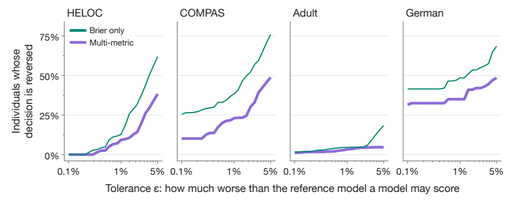
Figure 3 :Soft manipulation may reverse the decision of some individual predictions, even under multi-metric evaluation.Reach, or percentage of target individuals whose decision is reversed, for different levels of tolerance (how much worse a chosen model can score in comparison to the reference model) for four fair machine learning datasets. Includes soft manipulation under a Brier score only check and a multi-metric check.
원문 · CC BY 4.0 · Cassandra C. Chou, Benjamin Q. Huynh, Allison Koenecke, Elizabeth T. Chin · Adversarial Multiplicity: Cherry-Picked Models and the Limits of Disclosure · 원문 그림 인용 · 원본 PDF 9쪽에서 그림 영역을 추출했습니다.Reconcile이 적대적 파트너를 얼마나 막는지
Reconcile은 두 모델이 크게 다른 영역에서 관측 결과를 사용해 한쪽 또는 다른 쪽 예측을 보정하는 알고리즘입니다. 논문은 검증 집합을 A와 B로 나눠 기준 모델과 Rashomon set을 A에서 고르고, 보정은 B를 사용하게 했습니다. 그렇게 하지 않으면 Reconcile이 기준 모델 예측을 구조적으로 선호하게 되기 때문입니다. 개별 테스트 대상은 변경됨, 원래 결정 유지, 분쟁 중 하나로 분류됩니다. 적대적 파트너는 각 테스트 대상에 대해 결정을 뒤집고 예측 크기가 가장 큰 모델이며, 무작위 파트너는 Rashomon set의 모든 모델에 대한 평균입니다. 적대적 파트너의 결정은 기준 모델의 결정을 HELOC에서 6.1배, COMPAS에서 4.1배, Adult에서 6.7배, German에서 2.1배 더 자주 뒤집었습니다.
이 배수는 무작위 파트너 대비 비율입니다. 분쟁 상태로 남는 비율도 적대적 파트너 쪽이 더 높았습니다. 따라서 Reconcile은 대체로 다수의 불일치를 해소하지만, 적대적으로 고른 파트너 쪽으로 해소되는 경향을 완전히 막지는 못합니다.
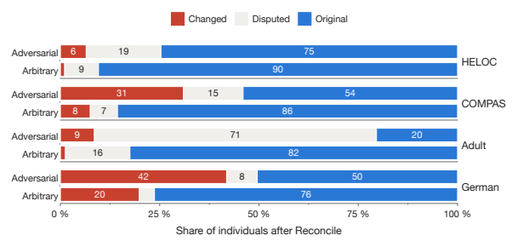
Figure 5 :Adversarial model decisions survive reconciliation more often than arbitrary model decisions.Percentage of individuals that fall into each category after Reconcile, when the partner is chosen adversarially or arbitrarily. Changed indicates that both models give the partner model’s decision; disputed indicates both models retain their original, split decisions; original indicates that both models give the reference model’s decision.
원문 · CC BY 4.0 · Cassandra C. Chou, Benjamin Q. Huynh, Allison Koenecke, Elizabeth T. Chin · Adversarial Multiplicity: Cherry-Picked Models and the Limits of Disclosure · 원문 그림 인용 · 원본 PDF 13쪽에서 그림 영역을 추출했습니다.산불 기후 기여 집계 추정치의 조작
논문은 개별 예측뿐 아니라 집계 추정치도 조작할 수 있는지 캘리포니아 산불 자료로 확인합니다. 집계 추정치는 분율 FAR = 1 − p̄1/p̄0로 정의되며, p̄1은 사전 산업화 반사실 기후에서 예측한 확률의 평균이고 p̄0은 현재 기후에서 관측된 극단 성장 확률입니다. 기준 모델의 FAR은 0.32였습니다. 하드 조작은 여섯 개 시간 블록 모델의 리프 값을 함께 편집해 교차 검증 Brier score가 1% 허용 범위를 넘지 않게 하면서 사전 산업화 평균 예측을 움직였습니다. 그 결과 FAR은 −15.3까지 내려갈 수 있었지만 다중 지표 확인을 적용하면 0.04에서 1.00 사이로 제한되었습니다. 소프트 조작은 ε 1% Rashomon set 안에서 FAR을 −0.11에서 0.48 사이로 바꿨습니다.
다중 지표 확인에서는 0.01에서 0.32 사이였습니다. 저자들은 FAR이 음수가 되는 것은 물리적으로 그럴듯하지 않다고 보며, 핵심은 방향 반전보다 추정치가 임의의 낮은 값으로 조작될 수 있다는 점이라고 해석합니다.
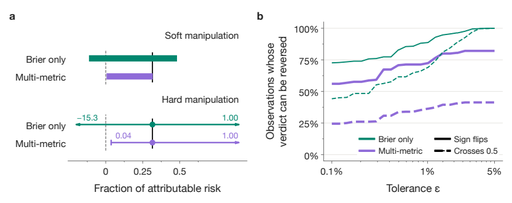
Figure 4 :Attribution of extreme wildfire growth to climate change under soft and hard manipulation. a,Range of aggregate fraction of attributable risk (FAR, pre-industrial vs. present-day) estimates atε = 1%under soft and hard manipulation using the Brier score-only and multi-metric evaluation. Reference model’s FAR is 0.32. Hard manipulation values are clipped on the negative x-axis.b,Percentage of the extreme fire days whose decision can be reversed (FAR crosses 0) under soft manipulation using Brier score-only and multi-metric evaluation. Additionally includes percentage of extreme fire days where the FAR may cross 0.5, the threshold often used to denote legal responsibility.
원문 · CC BY 4.0 · Cassandra C. Chou, Benjamin Q. Huynh, Allison Koenecke, Elizabeth T. Chin · Adversarial Multiplicity: Cherry-Picked Models and the Limits of Disclosure · 원문 그림 인용 · 원본 PDF 11쪽에서 그림 영역을 추출했습니다.적용 범위와 공개 절차에 대한 함의
연구 결과는 네 개의 공개 벤치마크 데이터셋과 캘리포니아 산불 데이터셋에 한정됩니다. 논문은 이론 결과는 더 넓게 적용될 수 있다고 보지만, Reconcile의 성공 정도는 소수 클래스 비율 같은 데이터 맥락에 따라 달라질 수 있다고 밝힙니다. 언어 모델이나 비전 모델은 이 실험에 포함되지 않았습니다. 모델링 가정도 보수적입니다. 하드 조작에서는 다른 예측을 고정했지만, 실제 행위자는 다른 관측치가 변하도록 두거나 목표 관측치를 평가 집합에서 제외할 수 있습니다. 규제 측면에서 논문은 대부분의 현행 제도가 문서화와 블랙박스 검사에 머물러 있으며 사전 등록을 요구하는 사례가 드물다고 분석합니다. 권고는 일회성 분석에서는 탐색 공간을 사전 등록하고, 지속 배포 모델에서는 모델 버전을 보관하는 것입니다.
이 권고는 조작을 완전히 제거한다고 주장하지 않으며, 조작 가능성을 공개 절차에 반영하도록 요구하는 수준입니다.
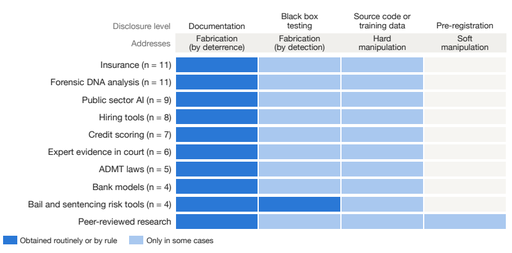
Figure 6 :Current regulation of machine learning and statistical models across sectors is not robust to adversarial multiplicity.Indicators for what types of disclosure are routinely acquired or acquired only in some cases, across high-stakes settings. Disclosure level indicates the amount and type of information an auditor receives and what types of manipulation the information can identify.
원문 · CC BY 4.0 · Cassandra C. Chou, Benjamin Q. Huynh, Allison Koenecke, Elizabeth T. Chin · Adversarial Multiplicity: Cherry-Picked Models and the Limits of Disclosure · 원문 그림 인용 · 원본 PDF 14쪽에서 그림 영역을 추출했습니다.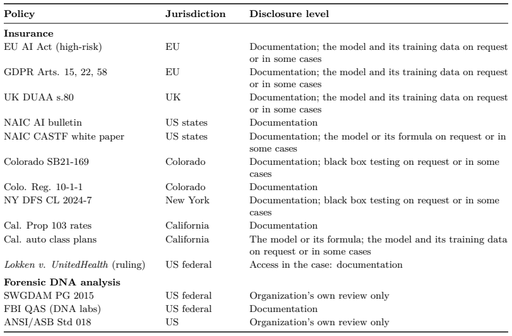
Table 2 : Policies and court rulings behind Figure 6. “Disclosure level” describes what an auditor, regulator, court, affected individual or the public is guaranteed, and what it can obtain only on request or in some cases.
원문 · CC BY 4.0 · Cassandra C. Chou, Benjamin Q. Huynh, Allison Koenecke, Elizabeth T. Chin · Adversarial Multiplicity: Cherry-Picked Models and the Limits of Disclosure · 원문 그림 인용 · 원본 PDF 25쪽에서 그림 영역을 추출했습니다.논문 정보
- 저자
- Cassandra C. Chou, Benjamin Q. Huynh, Allison Koenecke, Elizabeth T. Chin
- 학회·저널
- arXiv · 프리프린트
- 최초 공개일
- 2026년 11월 5일
- 등록일
- 2026년 11월 6일
- 수정일
- 2026년 11월 5일
- 버전
- v1
- arXiv
- 2611.07378
- 분류
- cs.LG · stat.AP
- 원문 이용 조건
- CC BY 4.0
- 제공 범위
- 논문 정보, 해설, 허용된 원문 그림
AI 해설은 논문 원문과 별개의 설명이며 오류가 있을 수 있습니다. 원문과 그림은 각 출처의 이용 조건과 따로 표시된 권리를 따릅니다.
초록
Predictive multiplicity -- where similarly accurate models disagree on individual predictions -- can be leveraged to optimize secondary metrics (e.g., fairness) without loss in predictive performance. However, exploiting multiplicity opens the opportunity for motivated parties (or coding agents gaming their objectives) to steer predictions toward their own ends, such as in litigation or consumer disputes with automated decision-making tools. In these adversarial multiplicity settings, we distinguish soft manipulation, where parties optimize over innocuous model choices (e.g., hyperparameter tuning, feature engineering), from hard manipulation, where parties directly perturb model parameters. We find a sufficiently flexible model can be manipulated to reverse any individual prediction with minimal change in predictive performance while passing black-box audits, making hard manipulation viable in most regulatory settings. Soft manipulation has smaller effects but can pass white-box audits requiring full access to code and data. Even aggregate estimates can be manipulated: a model's estimated effect of climate change on wildfires can be fully reversed by hard edits and soft search. We find the Reconcile algorithm typically resolves most disagreements between models, but more often in favor of the manipulator when the opposing model is chosen adversarially compared to at random. We map which manipulations can plausibly pass existing regulations and disclosure policies, and recommend mitigations such as pre-registration, proof of model training, sensitivity analyses, multi-metric evaluations, and committing to versioned public models.
원문 인용
Cassandra C. Chou, Benjamin Q. Huynh, Allison Koenecke, Elizabeth T. Chin (2026). Adversarial Multiplicity: Cherry-Picked Models and the Limits of Disclosure. arXiv:2611.07378v1. https://arxiv.org/abs/2611.07378v1
BibTeX
@misc{chou2026adversarial,
  title = {{Adversarial Multiplicity: Cherry-Picked Models and the Limits of Disclosure}},
  author = {Cassandra C. Chou and Benjamin Q. Huynh and Allison Koenecke and Elizabeth T. Chin},
  year = {2026},
  eprint = {2611.07378},
  archivePrefix = {arXiv},
  url = {https://arxiv.org/abs/2611.07378v1}
}