논문 해설
DU-GAN: Generative Adversarial Networks with Dual-Domain U-Net Based Discriminators for Low-Dose CT Denoising
DU-GAN: 저선량 CT 잡음 제거를 위한 이중 도메인 U-Net 기반 판별기를 갖는 생성적 적대 신경망
- 연구 문제 저선량 CT는 방사선 피폭을 줄이지만 잡음과 아티팩트가 늘어나 진단 품질을 떨어뜨립니다. 기존 GAN 기반 잡음 제거는 분류형 판별기로 전역 구조만 주로 피드백하여 국소 세부와 줄무늬 아티팩트 억제에 한계가 있습니다.
- 연구 방법 DU-GAN은 RED-CNN 생성기와 이미지·그래디언트 두 도메인의 U-Net 기반 판별기를 결합하고, CutMix로 판별기를 정규화합니다.
- 주요 결과 Mayo-10% 테스트 세트에서 DU-GAN은 MSE 및 GAN 기반 비교 방법 중 가장 높은 SSIM 0.7489를 보고합니다. 다만 RED-CNN과 Q-AE는 PSNR과 RMSE에서 더 나은 값을 보입니다.
저선량 CT 잡음과 기존 적대적 학습의 한계
저선량 CT(LDCT)는 방사선 피폭을 줄이지만 영상에 잡음과 아티팩트가 늘어나 진단 성능을 떨어뜨립니다. 기존 딥러닝 방법에서 MSE 손실은 높은 PSNR을 얻더라도 영상을 과하게 매끄럽게 만드는 경향이 있습니다. 적대적 손실은 텍스처 보존에 도움이 되지만, 판별기가 분류형 구조로 되어 있으면 전역 구조 피드백만 제공하고 국소 세부 구조에 대한 픽셀 단위 피드백은 약하게 전달됩니다. 또한 광자 부족(photon starvation)으로 생기는 줄무늬 아티팩트는 영상 도메인의 손실만으로는 충분히 제거되지 않는다고 논문은 설명합니다.
U-Net 기반 판별기의 구조와 손실
DU-GAN은 RED-CNN을 생성기로 사용하고, 판별기를 U-Net 구조로 바꿉니다. 인코더는 합성곱 층으로 입력을 점점 축소하면서 전역 구조를 포착하고, 디코더는 인코더와 건너뛰기 연결로 이어져 픽셀 단위 신뢰도 맵을 만듭니다. 판별기 손실은 인코더 출력과 디코더 출력 두 곳에서 계산되며, 최소제곱 GAN 형식으로 정답 영상에는 1, 생성 영상에는 0을 목표로 합니다. 이 구조는 이미지 도메인에 적용되며, 판별기 자체는 분류형 판별기에 디코더 경로를 더한 형태로 이해할 수 있습니다.
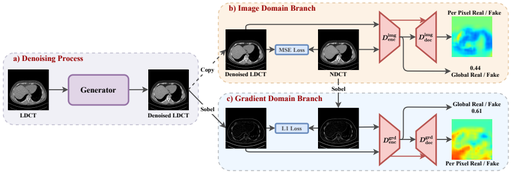
Fig. 1 . Overall framework of our proposed DU-GAN. The generator produces denoised LDCT images, and two independent branches with U-Net based discriminators perform at the image and gradient domains. The U-Net based discriminator provides both global structure and local per-pixel feedback to the generator. Furthermore, the image discriminator encourages the generator to produce photo-realistic CT images while the gradient discriminator is utilized for better edge and alleviating streak artifacts caused by photon starvation.
원문 · CC BY 4.0 · Zhizhong Huang, Junping Zhang, Yi Zhang, Hongming Shan · DU-GAN: Generative Adversarial Networks with Dual-Domain U-Net Based Discriminators for Low-Dose CT Denoising · 원문 그림 인용 · 원본 PDF 3쪽에서 그림 영역을 추출했습니다.그래디언트 도메인 판별기와 CutMix 정규화
DU-GAN은 이미지 도메인 판별기 외에 Sobel 연산자로 계산한 그래디언트 영상에 대해 두 번째 U-Net 기반 판별기를 둡니다. 저자들은 줄무늬와 가장자리가 수평·수직 그래디언트 크기에서 두드러진다고 보고, 그래디언트 도메인의 적대적 학습이 가장자리 강화와 줄무늬 완화에 도움이 된다고 설명합니다. 최종 적대적 손실은 두 도메인의 항을 합한 형태입니다. 또한 CutMix는 정상선량 영상과 생성 영상의 패치를 이진 마스크 M으로 섞어 판별기를 정규화하며, 인코더는 혼합 비율을, 디코더는 혼합 영역을 구분하도록 학습됩니다. 이 디코더 출력은 잡음 제거 결과의 불확실성을 보여 주는 신뢰도 맵으로 쓰일 수 있다고 논문은 제시합니다.
시뮬레이션·실제 데이터 비교 결과
논문은 Mayo-10%, Mayo-25%, Piglet-5% 테스트 세트에서 MSE 기반 방법과 GAN 기반 방법을 비교합니다. Mayo-10%에서 DU-GAN은 PSNR 22.3075, RMSE 0.0802, SSIM 0.7489를 보고하며, 표에 제시된 MSE 및 GAN 기반 비교 방법 중 SSIM이 가장 높습니다. 같은 표에서 RED-CNN과 Q-AE는 PSNR과 RMSE에서 더 나은 값을 보이지만, 저자들은 이 두 MSE 기반 방법이 영상을 과하게 매끄럽게 만들어 SSIM이 낮다고 해석합니다. 이 결과는 본문이 제시한 세 데이터셋과 지표 조건에서 얻은 것입니다.
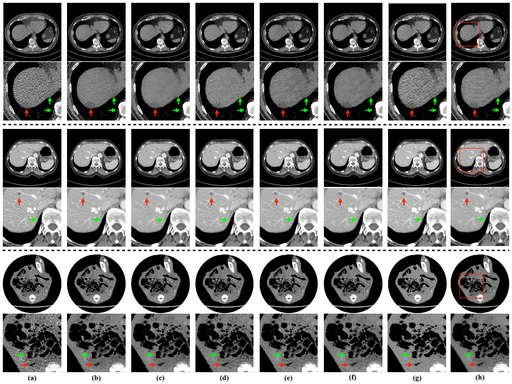
Fig. 5 . Transverse CT images from the Mayo-10%, Mayo-25%, and Piglet-5%: (a) LDCT; (b) NDCT; (c) RED-CNN; (d) WGAN-VGG; (e) CPCE-2D; (f) Q-AE; (g) CNCL; and (h) DU-GAN (ours). Zoomed ROI of the red rectangle is shown below the full-size one. The display window is [-160, 240] HU for better visualization. Red arrow indicates low attenuation lesion. Green arrow indicates the white edge artifacts shown in some baseline algorithms while not shown in our method.
원문 · CC BY 4.0 · Zhizhong Huang, Junping Zhang, Yi Zhang, Hongming Shan · DU-GAN: Generative Adversarial Networks with Dual-Domain U-Net Based Discriminators for Low-Dose CT Denoising · 원문 그림 인용 · 원본 PDF 8쪽에서 그림 영역을 추출했습니다.구성요소 절제와 판별기 구조 비교
절제 실험은 Mayo-10% 테스트 세트의 6,590개 슬라이스를 대상으로 수행되었습니다. 기준 모델은 전통적 분류 판별기를 사용하며 같은 하이퍼파라미터를 적용하고, U-Net 기반 판별기, CutMix 정규화, 그래디언트 도메인 판별기를 단계적으로 추가합니다. U-Net 기반 판별기를 추가하면 SSIM이 0.7454로 올라가고, CutMix를 더한 설정은 SSIM 0.7477로 나타나며, 최종 이중 도메인 설정은 PSNR 22.3075, RMSE 0.0802, SSIM 0.7489입니다. 다만 CutMix 단계에서는 PSNR과 RMSE가 기준 단계보다 약간 나빠졌다고 원문 표는 보고합니다. 판별기 구조 비교에서는 패치·픽셀·전역 판별기와 U-Net 판별기를 비교했으며, 원문은 U-Net 판별기가 SSIM에서 가장 높다고 보고합니다.
적용 범위와 남은 질문
저자들은 판정이 주로 정성적 비교와 정량 지표에 근거하므로 임상 진단 효과를 확인하려면 사람 판독 연구가 더 필요하다고 밝힙니다. 신뢰도 맵이 실제 임상 업무에 어떻게 도움이 되는지도 간 병변 진단 같은 구체적 과제로 더 검토해야 합니다. 학습 단계에서는 추가 계산 비용이 있지만, 추론 단계에서는 이중 도메인 판별기가 사용되지 않아 추론 효율은 기존 방식과 같다고 원문은 설명합니다. 또한 원문은 두 가지 선량 수준에서만 검증했다고 밝힙니다.
논문 정보
- 저자
- Zhizhong Huang, Junping Zhang, Yi Zhang, Hongming Shan
- 학회·저널
- arXiv · 프리프린트
- 최초 공개일
- 2021년 8월 24일
- 등록일
- 2026년 11월 6일
- 수정일
- 2021년 11월 7일
- 버전
- v2
- arXiv
- 2108.10772
- DOI
- 10.1109/tim.2021.3128703
- 분류
- eess.IV · cs.CV · physics.med-ph
- 원문 이용 조건
- CC BY 4.0
- 제공 범위
- 논문 정보, 해설, 허용된 원문 그림
AI 해설은 논문 원문과 별개의 설명이며 오류가 있을 수 있습니다. 원문과 그림은 각 출처의 이용 조건과 따로 표시된 권리를 따릅니다.
초록
LDCT has drawn major attention in the medical imaging field due to the potential health risks of CT-associated X-ray radiation to patients. Reducing the radiation dose, however, decreases the quality of the reconstructed images, which consequently compromises the diagnostic performance. Various deep learning techniques have been introduced to improve the image quality of LDCT images through denoising. GANs-based denoising methods usually leverage an additional classification network, i.e. discriminator, to learn the most discriminate difference between the denoised and normal-dose images and, hence, regularize the denoising model accordingly; it often focuses either on the global structure or local details. To better regularize the LDCT denoising model, this paper proposes a novel method, termed DU-GAN, which leverages U-Net based discriminators in the GANs framework to learn both global and local difference between the denoised and normal-dose images in both image and gradient domains. The merit of such a U-Net based discriminator is that it can not only provide the per-pixel feedback to the denoising network through the outputs of the U-Net but also focus on the global structure in a semantic level through the middle layer of the U-Net. In addition to the adversarial training in the image domain, we also apply another U-Net based discriminator in the image gradient domain to alleviate the artifacts caused by photon starvation and enhance the edge of the denoised CT images. Furthermore, the CutMix technique enables the per-pixel outputs of the U-Net based discriminator to provide radiologists with a confidence map to visualize the uncertainty of the denoised results, facilitating the LDCT-based screening and diagnosis. Extensive experiments on the simulated and real-world datasets demonstrate superior performance over recently published methods both qualitatively and quantitatively.
원문 인용
Zhizhong Huang, Junping Zhang, Yi Zhang, Hongming Shan (2021). DU-GAN: Generative Adversarial Networks with Dual-Domain U-Net Based Discriminators for Low-Dose CT Denoising. arXiv:2108.10772v2. https://doi.org/10.1109/tim.2021.3128703
BibTeX
@article{huang2021generative,
  title = {{DU-GAN: Generative Adversarial Networks with Dual-Domain U-Net Based Discriminators for Low-Dose CT Denoising}},
  author = {Zhizhong Huang and Junping Zhang and Yi Zhang and Hongming Shan},
  year = {2021},
  eprint = {2108.10772},
  archivePrefix = {arXiv},
  doi = {10.1109/tim.2021.3128703},
  url = {https://arxiv.org/abs/2108.10772v2}
}