Paper commentary
DU-GAN: Generative Adversarial Networks with Dual-Domain U-Net Based Discriminators for Low-Dose CT Denoising
- Problem Denoising low-dose CT with a GAN whose single classification discriminator gives only global or only local feedback leaves streak artifacts and edges poorly handled.
- Method Replaces the classification discriminator with U-Net discriminators in the image and gradient domains, regularizes the image-domain discriminator with CutMix, and trains a RED-CNN generator against both.
- Results Reached an SSIM of 0.7489 on Mayo-10%, the highest among the listed methods, while its PSNR of 22.3075 was below RED-CNN's 23.1388.
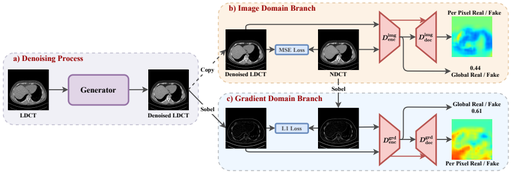
Fig. 1 . Overall framework of our proposed DU-GAN. The generator produces denoised LDCT images, and two independent branches with U-Net based discriminators perform at the image and gradient domains. The U-Net based discriminator provides both global structure and local per-pixel feedback to the generator. Furthermore, the image discriminator encourages the generator to produce photo-realistic CT images while the gradient discriminator is utilized for better edge and alleviating streak artifacts caused by photon starvation.
Original paper · CC BY 4.0 · Zhizhong Huang, Junping Zhang, Yi Zhang, Hongming Shan · DU-GAN: Generative Adversarial Networks with Dual-Domain U-Net Based Discriminators for Low-Dose CT Denoising · Original paper figure · Extracted the figure area from page 3 of the original PDF.Why one discriminator output limits denoising
Lowering the radiation dose of CT reduces patient exposure but adds noise and artifacts to the reconstructed images, which can make diagnosis harder. Denoisers trained only with mean-squared error score well on PSNR but tend to smooth images too much, so adversarial losses were brought in to restore texture. A standard GAN discriminator is a classifier whose outputs either summarize the whole image or a local region, and it loses earlier distinctions as the generator keeps changing.
DU-GAN replaces the classifier with a U-Net, so one network returns a global score from its encoder and a per-pixel map from its decoder. A second discriminator of the same kind works on image gradients, aimed at streak artifacts caused by photon starvation and at edges. Both discriminators feed the generator, and CutMix regularization lets the per-pixel output be read as an uncertainty map.
How the U-Net discriminator is built and trained
The encoder of the image-domain discriminator downsamples its input through convolutional layers, which captures the global structure. The decoder upsamples from that bottleneck, receives skip connections from the encoder in reverse order, and produces a per-pixel map. The global score comes from a fully connected layer at the bottom of the encoder, and the per-pixel map from a 1×1 convolution at the end of the decoder.
The gradient-domain discriminator has the same architecture but receives Sobel gradients of the denoised and NDCT images. Earlier work measured MSE in the gradient domain, which the authors judge insufficient for sharpening edges, and this motivates a GAN term there. The discriminator total loss is the image-domain loss plus the gradient-domain loss.
For the generator, the adversarial term adds the image-domain and gradient-domain terms, the latter applied to the Sobel gradient of the denoised image.
CutMix and the per-pixel confidence map
CutMix builds a training sample from a denoised image and an NDCT image, using a binary mask M to pick which pixels come from each. \[ I_{mix} = M \odot I_{ND} + (1 - M) \odot I_{den} \] The encoder is trained to call the mixed image fake, because mixing breaks the global context of an NDCT image, and the decoder is trained to recover the mask pixel by pixel.
The regularization loss adds the encoder term and a decoder term that compares the decoder output with the mask M. \[ \mathcal{L}_{reg} = \mathbb{E}_{I_{mix}}\left[ [D_{img}^{enc}(I_{mix})]^2 + [D_{img}^{dec}(I_{mix}) - M]^2 \right] \] A consistency term asks the decoder output on a mixed image to match the same mix of the decoder outputs on the two source images, measured with the Frobenius norm.
The mask comes from a mixing ratio r drawn from Beta(1, 1), with the top-left corner of the cropped region sampled uniformly so that the crop keeps the ratio r. CutMix is applied to each mini-batch with probability pmix, set to 0.5. In the decoder map, blue marks lower confidence, so regions the discriminator judges unlike NDCT appear as low-confidence areas.
Generator loss and training settings
The generator is RED-CNN with 10 (de)convolutional layers on each side, 32 filters per layer, ReLU activations and 10 residual skip connections, and it does not downsample. Its only input is the LDCT image, so the generator maps an LDCT image to a denoised one rather than sampling from a noise vector.
The generator loss is a weighted sum of the adversarial term and the two pixel-wise terms. \[ \mathcal{L}_G = \lambda_{adv}\mathcal{L}_{adv} + \lambda_{img}\mathcal{L}_{img} + \lambda_{grd}\mathcal{L}_{grd} \] The image term uses mean squared error on the pixels, and the gradient term uses an absolute mean error on Sobel gradients, because gradients are much sparser than pixels.
The weights were set in sequence: λimg fixed at 1, λadv raised from a small value while looking at the outputs, and λgrd set to a large value. The reported values are λadv 0.1, λimg 1 and λgrd 20.
Training uses 64×64 patches with a window of [−300, 300], mini-batches of 64, at most 100K iterations on one NVIDIA V100 GPU, He initialization, and Adam with a fixed learning rate of 10−4. Each discriminator uses six downsampling ResBlocks with 64 to 512 filters, with spectral normalization and a Leaky ReLU of slope 0.2 after each convolution except the last.
At test time only the generator runs, so the discriminators add training cost and no inference cost.
Simulated and real-world data
The simulated data come from the 2016 NIHAAPM-Mayo Clinic Low-Dose CT Grand Challenge, and Mayo-25% uses abdomen scans at 25% of normal dose while Mayo-10% uses chest scans at 10%. Each simulated set uses 20 randomly chosen patients for training and another 20 for testing, with no patient shared between them.
Piglet-5% comes from 850 CT scans of a deceased piglet taken on a GE scanner, with 708 scans used for training and the rest for testing. Only the 5% dose is evaluated, because it is the most challenging of the doses in that dataset.
Baselines are RED-CNN, WGAN-VGG, CPCE-2D, Q-AE and CNCL, run with the official source code. PSNR and RMSE measure pixel-level denoising quality, and SSIM measures structural similarity within a window.
Metric results on three datasets
On Mayo-10%, DU-GAN reached an SSIM of 0.7489, the highest among the listed methods. Its PSNR of 22.3075 is below RED-CNN's 23.1388, and its RMSE of 0.0802 is higher than RED-CNN's 0.0721, which is worse on that lower-is-better metric.
On Mayo-25%, DU-GAN's PSNR of 34.6186 sits just below Q-AE's 34.6477, and its SSIM of 0.9196 is below RED-CNN's 0.9236. DU-GAN and RED-CNN both have an RMSE of 0.0196 on Mayo-25%, while Q-AE has 0.0197.
On Piglet-5%, DU-GAN's SSIM of 0.9345 is the highest, while its PSNR of 29.8598 is below WGAN-VGG's 30.3787. Its RMSE of 0.0325 is above WGAN-VGG's 0.0318.
The authors note that PSNR and RMSE are pixel-wise and correlate poorly with human perception, and they link over-smoothing to lower SSIM. Each method has one value per metric per dataset, and the table reports no spread across runs.
What the visual comparisons show
The MSE-trained baselines look smoothed and blurred, which the authors link to averaging under the MSE loss. WGAN-VGG and CPCE-2D show minor streak artifacts, which the authors attribute to classification discriminators that give only global feedback. Low-attenuation lesions and bones are less distinct in WGAN-VGG and CPCE-2D than in NDCT and in DU-GAN's output.
The authors say the gradient branch lets streak artifacts be detected, and the image-domain discriminators then fill the affected region through adversarial training. The neck slice in the second figure contains strong streak artifacts and is compared on bone area and a small structure.
Reading the discriminator as an uncertainty map
The trained image-domain discriminator was applied directly to LDCT, NDCT and each method's denoised output, and both its global score and per-pixel map were read. The discriminator separates LDCT from NDCT on both the global score and the per-pixel map. RED-CNN and Q-AE receive the lowest global scores, which the authors read as detection of blurriness.
The authors report that DU-GAN's output gets the highest global score and a smoother per-pixel map, which they take to mean the discriminator cannot tell it from NDCT at pixel level. These are visual readings of one trained discriminator, not a measured uncertainty score.
Which component adds what
The baseline with the classification discriminator reached PSNR 21.4988, RMSE 0.0871 and SSIM 0.7365. Adding the U-Net based discriminator raised these to PSNR 22.1214, RMSE 0.0816 and SSIM 0.7454. Adding CutMix regularization gave PSNR 21.7894, RMSE 0.0844 and SSIM 0.7477, so PSNR and RMSE were worse than the U-Net-only variant while SSIM was higher.
The full dual-domain model reached PSNR 22.3075, RMSE 0.0802 and SSIM 0.7489.
The rows are cumulative, so each one adds a component to the row above it, and the full model without CutMix is not in the table. The authors interpret the CutMix row as making the discriminator focus more on local details, which raises SSIM at a small cost in PSNR and RMSE. They report the gradient-domain branch as the step that improves PSNR, RMSE and SSIM together, and as the one that helps remove streak artifacts.
Comparing discriminator architectures
The patch discriminator reached PSNR 21.4988, RMSE 0.0871 and SSIM 0.7365, the global one 22.6810, 0.0760 and 0.7262, the pixel one 23.1102, 0.0724 and 0.7343, and the U-Net one 22.1214, 0.0816 and 0.7454. The pixel discriminator has the highest PSNR and lowest RMSE, while the U-Net discriminator has the highest SSIM.
The patch and pixel discriminators were trained on image patches, whereas the global one was trained on whole 512×512 images, so these variants differ in input size as well as architecture. The authors read the U-Net result as combining global structure from the encoder with per-pixel differences from the decoder.
Effect of discriminator patch size
At 64×64 the model reached PSNR 22.3075, RMSE 0.0802 and SSIM 0.7489, while 128×128 gave 22.0218, 0.0826 and 0.7479, 256×256 gave 21.8478, 0.0843 and 0.7467, and 512×512 gave 21.7254, 0.0855 and 0.7441. Models at larger sizes were fine-tuned from the model trained on the previous smaller size. The authors attribute the advantage of small patches to training difficulty at larger sizes, which comes with fewer training samples.
Limitations
No human reader study was carried out, so clinical value rests on quantitative metrics and visual comparison. Usefulness of the confidence map for radiologists was not examined on a specific clinical task, and the authors name liver lesion diagnosis as a future direction. Only two dose levels were validated, and lower radiation doses remain untested.
Training cost rises slightly because of the U-Net discriminators and the dual-domain strategy, while inference cost is unchanged. The ablation was run only on the Mayo-10% testing set of 6,590 slices from 20 patients.
Paper info
- Authors
- Zhizhong Huang, Junping Zhang, Yi Zhang, Hongming Shan
- Venue
- arXiv · Preprint
- First published
- 2021-8-24
- Added
- 2026-11-6
- Updated
- 2021-11-7
- Version
- v2
- arXiv
- 2108.10772
- DOI
- 10.1109/tim.2021.3128703
- Category
- eess.IV · cs.CV · physics.med-ph
- Original paper terms
- CC BY 4.0
- What we show
- Paper info, commentary and permitted figures from the original paper
AI commentary is a separate explanation from the original paper and may contain errors. The original paper and figures follow each source's terms of use and any rights noted separately.
Abstract
LDCT has drawn major attention in the medical imaging field due to the potential health risks of CT-associated X-ray radiation to patients. Reducing the radiation dose, however, decreases the quality of the reconstructed images, which consequently compromises the diagnostic performance. Various deep learning techniques have been introduced to improve the image quality of LDCT images through denoising. GANs-based denoising methods usually leverage an additional classification network, i.e. discriminator, to learn the most discriminate difference between the denoised and normal-dose images and, hence, regularize the denoising model accordingly; it often focuses either on the global structure or local details. To better regularize the LDCT denoising model, this paper proposes a novel method, termed DU-GAN, which leverages U-Net based discriminators in the GANs framework to learn both global and local difference between the denoised and normal-dose images in both image and gradient domains. The merit of such a U-Net based discriminator is that it can not only provide the per-pixel feedback to the denoising network through the outputs of the U-Net but also focus on the global structure in a semantic level through the middle layer of the U-Net. In addition to the adversarial training in the image domain, we also apply another U-Net based discriminator in the image gradient domain to alleviate the artifacts caused by photon starvation and enhance the edge of the denoised CT images. Furthermore, the CutMix technique enables the per-pixel outputs of the U-Net based discriminator to provide radiologists with a confidence map to visualize the uncertainty of the denoised results, facilitating the LDCT-based screening and diagnosis. Extensive experiments on the simulated and real-world datasets demonstrate superior performance over recently published methods both qualitatively and quantitatively.
Quote from the paper
Zhizhong Huang, Junping Zhang, Yi Zhang, Hongming Shan (2021). DU-GAN: Generative Adversarial Networks with Dual-Domain U-Net Based Discriminators for Low-Dose CT Denoising. arXiv:2108.10772v2. https://doi.org/10.1109/tim.2021.3128703
BibTeX
@article{huang2021generative,
  title = {{DU-GAN: Generative Adversarial Networks with Dual-Domain U-Net Based Discriminators for Low-Dose CT Denoising}},
  author = {Zhizhong Huang and Junping Zhang and Yi Zhang and Hongming Shan},
  year = {2021},
  eprint = {2108.10772},
  archivePrefix = {arXiv},
  doi = {10.1109/tim.2021.3128703},
  url = {https://arxiv.org/abs/2108.10772v2}
}