Paper commentary
Frequency-Assisted Mamba for Remote Sensing Image Super-Resolution
- Problem Transformer super-resolution costs grow quadratically with token count, and CNNs cannot reach long-range context, which hurts wide remote sensing scenes.
- Method Stacks Frequency-assisted Mamba Groups in which each block pairs a VSSM global branch and a Hybrid Gate Module local branch with a Frequency Selection Module, merged through learnable scale factors.
- Results Reached 31.98 average PSNR across AID, DOTA and DIOR, against 31.89 for HAT-L, with 46 MB memory against 164 MB for HAT-L.
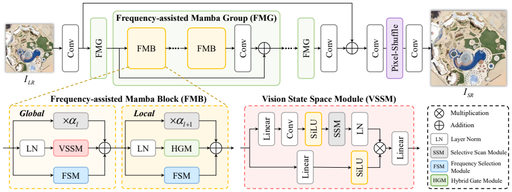
Fig. 2 . Overview of the proposed FMSR. The Frequency-assisted Mamba Blocks (FMB) are arranged sequentially in Frequency-assisted Mamba Groups (FMG). In FMB, a Frequency Selection Module (FSM) is adopted to assist the learning process of the Vision State Space Module (VSSM) and Hybrid Gate Module (HGM). αl is a learnable adaptor for hybrid adaptive integration in the l-th FMB.
Original paper · CC BY 4.0 · Yi Xiao, Qiangqiang Yuan, Kui Jiang, Yuzeng Chen, Qiang Zhang, Chia-Wen Lin · Frequency-Assisted Mamba for Remote Sensing Image Super-Resolution · Original paper figure · Extracted the figure area from page 4 of the original PDF.Long-range context at linear cost for large scenes
Transformer-based super-resolution gets global context from self-attention, but its cost grows quadratically with the number of tokens, which makes large remote sensing scenes expensive to process. CNN-based models stay cheap, yet their receptive fields are limited, so a pixel being predicted has little access to the wider region that informs it.
Both families face this trade-off most sharply in wide-range remote sensing images.
A state space model is an alternative: it tracks the evolution of an internal state through linear filtering and prediction, so its cost grows linearly with sequence length. Mamba extends this with a selection scan that filters out irrelevant information in long sequences, and its strong results in several domains are the reason it is considered a possible replacement for Transformers.
Applying Mamba to remote sensing raises two problems. Mamba treats each spatial token alike, so it does not single out the frequency content that satellite capture tends to lose. It also lacks explicit handling of the spatial diversity among observed objects, which weakens pixel-level representation during local modelling. FMSR keeps Mamba for global modelling and adds a frequency path and a spatially varying local gate, so that each block draws on both frequency and spatial cues.
How FMSR is organized
FMSR has three stages: a shallow convolution on the low-resolution input, a deep stage made of Frequency-assisted Mamba Groups, and a reconstruction stage. Figure 2 places the Frequency-assisted Mamba Blocks inside each group, with the FSM, VSSM and HGM drawn within every block.
The skip gives the reconstruction stage both the refined deep features and the shallow input features.
Reconstruction applies a 3 × 3 convolution, a pixel-shuffle layer with upscale factor s, and a final convolution, giving \(I_{SR} = \mathrm{Conv}(\mathrm{PS}(\mathrm{Conv}(F_{rec}), s))\). Each group is a cascade of blocks followed by a convolution and a residual connection, so the block is the unit that carries the method's frequency and spatial design.
One block with a global and a local step
Each block takes the previous output x_{l-1} and runs a global step: \[ y = \alpha_l \cdot x_{l-1} + \mathrm{VSSM}(\mathrm{LN}(x_{l-1})) + \mathrm{FSM}(x_{l-1}) \] The VSSM branch receives the layer-normalized input and captures long-range spatial information, the FSM branch works on the raw input to add high-frequency cues, and the learnable scale α_l weights the direct path.
Inside a group the blocks are chained, so the output of one block is the input of the next, as the group formula shows: \(F_i = \mathrm{Conv}(\Psi_n(\cdots\Psi(F_{i-1})))+F_{i-1}\).
The local step repeats the pattern on y: \[ x_l = \alpha_{l+1} \cdot y + \mathrm{HGM}(\mathrm{LN}(y)) + \mathrm{FSM}(y) \] Here the HGM supplies the local gate, the FSM again assists with frequency learning, and α_{l+1} is a second learnable scale that sets how the two levels are combined.
The FSM appears in both steps, so frequency selection shapes both the global and the local features of each block. Because the two scale factors are learnable, the balance between the direct path and the branch outputs is set during training rather than fixed by hand.
Vision State Space Module in the global branch
The VSSM normalizes x_l as \(x_N = \mathrm{LN}(x_l)\) and expands it along the channel dimension with a linear projection \(\phi_1\) using expansion factor λ. The first branch passes the expanded features through a 1 × 1 depth-wise convolution, a SiLU activation, the 2D selective scan module and a layer normalization: \[ h_1 = \mathrm{LN}(\mathrm{SSM}(\sigma_1(f_{1\times1}(\phi_1(x_N, \lambda))))) \] The expansion rate λ is set to 2 in the linear projection layer.
The second branch applies another linear projection followed by SiLU: \[ h_2 = \sigma_2(\phi_2(x_N, \lambda)) \] In FMSR this branch supplies the long-range spatial information, while the FSM term sits beside it rather than inside it.
Hybrid Gate Module as a local gate
The HGM expands the channels of its input X to 2c with a 1 × 1 convolution and splits the result into two halves, X1 and X2. The first half produces coordinate features: \[ X_{coor} = \mathrm{CA}(\mathrm{Dconv}(\mathrm{Conv}(X_1))) \] where the convolution is 1 × 1, Dconv is a 3 × 3 depth-wise convolution and CA is a channel attention block.
Figure 3 shows the channel split, the channel attention block and the linear projection as parallel branches that meet in a Hadamard product.
Unlike an MLP layer, the activation is applied only at the end of this projection. The output is \[ Y = \mathrm{Conv}(M \odot X_{coor}) \], so the gate rescales the coordinate features pixel by pixel before a final 1 × 1 convolution.
The module is meant for locality: it amplifies or attenuates features at each spatial position while keeping channel-specific features intact. The authors motivate it by noting that the VSSM aggregates features patch by patch and can miss pixel-level locality.
Frequency Selection Module variants
Each variant applies a 2D real Fast Fourier transform to the features, filters the frequency components and applies an inverse transform. Variant (a) uses one 1 × 1 convolution between the transforms: \(Z = F^{-1}(\mathrm{Conv}(F(x)))\). Variant (b) inserts a ReLU: \(Z = F^{-1}(\mathrm{ReLU}(F(x)))\). Variant (c) uses two 1 × 1 convolutions with a GELU between them: \(Z = F^{-1}\mathrm{Conv}(\mathrm{GELU}(\mathrm{Conv}(F(x))))\).
Figure 4 draws the three variants side by side.
The authors chose variant (c) because the 1 × 1 convolutions let the network set flexible thresholds for frequency selection at low cost. In the ablation protocol, variants (a), (b) and (c) reach 28.129 dB, 28.147 dB and 28.178 dB. Variant (b) is 0.018 dB above variant (a), and variant (c) is the highest. These variants are compared in the ablation protocol, which trains on AID at ×4 and evaluates on AID-tiny.
Training and evaluation setup
AID is used for both training and testing: 3000 images form the training set and 900 the test set, each 640 × 640, and the two parts do not overlap. DOTA and DIOR are used for evaluation, with 900 and 1000 randomly extracted images, each 512 × 512.
FMSR targets ×4 SR with 6 FMGs, each holding 6 FMBs, and an internal channel dimension c of 96. Kernels are 3 × 3 except in the HGM and FSM, which use 1 × 1 kernels, and the linear projection expansion rate is λ = 2.
Training uses an L1 loss and the Adam optimizer with β1 = 0.9 and β2 = 0.999, with 4 patches of 64 × 64 in each mini-batch.
Experiments ran in PyTorch on a single NVIDIA RTX 3090 with 24 GB memory. PSNR and SSIM are computed on the luminance channel of YCbCr, and LPIPS measures perceptual quality. The ablations use AID-tiny, 30 images randomly drawn from AID, and the baseline there replaces VSSM with window-based self-attention and HGM with 5 residual blocks.
Component ablations on AID-tiny
The baseline Model-1 reaches 27.751 dB. Replacing window-based self-attention with the VSSM gives Model-2 at 27.846 dB. The text describes this gain as 0.089 dB, while the Table I values are 27.751 dB and 27.846 dB. Figure 5 shows the 56th channel of the final FMG for each reference image.
Adding an MLP layer to the VSSM (Model-3) reaches 28.104 dB, and channel attention in its place (Model-4) reaches 28.088 dB, close to Model-2 at 27.846 dB. Replacing channel attention with the HGM (Model-5) reaches 28.122 dB, a gain of 0.034 dB stated in the text. The authors read the small gap between Model-4 and Model-2 as a sign that channel attention adds little on top of the VSSM.
The full FMSR (Model-6) reaches 28.178 dB, so adding the FSM to Model-5 gives 0.056 dB. The authors also report feature maps with and without the FSM, describing sharper boundaries and clearer edges with the FSM.
Adaptive integration of global and local branches
Relative to the model without HAI, the full model gains 0.13 dB, and relative to the skip-only variant it gains 0.36 dB.
The authors attribute the weak skip result to misalignment between global and local representations, so plain addition does not combine them well. The adaptive scale α lets the features at each range be adjusted before they are merged.
Depth and width of the stack
The authors chose 6 FMBs to balance performance and model size.
PSNR at 8 groups falls below 6 groups, which the authors suggest may be caused by over-fitting, and FMSR uses 6 FMGs. These depth ablations train on AID at ×4, as the other ablation studies do.
Memory, parameters and inference cost
Memory is the maximum CUDA consumption. FMSR uses 46 MB, against 164 MB for HAT-L and 206 MB for NLSN, and it is 28.05% of HAT-L's memory. The text gives a reduction of 160 MB relative to NLSN, which matches the Table VI values. Figure 9 plots memory, inference time, parameters and PSNR for the compared models on DOTA.
The text describes FMSR as taking about 90.6 ms more than RGT, while Table VI puts RGT at 191.48 ms and FMSR below it, so the two sources disagree in direction.
Input sizes run from 32 × 32 to 88 × 88, and the authors read the result as linear complexity with input resolution.
Accuracy on AID, DOTA and DIOR
FMSR++, the self-ensemble variant, reaches 32.16 average PSNR. The abstract gives an average gain of 0.11 dB over HAT-L, while the averages in Table VII are 31.98 for FMSR and 31.89 for HAT-L.
On AID, FMSR scores 30.93 dB, against 30.81 dB for HAT-L, and the text gives 29% of HAT-L's parameters and 19% of its FLOPs. On DOTA, FMSR scores 34.04 dB, against 33.99 dB for HAT-L and 33.86 dB for GRL-L. The text puts the gain over GRL-L at 0.18 dB with 60% lower complexity, although GRL-L's FLOPs do not appear in Table VI. On DIOR, FMSR scores 30.97 dB, above 30.91 dB for RGT and 30.87 dB for HAT-L.
The text states that MambaIR leads NLSN by 0.04 dB on AID, which the authors use to argue that spatial-wise global modelling reaches a plateau. Table VII gives 30.85 dB for MambaIR and 30.81 dB for NLSN. The text calls FMSR's AID LPIPS of 0.3001 much higher than the other approaches, but lower LPIPS is better and 0.3001 is the lowest AID LPIPS in Table VII, below 0.3023 for RGT.
Per-category results on AID
Table VIII reports PSNR and SSIM for 30 scene categories, comparing Bicubic, EDSR, HSENet, NLSN, HAT-L, MambaIR, RGT and FMSR. In Parking, FMSR scores 28.02 dB against 27.79 dB for RGT, and in Stadium it scores 29.97 dB against 29.77 dB for HAT-L. In Industrial, RGT scores 29.20 dB and FMSR scores 29.17 dB, so FMSR is not the highest in that category.
Visual and attribution comparisons
Figure 11 compares crops from AID at ×4 across Bicubic, EDSR, RCAN, HAN, NLSN, HAT-L, RGT, MambaIR and FMSR. The authors point to the runway lines in playground_270, which HAT-L and MambaIR struggle to reconstruct.
Figure 12 shows DOTA crops at ×4 for the same families of methods. For img_165 and img_658, the authors report that only FMSR recovers the severely damaged lines on the ground.
Figure 13 shows a DIOR case with large-scale structure, where the authors report that CNN, Transformer and Mamba baselines lose high-frequency texture. MambaIR without frequency selection misses details in this case, and HAT-L produces visible distortion, while FMSR keeps lines close to the ground truth.
Local Attribution Maps compare how many input pixels FMSR and HAT-L use, and a higher diffusion index indicates wider activation. The text reports that FMSR surpasses HAT-L by 8.637 in diffusion index, which the authors read as wider use of pixels from the spatial-frequency representation.
Limits of the evidence
The study covers only ×4 SR. The authors note that this restricts exploring super-resolution at other scaling factors.
The ablations use the 30-image AID-tiny subset, and the saturation at 8 FMGs is attributed by the authors to over-fitting.
Efficiency is mixed: FMSR's 100.88 ms inference time is above MambaIR and HSENet, and its 128.27G FLOPs are above RGT and TransENet, while its memory is lower than HAT-L's and its parameter count is below HAT-L's.
Several text statements differ from the tables: the RGT inference-time gap, the average gain over HAT-L, the Industrial scene gap, and the LPIPS wording. The DOTA and DIOR results come from models trained on AID, as the setup describes.
Paper info
- Authors
- Yi Xiao, Qiangqiang Yuan, Kui Jiang, Yuzeng Chen, Qiang Zhang, Chia-Wen Lin
- Venue
- arXiv · Preprint
- First published
- 2024-5-8
- Added
- 2026-11-6
- Updated
- 2024-8-29
- Version
- v2
- arXiv
- 2405.04964
- Category
- cs.CV
- Original paper terms
- CC BY 4.0
- What we show
- Paper info, commentary and permitted figures from the original paper
AI commentary is a separate explanation from the original paper and may contain errors. The original paper and figures follow each source's terms of use and any rights noted separately.
Abstract
Recent progress in remote sensing image (RSI) super-resolution (SR) has exhibited remarkable performance using deep neural networks, e.g., Convolutional Neural Networks and Transformers. However, existing SR methods often suffer from either a limited receptive field or quadratic computational overhead, resulting in sub-optimal global representation and unacceptable computational costs in large-scale RSI. To alleviate these issues, we develop the first attempt to integrate the Vision State Space Model (Mamba) for RSI-SR, which specializes in processing large-scale RSI by capturing long-range dependency with linear complexity. To achieve better SR reconstruction, building upon Mamba, we devise a Frequency-assisted Mamba framework, dubbed FMSR, to explore the spatial and frequent correlations. In particular, our FMSR features a multi-level fusion architecture equipped with the Frequency Selection Module (FSM), Vision State Space Module (VSSM), and Hybrid Gate Module (HGM) to grasp their merits for effective spatial-frequency fusion. Considering that global and local dependencies are complementary and both beneficial for SR, we further recalibrate these multi-level features for accurate feature fusion via learnable scaling adaptors. Extensive experiments on AID, DOTA, and DIOR benchmarks demonstrate that our FMSR outperforms state-of-the-art Transformer-based methods HAT-L in terms of PSNR by 0.11 dB on average, while consuming only 28.05% and 19.08% of its memory consumption and complexity, respectively. Code will be available at https://github.com/XY-boy/FreMamba
Quote from the paper
Yi Xiao, Qiangqiang Yuan, Kui Jiang, Yuzeng Chen, Qiang Zhang, Chia-Wen Lin (2024). Frequency-Assisted Mamba for Remote Sensing Image Super-Resolution. arXiv:2405.04964v2. https://arxiv.org/abs/2405.04964v2
BibTeX
@misc{xiao2024frequency,
  title = {{Frequency-Assisted Mamba for Remote Sensing Image Super-Resolution}},
  author = {Yi Xiao and Qiangqiang Yuan and Kui Jiang and Yuzeng Chen and Qiang Zhang and Chia-Wen Lin},
  year = {2024},
  eprint = {2405.04964},
  archivePrefix = {arXiv},
  url = {https://arxiv.org/abs/2405.04964v2}
}