Paper commentary
Fast at the Frontier, Wrong at the Fallback: A Commit-Level Analysis of Threshold Decoding in Diffusion Language Models
Frontier-only commits keep diffusion models accurate
- Problem Diffusion language models commit tokens in any order once they pass a confidence threshold, and commits are never revised. Wide decoding windows let commits land before the text to their left exists, which often costs accuracy.
- Method FRONTIER-ONLY keeps the usual threshold rule but commits only at the frontier, the leftmost masked position in the window. Unlike the default rule, it never commits ahead of the text to its left.
- Results FRONTIER-ONLY keeps at least 0.92 times the TPF of VANILLA across 34 settings. It recovers most of the lost accuracy on all four models.
Why wide windows lose accuracy
Diffusion language models fill an answer by predicting every masked position in parallel, so one forward pass can commit several tokens. The VANILLA rule commits every masked position whose confidence is at least 0.9, and commits the most confident one when none reaches it. Committed tokens are never changed, and the decoder may commit in any order, so a commit can land before the text to its left exists.
The cost of a wide window is large: LLaDA scores 77% on GSM8K with 32-token windows but 14% with one 256-token window. The authors call a commit ahead when a position to its left is still masked, and an ahead commit of EOS is particularly harmful.
Recent policies avoid this by keeping commits near the frontier, but they give up the freedom to commit anywhere. That freedom may slow generation, so the paper treats the trade-off as something to measure rather than assume. The paper's experiments use NLD with B = 128 or 256, LLaDA as a single block, and Fast-dLLM v2, with each model's training block set to 32.
Frontier-only commits as the alternative
The alternative, FRONTIER-ONLY, commits only the frontier, the leftmost masked position in the window, and keeps the rest of the threshold rule. If no position at the frontier passes the threshold, it commits the frontier position itself, so every step commits at least one token. The authors keep this design because the threshold rule is left intact, and only the choice of position is changed.
The idea rests on the observation that most positions become confident only near the frontier. So the positions that a wide window adds seldom give confident commits, and committing at the frontier loses little parallelism.
Two diagnostic policies isolate suspected causes of error from the rest of VANILLA. EOS-AT-FRONTIER allows the end-of-sequence token only at the frontier, and the distance cap limits commits to positions within k of the frontier. The distance cap extends the frontier-gating idea of Yeom et al. (2026), which limits commits to the first 16 positions from the frontier.
Figure 1 shows these labels on one real 32-token block, where “miles” is committed at step 0 before the “15” to its left. Because commits are never revised, an ahead commit like “miles” is a guess made before its left context exists.
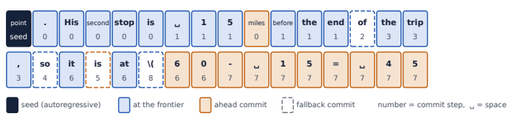
Figure 1 : One real 32-token block (NLD-3B, GSM8K,VANILLA); each box shows a token and its commit step. Blue: commits at the frontier; orange: ahead commits, made while a position to their left was still masked (“miles” at step 0, before “15”); dashed: fallback commits.
Original paper · CC BY 4.0 · Roman Makarov, Zhe Xu, Jian Kang · Fast at the Frontier, Wrong at the Fallback: A Commit-Level Analysis of Threshold Decoding in Diffusion Language Models · Original paper figure · Extracted the figure area from page 2 of the original PDF.In the Figure 2c comparison, FRONTIER-ONLY keeps at least 0.92 times the TPF of VANILLA across 34 settings. Across these settings, the other 32 cases fall between 0.92 and 1.23 times the VANILLA TPF. Ahead commits therefore add almost no speed, even though about half of VANILLA's commits on NLD are ahead commits. The authors read this as evidence that the speed comes from commits at the frontier, so the frontier-only policy keeps it.
Where the model is confident
The authors compare VANILLA with FRONTIER-ONLY to see where the model becomes confident about masked positions. In left-to-right decodes, they logged the first step at which each answer position passed the threshold, along with its distance from the frontier at that step. Distance is defined as d = j − f, where j is the commit position and f is the frontier.
So a wider window mostly adds positions that become confident only later.
The number of committed tokens per step therefore stops growing near the training block, as Figure 2b shows. LLaDA and Fast-dLLM v2 behave the same way, while only NLD-8B and NLD-3B on MATH-500 still gain 10 to 17% tokens per step from B = 32 to 128.
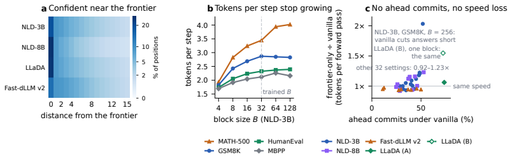
Figure 2 :Most tokens become confident only near the frontier, so wider windows add little speed. (a)How far ahead of the frontier answer positions first pass the threshold in left-to-right decodes (GSM8K; NLD B= 128 , LLaDA B= 256 prompt A, Fast-dLLM v2 B= 128 ), in % of answer positions per distance.(b)Tokens per step by B (NLD-3B,VANILLA, blocks inside the answer).(c)TPF ofFRONTIER-ONLYover TPF ofVANILLAat the same window, againstVANILLA’s ahead share; one marker per model, task and window (34 in all). The two high points are settings whereVANILLAcuts answers short.
Original paper · CC BY 4.0FRONTIER-ONLY makes no ahead commits, yet its TPF is at least 0.92 times that of VANILLA across the 34 settings in Figure 2. Most of the speed therefore comes from commits at the frontier, so ahead commits can be dropped without slowing decoding.
Wider windows also cost compute, because each forward pass processes the whole block. On NLD-3B at batch size 1, this extra compute is nearly free. At batch size 32, B = 128 runs 2.4 to 2.5 times slower than B = 32. Wider windows therefore make each forward pass more expensive while saving few passes, which slows decoding at larger concurrency.
The summary of RQ1 is that faster decoding should come from committing more tokens at the frontier in each step.
Order costs more than parallelism
The authors separate two possible causes: committing several tokens in parallel, and ignoring where those tokens sit. If parallel commits were the problem, committing one token per step would recover the accuracy. On GSM8K, the frontier-only policies beat the confidence-ordered ones on every model by 3 to 46 points. Parallelism costs a few points only on MATH-500, according to the comparison across every task in Appendix C.1.
The worst case is an early end-of-sequence token, which appears when the fallback commits EOS near the end of the block. Most of the block is still masked at that point, so no position passes the threshold. Over the same problems, 85 to 89% are solved when EOS is allowed only at the frontier. In smaller windows, with B≤64, EOS usually marks the right length of the answer.
Table 2 shows that restricting EOS to the frontier removes the order gap on NLD, but not on LLaDA or Fast-dLLM v2. Splitting each wide-window loss into an EOS cost and a content-order cost shows that the two causes mix differently by model. On Fast-dLLM v2, almost all of the loss is content-order cost, while LLaDA has both. The reported LLaDA collapse is mostly an EOS problem: in the CD4LM pipeline, GSM8K accuracy falls from 77.7% with 32-token blocks to 13.2% with one 256-token block.
Allowing EOS only at the frontier restores 64.5%, and committing at the frontier every step gives 79.3%, with the same number of forward passes.
The fixes that work on one model don't automatically carry over, so each fix has to be checked on the others. Table 3 compares frontier policies that allow different ahead commits against VANILLA at the wide window. FRONTIER-FALLBACK, FRONTIER-GATING and ENTROPY-BUDGET recover most of the loss on NLD and LLaDA. FRONTIER-ONLY is the only policy that recovers most of the loss on all four models.
Other frontier policies and how far ahead is safe
Table 3 compares several frontier policies, which differ in which ahead commits they allow. FRONTIER-FALLBACK allows any confident ahead commit, while FRONTIER-GATING allows any commit within 16 positions. ENTROPY-BUDGET allows confident commits that have little entropy to their left. On NLD and LLaDA, all three recover most of the loss, but only FRONTIER-ONLY does so on all four models.
On LLaDA with prompt B, VANILLA scored 35.5, compared to 82.3 for FRONTIER-ONLY.
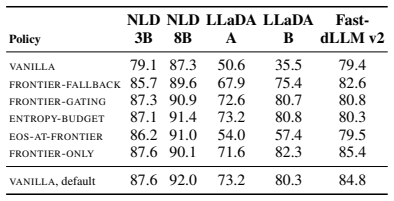
Table 3 :Frontier policies recover most of the loss; onlyFRONTIER-ONLYdoes so on all four models. GSM8K accuracy (%) at the wide window (NLD B= 128; LLaDA B= 256 , prompts A and B; Fast-dLLM v2 B= 128 ). Last row:VANILLAat each model’s default window (NLD and LLaDAB= 32 ; Fast-dLLM v2, 8-token sub-blocks).
Original paper · CC BY 4.0Setting k to 0 gives FRONTIER-ONLY, so the cap is a direct way to test how far ahead commits can go. Caps of k at most 2 keep FRONTIER-ONLY's accuracy in most settings. No cap value raises TPF by more than 18%, so the authors see little reason to commit ahead of the frontier at all. The gain grows with the window size: on GSM8K, VANILLA at each model's default window is within two points of FRONTIER-ONLY at the wide window.
On Fast-dLLM v2, VANILLA already loses 4 points on GSM8K when its window grows from the default 8-token sub-block to the 32-token training block. FRONTIER-ONLY recovers those 4 points, so the loss starts inside the training block as well.
Which commits start the failures
The authors decode each problem twice, once with VANILLA and once left-to-right, and compare the two decodes to find where they split. A harmful departure is a problem that LEFT-TO-RIGHT solves while VANILLA fails, and a helpful departure is the reverse. At wide windows, fallback commits were 11–35% of all commits, yet they started 61–72% of the harmful departures.
Most of these fallback roots lie ahead of the frontier, which means the risky commits are the ones made before the text to their left exists.
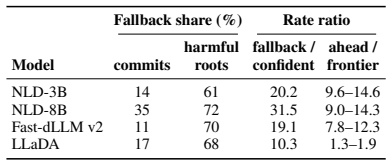
Table 4 :Most harmful departures start at fallback commits.Wide windows (NLD B= 128 , four tasks; Fast-dLLM v2 B= 128 ; LLaDA B= 256 , prompts A and B).Fallback share: of all commits, and of the roots of harmful departures.Rate ratiosper commit: harmful roots at fallback vs confident commits, and departures (harmful and helpful) at distance ≥1 vs 0 at the same confidence (range over distance bins; the reference commits the frontier, which lowers the frontier rate).
Original paper · CC BY 4.0Table 4 gives the fallback share of all commits and of the harmful roots for each model. The fallback share is high among the roots even where it is small among all commits, which is the pattern the authors use to locate the risk. Table 4 also gives the rate ratios: the harmful-root rate at fallback versus confident commits runs from 10.3 to 31.5 across the four models.
Ahead commits have lower confidence than frontier commits, so their risk could come from confidence alone. The authors model the number of departures each commit starts with Poisson regression, using its distance and its confidence.
To test whether the root causes the failure, the authors replay each failing decode with one change at the root's step. The replays covered NLD-3B and Fast-dLLM v2 on GSM8K and MATH-500 at B=128, and NLD-3B on GSM8K at B=256.
Limits of the evidence
The study covers threshold decoding that never revises a commit, so the claims don't extend to policies that revise commits. Policies that revise commits appear only in a side experiment on DiffusionGemma, which is outside the main results. Tasks such as Sudoku, planning and infilling are out of scope, so other orders aren't tested there.
The four main models have at most 8B parameters, and the authors didn't study larger models. The accuracy effects are large mainly for windows wider than the training block, where NLD is trained with B= 32. At the training block, VANILLA loses less accuracy and FRONTIER-ONLY gains less, as shown in Section 5.3. Fast-dLLM v2 is an exception, since its accuracy falls as its window widens even inside its training block.
The root selection uses the outcome, since the authors pick roots after they know whether an answer fails. The Poisson model doesn't account for how hard each problem is. The replays ran only on NLD-3B and Fast-dLLM v2, so the evidence that the root's step causes failure is limited to these two models.
Paper info
- Authors
- Roman Makarov, Zhe Xu, Jian Kang
- Venue
- arXiv · Preprint
- First published
- 2026-11-16
- Added
- 2026-11-17
- Updated
- 2026-11-16
- Version
- v1
- arXiv
- 2611.20693
- Category
- cs.CL · cs.LG
- Original paper terms
- CC BY 4.0
- What we show
- Paper info, commentary and permitted figures from the original paper
AI commentary is a separate explanation from the original paper and may contain errors. The original paper and figures follow each source's terms of use and any rights noted separately.
Abstract
Diffusion language models (DLMs) can write several tokens per forward pass. Open-weight DLMs commit, in any order, every masked position whose confidence passes a threshold. If none does, a fallback commits the most confident one, and the commits are never revised. Wide windows let the decoder commit far ahead of the text, which should speed up decoding but often costs accuracy. It is unclear where the model is confident and which commits cause errors. We trace every commit of four off-the-shelf DLMs on math, code, translation and summarization, and rerun failing answers with one step changed. Most tokens become confident only near the frontier, the leftmost masked position, so committing only there, still several tokens per step, is about as fast as committing anywhere. The accuracy loss comes from committing tokens before the text to their left, and committing one token per step does not reduce it. The worst case is an early end-of-sequence token that cuts the answer short. Fallback commits are 11-35% of commits but start 61-72% of the failures that left-to-right decoding avoids. Changing only the step where such a failure starts repairs it more often than changing a similar earlier step. Committing only at the frontier recovers most of the lost accuracy on all four models. Our code is available at https://github.com/rmakarovv/fast-at-the-frontier.
Quote from the paper
Roman Makarov, Zhe Xu, Jian Kang (2026). Fast at the Frontier, Wrong at the Fallback: A Commit-Level Analysis of Threshold Decoding in Diffusion Language Models. arXiv:2611.20693v1. https://arxiv.org/abs/2611.20693v1
BibTeX
@misc{makarov2026fast,
  title = {{Fast at the Frontier, Wrong at the Fallback: A Commit-Level Analysis of Threshold Decoding in Diffusion Language Models}},
  author = {Roman Makarov and Zhe Xu and Jian Kang},
  year = {2026},
  eprint = {2611.20693},
  archivePrefix = {arXiv},
  url = {https://arxiv.org/abs/2611.20693v1}
}