Paper commentary
Mandarin Wh-Indefinites Follow Nonveridicality in Multilingual LLMs, Unlike English any
Multilingual LLMs license Mandarin wh-indefinites differently from English any
- Problem Multilingual LLMs learn mostly from English, so they may apply English's downward-entailing rule for any to Mandarin too. Mandarin wh-indefinites follow a different nonveridical rule, and the two classes split in ways a single rule cannot capture.
- Method The authors test 48 matched Mandarin and English frames in 21 contexts across twelve open LLMs. They score each sentence by a log-probability difference-in-differences, normalised by the negation effect.
- Results Eleven models that pass the measurement gate license Mandarin shenme under possibility, necessity and evidential adverbs at 0.42 to 2.33 times negation. English any gets nothing in those same contexts.
Why a shared English rule would mislead
Multilingual LLMs absorb most of their knowledge from English, so their internal representations lean on English. Polarity-sensitive indefinites make a sharp test because English any needs a downward-entailing operator. Negation licenses any in Tom didn't buy anything, while a plain past-tense assertion does not license it. The open question is whether a model learns each language's own rule or applies the English rule everywhere.
Mandarin 什么 can mean 'something', but only inside licensing contexts. Those contexts are nonveridical, so they don't entail that the event happened. Negation, questions and conditionals fall into both classes, so the two rules agree there. The two classes split elsewhere in two directions, and that split is where a single rule breaks down.
An epistemic adverb such as perhaps licenses 什么 but not any, because it is nonveridical without being downward-entailing. Only licenses any, yet it entails that Zhang Wei bought something, so the Mandarin form is predicted to be degraded. A model with one English-shaped detector would get the only contrast right and miss the perhaps contrast.
The study tests this split with 48 frames in 21 contexts and matched Mandarin and English versions.
Two predictions and matched items
The authors pick contexts where the two rules predict opposite outcomes, then compare the Mandarin and English sentences inside each context. The zh-advantage prediction covers possibility, necessity and evidential adverbs, which are nonveridical but not DE. Such adverbs should license 什么 but not any, as in 张伟昨天可能买了什么东西 versus *Perhaps Tom bought anything.
The en-advantage prediction covers only, first to and regret, which are Strawson-DE but entail that the event happened. Those contexts should license any but not 什么, because 只有张伟买了 entails that Zhang Wei bought.
Each of the 48 frames has a target, a definite control and an indefinite control. Twenty-four frames take a thing object and 24 frames take a person object. The frames sit in 21 contexts that fall into seven classes, which gives 6,048 sentences per model. Two adverb classes, one veridical and one manner, check whether an extra preverbal adverb alone could produce a ZA effect.
Most contexts close with a shared declarative continuation, because without it the Mandarin sentence can be parsed as a question.
The score is a log-probability difference-in-differences built from the summed log-probability of each whole sentence. The BASE term subtracts the target's baseline cost in the episodic context. Dividing by the negation DiD gives L, so an L of 1 means as licensed as under negation. Uncertainty comes from a frame bootstrap stratified by object family, with 10,000 resamples and seed 0.
From log-probabilities to a normalised score
The score starts from the summed log-probability LP of each whole sentence, computed with the model's BOS token in bf16. The authors score plain text, so no chat template is applied to the sentences. The licensing effect is a difference-in-differences: the target minus the definite control C1 in a context, minus the same gap in the BASE context.
The BASE term then removes the target's baseline cost, so only the context's added effect remains.
Each context's DiD is divided by the negation DiD, so L(c) equals DiD(c) divided by DiD(NEG). An L of 1 means a context is as licensed as negation, which gives the scale a fixed reference point. The cross-language contrast Δ(c) is the Mandarin L minus the English L for the same context. The authors call L a relative effect and say it doesn't separate grammatical from ungrammatical sentences by itself.
Uncertainty comes from a frame bootstrap stratified by object family, with 10,000 resamples and seed 0. Each bootstrap resample recomputes the denominator, so the uncertainty in negation carries into every L value.
A model enters the analysis only after it passes the measurement gate, which asks NEG and QYN to have positive DiD in both languages. That gate also needs a CI that excludes 0 and at least 70% of frames positive. Qwen3-8B fails the gate, with a Mandarin negation DiD of 0.47 and a 95% CI of [−0.14, 1.07]. Because L divides by the negation cell, the authors treat Qwen3-8B's Lzh values as uninterpretable and report them without counting the model.
The zh side holds when ZA passes in at least 2 of the 3 classes, with Δ above 0 and at least 60% of frames positive. H1 sets the bar at 75% of gated models for the zh side, and H2 sets 50% for the en side. The protocol and criteria were committed before any main-study output existed.
Sentence-probability results for Mandarin and English any
Eleven of the twelve models pass the measurement gate, and Qwen3-8B is the one that fails. Its Mandarin negation DiD is only 0.47, with a 95% CI of [−0.14, 1.07], so its Lzh values can't be interpreted. The authors report it in Table 1 but don't count it toward the criteria. All 11 gated models show the Mandarin side, and each one passes all three ZA classes.
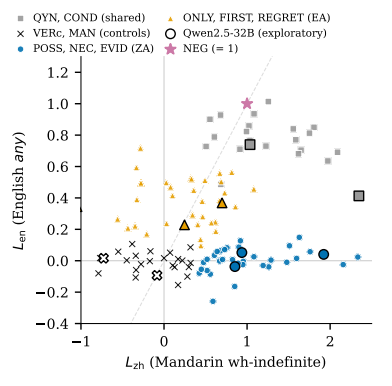
Figure 1 : Licensing strength in Mandarin (Lzh) against English (Len), one point per gated model and context class. Negation is 1 on both axes by definition; the dashed line is Lzh =L en. Nonveridical, non-DE ad- verbs (ZA, blue) license Mandarin wh-indefinites but not Englishany. DE, existence-entailing contexts (EA, orange) licenseanyweakly, and Mandarin 什么 in some models. Black outlines mark the exploratory Qwen2.5- 32B-Instruct, which falls in the same regions.
Original paper · CC BY 4.0 · Guofang Tang · Mandarin Wh-Indefinites Follow Nonveridicality in Multilingual LLMs, Unlike English any · Original paper figure · Extracted the figure area from page 3 of the original PDF.Across the 11 gated models, Mandarin licensing under the ZA classes ranges from 0.42 to 2.33 times negation. English any in the same contexts ranges from −0.26 to 0.15, so perhaps, surely and apparently do nothing for any. Figure 1 places each model and class on these two axes, with negation fixed at 1 on both. The EA points sit where English any is weakly licensed.
Some of the EA points also carry Mandarin licensing.
The exploratory Qwen2.5-32B-Instruct model passes the gate. Its three ZA classes are licensed at 0.85 to 1.92 times negation, while English any gets at most 0.05 there. Only 1 of the three EA classes holds, so the English side doesn't improve with scale. The mean English licensing under EA is 0.31, inside the 0.28 to 0.45 range of the 0.5B to 7B Qwen2.5 models.
Only 3 of the 11 models meet the en-side criterion, below the pre-registered 50% target. English any isn't unlicensed, though: it is above zero under only in 10 of 11 models. Under first to and regret, English any is above zero in 11 of 11 models each. Those values reach only 0.10 to 0.72 of negation. Many models also give Mandarin 什么 partial credit in these same contexts.
Do the items read as the theory expects?
The screener accepted almost every sentence, including the EA contexts, and flagged no frame as unnatural. The screener then judged the 11 sentences that all three LLM raters scored 2 or lower, accepting 8 of them once a discourse context was supplied. For example, 昨天只有张伟见了谁 became acceptable when the context made 谁 pick out a particular person.
The other 3 sentences, such as 已经见了谁, stayed degraded, so the Mandarin prediction in those EA contexts depends on context.
Three LLM raters from different developers scored all 2,016 target sentences and all 2,016 C1 controls at temperature 0. Per-sentence agreement is 0.44 to 0.53 for Mandarin. Per-sentence agreement is higher for English, at 0.72 to 0.85. Averaged over raters, Mandarin targets under POSS, NEC and EVID score close to the shared licensers. English any in those contexts scores near the floor, at 1.4 on the 1 to 5 scale at BASE, while under ONLY, FIRST and REGRET it scores 4.1, 4.0 and 3.9.
Across the 20 non-baseline contexts, mean ratings track the gated models' mean L with Spearman rho of 0.80 for Mandarin and 0.72 for English. A rating DiD built like the model DiD gives rho of 0.80 and 0.67. The raters score English any under ONLY, FIRST and REGRET nearly as well as under negation. The models license that same any at only 0.10 to 0.72 of negation, so the English shortfall comes from the models rather than the items.
The EA-side predictions are graded, because relative licensing doesn't separate grammatical from ungrammatical sentences.
Forced choice shows the English side of the dissociation
Only the eight models that pass the negation gate in both languages are scored in this protocol. Here the English side appears, even though it was weak in sentence probabilities.
For the English side, the advantage under only, first and regret has a CI below zero in 8, 7 and 6 models. So the forced choice recovers the full double dissociation that the log-probability measure showed only weakly on the English side.
The prompted L values track the log-probability L values, with rho between 0.58 and 0.92. That correlation suggests the two measures pick up related preferences in the same models. The authors stress that these are prompted preferences, not human judgements.
The exploratory Qwen2.5-32B model also shows the full double dissociation in forced choice. Because the 32B model is exploratory, this result sits outside the pre-registered model list.
Does the English direction reach Mandarin?
\[ d_g(\ell) = h_\ell[\mathrm{LIC}] - h_\ell[\mathrm{UNL}] \] LIC is NEG, QYN and COND, and UNL is BASE, VERc and MAN, paired over the same 48 frames, so the held-out ZA and EA classes never enter the direction. Ablation projects each layer's unit direction out of that layer's block output, at every position and every layer. \[ R(k) = 1 - \frac{\mathrm{DiD}_{abl}(k)}{\mathrm{DiD}(k)} \] The removal share measures how much of a class's DiD the projection takes away, so it doesn't mean the underlying entity is deleted.
Ablating the English direction removes English negation licensing beyond random in all 11 models, with R from 0.21 to 0.76. It also removes the held-out EA licensing in 8 models, so the direction captures classes it was not built from. The same direction removes Mandarin negation licensing beyond random in only 4 models under the continuation measure.
Under the pre-registered categories, 7 of 11 models read neither, with 1 shared, 2 separate and 1 partial.
Those 7 are all the Llama, GLM and Yi models plus Qwen2.5-0.5B. In Qwen2.5-1.5B to 7B the Mandarin direction removes neither, so a null result for the English direction says nothing about sharing in those models. Among the 7 models where the Mandarin direction works, only Llama-3.1-8B-Inst is shared. The authors conclude that the English direction reliably affects English licensing but doesn't reliably reach Mandarin, and a non-linear shared representation remains possible.
Adding the direction to baseline sentences at the middle layer raises English any above random for uen in 10 models, and for uzh in 9. Mandarin 什么 rarely rises above random, with 1 model for uzh and 3 for uen, so the addition test is uninformative for Mandarin. The protocol first scored only the object word, but that object-only measure tracked the behavioural DiD only at rho 0.57 to 0.89 for Mandarin.
After inspecting that first model, the authors added the continuation to the scored tokens and reran every model. Because the continuation measure scores the same tokens as the behavioural DiD, its agreement at rho of at least 0.90 checks alignment rather than replicating the result.
What these results do not establish
The licensing score is relative, so it can't tell grammatical from ungrammatical sentences. It compares a target with a definite control and scales the result by negation. The only human check was a screening by one native speaker, who is also an author.
The first measure scored only the object word, so it missed most of the Mandarin effect. Across models, that measure tracked the behavioural DiD for Mandarin only at 0.57 to 0.89. The continuation measure came after the first model was inspected, so it is the post-hoc one. Its agreement with the behavioural DiD, at 0.90 or above, confirms alignment rather than replicating the result.
Qwen3-8B fails the gate since its Mandarin negation cell breaks down. The authors report it rather than adjust the gate.
The study uses 48 templated frames with one continuation, so the results cover a narrow construction. Naturalistic sentences, other wh-words and embedded clauses have not been tested. The pre-registered models go up to 9B, and one exploratory 32B model extends that range.
Directional ablation relies on linear difference-of-means directions taken at a single position. For Qwen2.5-1.5B through 7B, the Mandarin direction shows no detectable effect on Mandarin licensing. Those models can't say much about sharing, so a null result doesn't rule out a shared representation.
Paper info
- Authors
- Guofang Tang
- Venue
- arXiv · Preprint
- First published
- 2026-11-15
- Added
- 2026-11-17
- Updated
- 2026-11-15
- Version
- v1
- arXiv
- 2611.20062
- Category
- cs.CL
- Original paper terms
- CC BY 4.0
- What we show
- Paper info, commentary and permitted figures from the original paper
AI commentary is a separate explanation from the original paper and may contain errors. The original paper and figures follow each source's terms of use and any rights noted separately.
Abstract
Multilingual LLMs learn mostly from English. Do they carry English polarity licensing over to other languages? English any is licensed by downward-entailing (DE) contexts, Mandarin wh-indefinites such as shenme 'what/something' by nonveridical ones, and the two classes come apart: perhaps licenses shenme but not any, while only licenses any but entails existence. We test this dissociation in a pre-registered study of twelve open LLMs (0.5B-9B, four families), using 48 matched bilingual frames in 21 contexts and a log-probability difference-in-differences normalised by negation. All 11 models that pass the measurement gate license Mandarin wh-indefinites under possibility, necessity and evidential adverbs, at 0.42-2.33 times the strength of negation, while English any gets nothing in the same contexts. An exploratory extension to Qwen2.5-32B shows the same. The English side is weaker: any under only, first and regret is licensed but at a fraction of negation, so only 3 models show the full double dissociation in sentence probabilities. When prompted to choose between sentences, most gated models show it. In exploratory directional ablations, a direction that carries English licensing, held-out classes included, does not reach Mandarin licensing in most models. The models do not simply apply the English rule to Mandarin.
Quote from the paper
Guofang Tang (2026). Mandarin Wh-Indefinites Follow Nonveridicality in Multilingual LLMs, Unlike English any. arXiv:2611.20062v1. https://arxiv.org/abs/2611.20062v1
BibTeX
@misc{tang2026mandarin,
  title = {{Mandarin Wh-Indefinites Follow Nonveridicality in Multilingual LLMs, Unlike English any}},
  author = {Guofang Tang},
  year = {2026},
  eprint = {2611.20062},
  archivePrefix = {arXiv},
  url = {https://arxiv.org/abs/2611.20062v1}
}