Paper commentary
On Representational and Functional Alignment of Training Data Attribution Methods for Language Models
Attribution methods agree within paradigms, not across
- Problem Earlier comparisons of training data attribution methods relied on downstream scores or one global rank correlation. Those checks miss whether two methods rank the same local pairs of documents alike.
- Method The authors compare attribution methods along three dimensions: representational alignment, functional alignment of full score vectors, and cross-method predictability of pairwise rankings.
- Results Methods within one paradigm share representational structure, while cross-paradigm alignment stays low and depends on the task.
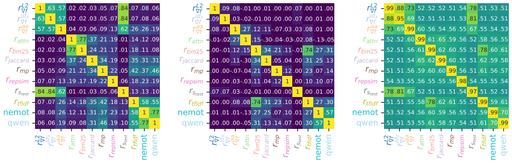
Figure 3 :Pairwise alignment.Left: representational alignment (CKA ∈[0,1] ), center: functional alignment (Spearman’s ρ∈[−1,1] ), and right: cross-method predictability (acc ∈[0,1] ) averaged across tasks and models. Higher values suggest better alignment. For CKNNA@25, RBO, and Kendall’sτ, see Appendix B.
Original paper · CC BY 4.0 · Loris Schoenegger, Benjamin Roth · On Representational and Functional Alignment of Training Data Attribution Methods for Language Models · Original paper figure · Extracted the figure area from page 7 of the original PDF.Why one-number comparisons fall short
Training data attribution methods score each training document by how much it contributed to a generation. They differ in the signal they read, such as loss gradients, model-internal states, or only lexical overlap. These signals rest on different rationales, so a gradient method estimates a first-order effect. A representation-based method instead asks whether an example is close to the test prediction in some feature space.
Earlier comparisons mostly relied on downstream task performance or on one rank correlation between two full rankings of the training set. Downstream scores show whether two methods perform alike on average, but they don't show whether the methods treat the same examples alike. A global correlation can also miss what matters for data selection, where only the relative judgement between two examples counts.
Existing studies don't separate representational structure from downstream ranking decisions. Without that separation, it is hard to tell whether two methods differ in what they encode or in how they rank. The authors therefore decompose alignment into functional, representational, and cross-method predictability dimensions.
Three lenses on alignment
The framework compares two attribution methods at three levels: their underlying representations, their full score vectors, and their pairwise relevance decisions. The authors stress that these three views are complementary, and they don't necessarily covary. Functional alignment asks whether two full attribution vectors correlate, which is the global view used in earlier comparisons.
Cross-method predictability instead asks whether two methods agree on local pairwise relevance judgments, rather than on the ranking of the whole training set.
Representational alignment starts from a map r that sends each training document to a vector, following Huh et al. (2024). Centered Kernel Alignment compares the similarity structures of two representations through the Frobenius norm of their cross-kernel, normalized by each representation's self-kernel. Because CKA compares the full kernels, it yields a global measure of representational alignment.
Centered Kernel Nearest-Neighbor Alignment, CKNN, applies the same comparison but restricts it to nearest neighbours, which makes it a local measure.
Functional alignment averages agreement between two attribution methods across test instances, computed per test instance over the full training data. Spearman's ρ and Kendall's τ measure rank correlation between the two pointwise relevance score vectors. Rank-biased overlap, RBO, prioritizes agreement at the top of the ranked lists, so it weights the highest-ranked training documents most.
Cross-method predictability is reported as accuracy between 0 and 1, so higher values mean better alignment. The paper's heatmaps show representational alignment, functional alignment, and cross-method predictability side by side for each pair of methods. The average cophenetic stability for cross-method predictability, accpred, is 0.79.
Twelve methods, four paradigms and seven models
The study covers 12 attribution methods across four paradigms, 5 tasks and 7 LoRA-finetuned models from three model families. The gradient-based group contains raw gradients, L2-normalized gradients and Adam-adjusted gradients, plus the Hessian-adjusted gradients. The model-internal group uses the last-token hidden state from rrepsim, mean-pooled hidden states from rmp, and a summary of normalized attention maps from rattn.
The embedding group uses Qwen3-Embedding-8B and llama-embed-nemotron-8b, while the lexical group uses BM25, Jaccard and TF-IDF vectors.
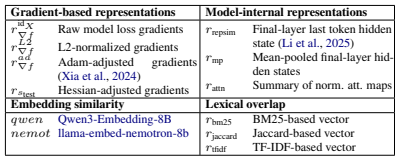
Table 1 : Summary of attribution methods studied.
Original paper · CC BY 4.0The seven base models span parameter sizes from 0.6B to 8B across three model families. The authors restrict the analysis to models of at most 8B parameters, because gradient-based influence estimates are expensive to obtain and analyze. Following prior work, they consider only LoRA-fine-tuned models, which keeps the gradient-based attribution affordable.
Attribution targets only a subset of model parameters here, so alignment patterns may differ when other parameters are targeted.
The 12 methods are the core of the study, and the authors treat them as a cross-section of the current literature. Prior comparisons mostly covered one paradigm at a time, such as different implementations of the same paradigm. The work of Pezeshkpour et al. (2021) is closest in scope, comparing embedding similarity with four gradient-based methods using BERT models.
The authors then ask whether the alignment findings depend on the tasks and base models used. Within-paradigm methods show high representational but moderate functional alignment.
Alignment within and across paradigms
Methods group by paradigm, and the within-paradigm blocks stand out in the heatmaps. The block structure is strongest for representational alignment and cross-method predictability, both among gradient methods and among embedding methods. Functional alignment shows the same block pattern only for the embedding methods. So methods in one paradigm tend to share representation structure, while their full rankings are only moderately aligned.
The gradient group contains raw, L2-normalized and Adam-adjusted gradients, plus the Hessian-adjusted gradients, while the model-internal group uses hidden-state and attention summaries. The clusters in Figure 2 separate gradient-based, embedding-based, and lexical similarity methods in the dendrograms. One exception is BM25 paired with the attention-based method, which shows relatively high representational alignment.
That pair still has weak functional alignment and low cross-method predictability, so shared structure doesn't carry over to rankings. Across paradigms, correlation between gradient and embedding methods is negligible.
The rank correlations are considerably lower than those Pezeshkpour et al. (2021) report for BERT models. The authors' results still broadly agree with theirs on which strategy pairs align. Gradient and Hessian-based methods show greater functional alignment than cross-paradigm pairings. On the SFT task, alignment between raa∇f and rstest is 11-20 pt lower (0.56) than on other tasks.
Cross-paradigm alignment, by contrast, appears largely invariant to the task.
How stable the clusters and metric agreements are
Cophenetic stability measures how well a dendrogram keeps its structure when conditions change. Averaged across metrics, the stability is 0.80 for CKA, 0.75 for CKNNA@25, 0.71 for ρ, 0.75 for τ, 0.72 for RBO and 0.79 for accpred. Stability across base models and across datasets also stays above 0.7. The authors conclude that dendrogram structure is largely preserved across these conditions.
Metrics that target the same quantity agree closely, with about 0.70 between CKA and CKNNA@25. Functional alignment measures agree moderately with each other, at 0.57 to 0.61 among τ, RBO and ρ. Metrics that target different quantities agree much less, at about 0.02 to 0.30 between CKA and ρ. This low agreement supports treating cross-method predictability as a distinct notion of alignment from functional alignment.
The clusterings and metric agreements don't shift much when the base model or dataset changes. Different choices produce statistically significant effects in likelihood-ratio tests, but the practical effect sizes are minor. Removing the dataset factor gives the largest drop in explained variance across metrics, except CKA. The base model choice has a stronger effect only on global representational alignment, CKA, and not on CKNNA@25.
Which settings change the alignment patterns
The authors ask whether base model and dataset choice change the alignment patterns between attribution methods. Different base model and dataset choices produce statistically significant effects in likelihood-ratio tests. The practical effect sizes are small, with the ΔR² values given in Table 6 of Appendix C. The authors read these minor effect sizes as evidence that the alignment properties between paradigms are fundamental rather than artifacts of one setup.
Removing the dataset factor lowers explained variance the most across metrics, except for CKA. The base model choice has a stronger effect only on global representational alignment, measured by CKA. The base model doesn't show the same effect on the local counterpart, CKNNA@25.
So the authors read the cross-paradigm patterns as properties of the methods rather than artifacts of one experimental setup. The next question asks what drives agreement at the instance level, which the authors examine qualitatively. For each pairing of representations, such as ridX∇f and rbm25, they analyze one test instance with minimal overlap and one with maximal overlap.
Their comparisons cover prompt and completion format, keyword overlap, and shared topics or themes.
What drives agreement at the instance level
The authors compare local neighbourhoods by hand for each pair of representations, looking at one test instance with minimal overlap and one with maximal overlap. For the pairing ridX∇f versus rbm25, the instance-level check follows the same protocol as for every other pair. The full annotations sit in Appendix F, so the main text only summarizes the findings.
Gradient- and embedding-based neighbourhoods often hold instances with similar structures or completion behaviors, even with limited keyword overlap.
Repeated instruction specifications and persona-prompting templates add shared structure and lexical overlap across all datasets. BM25 neighbourhoods look frequently driven by these artifacts, so lexical agreement often reflects template wording rather than task content. Representation-based methods instead seem to pick up task-relevant similarities from an instruction-tuning perspective.
Test instances targeting abilities outside task solving, such as safety refusals, are a case the paper's excerpt leaves unfinished. The authors therefore describe lexical methods as capturing surface-level prompting artifacts, and representation-based methods as capturing behavioral patterns. Because learning behavior rather than memorization is the goal of instruction tuning, the authors suggest that lexical overlap alone may be a weak basis for attribution.
Reading the Hessian-adjusted rstest result
The Hessian-adjusted rstest shows negligible functional alignment with gradient-similarity methods, yet it doesn't look like an outlier on the other two axes. Here the authors measure high representational alignment and high cross-method predictability between rstest and gradient-similarity methods. Decomposing alignment into the three dimensions offers a way to reconcile these numbers.
High representational alignment suggests that the reweighting in rstest, given as Equation 8, doesn't fundamentally alter the representation structure.
The reweighting does systematically change score assignment, so the rankings over the full training set move. Yet it keeps information about pairwise relevance, which the high cross-method predictability reflects. The method can therefore reorder whole rankings while still agreeing with gradient-similarity methods on which of two examples matters more.
Their representational alignment results and qualitative analysis show that alignment depends on capturing the same task-specific features.
This points to a broader lesson about rank correlation as a yardstick. Methods can show low correlation across the full dataset yet strong pairwise agreement on example relevance. Relying only on rank-correlation analyses can wrongly disqualify prospective methods, and the three-part framework gives more nuanced insight.
The same split may explain why prior studies disagree, since some report low cross-paradigm correlation while others see similar downstream performance. The authors suggest checking whether cross-method predictability scores predict performance on individual tasks. They didn't run that downstream test in this work.
Limitations of the alignment study
The experiments only cover text generation tasks, so the alignment findings may not carry over to other task formats. The authors expect alignment between specific paradigms may differ for simpler classification setups. Their framework is compatible with other task definitions and with models outside NLP contexts. They intentionally skip downstream performance evaluation, so the study tests alignment directly instead of judging method quality.
Their focus was complementary perspectives on alignment, not failure modes of individual tasks or replications of prior downstream evaluations.
The analysis is restricted to base models with a maximum of 8B parameters, because gradient-based influence estimates are computationally expensive. Only LoRA-fine-tuned models are considered, in line with prior work, because gradient-based attribution is costly. The 12 methods across four paradigms are described as a cross-section of the current literature, not as an exhaustive set.
The authors' analysis mainly yields recommendations on evaluation practices, not quality rankings of individual attribution methods. The instance-level explanation rests on a manual comparison of one minimal and one maximal test instance per pair of representations. Those qualitative findings describe local neighborhoods, so they don't establish general causes of cross-paradigm alignment.
Paper info
- Authors
- Loris Schoenegger, Benjamin Roth
- Venue
- arXiv · Preprint
- First published
- 2026-11-14
- Added
- 2026-11-17
- Updated
- 2026-11-14
- Version
- v1
- arXiv
- 2611.19286
- Category
- cs.CL
- Original paper terms
- CC BY 4.0
- What we show
- Paper info, commentary and permitted figures from the original paper
AI commentary is a separate explanation from the original paper and may contain errors. The original paper and figures follow each source's terms of use and any rights noted separately.
Abstract
Existing approaches to training data attribution derive influence estimates from different sources of information, including gradients, model-internal states, and surface-level similarity. However, comparisons between attribution methods remain incomplete, often relying on indirect evaluations through downstream task performance. In this work, we introduce a framework for directly comparing methods along three dimensions: functional alignment, which measures correlation between full attribution vectors; representational alignment, which captures structural similarity of the representations underlying attribution; and cross-method predictability, which evaluates agreement on local pairwise ranking decisions. We observe strong representational and moderate functional alignment within paradigms. Alignment across paradigms is low and task-dependent, yet stable across models. Our results suggest that the similar downstream performance observed across paradigms in prior work can be attributed to agreement on the relative importance of documents, rather than to agreement on rankings of the full training data.
Quote from the paper
Loris Schoenegger, Benjamin Roth (2026). On Representational and Functional Alignment of Training Data Attribution Methods for Language Models. arXiv:2611.19286v1. https://arxiv.org/abs/2611.19286v1
BibTeX
@misc{schoenegger2026representational,
  title = {{On Representational and Functional Alignment of Training Data Attribution Methods for Language Models}},
  author = {Loris Schoenegger and Benjamin Roth},
  year = {2026},
  eprint = {2611.19286},
  archivePrefix = {arXiv},
  url = {https://arxiv.org/abs/2611.19286v1}
}