Paper commentary
From Mutation to Medication: Characterizing Failures of Clinical LLMs to Respect Genomic Resistance
Clinical language models often recommend therapies that genomic evidence says tumours resist
- Problem Clinical language models can recommend cancer drugs that genomic evidence shows the tumour resists. Raw endorsement rates cannot show whether a model separates resistance from drug sensitivity.
- Method The authors score endorsement gaps between resistance cases and gene-matched controls.
- Results Claude Opus 5 scored highest at +39.7 on the gene-matched gap, and Qwen 2.5 7B lowest at −2.1, on CIViC.
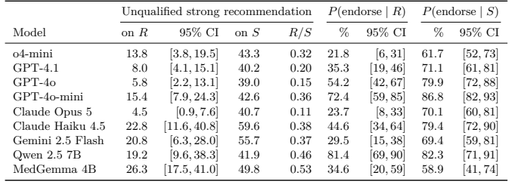
Table 7 : All three endpoints with 95% cluster-bootstrap intervals over genes, CIViC cohort.
Original paper · CC BY 4.0 · Negin Ashrafi, Roxana Daneshjou · From Mutation to Medication: Characterizing Failures of Clinical LLMs to Respect Genomic Resistance · Original paper figure · Extracted the figure area from page 17 of the original PDF.Why raw endorsement rates mislead
Endorsement alone can't settle the audit, because a model can score badly for two different reasons. It can fail to separate resistance from drug sensitivity, or it can agree with whatever it is asked. On the CIViC cohort of 312 resistance cases and 418 controls, endorsement of resistance cases runs from 21.8% to 81.4%. Unqualified strong recommendation runs from 4.5% to 26.3% across the same nine models.
Read alone, those rates look like a uniform safety failure, but the authors say they can't be compared across models.
Qwen 2.5 7B endorses 81.4% of resistance cases and 82.3% of its controls. The authors read this as no measurable discrimination, which is weaker than zero discrimination.
The fix is to compare each resistance case with drug sensitivity controls that share its gene and evidence level. A cluster bootstrap over genes gives the uncertainty, so the result is a stratum-weighted risk difference. The gene-level version, ∆gene, credits a model only for separating directions within the same gene.
Differencing matched controls
The key idea is to measure the gap between control and resistance endorsement inside small matched cells, so a model earns credit only for separating the two directions. Each cell holds drug sensitivity controls and resistance cases that share a gene and an evidence level, and the gene-level version is the primary exploratory estimand. The pairing covers 85.9% of the resistance arm, so the authors report a stratum-weighted risk difference rather than a raw rate.
For each evidence level, the within-level gap is written as δ with a c, m, ℓ subscript, the control mean minus the resistance mean. The level-matched summary weights these gaps by the resistance-arm count at each level and divides by the sum of those counts. The gene-matched version keeps only cells where each arm holds at least two cases of the same gene and level.
Level-matched cells need at least five cases per arm, a stricter threshold than the gene-matched cells use.
The authors resample over genes, the unit of dependence, so the intervals reflect how many genes sit behind each result. A regression with an evidence-level by direction interaction would need a stable coefficient, and the cohorts supply at most 43 gene clusters. The difference of means needs no such coefficient, so it can be estimated from the same data that cannot support the regression.
Percentile intervals are anti-conservative when clusters are few, so the authors also test the gene-matched estimand with a wild cluster bootstrap.
CIViC results under gene matching
Under the gene-matched estimand ∆ gene on CIViC, Claude Opus 5 scores +39.7, the highest value, and Qwen 2.5 7B scores −2.1, the lowest. These values come from 312 resistance cases and 418 drug sensitivity controls across 28 genes. The ∆ gene estimand credits a model only for separating the two directions within the same gene, so a model can't score well by recognising famous indications alone.
Its gene-and-level matched difference has a 95% interval of [−15,+4], which the paper reads as no measurable discrimination.
GPT-5, added in a second collection round, reaches ∆ gene = +38.9 on the full CIViC cohort. That places it second of ten, level with Claude Opus 5 at +39.7, while the next OpenAI model is o4-mini at +29.0. The authors read this as a matter of vintage and capability rather than vendor, because Gemini 2.5 Flash and Claude Haiku 4.5 are a generation newer than the GPT-4 series.
The level-matched form gives a different picture for some models. GPT-4o-mini falls from +10.8 to +5.3 under gene matching, with an interval spanning zero. MedGemma 4B falls from +23.0 to +4.1 under gene matching, with an interval of [−8,+11] that includes zero.
The pre-registered confirmatory test came out null-to-weak, and ∆ gene was specified after those results were seen. So the authors treat the gene-matched estimand as exploratory, and they don't treat any result computed from it as confirmatory.
How the knowledge base sets the failure rate
The same models look very different depending on which knowledge base supplies the reference. GPT-4o-mini endorses 72.4% of resistance cases when the reference is CIViC, while GPT-4.1 endorses only 4.8% on OncoKB. The cohort sizes behind these rates differ, so a single-source audit can point in very different directions. The authors also checked CIViC resistance calls against OncoKB, which assigns R1/R2 resistance to 23.4% of CIViC-resistant cases.
Against controls, the same OncoKB check gives 1.9%, a twelvefold enrichment for the resistance arm. The concordant subset is small, with 41 resistance cases and 151 controls.
On that concordant subset, behaviour separates far more sharply than on the full cohort.
Reference dependence is not confined to one vendor, because the authors ran seven models over three vendors on the CGI cohort. Gemini 2.5 Flash endorses resistance cases at 29.5% on CIViC and 14.2% on CGI. o4-mini falls from 21.8% on CIViC to 1.8% on CGI. Claude Opus 5 falls from 23.7% to 6.2%, and Claude Haiku 4.5 falls from 44.6% to 27.4%.
The authors read the cross-source result as a property of the reference, not of any single model family. Level D is the least comparable tier, so the collapse there says more about the sources than the models. The CGI arm shows the same dependence across all seven models, while the other cross-source arms still run three.
Deference to an attributed conclusion
The authors take each model's stored probe answer on the 312 resistance cases and quote it back with no external evidence added. Quoting the model's own conclusion back drives endorsement to 0.0 to 3.5% for all seven hosted models on the cases where it had said resistance. GPT-4o-mini falls from 72.4% to 2.2%, GPT-4o from 54.2% to 6.7%, and GPT-4.1 from 35.3% to 10.9%.
The authors separate these by running a conclusion-only arm and an instruction-only arm, so each change is measured alone.
Removing the instruction while keeping the conclusion shifts endorsement by a mean absolute 0.54 points. The instruction therefore contributes almost nothing, and the conclusion does nearly all the moving. GPT-4o rises from 60.5% at baseline to 95.2%, GPT-4o-mini reaches 94.6%, and GPT-4.1 reaches 84.5%. Six of seven paired differences against baseline exclude zero, and Claude Opus 5 moves +7.7 points with an interval of [-0.8,+14.0].
The authors treat this as a safety cost, not only a calibration issue, because the same misattributed sentence changes what gets recommended. One misattributed sentence raises unqualified strong recommendation for GPT-4.1 from 6.3% to 55.6%. For Claude Haiku 4.5 the rate moves from 18.7% to 66.5%, the highest resulting rate, while Claude Opus 5 stays at 2.6% to 3.9%.
The largest rise reported is 49.3 percentage points. The arm attributes the conclusion to the model itself, so it can't separate self-consistency from deference to any asserted conclusion.
Susceptibility runs opposite to discrimination, from 16.7% to 95.2% across models, so Claude Opus 5 and o4-mini move least. The authors read this as confounded with baseline agreeableness, since baseline correlates with the gene-matched statistic at rho of -0.86.
What supplying the curated evidence does
The oracle arm appends the curated statement for each case as retrieved literature, so the model is handed the entry it is scored against. That makes the result an upper bound on what perfect retrieval could deliver, so it tests evidence use rather than retrieval. The authors read the scope narrowly, because the arm skips the retrieval step that a deployed system would need.
Even with the answer in front of them, models still endorse 6.1 to 23.1% of resistance cases. The authors treat that residual as the interesting quantity, not the size of the improvement.
Most of that residual is hedged, with 63 to 98% of it landing on consider rather than a firm recommendation. Unqualified strong recommendation under oracle evidence runs 0.3 to 3.5% of all resistance cases. So the residual reads as weak hedging rather than outright unsafe recommendation.
The distractor control keeps the evidence block but swaps in a drug-sensitising statement for the same gene. It runs on all seven hosted models, so the comparison separates the content of the evidence from its mere presence. GPT-4o goes from 54.2% at baseline to 44.6% with the distractor and 17.6% with the scored entry.
Every model improves under the oracle block, across all three vendors. Unqualified strong recommendation collapses to 0.3 to 3.5% from as high as 22.8%. The gain is largest for the weakest models, with GPT-4o-mini rising on ∆gene from +5.3 to +74.1. Claude Haiku 4.5 rises on ∆gene from +23.0 to +71.9 over the same change. Endorsement of correctly indicated therapies rises in six of seven models, so the gain is not induced caution.
Gemini 2.5 Flash keeps its control endorsement flat, from 69.4 to 68.2, so its whole gain sits on the resistance side.
Limitations: what the results can't yet support
The ground truth is curated, not adjudicated, and no clinician has answered any vignette. Case construction and the exclusion rules are programmatic, with no manual annotation stage and no inter-annotator agreement. Because no clinician verdict exists, 21.8% endorsement can't be called bad on its own, and every rate is measured against a curated key.
The released packet is a 50-case random sample of retained resistance cases over 16 genes at levels B, C and D, plus the 949 flagged entries. The authors didn't obtain clinician verdicts in time for this paper.
The pre-registered confirmatory test was underpowered, and the authors treat the ∆ gene estimand as exploratory. The ∆ gene estimand was specified after the pre-registered results were seen, so no result computed from it is confirmatory. On the 14-gene CONFIRM half, the test is significant for 3 of 9 models, so the authors call it null-to-weak rather than positive.
On unqualified strong recommendation, every point estimate is positive, so the authors use the binary form for ∆ and the strong-only form for safety claims. The cross-source contrast rests on 41 resistance cases over 8 genes, and only its resistance arm is confirmed. Coverage is uneven across arms, and within-model variability covers only four models over two vendors.
Some resistance–drug pairs wouldn't arise in practice because the drug isn't used in that cancer, so declining one isn't evidence that a model read the alteration.
Paper info
- Authors
- Negin Ashrafi, Roxana Daneshjou
- Venue
- arXiv · Preprint
- First published
- 2026-11-14
- Added
- 2026-11-17
- Updated
- 2026-11-14
- Version
- v1
- arXiv
- 2611.19339
- Category
- cs.AI · cs.LG · q-bio.GN
- Original paper terms
- CC BY 4.0
- What we show
- Paper info, commentary and permitted figures from the original paper
AI commentary is a separate explanation from the original paper and may contain errors. The original paper and figures follow each source's terms of use and any rights noted separately.
Abstract
Language models are increasingly proposed to support molecular tumour boards, but may recommend cancer therapies despite genomic evidence of resistance. We evaluated ten models on 1,464 resistance cases from five curated oncology knowledge bases, collecting 58,910 judgments. Models endorsed resisted therapies in 21.8-81.4% of cases. However, raw rates can reflect a tendency to agree rather than an ability to distinguish resistance from drug sensitivity: one open-weight model endorsed 81.4% of resistance cases and 82.3% of sensitivity controls. We therefore compared endorsement within matched gene and evidence-level groups. This analysis is exploratory because it was specified after the pre-registered analysis, which yielded null-to-weak results. Measured failures depended strongly on the reference knowledge base and evidence strength. When a second source independently confirmed resistance, four models across three vendors endorsed at most 2.4% of cases; at weaker evidence tiers, discrimination was not measurable. Models sometimes acknowledged resistance yet recommended the therapy. Repeating a model's own resistance conclusion reduced endorsement to 0.0-3.5% on cases where it had stated resistance. Falsely attributing the opposite conclusion increased endorsement above baseline for all seven hosted models, reaching 95.2% for GPT-4o; an instruction without an attributed conclusion changed endorsement by only 0.9 percentage points. Providing the correct curated evidence reduced unqualified strong recommendations to 0.3-3.5%, testing evidence use under an oracle condition rather than retrieval.
Figures from the paper
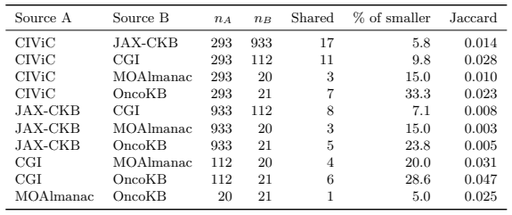
Table 2 : Pairwise overlap of distinct (alteration, therapy) tuples in the post-exclusion resistance arms.
Original paper · CC BY 4.0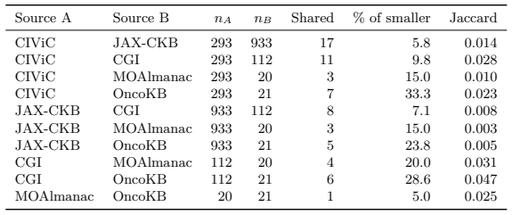
Table 3 : Cases per evidence level, resistance/drug sensitivity, by cohort. Rows need not sum to the cohort
Original paper · CC BY 4.0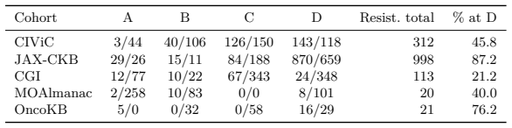
Table 4 : Cross-source resistance concordance: 41 resistance cases OncoKB independently assigns R1/R2 to
Original paper · CC BY 4.0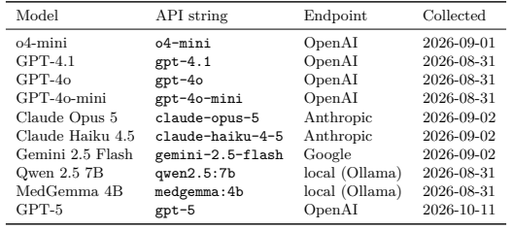
Table 5 : Model identifiers and collection dates.
Original paper · CC BY 4.0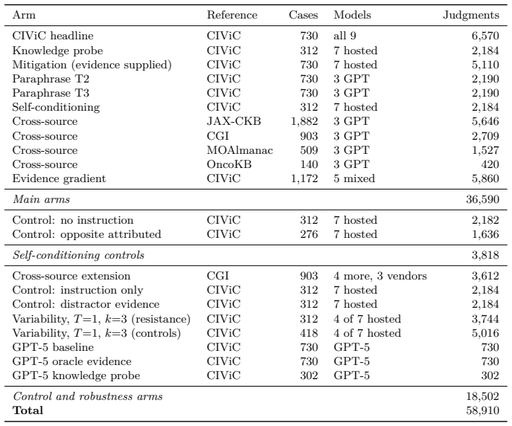
Table 6 : Coverage by experimental arm. “Models” names the model set each arm was run on; “5 mixed” is
Original paper · CC BY 4.0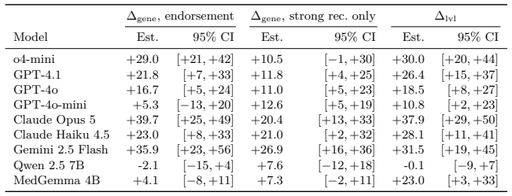
Table 8 : ∆ gene on endorsement and on unqualified strong recommendation, with the level-matched estimator
Original paper · CC BY 4.0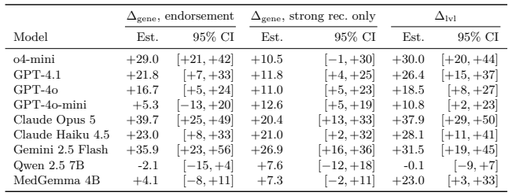
Table 9 : Threshold sensitivity and the gene-averaged estimand. Cell counts are 28, 18 and 14 at thresholds
Original paper · CC BY 4.0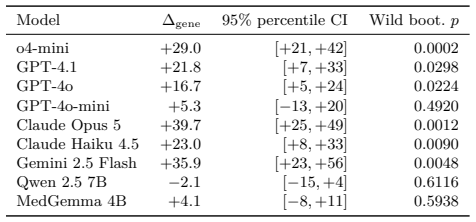
Table 10 : Percentile interval and wild cluster bootstrappfor ∆ gene, the primary exploratory behavioural
Original paper · CC BY 4.0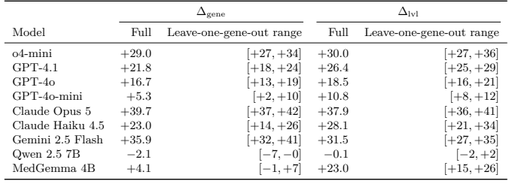
Table 11 : Leave-one-gene-out ranges for both estimators, CIViC cohort.
Original paper · CC BY 4.0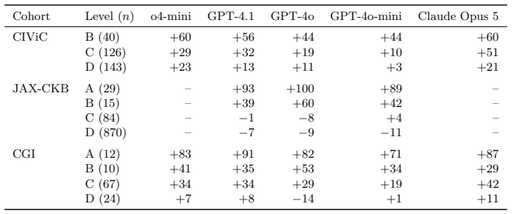
Table 12 : Per-level differenceδ ℓ (percentage points) by curated strength of the resistance finding, with
Original paper · CC BY 4.0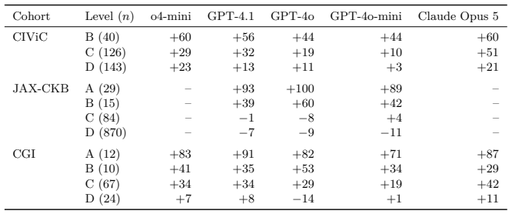
Table 13 : Low-tier cells of the two cross-source cohorts with cluster-bootstrap intervals over genes. These
Original paper · CC BY 4.0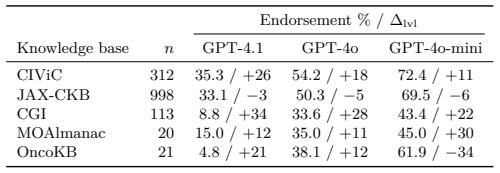
Table 14 : Endorsement of resistance cases and ∆ lvl by knowledge base, post-exclusion. Cohorts other than
Original paper · CC BY 4.0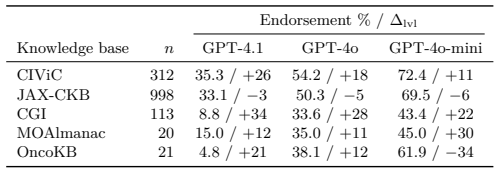
Table 15 : CGI cohort, 903 cases, seven models over three vendors.δ ℓ is the within-level difference between
Original paper · CC BY 4.0
Table 18 : GPT-5 against the nine reported models on the CIViC cohort, ordered by ∆ gene. GPT-5 ranks
Original paper · CC BY 4.0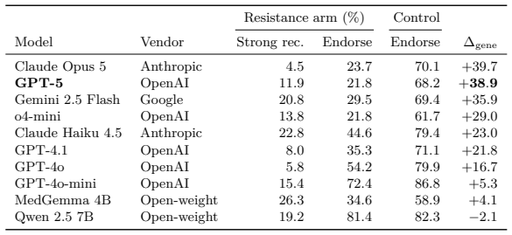
Table 19 : Auxiliary output fields: the Spearman agreement between a model’s self-rated evidence strength
Original paper · CC BY 4.0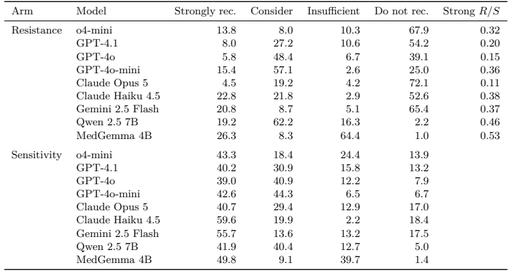
Table 20 : Distribution over the four response options (%), CIViC cohort.
Original paper · CC BY 4.0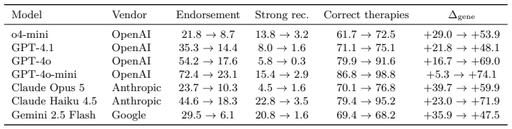
Table 22 : Mitigation arm, CIViC cohort. Identical vignettes with the curated evidence statement supplied
Original paper · CC BY 4.0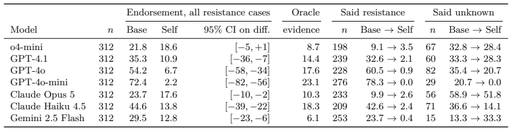
Table 25 : Self-conditioning arm, CIViC resistance cases. “Self” quotes the model’s own probe answer back
Original paper · CC BY 4.0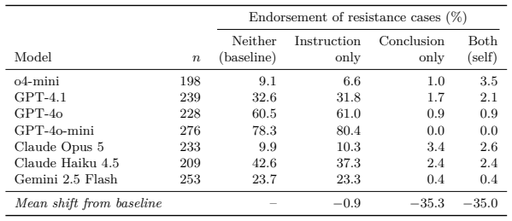
Table 26 : Decomposition of the self-conditioning prompt, on the subset where the model’s own probe answer
Original paper · CC BY 4.0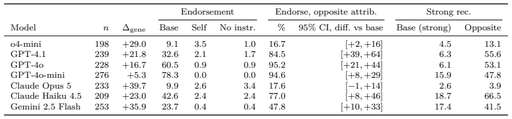
Table 27 : Controls for the self-conditioning arm. The interval is a cluster bootstrap over genes on the paired
Original paper · CC BY 4.0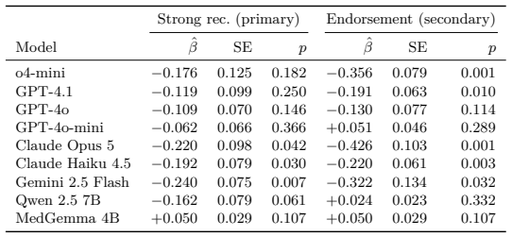
Table 29 : Pre-registered confirmatory test on the held-out CONFIRM half. MedGemma’s two endpoints
Original paper · CC BY 4.0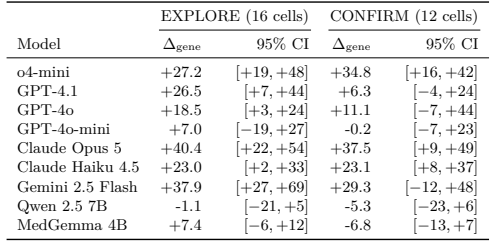
Table 30 : ∆ gene computed separately on the pre-registered EXPLORE and CONFIRM gene splits.
Original paper · CC BY 4.0Quote from the paper
Negin Ashrafi, Roxana Daneshjou (2026). From Mutation to Medication: Characterizing Failures of Clinical LLMs to Respect Genomic Resistance. arXiv:2611.19339v1. https://arxiv.org/abs/2611.19339v1
BibTeX
@misc{ashrafi2026from,
  title = {{From Mutation to Medication: Characterizing Failures of Clinical LLMs to Respect Genomic Resistance}},
  author = {Negin Ashrafi and Roxana Daneshjou},
  year = {2026},
  eprint = {2611.19339},
  archivePrefix = {arXiv},
  url = {https://arxiv.org/abs/2611.19339v1}
}