Paper commentary
Training Deep Learning Models with Norm-Constrained LMOs
Norm-constrained linear minimization oracles can train deep networks without Adam
- Problem Adam reshapes each update from gradients seen during training, so the known structure of a neural network goes unused. Fixing the geometry before training has been hard to do for whole networks.
- Method Scion uses a linear minimization oracle over a chosen norm ball to update every layer, instead of Adam. Each layer gets its own operator norm, so hyperparameters transfer across model widths.
- Results On a 3B GPT model, unconstrained Scion reached validation loss 2.882, compared to 3.024 for Adam.
Why fix the geometry in advance
Adam and related adaptive methods reshape each update from gradients seen during training, so the geometry is learned on the fly. The authors point out that neural networks aren't black boxes, since their structure is known and deliberately designed. That observation raises the question of whether the optimizer should be adapted a priori instead of exploring geometries on-the-fly.
The route they pick is to modify the norm that measures distances in the parameter space before training starts.
Choosing the norm a priori has precedent in stochastic spectral descent (SSD), which takes steepest-descent steps in the spectral norm. Carlson et al. showed that SSD can substantially accelerate deep learning training. Bernstein and Newhouse showed that Shampoo can be viewed as SSD when a certain accumulation is disabled. Jordan et al. incorporated the Newton-Schultz iteration with additional momentum into SSD under the name Muon, applying it to the hidden layers.
Muon leaves the first and last layers to Adam(W) or SGD, so it doesn't fix the geometry for the whole network. The authors instead apply uSCG and SCG to all layers and test whether the stepsize transfers. Their stated goal is to exploit an appropriate norm for the entire network, with emphasis on hyperparameter transfer across model sizes.
They build this on the conditional gradient family, which uses the linear minimization oracle over a norm-ball constraint.
A norm-ball oracle as the update step
The linear minimization oracle, written lmo, returns a point of a norm ball that minimizes the inner product with a given direction s. The lmo is scale invariant, so its output depends only on the direction of s and ignores the magnitude of the input. Under the norm constraint, every lmo output has norm at most ρ, however large the input gradient is.
Classical Conditional Gradient methods combine this output with the current iterate through a convex combination, which keeps each iterate feasible.
uSCG drops that convex combination and adds the oracle output directly to the iterate, scaled by a stepsize γk in (0, 1). The update reads xk+1 = xk + γk lmo(dk), so the method sums the oracle outputs instead of averaging them with the iterate. Because the oracle applied to one noisy gradient isn't unbiased, the method keeps a momentum average dk of past gradients with weight αk.
Each iteration of Algorithm 1 samples ξk, updates dk and xk+1, and finally returns an iterate chosen uniformly at random.
Because the oracle output has a fixed magnitude, every uSCG step has the same size whatever the size of the averaged gradient dk. Adding weight decay to uSCG gives xk+1 = xk + γk lmo(dk) − γkμxk, and the method then reduces to SCG. The weight decay parameter μ in [0, 1] interpolates between uSCG and SCG. For μ in (0, 1), the radius becomes ρμ and the stepsize becomes γkμ, so the method still solves a constrained problem.
Without weight decay, uSCG bounds the parameter norm by ρ times the sum of the stepsizes. SCG keeps the parameter norm within ρ, which gives explicit control on the weights during long runs. The authors use the lmo for unconstrained problems, where they say uSCG shows improvements when the norm ball matches the natural geometry of the problem.
Choosing a norm for each layer
Each layer gets its own operator norm, because an operator norm bounds how much a layer can stretch its input. In a linear MLP, the authors ask each hidden state to stay bounded in an average-entry, RMS or maximum-entry sense. Keeping every hidden state bounded turns into an operator norm constraint on each weight matrix and a norm constraint on each bias.
The authors start from RMS, where the initial layer needs the operator norm from the input norm to RMS to stay at most 1. For an intermediary layer, the relevant operator norm is RMS to RMS, which is a scaled spectral norm. Concretely, the RMS to RMS norm equals the square root of din over dout times the spectral norm.
Table 2 lists the lmo for each operator norm, including the sign lmo for the 1 to infinity norm. The column-normalized lmo comes from the 1 to RMS norm, and the row-normalized lmo comes from the RMS to infinity norm. For image domains, the authors recommend Spectral for the first layer, Spectral for the hidden layers and Sign for the last layer.
For one-hot input, they recommend ColNorm for the first layer, because its lmo can be computed exactly. When the first and last layers share weights, they recommend Sign for the first layer, Spectral for the hidden layers and Sign for the last layer. Each layer's radius needs scaling, so the lmo for the first layer uses max(1, the square root of dout over din).
The authors expect these lmo choices to transfer hyperparameters across model width. The spectral scaling rule of Yang et al. asks weight matrices and their updates to have spectral norms scaling with the square root of the width ratio. For uSCG, the update is the stepsize times the lmo output, so a spectral lmo satisfies this rule automatically.
The authors also show, under a simplified setting with momentum 1, that the maximal update learning rate doesn't depend on width.
What the convergence bounds promise
The analysis starts from an L-Lipschitz gradient, measured in a norm that need not be Euclidean. The paper also assumes f is bounded below by f⋆, and only needs Lipschitz continuity locally within a radius γρ. The stochastic gradient oracle is assumed unbiased, with variance bounded by σ². Because the lmo is scale invariant, the convergence proofs don't need the Lipschitz constant L to set the stepsize.
Insight 5.1 explains this by viewing uSCG as a normalized version of steepest descent.
For uSCG with constant momentum, the paper uses a constant stepsize γ = 1/√n over horizon n. Theorem 5.4 bounds the expected dual norm of the gradient at the averaged iterate by O(Lρ/√n + σ). This rate is fast, but the guarantee only reaches a noise-dominated region whose radius is proportional to σ. That path is slower in n, yet it drives the expected dual norm of the gradient small.
For SCG, the paper measures criticality with the Frank-Wolfe gap rather than the plain gradient norm. Theorem 5.7 gives O(1/n^{1/4} + Lρ²n^{3/4}) under vanishing momentum. Every SCG iterate stays feasible in D, because of the update design and the convexity of the norm ball.
Insight 5.2 says that tuning α balances two effects for both algorithms. A smaller α removes the constant term that is proportional to the noise level σ. However, if α becomes too small, it amplifies an O(1/√n) term and an O(σ/n) term. For vanishing momentum, the theory suggests a smaller constant stepsize to ensure convergence.
nanoGPT width transfer and 3B results
The authors test SCION on nanoGPT, training models from 64M to 1B parameters on FineWeb for 5100 iterations at batch size 512. They build on the modded-nanogpt codebase, which swaps in rotary embeddings, RMS norm and a linear decay schedule. SCION and UNCONSTRAINED SCION use the Sign to Spectral to Sign configuration, with scaling factors set by Tables 3 and 4.
They compare these runs against Adam and Muon across the same model widths. Muon and the unconstrained variant need no learning rate warmup, whereas Adam is compared with them on that point.
The sweep over learning rates and widths shows the optimal stepsize of SCION does not move with width. Adam and Muon don't show this transfer, so their best stepsize changes as the model grows. On the 124M configuration, SCION reached slightly lower validation loss than Muon across 3 runs. When Muon was tuned on the largest model, its validation loss was 2.988, compared to 2.984 for UNCONSTRAINED SCION.

Figure 1 . Performance on NanoGPT with between 64M and 1B parameters. The optimal learning rate of S CION is invariant to width.
Original paper · CC BY 4.0 · Pethick, Thomas, Xie, Wanyun, Antonakopoulos, Kimon, Zhu, Zhenyu, Silveti-Falls, Antonio, Cevher, Volkan · Training Deep Learning Models with Norm-Constrained LMOs · Original paper figure · Extracted the figure area from page 9 of the original PDF.For the 3B model, the authors reuse the optimal 124M configuration and increase the embedding dimension to 2560 and the depth to 36. On this 3B GPT model, validation loss was 3.024 for Adam and 2.909 for Muon. UNCONSTRAINED SCION reached 2.882, and SCION reached 2.890 in the same table. Both SCION variants beat Muon and Adam at this scale, so the 124M stepsize carries over.
Large batches and ImageNet
On the 124M NanoGPT model, UNCONSTRAINED SCION keeps validation loss lower than the baselines as batch size grows. The authors fixed the total number of tokens and rescaled the step count as the batch size changed. They tuned the stepsize over powers of two from 2−17 to 2−5 for each batch size and optimizer. For large batches, SCION reaches a significantly lower validation loss than Muon.
At batch size 6144, the authors cut the iteration count until SCION matched Muon's larger validation loss. In that run, SCION matched Muon's validation loss with a 25% smaller wallclock time.
The authors offer two explanations for why SCION favors large batches. The first ties the treatment of noise to Euclidean geometry, which lets the method exploit the unbiasedness of the stochastic oracle. The second observes that with a single sample, the linear-layer gradients are rank-1, so Schatten norms coincide.
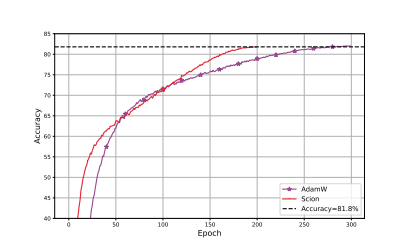
Figure 3 . SCION leads to 30% fewer epochs for ViT on ImageNet and >40% wallclock speedup due to a larger critical batch size.
Original paper · CC BY 4.0The authors also train vision transformers on ImageNet and CNNs on CIFAR10 with the Spectral to Spectral to Sign configuration. Against AdamW on ImageNet, SCION needs 30% fewer epochs to reach 81.8% accuracy. The authors attribute the wallclock speedup of more than 40% to a larger critical batch size. On CIFAR10, SCION's explicit norm control replaces the Frobenius normalization that Muon's implementation applies to the weights.
Limits of the evidence
The constant-momentum bound for uSCG converges faster, but only to a noise-dominated region. That region's radius is proportional to σ, the noise level in the stochastic gradient oracle. Tuning α therefore balances the constant noise term against the O(1/√n) and O(σ/n) terms.
The width-invariance argument for the learning rate rests on a simplified setting. The analysis fixes momentum at αk = 1 in Algorithm 1 to derive the width-invariant property. The analysis shows the maximal update learning rate γ* stays independent of width for ReLU, GELU and Tanh. The derivation therefore covers momentum equal to 1 only.
SCION can be read as an instance of Lion-K with ∂K chosen to be the lmo. K isn't smooth in this case, so the continuous-time analysis of Chen et al. (2023) does not apply. Across 3 runs at 124M, SCION reaches slightly lower validation loss than Muon.
For the 3B model, Table 5 lists one validation loss per method. Adam reached 3.024, Muon 2.909, UNCONSTRAINED SCION 2.882, and SCION 2.890. Each method's entry is a single number, so the table gives no spread across runs.
Paper info
- Authors
- Pethick, Thomas, Xie, Wanyun, Antonakopoulos, Kimon, Zhu, Zhenyu, Silveti-Falls, Antonio, Cevher, Volkan
- Venue
- arXiv · Preprint
- First published
- 2025-2-11
- Added
- 2026-10-29
- Updated
- 2025-6-6
- Version
- v2
- arXiv
- 2502.07529
- Original paper terms
- CC BY 4.0
- What we show
- Paper info, commentary and permitted figures from the original paper
AI commentary is a separate explanation from the original paper and may contain errors. The original paper and figures follow each source's terms of use and any rights noted separately.
Abstract
In this work, we study optimization methods that leverage the linear minimization oracle (LMO) over a norm-ball. We propose a new stochastic family of algorithms that uses the LMO to adapt to the geometry of the problem and, perhaps surprisingly, show that they can be applied to unconstrained problems. The resulting update rule unifies several existing optimization methods under a single framework. Furthermore, we propose an explicit choice of norm for deep architectures, which, as a side benefit, leads to the transferability of hyperparameters across model sizes. Experimentally, we demonstrate significant speedups on nanoGPT training using our algorithm, Scion, without any reliance on Adam. The proposed method is memory-efficient, requiring only one set of model weights and one set of gradients, which can be stored in half-precision. The code is available at https://github.com/LIONS-EPFL/scion .
Quote from the paper
Pethick, Thomas, Xie, Wanyun, Antonakopoulos, Kimon, Zhu, Zhenyu, Silveti-Falls, Antonio, Cevher, Volkan (2025). Training Deep Learning Models with Norm-Constrained LMOs. arXiv:2502.07529v2. https://arxiv.org/abs/2502.07529v2
BibTeX
@misc{thomas2025training,
  title = {{Training Deep Learning Models with Norm-Constrained LMOs}},
  author = {Pethick, Thomas and Xie, Wanyun and Antonakopoulos, Kimon and Zhu, Zhenyu and Silveti-Falls, Antonio and Cevher, Volkan},
  year = {2025},
  eprint = {2502.07529},
  archivePrefix = {arXiv},
  url = {https://arxiv.org/abs/2502.07529v2}
}