論文解説
Beyond Rigid Hands: Deforming Skin into Contact-Consistent Hand Meshes
剛体の手の皮膚を物体へ沿わせて接触を正しく作る
- 課題 既存のデータセットや推定器は手を剛体メッシュで表すため、指が物体の上で浮いたり表面を貫通したりします。既存の精緻化手法は姿勢を動かして接触を作るため、姿勢の精度が落ちます。
- 手法 本研究は剛体の手の姿勢をわずかに補正してから、皮膚の頂点を動かして物体表面に乗せます。姿勢を大きく動かさないので、既存の推定値をそのまま土台にできます。
- 結果 三つの推定器の平均で、接触帯の皮膚が表面に乗る割合が約20%からほぼ50%に増えました。
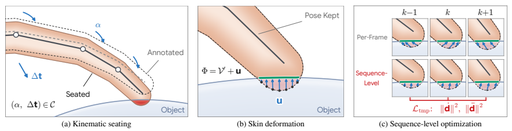
Figure 3 . Lifting a rigid hand in three stages. (a) Seating bends the annotated finger (dashed) toward the object by scaling its joint angles byα and shifting the wrist by ∆t within the box C, so that it presses slightly into the object (red). (b) The displacement u pushes the penetrating skin back onto the surface as a flat contact patch (green) without changing this pose, while the Jacobian regularizer keeps the skin from stretching. (c) Per-frame lifting changes the patch between frames although the finger barely moves (top), whereas the temporal prior Ltmp on the canonical deformationdkeeps it consistent (bottom).
出典 · CC BY 4.0 · Seonghwan Park, Min-Gyu Park · Beyond Rigid Hands: Deforming Skin into Contact-Consistent Hand Meshes · 論文の図を引用 · 元のPDFの3ページ目から図の部分を抽出しています。剛体メッシュが接触を外す理由
把持を理解するには、手が物体のどこに触れているかを正確に知ることが重要です。既存のデータセットや推定器は、手をMANOという剛体メッシュで表し、関節角と形状から皮膚の形を決めています。表面が変形しないため、指の形が合っていても、物体の上で浮くか表面を貫通する接触になります。
実際の皮膚は把持されると物体に沿って面状に変形するため、剛体の表面とは接触の形が違います。その差は大きく、正解アノテーションですらサーマルカメラで記録された接触の多くを捉えられません。既存の精緻化手法であるContactOptやGeneOH Diffusionは表面を剛体に保ち、姿勢を動かして接触を作ります。しかし指先を離すと根元が物体の内側に残るなど、姿勢を動かすこと自体が別の貫通を生みます。
そこで問題は、姿勢を大きく変えずに皮膚だけを物体へ沿わせられるかになります。ただし皮膚を物体へ単純に貼り付けると、接触は増えても皮膚が伸び、観測された深度から離れ、フレーム間で揺らぎます。さらに推定値では指が物体に届いていないことがあり、幾何だけではどこを接触させるべきか判断できません。
皮膚を変形させるという発想
本研究のliftは、剛体手の姿勢を少しだけ補正し、そのうえで皮膚の頂点を動かして物体表面に乗せる手法です。皮膚を動かして接触を作るなら、接触の増加はすべて皮膚から生まれ、姿勢を大きく動かす必要がなくなります。姿勢をほぼ保てるので、推定値や既存アノテーションをそのまま土台に使えます。
liftは三つの段階からなり、まず座位(kinematic seating)で指を物体へ寄せます。次にスキン変形で、侵入した皮膚と浮いた皮膚を表面へ移します。最後に時間的な事前分布で、フレームをまたいで変形を一貫させます。座位だけでは接触帯の皮膚の形が表面に合わないため、後段の皮膚変形が必要になります。
図2では、姿勢を動かす精緻化手法と並べて、推定姿勢のまま皮膚を表面に乗せる違いを比べられます。接触の形は皮膚の変形で決まり、姿勢の補正は指を物体へ寄せる範囲にとどまります。
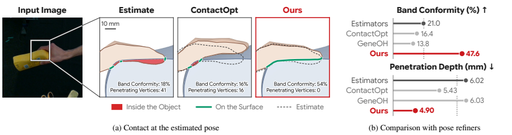
Figure 2 . Refining estimated hands by deforming the skin rather than changing the pose. (a) A finger predicted by an estimator [59] penetrates the object (red). A pose refiner [ 7] moves the finger away from the estimate (dashed) yet leaves its base inside, whereas our lift stays at the estimate and brings the skin onto the surface (green). Each panel reports band conformity (the share of near-contact skin lying on the surface) and the number of penetrating vertices. (b) Our lift more than doubles the average band conformity of three estimators [37, 53, 59] and reduces penetration depth the most, while pose refiners [7, 27] lower conformity. Dotted lines mark the rigid ground-truth annotations.
出典 · CC BY 4.0 · Seonghwan Park, Min-Gyu Park · Beyond Rigid Hands: Deforming Skin into Contact-Consistent Hand Meshes · 論文の図を引用 · 元のPDFの2ページ目から図の部分を抽出しています。座位と皮膚変形の計算
MANOは、姿勢θ(48次元)と形状β(10次元)から、線形ブレンドスキニングで778頂点の手メッシュを作ります。剛体の手は手首位置tを足したものですが、liftは座位した姿勢に頂点ごとの変位uを加えて、皮膚をΦへ動かします。\[ \Phi = M(\theta', \beta) + t' + u \]皮膚は貫通しないこと(C1)、接触帯の頂点が表面上にあること(C2)、姿勢補正が小さいこと(C3)の三つを満たすように決めます。
座位では各関節の回転角θ_jを(1+α_j)倍して指を曲げたり伸ばしたりし、手首をΔtだけ平行移動します。回転軸は変えないため、各関節は一つの自由度だけで動き、ねじれは生じません。最適化にはAdamを使い、各ステップで変数を箱の領域Cに射影します。ε=0.2mm、τ=1mmなどの許容値は、座位とスキン変形の設定値として与えられています。
皮膚変形では、面fごとのヤコビアンJ_f = I + ∇_f uを使い、変形が単位行列Iからどれだけ離れるかを罰則化します。並進は罰則に入らないため、皮膚のパッチ全体は伸ばさずに物体表面へ動けます。掌側の面は剛性を下げて物体に押される皮膚が譲れるようにし、背側の面は剛性を上げて手の甲を硬く保ちます。全体の目的関数は接触項と変形項の和で、接触項が皮膚を表面へ引き寄せ、変形項が伸びと変位の上限を抑えます。
時間的整合と接触ヘッド
フレームごとに解くと、同じ部分の凹みが隣のフレームで揺らぐため、フレーム間の一貫性が問題になります。そこで変位uを骨の回転で戻した正準変形d_{k,i} = A^{-1}_{k,i} u_{k,i}を使い、指が曲がっても同じ部位の変形が同じ値を保つようにします。\[ \dot{d}_k = d_{k+1} - d_k,\quad \ddot{d}_k = d_{k+1} - 2d_k + d_{k-1} \]速度と加速度の罰則は接触のあるフレームにだけ掛けられ、クリップ全体を同時に最適化します。
推定値の手では、皮膚が物体の近くにあっても本来触れるべき指が離れていることがあります。そこで凍結した推定器の画素対応の特徴量と、頂点から予測物体までの距離を入力に、lift後の距離を予測する軽量なヘッドを学習します。推定器は更新せず、推定器ごとに一つのヘッドを学習するので、既存の推定器をそのまま使えます。予測で接触すべきとされた頂点は、皮膚変形によって表面へ引き寄せられます。
推定値の手で接触を増やせるか
推定値の評価では、HOISDF、UniHOPE、VPHOの三つの推定器に幾何だけのliftを適用しました。HOISDFでは接触帯の皮膚の割合(C2、%)が20.7から48.6に上がり、関節誤差(MPJPE、mm)は10.3から10.5へと小幅に変わりました。三つの推定器の平均では、C2がおよそ20%からほぼ50%に増え、関節誤差の増加は最大でも0.3mmです。
一方、ContactOptとGeneOH Diffusionは接触を増やすどころか、姿勢を大きく動かして関節誤差を4から20mm増やしました。つまり、皮膚側で接触を作るため、推定姿勢の精度を大きく損なわずに接触帯を増やせると読めます。
幾何だけでも安定性は保たれ、HOISDFではS.D.@6が2.31から2.19に下がりました。ただし幾何だけでは推定値の隙間が残るため、次に学習ヘッドによる誘導の効果を見ます。
学習ヘッドで接触の隙間を埋める
学習ヘッドで誘導したliftでは、F1が推定器ごとに0.08から0.20増えました。HOISDFではF1が0.37から0.57に上がり、アノテーションとのF1GTは0.31から0.35に上がりました。
幾何のみのliftと比べると、接触帯の割合は2.1から3.1ポイント増え、F.E.@6は2.1から5.0ポイント下がりました。UniHOPEでは予測物体が31%のフレームで手に届かず、ContactOptだけがより安定でしたが、その代わり関節誤差が15.6mm増えました。
ただし接触が増えるだけでも残差は下がるため、同じ接触数に揃えた対照を二つ置きました。物体に近い頂点を同数追加する方法では残差が0.4から1.0ポイント高くなり、剛体ラベルで学習したヘッドでは0.8から1.7ポイント高くなりました。この実験の範囲では、利得は接触の数ではなく、リフトしたラベルで学んだヘッドが接触を置く場所に由来すると読めます。
剛体アノテーションのリフトと外部データでの検証
DexYCBとOakInkの剛体アノテーションそれぞれ500件をliftし、座位と皮膚変形を順に適用しました。皮膚変形を加えるとC2は87.9に上がり、侵入する頂点数は2.9まで下がりました。
座位だけではDexYCBの平衡残差はほとんど変わらないため、利得の大半は皮膚変形によると読めます。
熱接触との比較はContactPoseの1,766把持で行い、手から2mm以内の物体頂点を熱接触と比べました。F1は剛体アノテーションの0.43からliftの0.57に上がり、再現率が0.33から0.49に増えて、適合率は0.72から0.74にわずかに上がりました。接触の大きさを揃えた剛体アノテーションでもF1は0.54にとどまり、接触面積だけでは利得を説明できません。
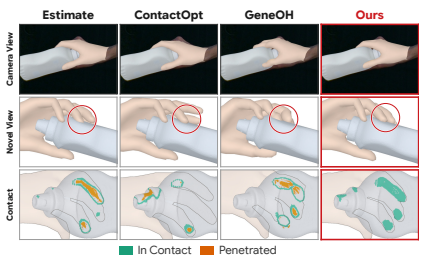
Figure 4 . Refining a VPHO [59] estimate. Rows show the camera view, a novel view, and contact on the object surface. Circles mark the finger pad. The estimate and the pose refiners [ 7, 27] leave contact (green) only as rims around penetrating regions (orange), whereas our lift forms conforming contact patches.
出典 · CC BY 4.0 · Seonghwan Park, Min-Gyu Park · Beyond Rigid Hands: Deforming Skin into Contact-Consistent Hand Meshes · 論文の図を引用 · 元のPDFの5ページ目から図の部分を抽出しています。時間的一貫性と後処理との差
19の設定を比べた図8では、同じC2に揃えた上限包絡線に対し、時間的事前分布のTrがDexYCBで7.6ポイント、OakInkで10.3ポイント高くなりました。つまり、移動量の一貫性と接触の保持は同時最適化によって初めて両立すると読めます。
限界と未解決の課題
評価はDexYCB、OakInk、ContactPoseを中心にしており、HO3Dの結果は補足にとどまります。本文の熱接触比較はContactPoseの1,766把持だけで、他のデータでの一致は本文では扱われていません。ヘッドは推定器ごとに学習され、推定器は更新しないため、推定器自体を学習に組み込んだ場合の効果は扱っていません。
学習ヘッドによる改善はアノテーションとの一致(F1GT)でHOISDFの0.31から0.35へと小幅にとどまります。UniHOPEでは予測物体が31%のフレームで手に届かず、この場合はContactOptの方が安定性で優れていました。Depthの評価はDexYCBの剛体アノテーションだけを対象にしており、推定値に対する観測深度との一致は本文では示されていません。
論文情報
- 著者
- Seonghwan Park, Min-Gyu Park
- 学会・ジャーナル
- arXiv · プレプリント
- 公開日
- 2026年11月24日
- 登録日
- 2026年11月25日
- 更新日
- 2026年11月24日
- バージョン
- v1
- arXiv
- 2611.31950
- カテゴリ
- cs.CV · cs.AI
- ライセンス
- CC BY 4.0
- 掲載内容
- 論文情報・解説・論文の図
この解説は、Refivuの韓国語解説をAIで翻訳したものです。不正確な翻訳や誤りが含まれる可能性があります。論文と図の利用条件は各出典に従います。
アブストラクト
Hands grasp objects with soft skin. A fingertip flattens against a mug, and a palm curves around a bottle. Yet hand-object datasets and estimators represent the hand as a rigid articulated mesh, which hovers above or penetrates the object where skin would press against it. Existing refiners keep the mesh rigid and adjust only the pose, trading pose accuracy for physical plausibility. We ask whether a rigid hand can instead touch the object as skin does while staying close to its original pose. We lift annotated or estimated rigid hands to contact-consistent meshes through an optimization that (i) slightly adjusts the joints and wrist to bring the fingers onto the object, (ii) deforms the skin so that penetrating regions settle onto the surface, and (iii) keeps this deformation consistent over time. Since deformation reaches only skin already near the object, we further train a lightweight head on the lifted annotations to predict where an estimated hand should touch and steer the deformation there. Unlike existing refiners, the lift more than doubles the skin lying on the object surface for three published estimators while barely changing the pose. Guidance from the learned head further improves grasp stability by closing contact gaps that the estimate leaves open. Existing hand-object datasets and estimators can thus adopt contact-consistent hands without changing the hand model or retraining the estimators.
論文の図
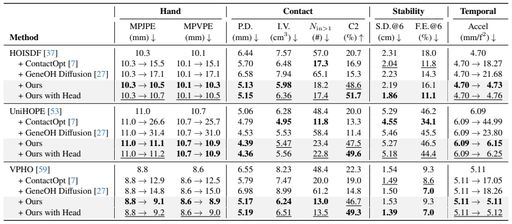
Table 1 . Refining estimated hands on the DexYCB [ 4] dataset. Each refiner receives the hand and object predicted by a published estimator [37, 53, 59], and our lift uses either geometry alone or the learned head. Hand and Temporal entries show the change from the estimate to the refined result, and C2 is measured on the band of the estimated hand.Boldand underline mark the best and second-best results. For Hand and Temporal the smallest change is best, and elsewhere only refiners that improve over the estimate are marked.
出典 · CC BY 4.0 · Seonghwan Park, Min-Gyu Park · Beyond Rigid Hands: Deforming Skin into Contact-Consistent Hand Meshes · 論文の図を引用 · 元のPDFの5ページ目から図の部分を抽出しています。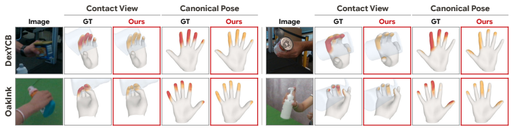
Figure 6 . Rigid annotations (GT) and our lifts on DexYCB [4] (top) and OakInk [55] (bottom), seen from the contact side and in the flat canonical pose. Colors show the signed distance to the object, with grey for free skin, orange for the contact band, and red for skin inside the object. The annotation penetrates wherever it presses, whereas the lift forms wide surface patches at the annotated pose.
出典 · CC BY 4.0 · Seonghwan Park, Min-Gyu Park · Beyond Rigid Hands: Deforming Skin into Contact-Consistent Hand Meshes · 論文の図を引用 · 元のPDFの6ページ目から図の部分を抽出しています。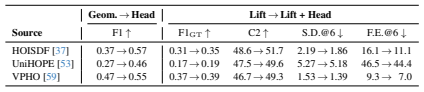
Table 2 . Learning contact for estimated hands on the DexYCB [4] dataset. F1 scores contact predicted from the estimated geometry and by the learned head against the lifted annotation. The other columns compare the lift without and with the head, where F1GT scores the refined contact against the annotated one.
出典 · CC BY 4.0 · Seonghwan Park, Min-Gyu Park · Beyond Rigid Hands: Deforming Skin into Contact-Consistent Hand Meshes · 論文の図を引用 · 元のPDFの6ページ目から図の部分を抽出しています。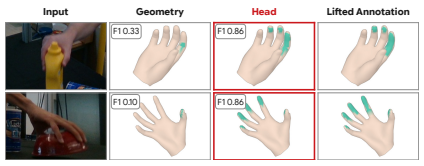
Figure 5 . Contact predicted on two HOISDF [ 37] test frames. Green marks hand vertices in contact from geometry, the learned head, and the lifted annotation that serves as the F1 reference.
出典 · CC BY 4.0 · Seonghwan Park, Min-Gyu Park · Beyond Rigid Hands: Deforming Skin into Contact-Consistent Hand Meshes · 論文の図を引用 · 元のPDFの6ページ目から図の部分を抽出しています。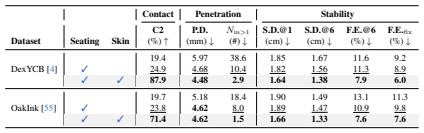
Table 3 . Applying the lifting stages in turn to 500 DexYCB and 500OakInk test annotations. Shaded rows give the full lift (ours).
出典 · CC BY 4.0 · Seonghwan Park, Min-Gyu Park · Beyond Rigid Hands: Deforming Skin into Contact-Consistent Hand Meshes · 論文の図を引用 · 元のPDFの6ページ目から図の部分を抽出しています。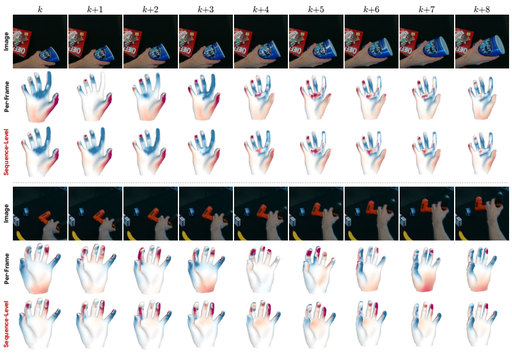
Figure 7 . Per-frame and sequence-level lifts over nine consecutive frames of two DexYCB [4] clips. Colors show the normal component of the canonical deformation, with red for inward and blue for outward displacement. The per-frame deformation flips sign on skin that stays in contact although the grasp barely changes, whereas the sequence-level lift evolves smoothly.
出典 · CC BY 4.0 · Seonghwan Park, Min-Gyu Park · Beyond Rigid Hands: Deforming Skin into Contact-Consistent Hand Meshes · 論文の図を引用 · 元のPDFの7ページ目から図の部分を抽出しています。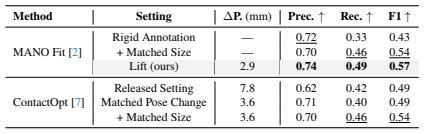
Table 4 . Agreement with thermal contact on ContactPose [2].∆P. is the pose change (mean vertex displacement from the MANO fit), and the matched settings align the contact size or∆P. with ours.
出典 · CC BY 4.0 · Seonghwan Park, Min-Gyu Park · Beyond Rigid Hands: Deforming Skin into Contact-Consistent Hand Meshes · 論文の図を引用 · 元のPDFの7ページ目から図の部分を抽出しています。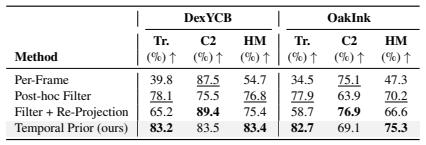
Table 5 . The temporal prior against post-hoc smoothing on held- out clips. Filtering per-frame lifts raises transfer (Tr.) but lowers band conformity (C2), and re-projecting the filtered result restores conformity at the cost of transfer. Only the temporal prior keeps both high, with the highest harmonic mean (HM) of the two.
出典 · CC BY 4.0 · Seonghwan Park, Min-Gyu Park · Beyond Rigid Hands: Deforming Skin into Contact-Consistent Hand Meshes · 論文の図を引用 · 元のPDFの7ページ目から図の部分を抽出しています。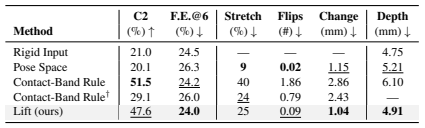
Table 6 . Simpler alternatives to the lift. Stretch, Flips, and Change measure skin distortion and its change between frames. All columns average the three estimators of Table 1 except Depth, the residual to observed depth on DexYCB annotations.†adds extra smoothing.
出典 · CC BY 4.0 · Seonghwan Park, Min-Gyu Park · Beyond Rigid Hands: Deforming Skin into Contact-Consistent Hand Meshes · 論文の図を引用 · 元のPDFの8ページ目から図の部分を抽出しています。
Table 7 . Source of the head’s gain. Each entry is the residual of the guided lift minus that of a variant (negative favors the head). Nearest Vertices adds as many vertices as the head by proximity to the object, and Rigid-Label Head is trained on rigid annotations.
出典 · CC BY 4.0 · Seonghwan Park, Min-Gyu Park · Beyond Rigid Hands: Deforming Skin into Contact-Consistent Hand Meshes · 論文の図を引用 · 元のPDFの8ページ目から図の部分を抽出しています。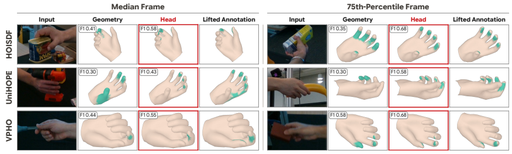
Figure 9 . Contact from geometry, the learned head, and the lifted annotation on DexYCB frames at the median (left) and the 75th percentile (right) of the head’s F1. Green marks vertices in contact, with F1 against the lifted annotation in each panel.
出典 · CC BY 4.0 · Seonghwan Park, Min-Gyu Park · Beyond Rigid Hands: Deforming Skin into Contact-Consistent Hand Meshes · 論文の図を引用 · 元のPDFの11ページ目から図の部分を抽出しています。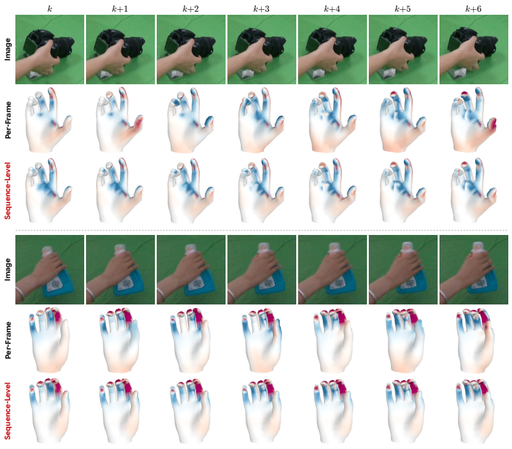
Figure 11 . Per-frame and sequence-level lifts on seven consecutive frames of two OakInk clips with a camera (top) and a bottle (bottom). Skin is colored by the normal component of its canonical deformation as inward (red) or outward (blue) displacement.
出典 · CC BY 4.0 · Seonghwan Park, Min-Gyu Park · Beyond Rigid Hands: Deforming Skin into Contact-Consistent Hand Meshes · 論文の図を引用 · 元のPDFの12ページ目から図の部分を抽出しています。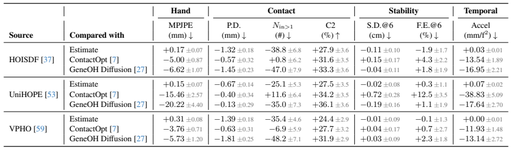
Table 8 . Differences between our lift and the estimate or each pose refiner of Table 1, paired frame by frame on the test clips. Each entry is the lift minus the compared method with±half the clip-clustered95%interval, so negative values favor the lift except for C2.
出典 · CC BY 4.0 · Seonghwan Park, Min-Gyu Park · Beyond Rigid Hands: Deforming Skin into Contact-Consistent Hand Meshes · 論文の図を引用 · 元のPDFの15ページ目から図の部分を抽出しています。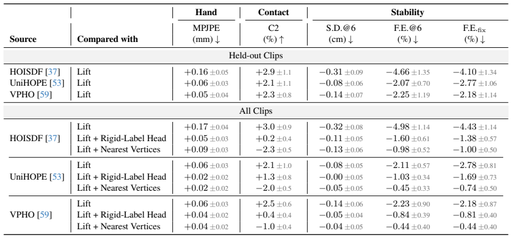
Table 9 . Differences between the guided lift (Lift + Head) and the lift without guidance or with one of two controls, paired frame by frame. Rigid-Label Head is trained on rigid annotations, and Nearest Vertices adds as many attraction vertices as the head by proximity to the object. Each entry is Lift + Head minus the variant, so negative values favor it except for C2. Held-out Clips exclude the20clips used for tuning.
出典 · CC BY 4.0 · Seonghwan Park, Min-Gyu Park · Beyond Rigid Hands: Deforming Skin into Contact-Consistent Hand Meshes · 論文の図を引用 · 元のPDFの16ページ目から図の部分を抽出しています。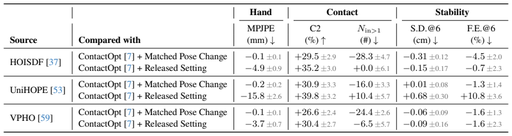
Table 10 . Differences between the guided lift (Lift + Head) and ContactOpt [7], paired frame by frame. ContactOpt runs with a lower learning rate that matches the pose change of the lift (Matched Pose Change) or at its released setting. Each entry is Lift + Head minus ContactOpt averaged within each clip and then over clips, so it can differ from the frame means of Table 1. Negative values favor the lift except for C2.
出典 · CC BY 4.0 · Seonghwan Park, Min-Gyu Park · Beyond Rigid Hands: Deforming Skin into Contact-Consistent Hand Meshes · 論文の図を引用 · 元のPDFの16ページ目から図の部分を抽出しています。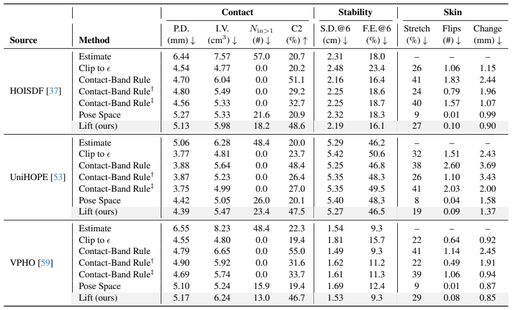
Table 12 . Closed-form and pose-space alternatives to the lift on the estimated inputs of Table 1, all starting from the seated hand. The contact-band rule is also smoothed 100 times more (†) or filtered over time by a Gaussian of σ= 2 frames (‡). Skin columns are measured against the seated hand. Only the lift reaches high conformity while flipping almost no faces and changing the least between frames.
出典 · CC BY 4.0 · Seonghwan Park, Min-Gyu Park · Beyond Rigid Hands: Deforming Skin into Contact-Consistent Hand Meshes · 論文の図を引用 · 元のPDFの17ページ目から図の部分を抽出しています。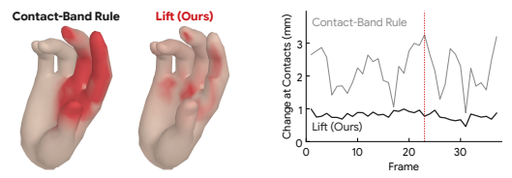
Figure 12 . Change between consecutive frames for the contact-band rule and the lift on a typical VPHO [59] clip. The hands show it at the frame marked by the dashed line, from skin color for none to red for 2 mm or more. The plot traces its mean over the contact vertices. The rule fluctuates while the lift stays low and steady.
出典 · CC BY 4.0 · Seonghwan Park, Min-Gyu Park · Beyond Rigid Hands: Deforming Skin into Contact-Consistent Hand Meshes · 論文の図を引用 · 元のPDFの18ページ目から図の部分を抽出しています。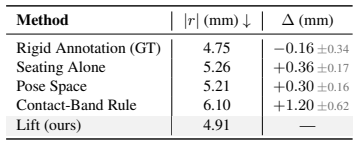
Table 13 . Agreement with observed depth on the contact rim of DexYCB test frames. |r| is the mean absolute residual and ∆ its difference from the lift with ± half the95%interval, so positive values favor the lift.
出典 · CC BY 4.0 · Seonghwan Park, Min-Gyu Park · Beyond Rigid Hands: Deforming Skin into Contact-Consistent Hand Meshes · 論文の図を引用 · 元のPDFの18ページ目から図の部分を抽出しています。この論文を引用
Seonghwan Park, Min-Gyu Park (2026). Beyond Rigid Hands: Deforming Skin into Contact-Consistent Hand Meshes. arXiv:2611.31950v1. https://arxiv.org/abs/2611.31950v1
BibTeX
@misc{park2026beyond,
  title = {{Beyond Rigid Hands: Deforming Skin into Contact-Consistent Hand Meshes}},
  author = {Seonghwan Park and Min-Gyu Park},
  year = {2026},
  eprint = {2611.31950},
  archivePrefix = {arXiv},
  url = {https://arxiv.org/abs/2611.31950v1}
}