論文解説
Toward Agentic Robotics: A Large-Scale Study of Harness Design for Robot-Use Agents
ロボット用エージェントの設計を大規模に比べる
- 課題 VLMは3Dの把持姿勢を正確に出すのが苦手で、VLAは環境が変わると崩れやすいです。両者をつなぐハーネスの設計は数千通りあり、試すのに多くの実行が必要なため、先行研究は少数の設計しか比べていませんでした。
- 手法 X-Harnessは、VLMに方策コードを書かせ、VLAを道具として呼ばせます。重みを更新せず、学習エピソードで失敗報告をもとにコードを直します。
- 結果 X-Harnessは重みを更新せずに、基本の方策を記憶、推論、ドメインずれの課題で最大+42.8ポイント押し上げました。
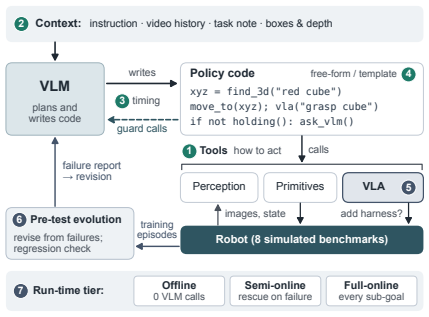
Figure 2 | Overview of the policy harness and our seven design studies.Badges mark each studied aspect, starting from VLMs (green, §4) and VLAs (gray, §5); the dashed arrow is a guardthat calls the VLM on failure.
出典 · CC BY 4.0 · Yuxiang Lai, Jike Zhong, Yu-Jhe Li, Lan Wang, Chengzhi Liu, Youbao Tang, Ming Li, Xi Xiao, Xiaofeng Yang, Liang Zhao, Zheda Mai, Ruixi Fan · Toward Agentic Robotics: A Large-Scale Study of Harness Design for Robot-Use Agents · 論文の図を引用 · 元のPDFの3ページ目から図の部分を抽出しています。VLMとVLAの組み合わせ方が定まらない理由
ロボットを言語で動かすエージェントでは、VLMが状況を理解して計画を立て、VLAやWAMが低レベルの制御を受け持つ構成が使われています。両者をつなぐのがポリシーハーネスで、VLMに渡す文脈、VLMが行動するか方策コードを書くか、そしてVLMをいつ呼ぶかを決めます。ここで問題になるのは、設計の組み合わせが数千通りあり、同じVLMと行動方策を使っても成功率が数十ポイント変わることです。一つの設計を評価するだけで数千のロールアウトが必要になり、API費用とGPU費用も重くなります。そのため先行研究は、単一のハーネスに固定するか、一つの条件とベンチマークだけで比べてきました。
VLAは標準条件では滑らかに動きますが、分布がずれたり長期のメモリが必要な課題では性能が落ちやすいとされています。一方でVLMは、3Dの把持姿勢を直接出させるとうまくいかず、この点は後の実験で確かめられます。つまり、どちらか一方に任せるだけでは足りず、両者の組み合わせ方が成否を分けると考えられます。そこで本研究は、8つのシミュレーションベンチマーク、6つのVLM、15のVLA/WAMを対象に、ハーネスの要素を一つずつ変えて比べました。
ポリシーハーネスの構成と3つの実行段階
中心となる考え方は、VLMに方策コードを書かせ、そのコードが知覚ツールと動作プリミティブ、VLAを道具として呼ぶ形にすることです。VLMにはシーンの指示文、カメラ画像やビデオ履歴、ツールの出力、任意のタスクノートを渡し、タスクノートで「右」の意味のような約束事を伝えます。知覚ツールは物体の検出、分割、追跡を行い、深度を返します。動作プリミティブはグリッパーの開閉や目標姿勢への移動を担い、VLAは言語のサブゴールとステップ上限を受け取る道具として呼ばれます。
方策コードは自由形式のPythonでも、ビヘイビアツリーやPDDLのような固定テンプレートでも書けます。生のカメラ画像と状態を読むものを閉ループ、固定の手順を実行するものを開ループと呼びます。テスト前には、学習エピソード(既定では10)で失敗報告をもとにVLMが方策コードを改訂し、選択ゲートで学習上の成功率が上がった改訂だけを残します。学習時の診断情報は任意で使え、テスト時には使われません。
Offlineは凍結された方策コードだけを実行し、VLMを一切呼びません。Semi-onlineは失敗の信号が出たときだけVLMを呼び、一度の引き継ぎか複数ターンのリスキューを行います。Full-onlineはサブゴールごとにVLMを呼ぶ方式で、3つの中で最も多くVLMを呼びます。この段階の違いが、成功率とコストのどちらを優先するかを決めます。
3D姿勢の直接出力とサブゴール委譲の比較
最初の問いは、VLMが低レベルの動きまで決めるべきか、それともVLAに委譲すべきかという点です。Flashの推論強度を変えても、低い推論強度で47.1%、標準で51.9%、高い推論強度で52.4%と差は小さく、推論量を増やすだけでは埋まりません。
Opusでも高い推論強度でキーポーズの差は縮まらず、直接の姿勢出力は最も強いモデルでも苦手だと分かります。著者らは、VLMは何をすべきかは分かっても、どう動くかは苦手だと解釈し、動きは言語のサブゴールとしてVLAに委譲するよう勧めています。LIBERO-PRO(位置ずれ)の条件では、VLA呼び出しがFlashやSonnetを助け、Opusは3Dツールのプリミティブで強くなりました。オラクルのサブゴールでは、目標点付きで上限83.1%、言語だけでは49.6%で、視覚的に示す情報の価値がどれほど大きいかを示しています。
深度の質と視覚文脈の効果
3Dツールは深度を使うため、深度の質が成否に直結すると考えられます。この検証では、凍結した進化済みのOffline方策コードを186セル、各20エピソードで評価し、深度の供給源だけを変えました。深度はカメラ深度、単眼のDepth Anything V2、多視点ステレオの3つで、RGBのボックスとマスクは3条件で同じものを使いました。その結果、カメラ深度は単眼深度より+16.4ポイント高く(95%信頼区間は[+11.7,+21.7])、多視点ステレオより+24.9ポイント高くなりました。
単眼深度は多視点ステレオより+8.5ポイント高く、深度推定の精度が下がるほど3Dツールの効果も下がることが分かります。プリミティブだけのコードは−29.8ポイント下がり、その差は+20.3ポイントになります。著者らは、VLAが深度の雑音を吸収していると解釈しています。
この差は、推論量を増やすよりも視覚的な文脈を与えるほうが効くという読み方を裏づけます。
テスト時のVLM呼び出しと方策コード進化の効果
進化前の5つの共通ベンチマークでは、VLM呼び出し0回の37.8%から、6.7回のツールエージェントでも46.1%にとどまりました。これに対し、8ラウンドの進化後にはテスト時に呼び出さないOffline方策コードが77.5%に達し、ガード付きでも77.7%でした。テスト時のVLM呼び出しより、事前の進化が成功率の大きな部分を担うと読めます。
RoboCasa365ではAwomo-0.5Iに対して、Semi-onlineのリスキューが77.3%となり、公式のVLA単独より+12.9ポイント高くなりました。Full-onlineは76.8%で、Semi-onlineと同程度の精度でした。一方でVLM呼び出しはSemi-onlineが5.3回、Full-onlineが8.6回で、トークンは207.3kと356.9kでした。つまり、失敗のときだけVLMを呼ぶ方式は、精度を保ちながらVLMの使用量を42%減らせることを示しています。
ツールバンク進化は、方策コードを書き換える代わりに共有ツールの集合を進化させる方法です。166セルで、4ラウンドのツールバンク進化は63.5%、8ラウンドの方策コード進化は63.4%で、差は95%信頼区間[−2.4,+2.5]の中に収まりました。RoboDojoでは+4.0ポイント([+0.7,+7.8])の上積みがありました。
X-Harnessは、これらの知見を組み合わせた参照レシピで、重みを更新せずに5から40の学習エピソードで方策コードを進化させます。この図は、未見シードでのOffline評価、ローカルモデルによるゲート、コンパイル済みOfflineとの比較を並べて示しています。
実機検証の範囲と未確認の点
実機の確認はBimanual YAM上の2つのタスクだけで、Two-Bin Object MemoryとLED-Counted Bean Scoopingに限られています。学習は70と89のエピソード、テストは30と44のエピソードで、それ以外の条件の一般化は確かめていません。実験の中心はシミュレーションで、実機は補助的な確認として位置づけられています。
VLMの強さによる効果の差が大きく、強いコーダーほど改善が大きくなる傾向があります。改善幅はベンチマークやVLAで大きく異なり、VLABenchの+42.8ポイントは同じVLM条件での値です。エッジの局所モデルでは、クラウドのリスキューの方が改善の余地を広げると報告されています。
論文情報
- 著者
- Yuxiang Lai, Jike Zhong, Yu-Jhe Li, Lan Wang, Chengzhi Liu, Youbao Tang, Ming Li, Xi Xiao, Xiaofeng Yang, Liang Zhao, Zheda Mai, Ruixi Fan
- 学会・ジャーナル
- arXiv · プレプリント
- 公開日
- 2026年11月25日
- 登録日
- 2026年11月27日
- 更新日
- 2026年11月25日
- バージョン
- v1
- arXiv
- 2611.34778
- カテゴリ
- cs.RO
- ライセンス
- CC BY 4.0
- 掲載内容
- 論文情報・解説・論文の図
この解説は、Refivuの韓国語解説をAIで翻訳したものです。不正確な翻訳や誤りが含まれる可能性があります。論文と図の利用条件は各出典に従います。
アブストラクト
Recent vision-language models (VLMs) can act as robot-use agents that understand diverse scenes and control robots through policy code and tools. However, they predict 3D gripper poses poorly even with extended reasoning, struggling with precise manipulation. Vision-language-action (VLA) and world-action (WAM) models are the opposite: they execute fast, smooth control on trained tasks, yet fail under domain shifts or when tasks require long-horizon memory and reasoning. Agentic robots therefore combine VLM reasoning and perception with precise VLA/WAM control through a policy harness. Yet harness design spans thousands of configurations, shifting success by tens of points with the same models. Moreover, testing even one design takes thousands of rollouts at high API and GPU cost, so prior works often commit to a single design chosen from few alternatives. To guide harness design, we evaluate over 470,000 rollouts across eight simulation benchmarks, six VLMs, and 15 VLA/WAM checkpoints. Seven controlled studies show effective harnesses must adapt to both VLM and VLA/WAM capabilities. Our findings specify what structure the VLM's policy code needs, where VLA manipulation needs help from tools and policy code, and when to involve the VLM at test time. The reference recipe X-Harness shows that these findings compose without weight updates, lifting base policies up to $+42.8$ points across memory, reasoning, and domain shifts.
論文の図
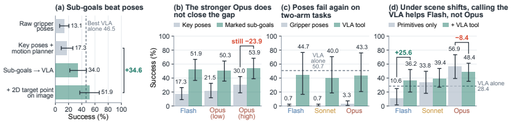
Figure 3 | Study 1 / Takeaway 1: Direct VLM pose predictions fail; VLMs should delegate via VLA sub-goals or query 3D tools in code. (a)On RoboMME (Flash), language sub-goals beat gripper or key poses, and marking a 2D target point lifts the VLA past its standalone baseline (dashed).(b)Scaling to Opus with high reasoning effort does not close the key-pose gap.(c)On two-arm RoboDojo, direct gripper poses fail across VLMs, while calling𝜋0.5 restores execution.(d) Under LIBERO-PRO shifts, calling the VLA helps weaker VLMs, whereas Opus excels with 3D-tool primitives. Error bars: 95% CIs.
出典 · CC BY 4.0 · Yuxiang Lai, Jike Zhong, Yu-Jhe Li, Lan Wang, Chengzhi Liu, Youbao Tang, Ming Li, Xi Xiao, Xiaofeng Yang, Liang Zhao, Zheda Mai, Ruixi Fan · Toward Agentic Robotics: A Large-Scale Study of Harness Design for Robot-Use Agents · 論文の図を引用 · 元のPDFの4ページ目から図の部分を抽出しています。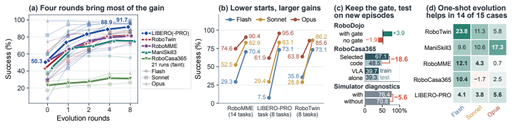
Figure 8 | Study 6 / Takeaway 6: A few rounds of pre-test evolution, guarded by a regression check, lift weak and strong VLMs alike. (a)Offline test success across rounds (0: initial code; faint: 21 runs; bold: benchmark means) rises steeply by round 4 and plateaus by round 8.(b)Weaker coders (Flash, Sonnet) gain more by round 8, narrowing the gap to Opus.(c)Dropping the regression check hurts test success on RoboDojo (top, GPT-6 Astra); training-only selection generalizes to blind RoboCasa365 tests (middle, Opus); and evolution stays strong without simulator diagnostics (bottom). (d)One-shot evolution improves nearly all settings (bold: significant).
出典 · CC BY 4.0 · Yuxiang Lai, Jike Zhong, Yu-Jhe Li, Lan Wang, Chengzhi Liu, Youbao Tang, Ming Li, Xi Xiao, Xiaofeng Yang, Liang Zhao, Zheda Mai, Ruixi Fan · Toward Agentic Robotics: A Large-Scale Study of Harness Design for Robot-Use Agents · 論文の図を引用 · 元のPDFの8ページ目から図の部分を抽出しています。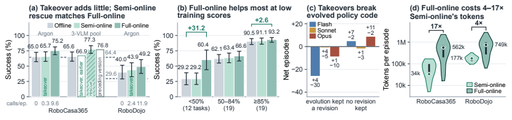
Figure 9 | Study 7 / Takeaway 7: After evolution, Semi-online multi-turn rescue matches Full-online at much lower cost, outperforming one-shot takeovers. (a)With Awomo-0.5I (dashed: VLA alone), one-shot takeovers add little over Offline code, whereas Semi-online multi-turn rescue (hatched) matches Full-online with fewer calls.(b)On RoboCasa365, Full-online helps mainly on hard tasks (< 50%training score) and adds little when Offline code is reliable (≥ 85%).(c) One-shot takeovers break more evolved episodes than they rescue (labels:+/− counts).(d)Full-online uses4–17 × more tokens than Semi-online takeovers (violins: tasks with calls; diamonds: means; 95% CIs).
出典 · CC BY 4.0 · Yuxiang Lai, Jike Zhong, Yu-Jhe Li, Lan Wang, Chengzhi Liu, Youbao Tang, Ming Li, Xi Xiao, Xiaofeng Yang, Liang Zhao, Zheda Mai, Ruixi Fan · Toward Agentic Robotics: A Large-Scale Study of Harness Design for Robot-Use Agents · 論文の図を引用 · 元のPDFの8ページ目から図の部分を抽出しています。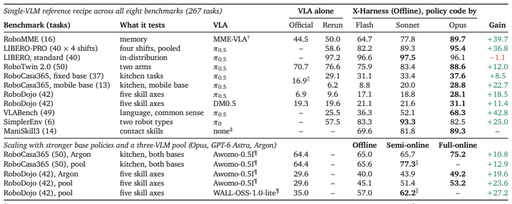
Table 2 | The takeaways compose: one reference recipe on eight benchmarks.Test success (%) of VLAs alone and in X-Harness.Official: leaderboard;Rerun: same VLA, our protocol. Top: Offline code after eight evolution rounds;Gain: Opus minusRerun(unrounded). Bottom: tiers of §5.3;pool: added tools, one training-selected candidate per task;Gain: best tier minusOfficial. Bold: best.
出典 · CC BY 4.0 · Yuxiang Lai, Jike Zhong, Yu-Jhe Li, Lan Wang, Chengzhi Liu, Youbao Tang, Ming Li, Xi Xiao, Xiaofeng Yang, Liang Zhao, Zheda Mai, Ruixi Fan · Toward Agentic Robotics: A Large-Scale Study of Harness Design for Robot-Use Agents · 論文の図を引用 · 元のPDFの9ページ目から図の部分を抽出しています。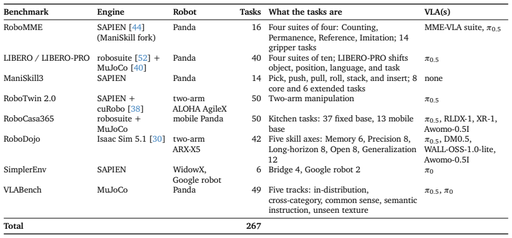
Table 3 | Eight simulation benchmarks with 267 tasks.Engine, robot, number of tasks, task content, and the VLAs used. ManiSkill3 has no public multi-task, language-conditioned VLA checkpoint, so it tests the harness with perception tools and motion primitives alone.
出典 · CC BY 4.0 · Yuxiang Lai, Jike Zhong, Yu-Jhe Li, Lan Wang, Chengzhi Liu, Youbao Tang, Ming Li, Xi Xiao, Xiaofeng Yang, Liang Zhao, Zheda Mai, Ruixi Fan · Toward Agentic Robotics: A Large-Scale Study of Harness Design for Robot-Use Agents · 論文の図を引用 · 元のPDFの16ページ目から図の部分を抽出しています。
Figure 11 | 4,025 evaluated configurations across eight benchmarks.Each tile represents one cell (one task under a specific VLM, VLA, and harness configuration), grouped by benchmark and sorted by test success rate from low to high. The LIBERO-PRO block includes standard LIBERO cells.
出典 · CC BY 4.0 · Yuxiang Lai, Jike Zhong, Yu-Jhe Li, Lan Wang, Chengzhi Liu, Youbao Tang, Ming Li, Xi Xiao, Xiaofeng Yang, Liang Zhao, Zheda Mai, Ruixi Fan · Toward Agentic Robotics: A Large-Scale Study of Harness Design for Robot-Use Agents · 論文の図を引用 · 元のPDFの16ページ目から図の部分を抽出しています。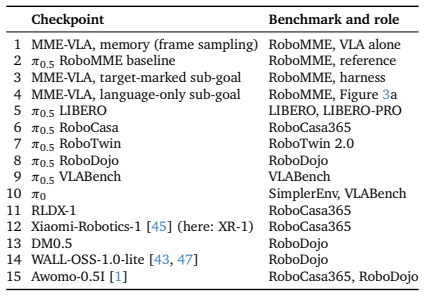
Table 4 | Fifteen VLA checkpoints.Where each is used. Rows 1, 3, and 4 are from the MME-VLA suite. Row 2 alone scores 18.6 on the 16 RoboMME tasks. Row 14 is the public WALL-OSS-1.0-lite checkpoint for RoboDojo, used in the last row of Table 2. Rows 10 and 15 each count one model:𝜋0 has three public fine-tunes, and Awomo-0.5I its official weights for RoboCasa365 and for RoboDojo.
出典 · CC BY 4.0 · Yuxiang Lai, Jike Zhong, Yu-Jhe Li, Lan Wang, Chengzhi Liu, Youbao Tang, Ming Li, Xi Xiao, Xiaofeng Yang, Liang Zhao, Zheda Mai, Ruixi Fan · Toward Agentic Robotics: A Large-Scale Study of Harness Design for Robot-Use Agents · 論文の図を引用 · 元のPDFの17ページ目から図の部分を抽出しています。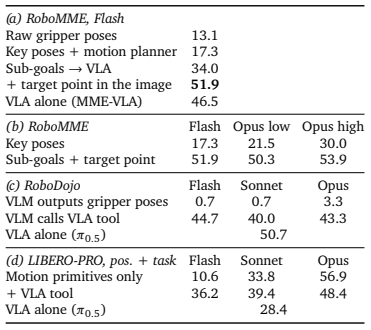
Table 6 | Sub-goals carried out by VLAs beat poses that VLMs read from images (Figure 3).Success (%). (a–c) VLM in the loop; (d) code per episode. VLA alone: dashed lines in the figure.
出典 · CC BY 4.0 · Yuxiang Lai, Jike Zhong, Yu-Jhe Li, Lan Wang, Chengzhi Liu, Youbao Tang, Ming Li, Xi Xiao, Xiaofeng Yang, Liang Zhao, Zheda Mai, Ruixi Fan · Toward Agentic Robotics: A Large-Scale Study of Harness Design for Robot-Use Agents · 論文の図を引用 · 元のPDFの18ページ目から図の部分を抽出しています。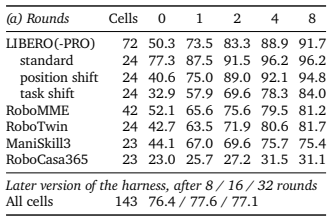
Table23 | Fourroundsbringmostofthegain(Figure8a,b). Offline test success (%) after each number of evolution rounds. Round0istheVLM’sinitialfree-formpolicycode. Thelastrow of (a) pools 143 cells under the later version of the harness (§B).
出典 · CC BY 4.0 · Yuxiang Lai, Jike Zhong, Yu-Jhe Li, Lan Wang, Chengzhi Liu, Youbao Tang, Ming Li, Xi Xiao, Xiaofeng Yang, Liang Zhao, Zheda Mai, Ruixi Fan · Toward Agentic Robotics: A Large-Scale Study of Harness Design for Robot-Use Agents · 論文の図を引用 · 元のPDFの26ページ目から図の部分を抽出しています。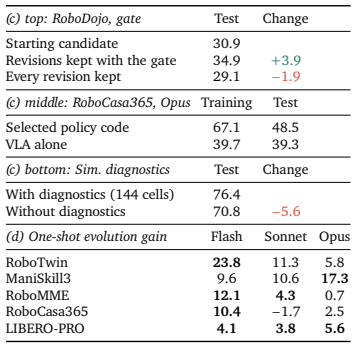
Table 24 | The selection gate and one-shot evolution both raise test success (Figure 8c,d).(c) Success (%). (d) Gain (points); bold: significant. Tier: Offline; (c) top also Semi-online.
出典 · CC BY 4.0 · Yuxiang Lai, Jike Zhong, Yu-Jhe Li, Lan Wang, Chengzhi Liu, Youbao Tang, Ming Li, Xi Xiao, Xiaofeng Yang, Liang Zhao, Zheda Mai, Ruixi Fan · Toward Agentic Robotics: A Large-Scale Study of Harness Design for Robot-Use Agents · 論文の図を引用 · 元のPDFの26ページ目から図の部分を抽出しています。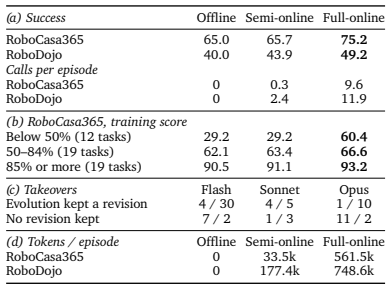
Table 25 | Runtime VLM calls help most on harder low-training-score tasks, while evolved Offline code should avoid one-shot takeovers (Figure 9).(a, b) Suc- cess (%) per run-time tier. (c) Episodes rescued / broken. (d) VLM tokens per episode, over all test episodes.
出典 · CC BY 4.0 · Yuxiang Lai, Jike Zhong, Yu-Jhe Li, Lan Wang, Chengzhi Liu, Youbao Tang, Ming Li, Xi Xiao, Xiaofeng Yang, Liang Zhao, Zheda Mai, Ruixi Fan · Toward Agentic Robotics: A Large-Scale Study of Harness Design for Robot-Use Agents · 論文の図を引用 · 元のPDFの27ページ目から図の部分を抽出しています。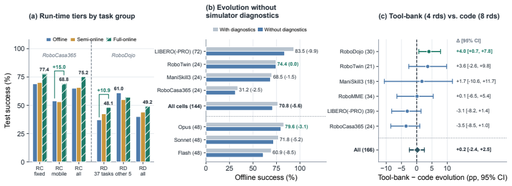
Figure 16 | Group-level tier progression, diagnostics-free evolution, and tool-bank parity. (a)Run-time tier success (%) with Gemini 4 Argon and Awomo-0.5I by task group: RoboCasa365 fixed (510/519/573 of 740), mobile (140/138/179 of 260), all (650/657/752 of 1,000); RoboDojo 37 tasks (275/314/356 of 740), remaining 5 tasks already solved at≥ 85% by DM0.5 alone (61/55/57 of 100), all (336/369/413 of 840).(b)Eight-round Offline success without vs. with simulator diagnostics across 144 cells (2,880 test episodes/arm; label shows score without diagnostics and change).(c)Four-round tool-bank evolution around frozen policy code minus eight-round full policy-code evolution across 166 non-saturated cells (95% paired bootstrap CIs; RoboDojo+4.0strictly above zero).
出典 · CC BY 4.0 · Yuxiang Lai, Jike Zhong, Yu-Jhe Li, Lan Wang, Chengzhi Liu, Youbao Tang, Ming Li, Xi Xiao, Xiaofeng Yang, Liang Zhao, Zheda Mai, Ruixi Fan · Toward Agentic Robotics: A Large-Scale Study of Harness Design for Robot-Use Agents · 論文の図を引用 · 元のPDFの34ページ目から図の部分を抽出しています。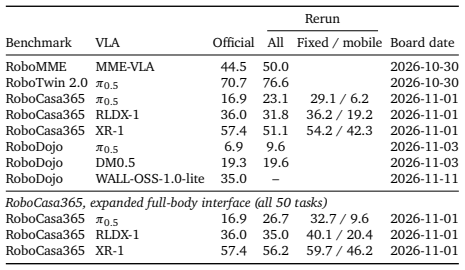
Table36 |WhereverTable2reportsbothscores,ourRerunmeets or exceeds the official leaderboard score.Official leaderboard and Rerun VLA-alone success (%; –: not rerun). Top: standard interface used in Table 2 and Figure 7. Bottom: expanded full-body RoboCasa365 interface (all 50 tasks, 1,000 episodes per VLA) used in Figure 8c.
出典 · CC BY 4.0 · Yuxiang Lai, Jike Zhong, Yu-Jhe Li, Lan Wang, Chengzhi Liu, Youbao Tang, Ming Li, Xi Xiao, Xiaofeng Yang, Liang Zhao, Zheda Mai, Ruixi Fan · Toward Agentic Robotics: A Large-Scale Study of Harness Design for Robot-Use Agents · 論文の図を引用 · 元のPDFの34ページ目から図の部分を抽出しています。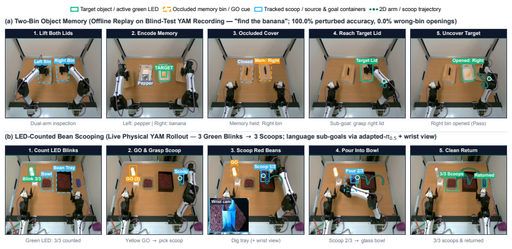
Figure 18 | Real-robot visual grounding, memory tracking, and sub-goal execution on a bimanual YAM platform. (a)Offline replay on a blind-test Two-Bin Object Memory recording (“find the banana”): policy code lifts both lids, remembers the occluded target bin, and uncovers the banana (100.0%perturbed accuracy under RGB + DINO/SAM,0.0% wrong-bin openings; Table 37).(b)Live physical LED-Counted Bean Scooping rollout (3 green blinks→ 3 scoops) driving the unmodified adapted-𝜋0.5 server via language sub-goals across all three scoop-and-pour cycles.
出典 · CC BY 4.0 · Yuxiang Lai, Jike Zhong, Yu-Jhe Li, Lan Wang, Chengzhi Liu, Youbao Tang, Ming Li, Xi Xiao, Xiaofeng Yang, Liang Zhao, Zheda Mai, Ruixi Fan · Toward Agentic Robotics: A Large-Scale Study of Harness Design for Robot-Use Agents · 論文の図を引用 · 元のPDFの36ページ目から図の部分を抽出しています。この論文を引用
Yuxiang Lai, Jike Zhong, Yu-Jhe Li, Lan Wang, Chengzhi Liu, Youbao Tang, Ming Li, Xi Xiao, Xiaofeng Yang, Liang Zhao, Zheda Mai, Ruixi Fan (2026). Toward Agentic Robotics: A Large-Scale Study of Harness Design for Robot-Use Agents. arXiv:2611.34778v1. https://arxiv.org/abs/2611.34778v1
BibTeX
@misc{lai2026toward,
  title = {{Toward Agentic Robotics: A Large-Scale Study of Harness Design for Robot-Use Agents}},
  author = {Yuxiang Lai and Jike Zhong and Yu-Jhe Li and Lan Wang and Chengzhi Liu and Youbao Tang and Ming Li and Xi Xiao and Xiaofeng Yang and Liang Zhao and Zheda Mai and Ruixi Fan},
  year = {2026},
  eprint = {2611.34778},
  archivePrefix = {arXiv},
  url = {https://arxiv.org/abs/2611.34778v1}
}