論文解説
Edit Recommendation: Can LLMs Anticipate Edit Requests from Users, and When?
Edit Recommendation:LLMはユーザーの編集要求を予測できるか、またいつ可能か
- 課題 LLMは、ユーザーの次の編集要求を事前に当てるのが難しく、文脈にない情報を含む要求では予測が大きく落ちます。
- 手法 実際の対話ログから編集要求のベンチマークを作り、当たる可能性が低い予測候補を隠す決定モデルのゲーティングを学習します。
- 結果 gpt-6.1-solはpass@5で47%を記録しました。Qwen3.5-4Bを基にしたゲーティングは、表示率20%の条件では、表示した提案のpass@5を12から25ポイント高めました。
編集要求を事前に予測する理由
LLMエージェントが成果物を作ったあと、ユーザーは通常、修正を依頼します。この論文は、その要求を応答の前に予測できるかを問うています。予測が当たれば、提案の一覧をワンクリックで送れるため、確認やフィードバックにかかる手間が減ります。ただし、ユーザーの次の発話を予測する先行研究は、対話シミュレーションやプロンプト推薦が中心で、成果物を修正する編集要求だけを評価する基準は不足していました。この論文は、編集要求の予測をedit recommendationというタスクとして定義し、そのタスクを評価するベンチマークEditRecBenchを作成しています。
EditRecBenchの構成と評価方法
タスクの定義は、文脈cと最後のアシスタント応答から、次の編集要求eを予測することです。予測器は上位K個の編集要求を出し、判定器は各予測が実際の要求の要件をすべて満たすかを確認します。1つ以上の予測が当たれば、そのサンプルは正解として数え、これをpass@kと呼びます。データは、WildChat-4.8Mの実際の対話ログから、ルールベースの事前フィルタリング、LLMによる編集要求の抽出、そして3回繰り返して同じ要求が出たサンプルだけを残す工程を経て作成しました。最終的にユーザーごとに1サンプルをランダムに選び、12,298件を得ました。時系列順にtrain、dev、testに分割しています。
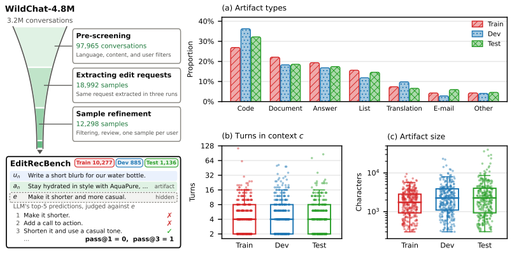
Figure 2 : Overview of EditRecBench. Left: illustration of data curation from WildChat-4.8M and task. Right: statistics for each split: (a) artifact types, (b) number of turns in contextc, and (c) artifact size ina n.
出典 · CC BY 4.0 · Kikuta, Daisuke · Edit Recommendation: Can LLMs Anticipate Edit Requests from Users, and When? · 論文の図を引用 · 元のPDFの3ページ目から図の部分を抽出しています。LLM予測器の性能とnew infoサンプル
テスト分割で複数の予測器を比較しました。1つ以上の予測器が当てた割合であるempirical ceilingは、pass@5で61%でした。最も良い予測器でも、この上限まで約14ポイントの余地があります。失敗分析では、正解の要求が文脈にない情報を含むかどうかでサンプルを分けました。新しい情報を含むnew infoサンプルは、pass@5が大きく下がりました。これは、文脈だけからは予測しにくい編集要求があることを示しており、すべての応答の後に必ず提案を表示することが、ユーザー体験にとって役立たないかもしれないという問題につながります。
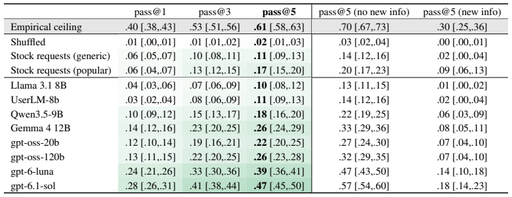
Table 1 : Left: pass@k of predictors on the test split. Right: pass@5 fornew infoandno new infosamples. Brackets denote 95% bootstrap intervals over the test samples.
出典 · CC BY 4.0 · Kikuta, Daisuke · Edit Recommendation: Can LLMs Anticipate Edit Requests from Users, and When? · 論文の図を引用 · 元のPDFの4ページ目から図の部分を抽出しています。決定モデルによるゲーティングの構造
ゲーティングモデルは、文脈cと予測リストe'を受け取り、g(c,e')を出力します。gは、予測リストのうち1つ以上が実際の要求と一致する確率を推定し、gがしきい値τ以上のときだけ、そのリストをユーザーに表示します。実装には決定モデルを使い、自然言語の指示と出力スキーマを受け取って、各選択肢についてyes/noの確率を出力します。この論文は、基盤モデルの重みを固定し、LoRAアダプタと分類ヘッドを学習します。学習目標は、判定器の3回の投票による多数決ラベルに対するクロスエントロピーで、全体のmatch項目と、予測ごとの補助項目s_iを併用します。
ゲーティングのAUROCとpass@5の改善
しきい値をdevサンプルの20%だけが通るように設定すると、testではgpt-6.1-solのpass@5が47%から62%に上がり、12から25ポイント改善しました。一方で、提案の頻度は72%減り、正解全体のうち37%しか残りませんでした。この数値は、主にさまざまな予測器を対象に測定した結果であり、実際のユーザー体験への効果は測定していません。
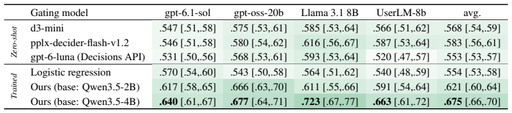
Table 3 : AUROC of gating models for LLM predictors not seen in training, which demonstrates generalization to unseen predictors. Brackets denote 95% bootstrap intervals over the test samples.
出典 · CC BY 4.0 · Kikuta, Daisuke · Edit Recommendation: Can LLMs Anticipate Edit Requests from Users, and When? · 論文の図を引用 · 元のPDFの5ページ目から図の部分を抽出しています。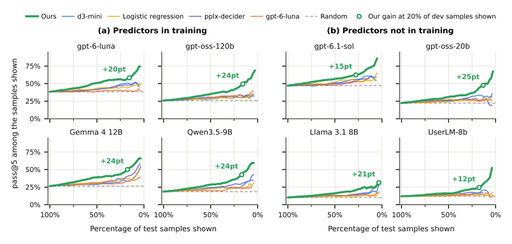
Figure 3 : pass@5 on test among the samples shown against the percentage of test samples shown. (a): predictors used for gating training. (b): predictors not used. We choose thresholds τ that let 100%, 95%, ..., 5% of dev samples pass the gate, then plot the actual percentage of test samples passing each threshold on the x-axis.
出典 · CC BY 4.0 · Kikuta, Daisuke · Edit Recommendation: Can LLMs Anticipate Edit Requests from Users, and When? · 論文の図を引用 · 元のPDFの6ページ目から図の部分を抽出しています。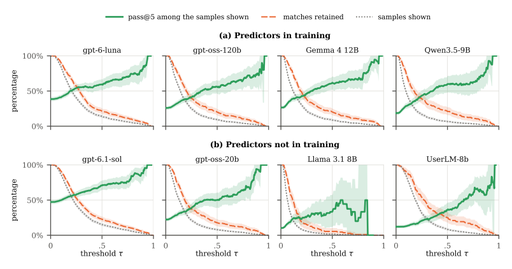
Figure 6 : Effect of the threshold τ in our gating model on pass@5 among shown suggestions, the fraction of matches retained, and the fraction of samples shown. Shaded areas are 95% bootstrap confidence intervals.
出典 · CC BY 4.0 · Kikuta, Daisuke · Edit Recommendation: Can LLMs Anticipate Edit Requests from Users, and When? · 論文の図を引用 · 元のPDFの14ページ目から図の部分を抽出しています。限界
ゲーティングモデルは文脈と予測リストの両方を受け取るため、提案を隠す場合でも、LLM予測器の推論コストは避けられません。ユーザー調査は行っていないため、表示率とpass@5が実際のユーザー体験にどう影響するかは確認されていません。評価は、オフライン指標であるpass@kと表示率に基づいています。
論文情報
- 著者
- Kikuta, Daisuke
- 学会・ジャーナル
- arXiv · プレプリント
- 公開日
- 2026年11月16日
- 登録日
- 2026年11月17日
- 更新日
- 2026年11月16日
- バージョン
- v1
- arXiv
- 2611.21155
- カテゴリ
- cs.CL · cs.AI · cs.HC
- ライセンス
- CC BY 4.0
- 掲載内容
- 論文情報・解説・論文の図
この解説は、Refivuの韓国語解説をAIで翻訳したものです。不正確な翻訳や誤りが含まれる可能性があります。論文と図の利用条件は各出典に従います。
アブストラクト
After a large language model (LLM) agent generates an artifact, users often send edit requests for it. This paper studies whether an LLM can anticipate these requests before they are sent. Such anticipation is useful in practice because it reduces the effort of user review and feedback. We formalize this task as edit recommendation and build EditRecBench, a benchmark for evaluating the performance of LLMs on this task, from real-world conversation logs in WildChat-4.8M. Through benchmarking and failure analysis, we identify a practical challenge that some cases are inherently difficult to predict in real-world settings. To address this, we introduce decision model-based gating to filter out cases where predictions are unlikely to be correct before they are presented to the user. Our trained model outperforms existing decision models and raises pass@5 among shown suggestions by 12--25 points at a gating threshold. Our code is available at https://github.com/ntt-dkiku/llm-edit-recommendation.
この論文を引用
Kikuta, Daisuke (2026). Edit Recommendation: Can LLMs Anticipate Edit Requests from Users, and When?. arXiv:2611.21155v1. https://arxiv.org/abs/2611.21155v1
BibTeX
@misc{daisuke2026edit,
  title = {{Edit Recommendation: Can LLMs Anticipate Edit Requests from Users, and When?}},
  author = {Kikuta, Daisuke},
  year = {2026},
  eprint = {2611.21155},
  archivePrefix = {arXiv},
  url = {https://arxiv.org/abs/2611.21155v1}
}