論文解説
Risk-Averse Decision-Focused Learning: Minimizing CVaR of Regret
regretのCVaRを最小化するリスク回避型DFL
- 課題 平均regretで学習すると、まれに起きる大きな損失を見逃し、高リスクな決定で裾の危険が残ります。
- 手法 CVaRの双対形式とエントロピー正則化により滑らかな代理目的を作り、既存のDFLの勾配をインスタンス重みで再調整します。
- 結果 異質なロングテールのshortest-pathでは、RESTRO SPO+(exact η)がCVaR0.9 regretで4.99±0.63を記録し、SPO+の11.04±0.96より低くなりました。
点予測学習の裾のリスク問題
予測モデルを平均誤差で学習すると、決定品質の平均は良くなることがありますが、まれに生じる大きなregretを十分に減らせません。緊急車両の配車のような高リスクな場面では、平均regretよりも裾のregretが重要です。既存のリスク考慮型の手法は、推論時に確率的最適化または頑健最適化を解く必要があり、計算コストが大きくなります。この論文は、点予測と決定論的最適化を保ったまま、regretのCVaRを下げることを目標としています。
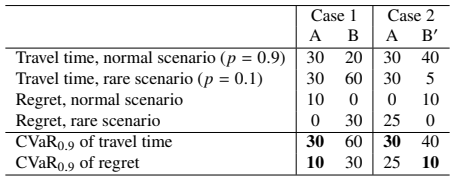
Table 1 : Travel times and regrets (in minutes) in the illustrative example. Bold entries mark the route preferred by each CVaR objective.
出典 · CC BY 4.0 · Jayanta Mandi, Senne Berden, Victor Bucarey, Concepcion Dominguez, Tias Guns · Risk-Averse Decision-Focused Learning: Minimizing CVaR of Regret · 論文の図を引用 · 元のPDFの5ページ目から図の部分を抽出しています。CVaR代理損失とインスタンス重み
論文は、CVaRの双対表現にエントロピー正則化を加えて、滑らかな代理目的を作ります。各インスタンスの重みλ_iはシグモイド形で計算され、正規化した形では損失ℓ_iを閾値ηで割った値を用います。この重みは、閾値以上の損失を持つインスタンスに大きな値を与えます。勾配の導出では、λ_iを定数として扱い、既存のDFL損失の部分勾配に掛けます。そのため、SPO+のような既存の損失に再重み付けを加える形で適用できます。
SPO+に基づく汎化境界
SPO+はregretを点ごとに上から抑えるため、SPO+損失のCVaRはregretのCVaRの上界になります。論文は、この関係とRademacher複雑度を用いて、population CVaR of regretがRESTRO目的と複雑度項で上から抑えられる境界を示しています。この境界には、コストベクトルがほぼ確実に有界であり、仮説クラスが一様に有界であるという仮定が必要です。また、エントロピー平滑化によって生じるバイアスはβで調整され、論文ではβが√N程度まで大きくなると統計誤差と合うと議論しています。
異質なロングテールデータでの結果
異質なロングテールのコストを入れたshortest-path設定では、RESTRO SPO+(exact η)がCVaR0.9 regretで4.99±0.63を記録し、SPO+は11.04±0.96でした。knapsack設定では、RESTRO SPO+(quantile η)が8.07±0.90、SPO+が20.54±5.11を記録しました。両方の値は5つのランダムシードの平均と標準偏差で、1000個のテストインスタンスでα=0.9として計算しています。この結果は、一部の係数にだけ裾のコストがある設定で得られたものです。
同質データでの差
標準のPyEPOの同質なコストベクトルでは、SPO+がすでに低いCVaR0.9 regretを示していました。shortest-pathではSPO+が0.38±0.07、RESTRO SPO+(exact η)が0.38±0.06で、knapsackでは両値がそれぞれ1.61±0.07と1.61±0.11でした。この設定ではβが概ね小さく選ばれ、重みがほぼ一様になったため、RESTROはSPO+と同程度に動作しました。
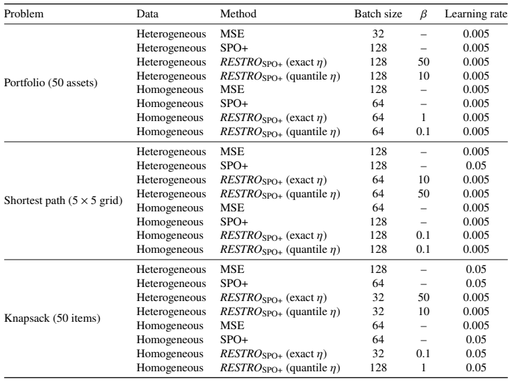
Table 2 :Selected Hyperparameters for Each Problem, Dataset, and Method.
出典 · CC BY 4.0 · Jayanta Mandi, Senne Berden, Victor Bucarey, Concepcion Dominguez, Tias Guns · Risk-Averse Decision-Focused Learning: Minimizing CVaR of Regret · 論文の図を引用 · 元のPDFの12ページ目から図の部分を抽出しています。エネルギー考慮型スケジューリングの結果
エネルギー考慮型スケジューリングでは、元データにおいてすべてのDFL手法がMSEより改善し、RESTRO SPO+(exact η)は157,237.15で、SPO+ (cached)の159,213.45より低くなりました。異質な変種では、RESTRO SPO+(quantile η)が227,848.71を記録し、SPO+ (cached)の238,957.60より低くなりました。これらは5つのランダムシードの平均です。元データのnon-cached SPO+は、同じ比較には含まれていません。
損失の適用範囲と残された課題
効果はSPO+で最も強く、一貫していました。論文では、IMLEやPFYのようにregretの点ごとの上界を持たない損失には、この保証は直接には拡張されないと述べられています。制約条件の不確実性は今回の研究の範囲外で、今後の課題として残されています。
論文情報
- 著者
- Jayanta Mandi, Senne Berden, Victor Bucarey, Concepcion Dominguez, Tias Guns
- 学会・ジャーナル
- arXiv · プレプリント
- 公開日
- 2026年11月14日
- 登録日
- 2026年11月17日
- 更新日
- 2026年11月14日
- バージョン
- v1
- arXiv
- 2611.19575
- カテゴリ
- cs.LG · cs.AI
- ライセンス
- CC BY 4.0
- 掲載内容
- 論文情報・解説・論文の図
この解説は、Refivuの韓国語解説をAIで翻訳したものです。不正確な翻訳や誤りが含まれる可能性があります。論文と図の利用条件は各出典に従います。
アブストラクト
Many combinatorial optimization (CO) problems involve parameters that are uncertain when the problem must be solved. In such settings, the parameters have to be predicted from correlated contextual information before a solution can be computed. \emph{Decision-focused learning} (DFL) addresses this by training the predictive model to produce predictions that optimize downstream decision quality. Most existing DFL methods are risk-neutral and minimize the expected regret. In high-stakes applications this can lead to undesirable outcomes, because decision-makers must also account for the tail risk of decision quality. Prior risk-sensitive approaches typically model uncertainty explicitly and solve a stochastic or robust optimization problem at inference time, which increases computational complexity. We instead propose a DFL framework that achieves risk-sensitive behavior while retaining point predictions and deterministic optimization at inference time. Starting from the dual representation of the Conditional Value-at-Risk (CVaR) and adding entropy regularization, we derive a smooth surrogate for the CVaR of regret. Its gradient induces an instance-dependent reweighting within each minibatch that emphasizes high-risk outcomes, so the approach can turn existing surrogate-loss DFL methods, including the SPO+ loss, into risk-sensitive variants. When instantiated with SPO+, the resulting objective admits a generalization bound on the CVaR of the true regret. Experiments on knapsack, portfolio, shortest-path, and energy-aware scheduling problems show substantial reductions in tail regret when the uncertain parameters exhibit heterogeneous tail behavior.
この論文を引用
Jayanta Mandi, Senne Berden, Victor Bucarey, Concepcion Dominguez, Tias Guns (2026). Risk-Averse Decision-Focused Learning: Minimizing CVaR of Regret. arXiv:2611.19575v1. https://arxiv.org/abs/2611.19575v1
BibTeX
@misc{mandi2026risk,
  title = {{Risk-Averse Decision-Focused Learning: Minimizing CVaR of Regret}},
  author = {Jayanta Mandi and Senne Berden and Victor Bucarey and Concepcion Dominguez and Tias Guns},
  year = {2026},
  eprint = {2611.19575},
  archivePrefix = {arXiv},
  url = {https://arxiv.org/abs/2611.19575v1}
}