論文解説
ANCHOR: A Port-Hamiltonian Model for Forecasting Team Dynamics in Human-in-the-Loop Systems
ANCHOR:Human-in-the-Loopシステムにおけるチーム動態予測のためのPort-Hamiltonianモデル
- 課題 チームの相互作用は時間とともに乱れて崩れていきます。ブラックボックス型の予測器は、少ないチームで学習するのが難しく、繰り返し予測すると不安定になり、設計者が解釈しにくいという課題があります。
- 手法 チームを静止点の周りにあるエネルギーの器の中のボールとみなし、調整・交換・タスク入力を備えたスイッチ型Port-Hamiltonianモデルで状態を予測します。
チーム相互作用予測が難しい理由
複数人で働くチームでは、発話の分布、視線の共有、近くに立つ程度が時間とともに変わり、1人が発話を独占したり、チームが共有の焦点を失ったりする崩壊が起きます。この論文は、複合現実ヘッドセットが発話、視線、姿勢を検知し、短い手がかりを出せる状況を想定しています。そのうえでループを閉じるには、少ないチーム数で学習でき、繰り返し予測しても安定しており、設計者が読み取れるチームモデルが必要だと考えています。既存のブラックボックス型予測器は、この3つの要件を同時に満たすのが難しく、それが問題設定だとされています。
静止点とエネルギーの器
ANCHORは、チームの状態qを静止点q★の周りの偏差z=q−q★で表し、エネルギーH=(1/2)z^T K zによって偏差の大きさを測ります。静止点は、直近5つの窓の指数平均、セッション履歴、人口平均を要素ごとの重み付き混合で計算します。各行動について3つの重みは非負で、合計は1です。エネルギー項だけでは、チームが静止点へ戻る向きが決まらないため、調整行列R_σと交換行列J_σを加えます。その結果、dz/dtは(J_σ−R_σ)Kz+g uの形で与えられます。ここでJ_σは反対称なので全エネルギーを変えず、R_σは正定値なのでエネルギーを取り除きます。
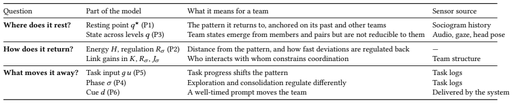
Table 2 : From team behaviour to ANCHOR, in plain terms. The principles P1–P6 and their sources are listed above, and table 4 gives the test of each part on held-out teams.
出典 · CC BY 4.0 · Diana Romero, Salma Elmalaki · ANCHOR: A Port-Hamiltonian Model for Forecasting Team Dynamics in Human-in-the-Loop Systems · 論文の図を引用 · 元のPDFの3ページ目から図の部分を抽出しています。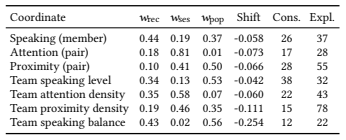
Table 15 : Fitted model on all teams. Anchor weights; shift of the resting point per unit of remaining work (negative: it rises as images are decided); and recovery time constants in seconds in consolidation and exploration.
出典 · CC BY 4.0 · Diana Romero, Salma Elmalaki · ANCHOR: A Port-Hamiltonian Model for Forecasting Team Dynamics in Human-in-the-Loop Systems · 論文の図を引用 · 元のPDFの18ページ目から図の部分を抽出しています。エネルギー収支と有界性
離散化された予測は中点規則により1ステップずつ進め、命題1のエネルギー収支H_{h+1}−H_h = −v^T R_σ v + v^T g ū_hを正確に保ちます。ここでv=(1/2)K(z_h+z_{h+1})は、ステップの中間におけるエネルギーの勾配です。タスク入力がなければエネルギーは減るだけです。調整行列が正定値であれば、1ステップごとにエネルギーのノルムが係数ρ<1の分だけ縮みます。命題2は、手がかりの大きさδと最小間隔τが与えられたとき、∥z_h∥_K ≤ ρ^h∥z_0∥_K + δ/(1−ρ^τ)によって偏差が抑えられると述べています。この上界は静止点が固定されている場合の結果です。
静止点が各窓で再計算される場合は、付録Eで別途扱われています。
実際のチームの偏差減衰
検証の最初の問いは、実際のチームも球形の器のように静止点へ戻るのかどうかです。17個の未観測チームで、偏差が残る割合m_hを測定しました。32秒後の実際の偏差は24%が残っており、ANCHORの予測の30%に近い値でした。セッションをシャッフルした場合はほぼ0になり、減衰が時間順序から生じることが対比されています。ただしAR(1)の代理モデルと比べると、実際のチームの方が速く減衰します。行動ごとの結果では、注意(attention)のペアが予測より速く減っており、モデルは保守的に予測しています。
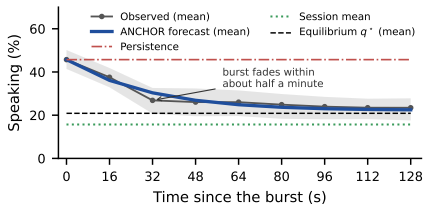
Figure 2 : Speaking bursts fade, and ANCHOR predicts how. Curves average all 137 bursts on held-out teams in which a member speaks at least 20 points above their session average. ANCHOR (blue), fitted without the team, follows the decay, whereas persistence assumes that the burst continues and the session mean assumes that it never happened.
出典 · CC BY 4.0 · Diana Romero, Salma Elmalaki · ANCHOR: A Port-Hamiltonian Model for Forecasting Team Dynamics in Human-in-the-Loop Systems · 論文の図を引用 · 元のPDFの3ページ目から図の部分を抽出しています。原理ごとの除去実験
各モデル部分を代替構成に置き換え、未観測チームで再学習した結果を示します。静止点を直近の行動だけで決めると、メンバー・ペアのnMSEが19.3%増えました。17チーム中17チームでANCHORの方が良い結果でした。チームレベルの状態をメンバーの予測から計算すると、誤差が大きく増えました。段階(位相)、タスクポート、減衰項は同程度の結果で、縮小モデルと差がありませんでした。したがって、この結果が支持するのは、静止点の混合と動態、チームレベルの状態、共有の接続構造の有用性です。位相とタスクポートは、精度の根拠としてではなく、保証と入力経路のために残されたものです。
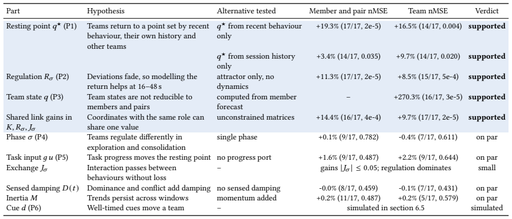
Table 4 : The hypothesis behind each part of the model and what held-out teams say about it. Each test replaces one part with the alternative shown and retrains the full model, which here also contains the sensed damping. Cells give the change in held-out nMSE, so a positive change means the part helps, followed by the number of teams for which ANCHOR is better and the paired Wilcoxon 𝑝. Errors are over 16–256 s, except for P2 (16–48 s, where dynamics act) and P3 (speaking balance). Shaded: supported (𝑝< 0.05). On par: the reduced model reaches the same accuracy, and these parts are kept because they carry a guarantee or the channel for task progress and cues.
出典 · CC BY 4.0 · Diana Romero, Salma Elmalaki · ANCHOR: A Port-Hamiltonian Model for Forecasting Team Dynamics in Human-in-the-Loop Systems · 論文の図を引用 · 元のPDFの7ページ目から図の部分を抽出しています。
table 3 . The selected model is within 1% of several neighbours. The rows from “attractor: recent only” on remove one part from the switched topology-tied model with sensed damping (54 parameters), as in table 4; diag, equiv and full denote the topology-tied, looser-tie and free-matrix families, friction is the sensed damping, and scale coupling is the tie 𝜒 between levels.
出典 · CC BY 4.0 · Diana Romero, Salma Elmalaki · ANCHOR: A Port-Hamiltonian Model for Forecasting Team Dynamics in Human-in-the-Loop Systems · 論文の図を引用 · 元のPDFの16ページ目から図の部分を抽出しています。ベースラインモデルとの精度比較
ANCHORは52個のパラメータで、augmented ridgeと同程度の誤差を示しました。ridgeは約40,000個のパラメータを使い、16~256秒の区間でANCHORより1.5%高い誤差を記録しました。この差は有意ではないため、on parに分類されます。評価はleave-one-team-outクロスバリデーションにより未観測チームで行い、指標は学習分散で正規化したnMSEです。同じ構造を持たず、すべての行列を自由に置いたモデルは、データが少ない場合に不利だったと報告されています。
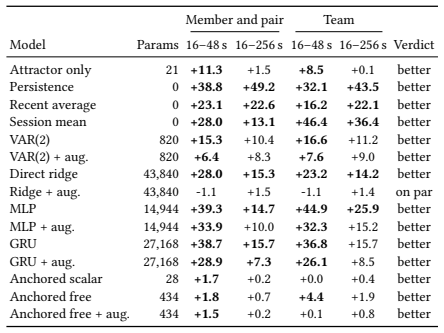
Table 5 : Forecast error of each model relative to ANCHOR on held-out teams: how much higher its error is, averaged over teams (%; positive: higher error than ANCHOR). Bold: significant (paired Wilcoxon over the 17 teams, 𝑝< 0.05). Ver- dict for ANCHOR: better if significantly better in at least one column and worse in none; on par if no column is significant. The anchored models use ANCHOR’s fitted anchors, which favors them. Win counts, 𝑝-values and absolute errors are in tables 13 and 14 in section F.2.
出典 · CC BY 4.0 · Diana Romero, Salma Elmalaki · ANCHOR: A Port-Hamiltonian Model for Forecasting Team Dynamics in Human-in-the-Loop Systems · 論文の図を引用 · 元のPDFの8ページ目から図の部分を抽出しています。
Table 11 : All model families and ablations (nMSE on held-out teams, lower is better). Params: free parameters, counted as in
出典 · CC BY 4.0 · Diana Romero, Salma Elmalaki · ANCHOR: A Port-Hamiltonian Model for Forecasting Team Dynamics in Human-in-the-Loop Systems · 論文の図を引用 · 元のPDFの16ページ目から図の部分を抽出しています。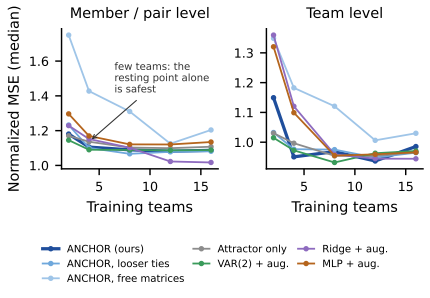
Figure 14 : Error versus the number of training teams, as the median over held-out teams and random training subsets. With very few teams the resting point alone is the safest forecast. ANCHOR, looser ties and ANCHOR, free matrices are the permutation-equivariant and unconstrained variants of section C.
出典 · CC BY 4.0 · Diana Romero, Salma Elmalaki · ANCHOR: A Port-Hamiltonian Model for Forecasting Team Dynamics in Human-in-the-Loop Systems · 論文の図を引用 · 元のPDFの18ページ目から図の部分を抽出しています。崩壊の早期警告と手がかりのシミュレーション
崩壊の警告は、発話バランスの座標が学習チームの25番目の百分位数を下回る事象を、64秒以内に予測するタスクです。この設定で、ANCHORは発話崩壊のAUROC 0.85を記録し、20%の誤警報率で崩壊開始の74%を捉えました。手がかりのタイミングは、実際のセッションに手がかりがないため、効果を仮定したシミュレーションでのみ評価しました。仮定した効果が学習時の標準偏差0.5の場合、ANCHORによる予測型の方策は、周期的な手がかりに比べて手がかり1回あたりの崩壊時間を2.2倍多く減らしました。この数値は実際のチームに対する手がかり効果の測定ではないため、現場の効果として扱うべきではありません。
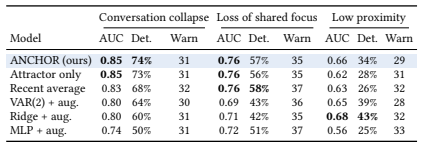
Table 6 : Warning of a breakdown that starts within the next 64 s and is absent now, on held-out teams. AUC: AUROC (0.5 = chance); Det.: share of onsets detected when alarms fire at 20% of origins without a breakdown; Warn: mean warning time (s). Shaded: ANCHOR; bold: best in each column.
出典 · CC BY 4.0 · Diana Romero, Salma Elmalaki · ANCHOR: A Port-Hamiltonian Model for Forecasting Team Dynamics in Human-in-the-Loop Systems · 論文の図を引用 · 元のPDFの9ページ目から図の部分を抽出しています。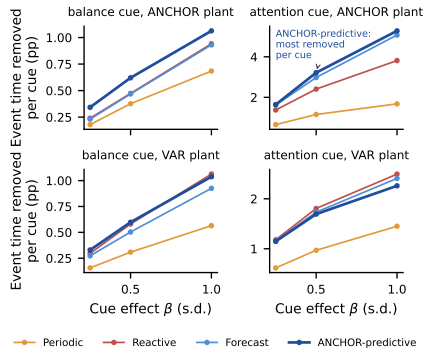
Figure 8 : Simulated cues under an assumed effect 𝛽. Break- down time removed per cue (percentage points of the episode; higher is better), on ANCHOR itself (top) and on an inde- pendently learned V AR plant (bottom). ANCHOR-predictive (thick blue) is on top in 6 of 6 settings on its own plant and in 2 of 6 on the V AR plant.
出典 · CC BY 4.0 · Diana Romero, Salma Elmalaki · ANCHOR: A Port-Hamiltonian Model for Forecasting Team Dynamics in Human-in-the-Loop Systems · 論文の図を引用 · 元のPDFの10ページ目から図の部分を抽出しています。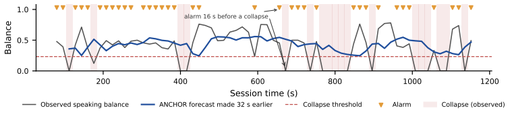
Figure 16 : Early warning on the longest session (team 8). Grey: observed speaking balance; blue: ANCHOR forecast made 32 s earlier, which follows the slow drift of the balance rather than its window-to-window swings; dashed: collapse threshold; shaded: windows in collapse; triangles: alarms at the pooled 20% false-alarm level. Most collapses are preceded by an alarm, but this chronically uneven team also triggers many alarms that are not followed by a collapse.
出典 · CC BY 4.0 · Diana Romero, Salma Elmalaki · ANCHOR: A Port-Hamiltonian Model for Forecasting Team Dynamics in Human-in-the-Loop Systems · 論文の図を引用 · 元のPDFの20ページ目から図の部分を抽出しています。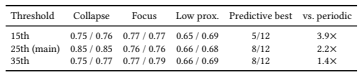
Table 18 : Sensitivity to the breakdown threshold (training percentile). Early warning: AUROC of ANCHOR / best other model for conversation collapse, loss of shared focus and low proximity. Intervention: settings (of 12) in which ANCHOR- predictive is the most cue-efficient policy, and its breakdown time removed per cue relative to periodic cueing at 𝛽= 0.5s.d. The remaining settings are won by reactive cueing, and at the 35th percentile also by the forecast policy.
出典 · CC BY 4.0 · Diana Romero, Salma Elmalaki · ANCHOR: A Port-Hamiltonian Model for Forecasting Team Dynamics in Human-in-the-Loop Systems · 論文の図を引用 · 元のPDFの20ページ目から図の部分を抽出しています。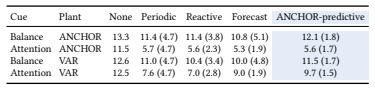
Table 19 : Time in breakdown and cue budget at cue effect 𝛽= 0.5s.d. Each cell gives the share of the episode spent in the breakdown (%, lower is better), with the number of cues per 10 min in parentheses. Shaded: ANCHOR-predictive, the most selective policy.
出典 · CC BY 4.0 · Diana Romero, Salma Elmalaki · ANCHOR: A Port-Hamiltonian Model for Forecasting Team Dynamics in Human-in-the-Loop Systems · 論文の図を引用 · 元のPDFの20ページ目から図の部分を抽出しています。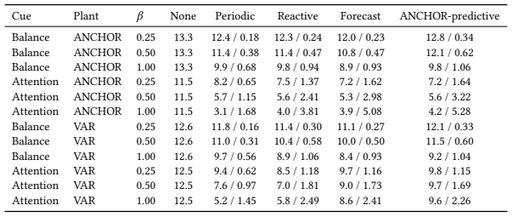
Table 20 : Simulated interventions for every assumed cue effect 𝛽 (training s.d.): share of the episode in the breakdown (%, lower is better) / breakdown time removed per cue (percentage points, higher is better). ANCHOR-predictive is the most efficient policy in 8 of the 12 settings, and reactive cueing in the others.
出典 · CC BY 4.0 · Diana Romero, Salma Elmalaki · ANCHOR: A Port-Hamiltonian Model for Forecasting Team Dynamics in Human-in-the-Loop Systems · 論文の図を引用 · 元のPDFの21ページ目から図の部分を抽出しています。適用範囲と仮定
この研究は、1つの課題、部屋の大きさは1種類、4人の同僚チームで行われました。そのため、学習されたアンカーとゲインの値はこの課題のものであり、構造は別の課題で再学習する必要があります。手がかりの効果は、記録されたセッションに実際の手がかりがないため、仮定した値でのみ評価しました。手がかりによって静止点が動く長期の上界は、最悪の場合を示す保守的な分析であり、現場での確認は残されています。
論文情報
- 著者
- Diana Romero, Salma Elmalaki
- 学会・ジャーナル
- arXiv · プレプリント
- 公開日
- 2026年11月14日
- 登録日
- 2026年11月17日
- 更新日
- 2026年11月14日
- バージョン
- v1
- arXiv
- 2611.19124
- カテゴリ
- eess.SY · cs.HC · cs.LG
- ライセンス
- CC BY 4.0
- 掲載内容
- 論文情報・解説・論文の図
この解説は、Refivuの韓国語解説をAIで翻訳したものです。不正確な翻訳や誤りが含まれる可能性があります。論文と図の利用条件は各出典に従います。
アブストラクト
Cyber-physical-human systems close a loop around people by sensing human behavior, predict it and act on it. Human teams are a natural target, because collaboration breaks down in ways that a timely prompt could prevent. Collaborative mixed reality makes this loop practical, since each headset senses who speaks, where its wearer looks and who stands together, and it can deliver a light prompt. In this loop, the headsets are sensors, the prompts are actuators and the team is the plant. Closing the loop needs a plant model that is small enough to learn from few teams, safe to iterate and readable by a designer. We propose ANCHOR, which models a team as a ball in an energy bowl. The bottom of the bowl is where the team rests, and it is set by the team's recent behavior, its own history and other teams. Formally, ANCHOR is a switched port-Hamiltonian system with 52 parameters, and each part stands for a testable claim from team psychology. Because of this structure, for any fitted parameters, a forecast moves away from rest only when task progress or a prompt pushes it, and prompts of bounded size that are spaced in time move it a bounded distance. On \nGroups{} four-person teams held out from training, a team that drifts from its usual behavior returns most of the way within half a minute. After 32 s, about 24% of the deviation remains, and ANCHOR predicted 30%. Forecasts are clearly better when the resting point blends its three sources than when it uses one. ANCHOR matches the accuracy of a black-box baseline with about 40,000 parameters. It anticipates conversation collapse with an AUROC of 0.85. In simulation under assumed prompt effects, it removes 2.2 times as much breakdown time per prompt as periodic prompting.
この論文を引用
Diana Romero, Salma Elmalaki (2026). ANCHOR: A Port-Hamiltonian Model for Forecasting Team Dynamics in Human-in-the-Loop Systems. arXiv:2611.19124v1. https://arxiv.org/abs/2611.19124v1
BibTeX
@misc{romero2026anchor,
  title = {{ANCHOR: A Port-Hamiltonian Model for Forecasting Team Dynamics in Human-in-the-Loop Systems}},
  author = {Diana Romero and Salma Elmalaki},
  year = {2026},
  eprint = {2611.19124},
  archivePrefix = {arXiv},
  url = {https://arxiv.org/abs/2611.19124v1}
}