論文解説
Large Language Models for AI Infrastructure
AIインフラのための大規模言語モデル
- 課題 AIインフラの設計、運用、データとエネルギーの管理に使われるLLMの研究は複数の分野に散らばっており、報告された成果を一つの枠組みで比較しにくい状況です。
- 手法 ライフサイクルを7段階に分け、LLMが管理する資源に応じて手法を3つのグループと8つのカテゴリに分類しています。
AIインフラとLLM活用に関する分散した文献
AIインフラは、アクセラレータ設計、カーネルエンジニアリング、コンパイル、デプロイと推論サービング、クラスタ運用、データ供給、電力管理が互いに絡み合ったライフサイクルです。一方で、この領域のLLM活用の研究はハードウェア設計、機械学習システム、EDA、HPCに分散しており、一つの流れとして比較するのは難しい状況です。この論文は、こうした文献をライフサイクルの観点からまとめ、各手法がLLMで管理する主要な資源、評価に使うフィードバック、評価結果を基準に整理しています。
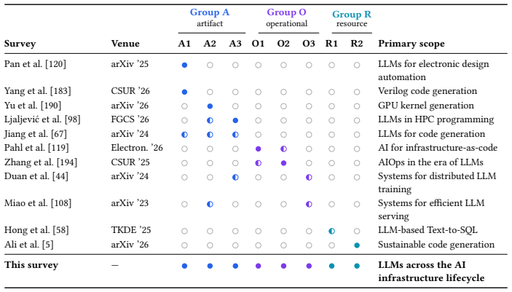
Table 1 . Principal scope of selected related surveys under the proposed taxonomy. primary topic; related coverage;
出典 · CC BY 4.0 · Bolin Shen, Shaoyi Huang, Yushun Dong · Large Language Models for AI Infrastructure · 論文の図を引用 · 元のPDFの5ページ目から図の部分を抽出しています。3つのグループと8つのカテゴリによる分類の枠組み
論文は、LLMが主に管理する資源をもとに、手法を3つのグループに分けています。成果物を生成するartifact-centricグループ(A1 ハードウェア設計、A2 カーネルエンジニアリング、A3 HPCソフトウェア)、デプロイの文脈やシステムの状態を扱うoperational-centricグループ(O1 システム統合、O2 運用、O3 ワークロードオーケストレーション)、データとエネルギーを扱うresource-centricグループ(R1 データ管理、R2 エネルギー最適化)です。ライフサイクルは7段階に配置され、主カテゴリは主な貢献に応じて決め、残りの目的は付随する属性として残しています。
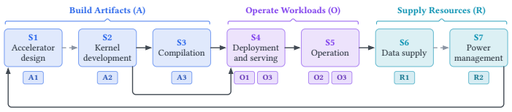
Fig. 2 . Lifecycle of AI infrastructure engineering. Seven stages form three phases that place the artifact-centric (A), operational-centric (O), and resource-centric (R) groups on the lifecycle; the chips below each stage list the categories whose primary contribution falls in it. Solid arrows mark hand-offs at which the output of an LLM-driven method in one stage has been evaluated in the next; dashed arrows mark hand-offs without such an end-to-end evaluation.
出典 · CC BY 4.0 · Bolin Shen, Shaoyi Huang, Yushun Dong · Large Language Models for AI Infrastructure · 論文の図を引用 · 元のPDFの4ページ目から図の部分を抽出しています。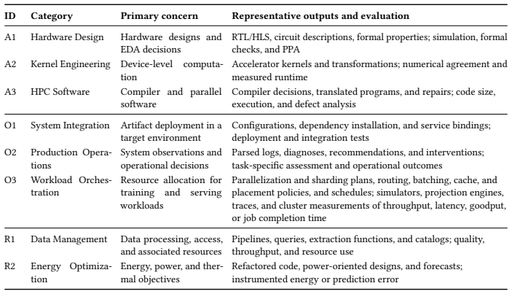
Table 16 . Lifecycle-aligned taxonomy of LLM applications to AI infrastructure (eight categories). The principal contribution and evaluation objective determine the primary category. Secondary objectives remain attributes of a study rather than evidence that categories are disjoint.
出典 · CC BY 4.0 · Bolin Shen, Shaoyi Huang, Yushun Dong · Large Language Models for AI Infrastructure · 論文の図を引用 · 元のPDFの42ページ目から図の部分を抽出しています。共通のタスク定式化
各インフラタスクは、入力I、候補行動空間A、環境E、フィードバック関数F、コストJで表されます。候補aを評価すると、フィードバックfはF(E, a; I)として得られ、タスクはFeasible(E, a; I)=⊤の条件のもとでJ(E, a; I)を最小化する制約付き最適化として書かれます。ここでFeasibleは、正確性、セキュリティ、サービス要件を満たすかどうかを表し、フィードバックはその条件の代理指標にすぎない点が重要です。テストがカバーしない場合やシミュレータに基づく評価は、デプロイ時の実際の性質と異なることがあります。
KernelBenchのfast_p指標とフィードバックの効果
KernelBenchは、正解であり基準実装より速い候補が得られたタスクの割合としてfast_pを定義しています。候補の予算kを設定し、各タスクでk個のうち1つでも正解で、基準に対する速度がしきい値pを超えるかを数え、平均します。論文の表3のKernelBenchの行では、Level 1で見ると、fast1は1 attemptと比べて10 callsとした設定で、DeepSeek-R1が12から43に上がったと報告されています。同じ表では、フィードバックチャネルを追加する効果はモデルとタスクによって異なり、プロファイル情報は一部の設定で下がりました。したがって、フィードバックはモデルと合わせて評価する必要があります。
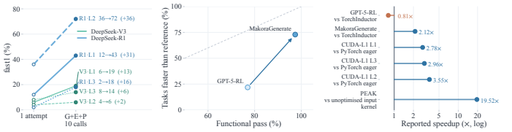
Fig. 5 . Kernel-generation performance under feedback refinement and study-specific execution references. Panel (a) uses KernelBench on L40S [ 118]; panel (b) uses the TorchInductor [ 8] protocol [ 155]; panel (c) includes different baselines and aggregation rules [85, 153, 155]. fast1 requires both correctness and faster execution. Both coordinates in (b) are task percentages; speedups in (c) are factors relative to the named baseline. Higher is better, and a speedup below1×denotes a slowdown.
出典 · CC BY 4.0 · Bolin Shen, Shaoyi Huang, Yushun Dong · Large Language Models for AI Infrastructure · 論文の図を引用 · 元のPDFの24ページ目から図の部分を抽出しています。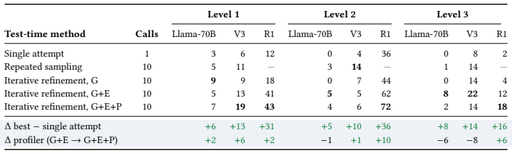
Table 11 . fast1 of test-time methods on KernelBench [118]. Levels 1, 2, and 3 contain 100, 100, and 50 tasks; all runs use an NVIDIA L40S GPU and the PyTorch eager reference. G, E, and P return the previous generation, the execution result, and the timing profile to the model. fast1 is the percentage of tasks that are both correct and faster than the reference; higher is better. The Δ rows give percentage-point changes. Bold marks column maxima; a dash denotes that repeated sampling is unavailable for the fixed-temperature DeepSeek-R1 endpoint.
出典 · CC BY 4.0 · Bolin Shen, Shaoyi Huang, Yushun Dong · Large Language Models for AI Infrastructure · 論文の図を引用 · 元のPDFの25ページ目から図の部分を抽出しています。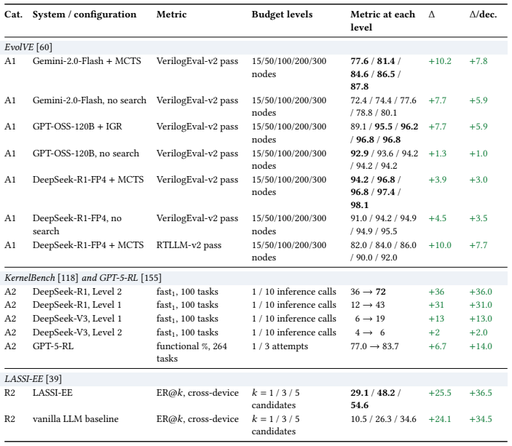
Table 22 . Performance across test-time budgets. EvolVE varies the number of search nodes on VerilogEval-v2 and RTLLM-v2 [60]; KernelBench and GPT-5-RL vary the number of inference calls or attempts [118, 155]; LASSI-EE varies the number of sampled candidates𝑘 [39]. Metric values follow the listed budget order. Δ is the endpoint change in the native metric, and Δ/dec. is the change per tenfold budget increase. Bold marks the better value of each matched pair or the best value within a block.
出典 · CC BY 4.0 · Bolin Shen, Shaoyi Huang, Yushun Dong · Large Language Models for AI Infrastructure · 論文の図を引用 · 元のPDFの51ページ目から図の部分を抽出しています。ワークロードオーケストレーションの結果と評価環境
O3の結果は、シミュレータ、投影エンジン、実クラスタ、本番デプロイで得られたもので、同じ倍率でも環境や基準手法によって意味が異なります。著者らは、大きな倍率は主にシミュレータとオフラインハーネスで出ており、実クラスタの結果は全体的に小さいと整理しています。そのため、この分野の利得は評価環境とあわせて報告する必要があり、シミュレータの結果と実クラスタの結果を一つの軸で順位づけしてはいけません。主な結果指標であるgoodputとJCTも測定対象が異なるため、直接比較はしていません。
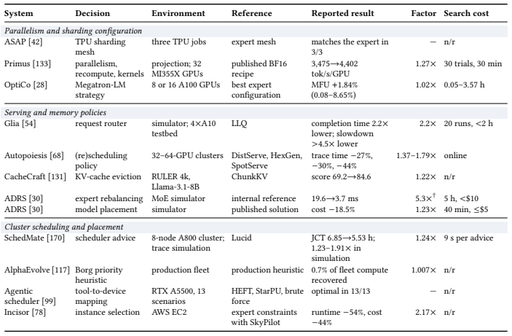
Table 19 . Workload-orchestration results under native evaluation conditions. Factors are derived from the reported values as in Figure 7; a dash means that the study reports agreement or optimality rather than a ratio, and n/r means not reported. Glia’s simulator runs Llama-3-8B on four A10 GPUs; CacheCraft’s result is at 88% KV-cache compression.†ADRS reports this speedup as 5.0× in its case-study text and as 2× in its summary table; the factor shown is computed from the reported runtimes.
出典 · CC BY 4.0 · Bolin Shen, Shaoyi Huang, Yushun Dong · Large Language Models for AI Infrastructure · 論文の図を引用 · 元のPDFの49ページ目から図の部分を抽出しています。まだ空白のライフサイクル領域
論文では、チェックポインティング、ストラグラー緩和、量子化の選択、データローディングのような学習とサービングのconcernにおいて、LLMがエンジニアリングの主体として使われたシステムは見つからなかったと報告されています。同じ文脈で、電力キャッピングのようなAIワークロードのエネルギー管理も見つからなかったとされています。この空白の領域は著者らが今後の研究の優先課題として挙げたもので、検索範囲内で確認された結果です。
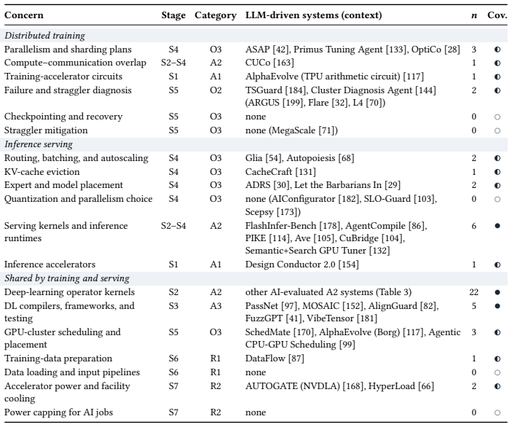
Table 17 . Coverage of AI-specific training and serving concerns by LLM-driven methods. 𝑛 counts the LLM- driven systems for each concern; 𝑛≥ 4, 1≤𝑛≤ 3, 𝑛= 0. Systems in parentheses address the concern without an LLM acting as the engineering agent and are not counted.
出典 · CC BY 4.0 · Bolin Shen, Shaoyi Huang, Yushun Dong · Large Language Models for AI Infrastructure · 論文の図を引用 · 元のPDFの43ページ目から図の部分を抽出しています。論文情報
- 著者
- Bolin Shen, Shaoyi Huang, Yushun Dong
- 学会・ジャーナル
- arXiv · プレプリント
- 公開日
- 2026年11月14日
- 登録日
- 2026年11月17日
- 更新日
- 2026年11月14日
- バージョン
- v1
- arXiv
- 2611.19061
- カテゴリ
- cs.AI · cs.CL
- ライセンス
- CC BY 4.0
- 掲載内容
- 論文情報・解説・論文の図
この解説は、Refivuの韓国語解説をAIで翻訳したものです。不正確な翻訳や誤りが含まれる可能性があります。論文と図の利用条件は各出典に従います。
アブストラクト
Large language models (LLMs) are increasingly used to design, optimize, and operate the infrastructure behind AI training and serving, yet the literature remains fragmented across hardware design, machine learning systems, electronic design automation, and high-performance computing. We present a comprehensive survey of LLM-assisted AI infrastructure across its lifecycle, from accelerator design and kernel engineering to compilation, deployment, operations, data management, and energy optimization. We organize the literature by the primary resource the LLM manages: artifact-centric methods for computational artifacts, operational-centric methods for deployment context and system state, and resource-centric methods for data and energy. These categories span the lifecycle and cover AI-specific concerns such as distributed-training configuration, inference serving, GPU-cluster scheduling, and data loading. Building on this taxonomy, we conduct a cross-study quantitative synthesis of reported results. Because studies adopt heterogeneous benchmarks, baselines, hardware, and metrics, we compare methods only where evaluation conditions permit and align results along common dimensions: functional correctness, execution performance, throughput, resource and energy consumption, operational outcomes, and optimization cost, keeping each result's native metric, baseline, and setting rather than collapsing them into a single score. This comparison reveals where LLM-driven methods yield consistent gains, how reported gains in workload orchestration depend on the evaluation environment, from simulators to real clusters and production, and where evidence is still lacking. Together, the taxonomy, lifecycle perspective, and quantitative evaluation provide an evidence-grounded reference for LLM-driven engineering of AI infrastructure.
この論文を引用
Bolin Shen, Shaoyi Huang, Yushun Dong (2026). Large Language Models for AI Infrastructure. arXiv:2611.19061v1. https://arxiv.org/abs/2611.19061v1
BibTeX
@misc{shen2026large,
  title = {{Large Language Models for AI Infrastructure}},
  author = {Bolin Shen and Shaoyi Huang and Yushun Dong},
  year = {2026},
  eprint = {2611.19061},
  archivePrefix = {arXiv},
  url = {https://arxiv.org/abs/2611.19061v1}
}