논문 해설
Large Language Models for AI Infrastructure
AI 인프라를 위한 대규모 언어 모델
- 연구 문제 AI 인프라의 설계, 운영, 데이터·에너지 관리에 쓰이는 LLM 연구가 여러 분야에 흩어져 있어 보고된 성과를 한 틀에서 비교하기 어렵습니다.
- 연구 방법 수명주기를 일곱 단계로 나누고 LLM이 관리하는 자원에 따라 방법을 세 그룹과 여덟 범주로 분류했습니다.
AI 인프라와 LLM 활용의 분산된 문헌
AI 인프라는 가속기 설계, 커널 엔지니어링, 컴파일, 배포와 서빙, 클러스터 운영, 데이터 공급, 전력 관리가 서로 얽힌 수명주기입니다. 그런데 이 영역의 LLM 활용 연구는 하드웨어 설계, 머신러닝 시스템, EDA, HPC에 흩어져 있어 한 흐름으로 비교하기 어렵습니다. 이 논문은 이런 문헌을 수명주기 관점에서 한데 모으고, 각 방법이 LLM이 관리하는 주요 자원, 평가에 쓰는 피드백, 평가 결과를 기준으로 정리합니다.
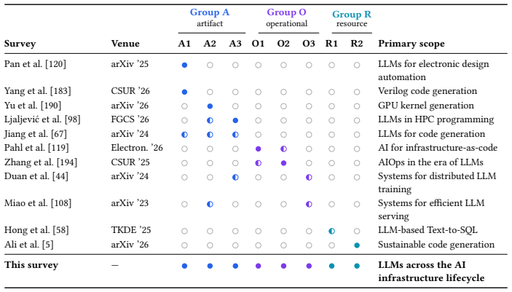
Table 1 . Principal scope of selected related surveys under the proposed taxonomy. primary topic; related coverage;
원문 · CC BY 4.0 · Bolin Shen, Shaoyi Huang, Yushun Dong · Large Language Models for AI Infrastructure · 원문 그림 인용 · 원본 PDF 5쪽에서 그림 영역을 추출했습니다.세 그룹과 여덟 범주의 분류 틀
논문은 LLM이 주로 관리하는 자원을 기준으로 방법을 세 그룹으로 나눕니다. 산출물을 만드는 artifact-centric 그룹(A1 하드웨어 설계, A2 커널 엔지니어링, A3 HPC 소프트웨어), 배포 문맥이나 시스템 상태를 다루는 operational-centric 그룹(O1 시스템 통합, O2 운영, O3 워크로드 오케스트레이션), 데이터와 에너지를 다루는 resource-centric 그룹(R1 데이터 관리, R2 에너지 최적화)입니다. 수명주기는 일곱 단계로 놓이며, 주 범주는 주요 기여에 따라 정하고 나머지 목적은 부속 속성으로 남깁니다.
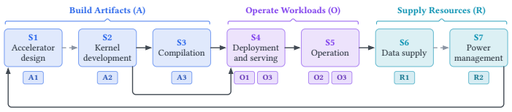
Fig. 2 . Lifecycle of AI infrastructure engineering. Seven stages form three phases that place the artifact-centric (A), operational-centric (O), and resource-centric (R) groups on the lifecycle; the chips below each stage list the categories whose primary contribution falls in it. Solid arrows mark hand-offs at which the output of an LLM-driven method in one stage has been evaluated in the next; dashed arrows mark hand-offs without such an end-to-end evaluation.
원문 · CC BY 4.0 · Bolin Shen, Shaoyi Huang, Yushun Dong · Large Language Models for AI Infrastructure · 원문 그림 인용 · 원본 PDF 4쪽에서 그림 영역을 추출했습니다.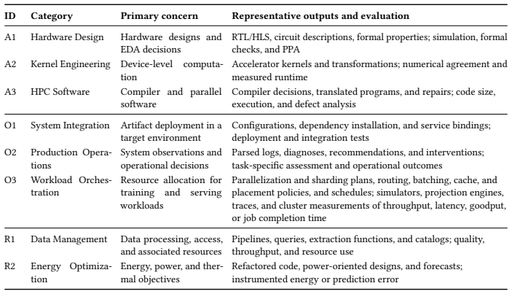
Table 16 . Lifecycle-aligned taxonomy of LLM applications to AI infrastructure (eight categories). The principal contribution and evaluation objective determine the primary category. Secondary objectives remain attributes of a study rather than evidence that categories are disjoint.
원문 · CC BY 4.0 · Bolin Shen, Shaoyi Huang, Yushun Dong · Large Language Models for AI Infrastructure · 원문 그림 인용 · 원본 PDF 42쪽에서 그림 영역을 추출했습니다.공통 작업 공식화
각 인프라 작업은 입력 I, 후보 행동 공간 A, 환경 E, 피드백 함수 F, 비용 J로 표현됩니다. 후보 a를 평가하면 피드백 f는 F(E, a; I)로 얻어지며, 작업은 Feasible(E, a; I)=⊤ 조건 아래에서 J(E, a; I)를 최소화하는 제약 최적화로 쓰입니다. 여기서 Feasible은 정확성, 보안, 서비스 요구를 만족하는지 나타내며, 피드백은 그 조건의 대리 지표일 뿐이라는 점이 중요합니다. 테스트가 커버하지 않는 경우나 시뮬레이터 기반 평가는 배포 시의 실제 성질과 다를 수 있습니다.
KernelBench의 fast_p 지표와 피드백 효과
KernelBench는 정답이고 기준 구현보다 빠른 후보가 나온 작업의 비율로 fast_p를 정의합니다. 후보 예산 k를 두면 각 작업에서 k개 중 하나라도 정답이며 기준 대비 속도가 임계값 p를 넘는지를 세어 평균합니다. 원문 표 3의 KernelBench 행에서 fast1은 1 attempt 대비 10 calls 설정에서 Level 1 기준 DeepSeek-R1이 12에서 43으로 올랐다고 보고됩니다. 같은 표에서 피드백 채널을 추가하는 효과는 모델과 과제 수준에 따라 달라서, 프로파일 정보가 일부 설정에서는 낮아졌습니다. 따라서 피드백은 모델과 함께 평가해야 합니다.
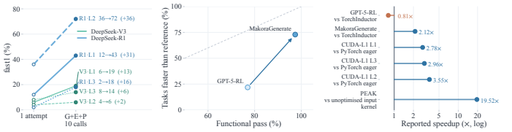
Fig. 5 . Kernel-generation performance under feedback refinement and study-specific execution references. Panel (a) uses KernelBench on L40S [ 118]; panel (b) uses the TorchInductor [ 8] protocol [ 155]; panel (c) includes different baselines and aggregation rules [85, 153, 155]. fast1 requires both correctness and faster execution. Both coordinates in (b) are task percentages; speedups in (c) are factors relative to the named baseline. Higher is better, and a speedup below1×denotes a slowdown.
원문 · CC BY 4.0 · Bolin Shen, Shaoyi Huang, Yushun Dong · Large Language Models for AI Infrastructure · 원문 그림 인용 · 원본 PDF 24쪽에서 그림 영역을 추출했습니다.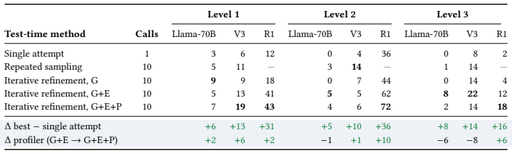
Table 11 . fast1 of test-time methods on KernelBench [118]. Levels 1, 2, and 3 contain 100, 100, and 50 tasks; all runs use an NVIDIA L40S GPU and the PyTorch eager reference. G, E, and P return the previous generation, the execution result, and the timing profile to the model. fast1 is the percentage of tasks that are both correct and faster than the reference; higher is better. The Δ rows give percentage-point changes. Bold marks column maxima; a dash denotes that repeated sampling is unavailable for the fixed-temperature DeepSeek-R1 endpoint.
원문 · CC BY 4.0 · Bolin Shen, Shaoyi Huang, Yushun Dong · Large Language Models for AI Infrastructure · 원문 그림 인용 · 원본 PDF 25쪽에서 그림 영역을 추출했습니다.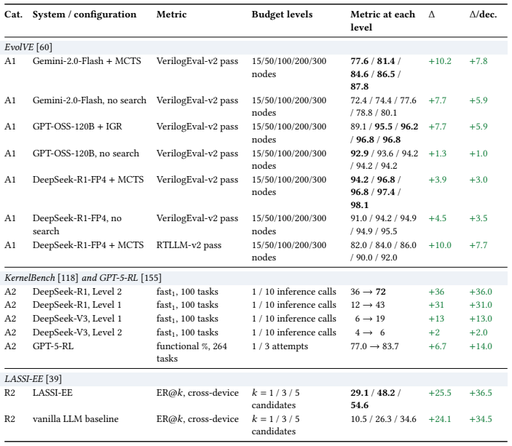
Table 22 . Performance across test-time budgets. EvolVE varies the number of search nodes on VerilogEval-v2 and RTLLM-v2 [60]; KernelBench and GPT-5-RL vary the number of inference calls or attempts [118, 155]; LASSI-EE varies the number of sampled candidates𝑘 [39]. Metric values follow the listed budget order. Δ is the endpoint change in the native metric, and Δ/dec. is the change per tenfold budget increase. Bold marks the better value of each matched pair or the best value within a block.
원문 · CC BY 4.0 · Bolin Shen, Shaoyi Huang, Yushun Dong · Large Language Models for AI Infrastructure · 원문 그림 인용 · 원본 PDF 51쪽에서 그림 영역을 추출했습니다.워크로드 오케스트레이션 결과의 평가 환경
O3 결과는 시뮬레이터, 투영 엔진, 실클러스터, 프로덕션 배포에서 얻어졌고, 같은 배율이라도 환경과 기준 방법에 따라 의미가 다릅니다. 저자들은 큰 배율이 주로 시뮬레이터와 오프라인 하네스에서 나왔으며 실클러스터 결과는 대체로 더 작다고 정리합니다. 따라서 이 분야의 이득은 평가 환경을 함께 보고해야 하며, 시뮬레이터 결과와 실클러스터 결과를 한 축에서 순위 매기지 않아야 합니다. 주된 결과 지표인 goodput과 JCT도 측정 대상이 서로 다르므로 직접 비교하지 않습니다.
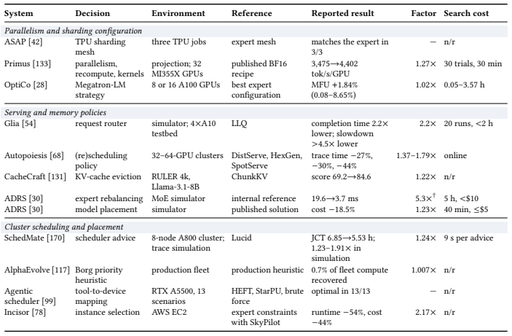
Table 19 . Workload-orchestration results under native evaluation conditions. Factors are derived from the reported values as in Figure 7; a dash means that the study reports agreement or optimality rather than a ratio, and n/r means not reported. Glia’s simulator runs Llama-3-8B on four A10 GPUs; CacheCraft’s result is at 88% KV-cache compression.†ADRS reports this speedup as 5.0× in its case-study text and as 2× in its summary table; the factor shown is computed from the reported runtimes.
원문 · CC BY 4.0 · Bolin Shen, Shaoyi Huang, Yushun Dong · Large Language Models for AI Infrastructure · 원문 그림 인용 · 원본 PDF 49쪽에서 그림 영역을 추출했습니다.아직 비어 있는 수명주기 영역
논문은 체크포인팅, 스트래글러 완화, 양자화 선택, 데이터 로딩 같은 학습과 서빙 concern에서 LLM이 엔지니어링 주체로 쓰인 시스템을 찾지 못했다고 보고합니다. 같은 맥락에서 전력 캡핑과 같은 AI 작업 에너지 관리도 찾지 못했습니다. 이 빈 영역은 저자들이 향후 연구 우선순위로 제시한 것이며, 검색 범위 안에서 확인한 결과입니다.
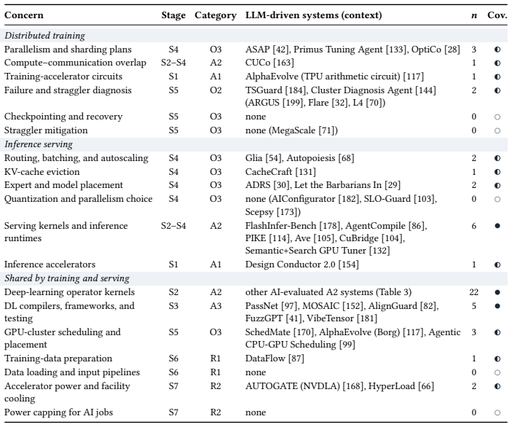
Table 17 . Coverage of AI-specific training and serving concerns by LLM-driven methods. 𝑛 counts the LLM- driven systems for each concern; 𝑛≥ 4, 1≤𝑛≤ 3, 𝑛= 0. Systems in parentheses address the concern without an LLM acting as the engineering agent and are not counted.
원문 · CC BY 4.0 · Bolin Shen, Shaoyi Huang, Yushun Dong · Large Language Models for AI Infrastructure · 원문 그림 인용 · 원본 PDF 43쪽에서 그림 영역을 추출했습니다.논문 정보
- 저자
- Bolin Shen, Shaoyi Huang, Yushun Dong
- 학회·저널
- arXiv · 프리프린트
- 최초 공개일
- 2026년 11월 14일
- 등록일
- 2026년 11월 17일
- 수정일
- 2026년 11월 14일
- 버전
- v1
- arXiv
- 2611.19061
- 분류
- cs.AI · cs.CL
- 원문 이용 조건
- CC BY 4.0
- 제공 범위
- 논문 정보, 해설, 허용된 원문 그림
AI 해설은 논문 원문과 별개의 설명이며 오류가 있을 수 있습니다. 원문과 그림은 각 출처의 이용 조건과 따로 표시된 권리를 따릅니다.
초록
Large language models (LLMs) are increasingly used to design, optimize, and operate the infrastructure behind AI training and serving, yet the literature remains fragmented across hardware design, machine learning systems, electronic design automation, and high-performance computing. We present a comprehensive survey of LLM-assisted AI infrastructure across its lifecycle, from accelerator design and kernel engineering to compilation, deployment, operations, data management, and energy optimization. We organize the literature by the primary resource the LLM manages: artifact-centric methods for computational artifacts, operational-centric methods for deployment context and system state, and resource-centric methods for data and energy. These categories span the lifecycle and cover AI-specific concerns such as distributed-training configuration, inference serving, GPU-cluster scheduling, and data loading. Building on this taxonomy, we conduct a cross-study quantitative synthesis of reported results. Because studies adopt heterogeneous benchmarks, baselines, hardware, and metrics, we compare methods only where evaluation conditions permit and align results along common dimensions: functional correctness, execution performance, throughput, resource and energy consumption, operational outcomes, and optimization cost, keeping each result's native metric, baseline, and setting rather than collapsing them into a single score. This comparison reveals where LLM-driven methods yield consistent gains, how reported gains in workload orchestration depend on the evaluation environment, from simulators to real clusters and production, and where evidence is still lacking. Together, the taxonomy, lifecycle perspective, and quantitative evaluation provide an evidence-grounded reference for LLM-driven engineering of AI infrastructure.
원문 인용
Bolin Shen, Shaoyi Huang, Yushun Dong (2026). Large Language Models for AI Infrastructure. arXiv:2611.19061v1. https://arxiv.org/abs/2611.19061v1
BibTeX
@misc{shen2026large,
  title = {{Large Language Models for AI Infrastructure}},
  author = {Bolin Shen and Shaoyi Huang and Yushun Dong},
  year = {2026},
  eprint = {2611.19061},
  archivePrefix = {arXiv},
  url = {https://arxiv.org/abs/2611.19061v1}
}