論文解説
MegNIST, A Benchmark for Non-Invasive Inner Speech Decoding
MegNIST:非侵襲内部発話デコーディングのためのベンチマーク
- 課題 非侵襲のinner speechデコーディングには、アクセスしやすい標準ベンチマークが不足しています。
- 結果 1024ユニットのMLPは、10seedでのテスト精度22.6±0.8%を記録しました。これは10%のランダムベースラインを有意に上回る値です。
非侵襲inner speechデコーディングのベンチマーク不足
神経デコーディングは、脳の記録を意味のある出力に変換する課題ですが、この分野にはMNISTのように誰でも使いやすいベンチマークが不足しています。データへのアクセスや前処理には専門知識が必要で、承認が必要なデータセットや、ダウンロードが制限されたプラットフォームも障壁になります。LibriBrainシリーズはheard speech、つまり聞き取った発話を扱っており、inner speech(声に出さずに想像する発話)のための基礎的なベンチマークはまだありません。
侵襲的BCIはECoGでattempted speechを解読する成果を出していますが、対象は話すことのできない麻痺患者です。健常な参加者でovert speechを研究すると動きによるartefactが生じるため、本論文はinner speechを非侵襲BCIのより現実的な道筋とみなしています。MEGはミリ秒単位の時間精度と、EEGより優れた空間的局在性を併せ持つため、この目的に適していると論じています。
MegNISTデータセットの構成
MegNISTは、1名の参加者が数字の0から9までを想像しながら発話したMEG記録12,000試行で構成されます。10個の数字クラスは均等に配分されています。分割は試行をランダムに混ぜず、実験runの単位で行います。run 1–10は学習(10,000試行)、run 11は検証(1,000試行)、run 12はテスト(1,000試行)です。著者らは、隣接する試行の間にある緩やかな生理的変化による情報リークを防ぐためと、実際のBCI運用のように将来のセッションへ汎化する必要がある状況を反映するために、このように分けたと考えています。
データはBIDS形式と直列化されたテンソルの2種類で提供されます。原データはFIF形式で、前処理後の学習・検証・テストの分割はHDF5ファイルとして保存されており、float32のテンソルとしてすぐ使えます。各HDF5ファイルにはdata(N×306×250)、labels、timesが含まれています。
前処理パイプラインと記録条件
参加者は数字を750 ms提示された後、想像の中で3回繰り返して発話するよう指示されました。前処理はMNE-Pythonで行いました。自動で検出した不良チャンネルを補間し、SSS(時間非拡張アルゴリズム)で外部磁気干渉を抑制しながら、頭の動きを補正します。
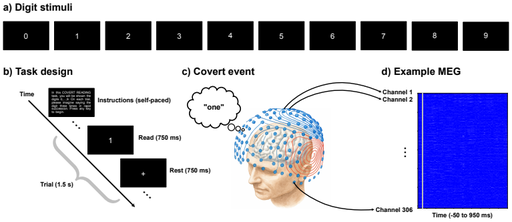
Figure 1 : MEG digit classification paradigm. (a) Digit stimuli: Visual stimuli consisted of the digits 0–9 presented on a dark background. (b) Task design: Each trial (1.5 s) began with a digit presentation (750 ms) followed by a rest period with fixation cross (750 ms). (c) Covert event: Participants covertly read the presented digit (e.g., “one”) while MEG signals were recorded from 306 sensors distributed across the scalp. (d) Example MEG: Representative MEG data showing activity across all 306 channels over a 1-second epoch (−50to950ms relative to the stimulus onset, depicted here with a vertical grey line).
出典 · CC BY 4.0 · Teyun Kwon, Pratik Somaiya, Gereon Elvers, Francesco Mantegna, Anna Camera, Sven Braeutigam, Mark Woolrich, Oiwi Parker Jones · MegNIST, A Benchmark for Non-Invasive Inner Speech Decoding · 論文の図を引用 · 元のPDFの4ページ目から図の部分を抽出しています。full-epochのMLPベースラインモデル
ベースラインモデルはfull-epochデコーディングの手法を使います。各試行の306チャンネル×250時点の行列を76,500次元のベクトルに展開し、一度に入力します。時間的な変化についての仮定は別に置かない、単純なベースラインです。モデルは隠れ層が1つのMLPで、隠れユニット数Hだけを調整します。隠れ層にはReLUを使い、出力は10クラスに対するsoftmaxです。
学習率0.001、batch size 32、最大200 epochという共通の設定を用いました。標準化は学習分割の平均と標準偏差で計算し、検証とテストに適用しました。この設定は、隠れユニット数32–2,048の範囲のMLP実験に関するものです。
隠れユニット数ごとの精度
各構成は10個のrandom seedで学習しました。検証精度の平均が最も高かった構成は1024ユニットで、26.8±0.8%でした。以降の分析ではこの構成を使いました。
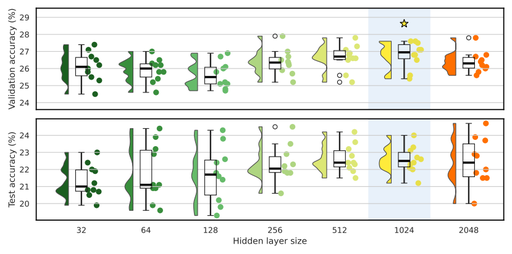
Figure 5 : Model selection and generalisation. Validation (top) and test (bottom) accuracy across hidden layer sizes (10 seeds each). Each architecture is shown with individual data points, box plots (median as bold line, interquartile range as box, whiskers at 1.5× IQR), and kernel density estimates (half-violins). Colours progress from green (smaller models) through yellow (optimal) to orange (larger models). The 1024-unit architecture (yellow star, blue shading) achieved the highest validation performance (26.8±0.8%) and was selected. Test accuracy confirms reliable generalisation. Both panels use matching y-axis spans for direct comparison.
出典 · CC BY 4.0 · Teyun Kwon, Pratik Somaiya, Gereon Elvers, Francesco Mantegna, Anna Camera, Sven Braeutigam, Mark Woolrich, Oiwi Parker Jones · MegNIST, A Benchmark for Non-Invasive Inner Speech Decoding · 論文の図を引用 · 元のPDFの10ページ目から図の部分を抽出しています。同じ1024ユニットのモデルのテスト精度は、10seedでの測定で22.6±0.8%でした。ランダムなベースラインである10%を大きく上回る値で、検証性能と比較的近い動きを示しました。著者らは、この結果をMegNISTにデコーディング情報があることの根拠と解釈しています。
テストラベル置換検定
偶然の水準を上回るかを確認するため、seed 47のモデルを選び、テストラベルを100,000回ランダムに並べ替えました。各並べ替えの精度からnull分布を作成し、観測精度22.6%以上となった並べ替えの割合をone-tailed empirical p-valueとして計算しました。補正式はp = (b + 1)/(100000 + 1)です。
観測精度22.6%のp-valueは1/100001 ≈ 1.0 × 10⁻⁵と報告されており、α = 0.01よりはるかに小さい値です。null分布の中央値は10.0%でした。精度は0.1 percentage point単位で離散的なので、p ≤ 0.01となる最小の精度は12.3%です。
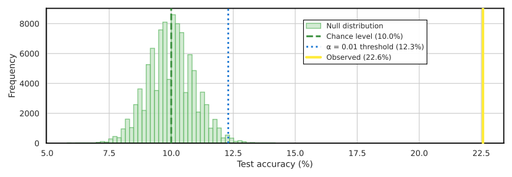
Figure 6 : Decoding performance. Using 100,000 test-label permutations, the observed test accuracy of 22.6% (yellow line) was significantly higher than expected under the null distribution (green histogram), exceeding it by a wide margin: the dashed green line shows chance (10%) for balanced 10-class classification, and the dotted blue line marks the critical value of12.3%, which is the smallest attainable accuracy withp≤0.01.
出典 · CC BY 4.0 · Teyun Kwon, Pratik Somaiya, Gereon Elvers, Francesco Mantegna, Anna Camera, Sven Braeutigam, Mark Woolrich, Oiwi Parker Jones · MegNIST, A Benchmark for Non-Invasive Inner Speech Decoding · 論文の図を引用 · 元のPDFの11ページ目から図の部分を抽出しています。時間方向の重要度の解釈
時間方向の解釈のため、±50 msの窓を250時点すべてにわたってスライドさせ、窓内のセンサーをランダムに並べ替えて、10回の繰り返しの平均精度低下を計算しました。重要度は約242 msで最も高く、100 msと170 ms付近にも初期のピークが見られました。著者らは242 msを語彙アクセスに関係する成分と結びつけて解釈しています。この解釈は本文の観察に対する著者の解釈であり、神経機構を直接証明した結果ではありません。
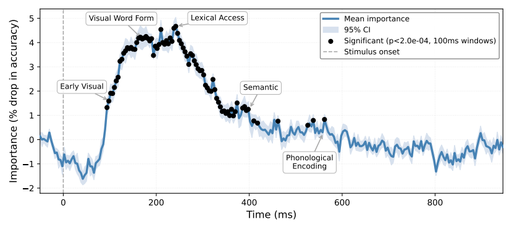
Figure 7 : Permutation feature importance (PFI) in time during imagined-speech decoding. The y-axis shows the % drop in accuracy when spatial features are shuffled within a±50ms window around each time point. More important times show higher values, with shaded regions providing 95% confidence intervals and black dots indicating significant importance (one-sided one-samplet-tests across 10 repeats, Bonferroni-corrected; p <2 × 10⁻⁴). Importance rises sharply following stimulus onset, peaking at 242 ms (4.8% drop) which is a response time associated with linguistic processing54,55. Earlier importance (100–170 ms) corresponds to visual and orthographic processing56,57, while later sustained importance (300–600 ms) reflects semantic and phonological encoding36,58,59. Negative values indicate random variability where permutation slightly improved accuracy relative to the baseline.
出典 · CC BY 4.0 · Teyun Kwon, Pratik Somaiya, Gereon Elvers, Francesco Mantegna, Anna Camera, Sven Braeutigam, Mark Woolrich, Oiwi Parker Jones · MegNIST, A Benchmark for Non-Invasive Inner Speech Decoding · 論文の図を引用 · 元のPDFの12ページ目から図の部分を抽出しています。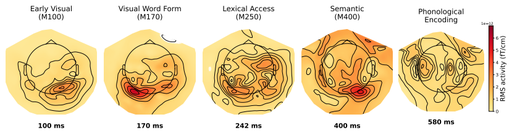
Figure 8 : Spatial–temporal progression of neural activity during digit recognition with imagined speech. Baseline-corrected planar-gradiometer RMS topographies at five key latencies illustrate the cascade from early visual (M100) and visual-word-form (M170) processing through lexical-semantic (M250–M400) to phonological encoding (∼580 ms). All maps share a common scale for direct comparison.
出典 · CC BY 4.0 · Teyun Kwon, Pratik Somaiya, Gereon Elvers, Francesco Mantegna, Anna Camera, Sven Braeutigam, Mark Woolrich, Oiwi Parker Jones · MegNIST, A Benchmark for Non-Invasive Inner Speech Decoding · 論文の図を引用 · 元のPDFの13ページ目から図の部分を抽出しています。単一参加者とベースラインモデルの範囲
このベンチマークのベースライン結果は、1名の参加者のデータと単純なMLPベースラインモデルから得られたものです。複数の参加者への汎化や、より強力なモデルの性能は、この論文の結果には含まれません。また、inner speech実験では声に出す調音(overt articulation)がなかったことをEMGと映像記録で確認しましたが、映像データは公開されていません。
論文情報
- 著者
- Teyun Kwon, Pratik Somaiya, Gereon Elvers, Francesco Mantegna, Anna Camera, Sven Braeutigam, Mark Woolrich, Oiwi Parker Jones
- 学会・ジャーナル
- arXiv · プレプリント
- 公開日
- 2026年11月16日
- 登録日
- 2026年11月18日
- 更新日
- 2026年11月16日
- バージョン
- v1
- arXiv
- 2611.21399
- カテゴリ
- cs.LG
- ライセンス
- CC BY 4.0
- 掲載内容
- 論文情報・解説・論文の図
この解説は、Refivuの韓国語解説をAIで翻訳したものです。不正確な翻訳や誤りが含まれる可能性があります。論文と図の利用条件は各出典に従います。
アブストラクト
MegNIST is a benchmark dataset for developing and evaluating machine learning methods for inner speech decoding from magnetoencephalography (MEG). The dataset comprises 12,000 trials of a single participant imagining speaking the digits zero through nine, recorded across four sessions. Each trial contains 306-channel MEG recordings sampled at 250 Hz, preprocessed using signal space separation, filtering, and downsampling. Data are provided as pre-defined training (10,000 trials), validation (1,000 trials), and test (1,000 trials) splits, with entire experimental runs assigned to each split to preserve temporal independence. The dataset is available in both BIDS format for neuroimaging analysis and as serialised tensors for machine learning workflows. Baseline classification results demonstrate that imagined digits can be decoded significantly above chance. Standardised splits, validated baselines, example code, and a PyTorch-compatible loader in the pnpl Python library enable straightforward integration with machine learning frameworks, lowering barriers for researchers to rapidly develop and benchmark inner speech decoding methods for non-invasive brain-computer interfaces.
この論文を引用
Teyun Kwon, Pratik Somaiya, Gereon Elvers, Francesco Mantegna, Anna Camera, Sven Braeutigam, Mark Woolrich, Oiwi Parker Jones (2026). MegNIST, A Benchmark for Non-Invasive Inner Speech Decoding. arXiv:2611.21399v1. https://arxiv.org/abs/2611.21399v1
BibTeX
@misc{kwon2026megnist,
  title = {{MegNIST, A Benchmark for Non-Invasive Inner Speech Decoding}},
  author = {Teyun Kwon and Pratik Somaiya and Gereon Elvers and Francesco Mantegna and Anna Camera and Sven Braeutigam and Mark Woolrich and Oiwi Parker Jones},
  year = {2026},
  eprint = {2611.21399},
  archivePrefix = {arXiv},
  url = {https://arxiv.org/abs/2611.21399v1}
}