論文解説
EchoSpec: Training Search Agents to Weigh Evidence Above Echoes
EchoSpec:echoより根拠を重視して判断する検索エージェントの学習
- 課題 強化学習の検索エージェントは、繰り返される偽の主張(echo)に引っ張られやすく、根拠がないときに回答を見送る能力も失ってしまいます。
- 手法 1次根拠を見つけるまで検索を続けるようウォームスタートしたうえで、棄権の閾値を保つ𝜆報酬でグループRLを行います。
検索エージェントが繰り返しの主張に揺らぐ理由
検索拡張型の強化学習エージェントは、何を検索するか、いつ再検索するか、いつ答えるかを自分で決めます。しかし実際の検索コーパスでは、1つの主張が複数のページに複製されたり、言い換えられたりした形で繰り返し現れることが多いです。一方、質問を実際に解決する1次根拠は、1回しか現れない場合が多く見られます。この論文は、Wikipediaベースの多段階質問において、1次根拠がそのまま残っていても、偽の主張のechoが複数入ってくると正解が覆される現象を測定しました。例えばQwen2.5-7Bベースのモデルでは、8つのechoが正解の質問のうち58–66%を覆しました。Search-R1は同じベースモデルより、すべてのecho数で多くdeferし、m=8では66%を記録しました。
また、正解の一致のみに報酬を与えるExact-match RLは、根拠が削除された質問での棄権率を47%から15%未満へ下げました。
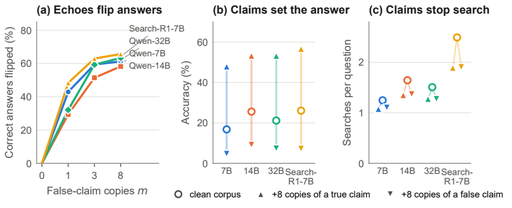
Figure 2 . Echoes override intact evidence and end the search.Qwen2.5-Instruct at 7B, 14B, and 32B alongside Search-R1-7Bon1,114multi-hopquestionsoverwiki-18acrosstwoheld-outtestsets,withprimaryevidenceretrievable in every condition. (a) Share of clean-correct questions that switch to the injected answer as𝑚false echoes enter the corpus. (b)Accuracyonthecleancorpusandundereightechoesofatrueorfalseclaimsharingidenticaltextwiththe answer swapped. (c) Mean number of searches issued per question across the same three corpus conditions.
出典 · CC BY 4.0 · Shihao Yang, Can Zeng, Xinzhe Li · EchoSpec: Training Search Agents to Weigh Evidence Above Echoes · 論文の図を引用 · 元のPDFの4ページ目から図の部分を抽出しています。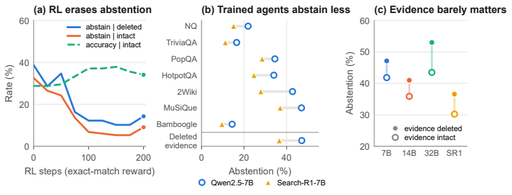
Figure3 . Exact-matchrewardseraseabstentionunderapromptpermittingabstention. (a)Qwen2.5-7Btrainedwith the Search-R1 recipe sees deleted-evidence abstention collapse within 100 steps. (b) Search-R1-7B vs. Qwen2.5-7B across seven QA sets and deleted evidence. (c) Abstention with intact hollow markers vs. deleted filled markers.
出典 · CC BY 4.0 · Shihao Yang, Can Zeng, Xinzhe Li · EchoSpec: Training Search Agents to Weigh Evidence Above Echoes · 論文の図を引用 · 元のPDFの5ページ目から図の部分を抽出しています。EchoSpecの2段階学習
EchoSpecは、コーパス変換ごとに既知の目標回答を定め、その回答を当てるように検索ポリシーを学習させます。回答を保つ変換は、根拠を複製したり、同じ主張のechoを注入したりすることです。回答を変える変換は、根拠を書き換えたり、根拠を削除したりすることです。根拠が削除された世界の目標はABSTAINです。真偽のechoは、答えの文字列だけが変わるように作られており、文体や複製回数から真偽を判別できないようにしています。1段階目の検証付きウォームスタートでは、32B教師モデルが多段階のブリッジエンティティを検索する軌跡を生成し、根拠への到達、ホップの連続性、自己完結性を基準にフィルタリングしたうえで、LoRAで教師あり学習を行います。
この際、教師に与えた案内文は軌跡の生成にのみ使い、学習プロンプトからは取り除きます。2段階目のグループRLでは、evidence-gated 𝜆-rewardを用います。これは、根拠が検索されれば+1、根拠なしで正解した回答は𝛼、正当な棄権は0、誤答は−𝜆を与えるものです。さらに、検索された集合に根拠が含まれるかどうかと、ホップ到達率を加算するacquisition bonusを設け、棄権の閾値を変えないようにしています。

Table5 . HyperparametersforEchoSpecStage1warm-startsynthesisandSFTalongsideStage2𝜆-calibratedgroup RL.
出典 · CC BY 4.0 · Shihao Yang, Can Zeng, Xinzhe Li · EchoSpec: Training Search Agents to Weigh Evidence Above Echoes · 論文の図を引用 · 元のPDFの15ページ目から図の部分を抽出しています。𝜆報酬と棄権の閾値
回答時の報酬は、e∈Dの回答可能な世界において正解確率をpとすると、期待値はp·1+(1−p)(−𝜆)=p(1+𝜆)−𝜆です。棄権の期待値は0なので、回答が棄権より有利になる条件はp>𝜆/(1+𝜆)です。これがProposition 1が示す棄権の閾値です。論文は、標準GRPOが中心化した報酬をグループの標準偏差で割ると、失敗グループでは𝜆の大きさが平均と標準偏差の両方に入り込み、打ち消されると指摘しています。そのためEchoSpecでは、標準偏差による正規化を用いないscale-preserving advantageを使います。検索集合Dに対するterminalボーナスは、回答と棄権の差で相殺されるため、この閾値は変わりません。
付録Cの一般式では、根拠が欠けている場合にg_Dがαとなるため、閾値は𝜆/(α+𝜆)に上がります。したがって閾値𝜆/(1+𝜆)は、根拠が検索された条件での結果です。
根拠到達率と棄権の結果
根拠への到達を比べると、echoが作用する地点が見えてきます。軌跡が1次根拠を検索した場合、8つのechoでのdeferenceは25–34%で、1つのechoの27–39%より高くはありませんでした。反対に、根拠がコンテキストの外に残った場合、8つのechoでのdeferenceは70–85%に達しました。1次根拠への到達率は、1つのechoでは53–72%、8つのechoでは20–31%に低下しました。したがって、主な失敗は根拠を得た後の判断よりも、根拠を獲得する段階にあると読み取れます。棄権についても、正解一致の報酬はwrong answerとabstentionを同じスコアとして扱うため、棄権の能力を弱めてしまいました。
この結果は、Qwen2.5-7BとSearch-R1系の実験で確認されたものです。

Table 2 . Echoes act by keeping the evidence out of reach.Questions each agent answers correctly on the clean corpus, split by whether it retrieved the primary evidence.Reachis the share of trajectories that retrieved it.
出典 · CC BY 4.0 · Shihao Yang, Can Zeng, Xinzhe Li · EchoSpec: Training Search Agents to Weigh Evidence Above Echoes · 論文の図を引用 · 元のPDFの5ページ目から図の部分を抽出しています。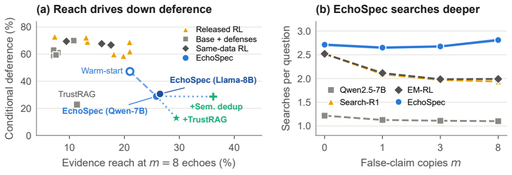
Figure 5 . Behavioral mechanism.(a) Def@8 vs. Reach@8 across agents, backbones, and filters. (b) Searches per question across echo count𝑚over 3 seeds, where baselines stop early whileEchoSpecsearches deeper.
出典 · CC BY 4.0 · Shihao Yang, Can Zeng, Xinzhe Li · EchoSpec: Training Search Agents to Weigh Evidence Above Echoes · 論文の図を引用 · 元のPDFの9ページ目から図の部分を抽出しています。検索範囲とリアルタイムWebの限界
リアルタイムのWeb検索に広げると、動的なランキング、SEO操作、破損した出典が加わります。また、世界を作るには既知の根拠を持つ多段階の項目が必要なので、著者らは開かれた複数出典の統合を後続の課題と見ています。
論文情報
- 著者
- Shihao Yang, Can Zeng, Xinzhe Li
- 学会・ジャーナル
- arXiv · プレプリント
- 公開日
- 2026年11月15日
- 登録日
- 2026年11月17日
- 更新日
- 2026年11月15日
- バージョン
- v1
- arXiv
- 2611.20034
- カテゴリ
- cs.IR
- ライセンス
- CC BY 4.0
- 掲載内容
- 論文情報・解説・論文の図
この解説は、Refivuの韓国語解説をAIで翻訳したものです。不正確な翻訳や誤りが含まれる可能性があります。論文と図の利用条件は各出典に従います。
アブストラクト
Search agents trained with reinforcement learning decide what to retrieve, when to search again, and when to answer. In real corpora, one claim is copied and paraphrased across many pages while the primary source settling a question appears once. We show that reinforcement-learned search agents grant echoes the credence of independent sources and lose their ability to abstain. Across five base models from 3B to 32B and seven released RL agents on multi-hop Wikipedia questions with primary evidence intact, eight paraphrased false-claim echoes overturn 58-73% of previously correct answers, while exact-match RL drives deleted-evidence abstention below 15%. Conditioning on retrieval localizes the failure to evidence acquisition: once primary evidence enters context, agents overrule eight echoes as reliably as one, whereas echoes fill top ranks and halt search early, so larger budgets, forced search turns, or passive passage filtering alone fail to recover displaced evidence. We introduce EchoSpec, specifying reliability across five corpus transformations with known target answers and training in two stages. Verification warm-start teaches multi-hop bridge-entity recovery past echoes, after which group RL optimizes an evidence-gated $λ$-reward with an outcome-independent acquisition bonus and scale-preserving advantages retaining the optimal rule $λ/(1+λ)$. Across Qwen2.5-3B, Qwen2.5-7B, and Llama-3.1-8B backbones on nine evaluation suites, EchoSpec cuts eight-echo deference by 30-44 points on Qwen2.5-7B down to 29-31%, nearly quadruples eight-echo reach to 26-27% with zero-shot transfer to unseen BGE and BM25 retrievers, and raises standalone QA precision to 47-55%. Code is publicly available at https://github.com/unihsy/EchoSpec.
この論文を引用
Shihao Yang, Can Zeng, Xinzhe Li (2026). EchoSpec: Training Search Agents to Weigh Evidence Above Echoes. arXiv:2611.20034v1. https://arxiv.org/abs/2611.20034v1
BibTeX
@misc{yang2026echospec,
  title = {{EchoSpec: Training Search Agents to Weigh Evidence Above Echoes}},
  author = {Shihao Yang and Can Zeng and Xinzhe Li},
  year = {2026},
  eprint = {2611.20034},
  archivePrefix = {arXiv},
  url = {https://arxiv.org/abs/2611.20034v1}
}