論文解説
ReactBench-AD: Do Driving VLAs and World-Action Models React to Imminent Hazards in Their Path?
進路上の危険への反応を実走シーンで測るベンチマークを作る
- 課題 既存の自動運転ベンチマークは通常の運転が大半を占めるため、進路上に飛び出す歩行者などの危険に、VLAやWAMが反応できるかを確かめられていませんでした。
- 手法 ReactBench-ADは、実走シーンの進路上に歩行者や車を描き込み、挿入物の有無だけが違う対を作ります。その軌跡の差から、モデルが危険に反応したかを測ります。
- 結果 多くのモデルは危険にほとんど反応せず、ReCogDriveは短い追加学習でReactNAVの∆Pが+0.5から+41.4ポイントに改善しました。
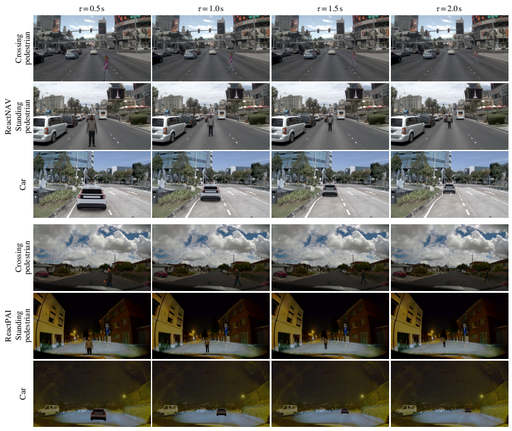
Figure 7 . Randomly selected ReactNA V (top) and ReactPAI (bottom) samples for each inserted object and look-ahead timeτ, shown in the edited front-camera image at the current framet. Each row shows a single scene, whose four look-ahead variants share the same asset.
出典 · CC BY 4.0 · Theodoridis, Nikos, Mohandas, Reenu, Sharma, Sushil, Hogan, Ciarán, Sistu, Ganesh, Scanlan, Anthony, Brophy, Tim, Eising, Ciarán · ReactBench-AD: Do Driving VLAs and World-Action Models React to Imminent Hazards in Their Path? · 論文の図を引用 · 元のPDFの14ページ目から図の部分を抽出しています。進路上の危険への反応が測れない理由
VLAは視覚言語モデルを行動予測へ広げたモデルで、WAMは動画生成モデルを土台に、動画と行動を同時に扱うモデルです。NAVSIMなどの評価で高い成績を収めていますが、評価に使われるサンプルの大半は、予期しない事象がほとんど起きない通常の運転です。そのため、進路上の差し迫った危険にモデルがどう反応するかは、十分に検証されていません。
危険への反応を正しく測るには、入力と測定の両方に条件があります。入力は実走シーンで、モデルの学習時と同じカメラや履歴長でなければなりません。測定では、危険な物体を含むシーンと含まないシーンを対にして、物体の因果効果を切り分ける必要があります。さらに、衝突率だけでは、危険を無視したモデルと、反応が弱すぎたり遅すぎたりしたモデルを区別できません。
既存研究では、CARLAの合成画像を使うものは、実車データで学習したモデルに対してsim-to-real gapが大きくなります。全画像を再レンダリングする方法は、挿入物だけを変えた対にはなりません。そこで本研究は、挿入物を進路上に正確に描いた対で反応を測るベンチマークを作りました。
挿入物の合成と評価指標
鍵になるのは、挿入物を全視点で一貫して描き、元のシーンとの差を軌跡で測ることです。具体的には、3DアセットをBlenderで描画して元のシーンに合成し、変えるのは挿入物と影の画素だけにします。
挿入位置は、正解軌跡上で自車の前バンパーがlook-ahead time τ後に通る地点です。τは0.5、1.0、1.5、2.0 sの4通りで、そのまま走り続けるとτ以内に衝突する位置になります。横断歩行者は1.4 m/sで進路に向かって歩き、その地点へτ後に到達します。描画は4つの履歴時刻と最大4つのカメラ視点に行い、既存の物体で隠れる部分は描きません。COCO検出器は編集後の前方カメラ画像の99.3%で挿入物を見つけたため、挿入物は認識できる程度に写っています。
評価では、元のシーンの軌跡yOと編集後の軌跡yEを、どちらも編集後のシーンSEで採点します。yOは挿入物を見ていないので、その採点は、モデルが危険を無視したときの結果を表します。そこで、\( \Delta M = M(y^E;S^E) - M(y^O;S^E) \)をedit effectと定義し、差が反応の効果を表すようにしています。安全性の指標Pは、ReactNAVではNC×DAC、ReactPAIではNCだけです。衝突を避けられない場合の減り方はCSで見て、ADEが閾値ϵより小さい割合をTIRとして、挿入物を無視しているかを見ます。
データはnavtestからReactNAVを3,228サンプル、PhysicalAI-Autonomous-VehiclesからReactPAIを1,045サンプル作ります。どちらも自車速度は5から40 km/hの範囲に限り、ほぼ停止している場面は除きます。例えば2 Hzで予測されることが多い軌跡は、区分線形に補間して100 Hzで衝突を判定します。
VLAとWAMは挿入物にどこまで反応するか
元のシーンと挿入後のシーンを比べると、6つのモデルの軌跡は短くなるとしても少しにとどまりました。AutoVLA、ReCogDrive、DriveWAM、SimWAMでは、1ポイントを超える改善は停車車両の場合に限られ、例外はDriveWAMが立ち止まった歩行者をτ=2.0 sで少し改善した場合だけです。一方、Alpamayo 1.5は停車車両でτ=2.0 sの∆Pが+28.81ポイントに達し、同じ条件のAutoVLAは+3.26ポイントでした。
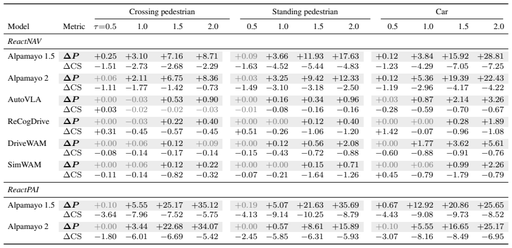
Table 1 . Results on ReactNA V and ReactPAI by model, inserted object, and look-ahead timeτ (s). ∆P is in percentage points (higher is better);∆CSis in km/h (lower is better). Gray: the paired 95% bootstrap CI includes zero.
出典 · CC BY 4.0 · Theodoridis, Nikos, Mohandas, Reenu, Sharma, Sushil, Hogan, Ciarán, Sistu, Ganesh, Scanlan, Anthony, Brophy, Tim, Eising, Ciarán · ReactBench-AD: Do Driving VLAs and World-Action Models React to Imminent Hazards in Their Path? · 論文の図を引用 · 元のPDFの5ページ目から図の部分を抽出しています。ReactPAIでは、Alpamayo 1.5が立ち止まった歩行者(τ=2.0 s)で∆Pを+35.69ポイント改善しました。ただし、この最良の条件でも危険な軌跡が62.01%残るため、反応が十分とはいえません。同じ条件のAlpamayo 2の改善は+15.89ポイントにとどまりました。衝突を避けられない場合の減速は、最後の0.5 sで平均13.0 km/h減速するAlpamayo 1.5のほうが、Alpamayo 2の7.7 km/hより強くなっています。
AutoVLAは横断歩行者を挿入した場合のトラジェクトリ・ペアの34.9%で、ADEが0.05 m未満でした。つまり、多くの場合モデルは挿入物にほとんど反応していないと読めます。ReactNAVのAlpamayoは3つの前方カメラだけを0.5 s間隔で受け取るため、入力分布のずれが大きい状態です。この点を考えると、Alpamayoの結果は解釈に注意が必要です。
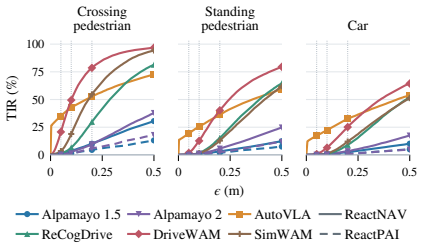
Figure 3 . Trajectory invariance rate, TIRϵ: the percentage of samples whose original and edited trajectories differ by an ADE below ϵ, i.e., for which the model essentially ignores the inserted object (higher means less reactive). Results are aggregated across all four look-ahead timesτ.
出典 · CC BY 4.0 · Theodoridis, Nikos, Mohandas, Reenu, Sharma, Sushil, Hogan, Ciarán, Sistu, Ganesh, Scanlan, Anthony, Brophy, Tim, Eising, Ciarán · ReactBench-AD: Do Driving VLAs and World-Action Models React to Imminent Hazards in Their Path? · 論文の図を引用 · 元のPDFの5ページ目から図の部分を抽出しています。CoTは挿入物を認識しても行動に結びつかない
Alpamayo 1.5とAlpamayo 2は、軌跡の前にChain-of-Thought(CoT)を自然言語で生成するため、その内容を調べられます。挿入した歩行者に対しては、大半のサンプルでCoTの先頭行動がslow/stopに切り替わり、挿入物を指す指示が出ます。それでも多くの場合、実際の軌跡は衝突を避けるほど減速しません。著者らは、この原因を知覚や推論ではなく、VLM基盤とアクションエキスパートの間の“miscommunication”と見ています。
停車車両の場合、Alpamayo 1.5のCoTは主にkeep distanceの指示に変わります。車両を停車と書いたCoTは、Alpamayo 1.5で33%、Alpamayo 2で24%でした。ここから、停車車両では認識そのものが弱いと読めます。
CoTの効果を切り分けるため、元のシーンと編集後のシーンのCoTを入れ替え、τ=2.0 sでNCを比べました。最も大きな安全性の利得は、挿入物を直接見ることから来るように見えます。一方、挿入物が見えている場合は、編集後シーン由来のCoTのほうが元シーン由来より安全な軌跡を生みました。明示的に即時停止と指示しても、多くのサンプルで衝突が残ります。
学習段階ごとの反応の変化
ReCogDriveとSimWAMは段階ごとのチェックポイントが公開されているため、段階ごとの反応を比べられます。どちらもIL(専門家の軌跡を模倣する学習)の後にRLを行い、RLでは報酬にPredictive Driver Model Score(PDMS)を使います。更新にはGRPOの拡散向け変種(ReCogDrive)とflow-matching向け変種(SimWAM)を使い、ReCogDriveはさらにVLMのSFTを初期段階に持ちます。
表2は、初速20 km/h未満のサンプル(n=1762)で、τ=2.0 sの∆Pを段階ごとに示しています。段階が進むとnavtest上のPDMSは上がり、ReCogDriveはVLM SFTの84.1からRLの90.8へ、SimWAMはILの90.3からRLの91.9へ上がります。一方、停車車両の∆Pは、ReCogDriveでVLM SFTの+10.39からILの+4.88へ大きく下がり、RLでは+3.29でした。横断歩行者の差は小さく、この段階差はほとんど効いていません。この結果は、名目上の運転性能を伸ばす学習が危険への反応を弱める可能性を示唆しています。
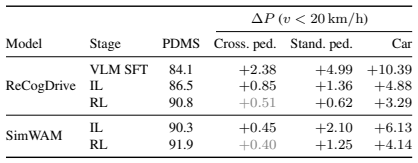
Table 2 . Safety improvement ∆P (in percentage points) on React- NA V atτ= 2.0 s for each training-stage checkpoint of ReCog- Drive and SimW AM, over samples with an initial ego-vehicle speed below 20 km/h (n= 1762 ). Gray: the paired 95% bootstrap CI of the difference to the previous training stage includes zero. PDMS on navtest as reported in [22, 53].
出典 · CC BY 4.0 · Theodoridis, Nikos, Mohandas, Reenu, Sharma, Sushil, Hogan, Ciarán, Sistu, Ganesh, Scanlan, Anthony, Brophy, Tim, Eising, Ciarán · ReactBench-AD: Do Driving VLAs and World-Action Models React to Imminent Hazards in Their Path? · 論文の図を引用 · 元のPDFの7ページ目から図の部分を抽出しています。正解のない危険シーンに目標軌跡を与える
危険シーンは正解軌跡を持たないため、RLに混ぜる案が考えられますが、GRPOは実際に得た候補同士の差しか強化できません。navtrainから作った300件の危険シーンでは、グループサイズ32で試しても、非ゼロの勾配が得られたのは26.3%のグループにとどまりました。さらに、安全な軌跡を強化できたのは1.3%でした。そこで、目標軌跡を人工的に作り、SFTで模倣させる方針に切り替えました。
学習データはnavtrainの1,957サンプルから作り、危険シーンは11,742件になります。挿入物を進路外に置いた良性シーンも同数作り、合計23,484サンプルをReactTrainと呼びます。良性シーンを入れるのは、挿入物が見えること自体をブレーキの合図だと学習しないようにするためです。
目標軌跡は、正解のウェイポイントにcubic splineを当てて経路を保ち、その上で速度の変化だけを作り直します。停止点までの弧長Δsから、\( a = \min\{ v_0^2/(2\Delta s),\ a_{\max} \} \)の一定減速度を求めます。dmは1 m、amaxは8 m/s2とし、amaxでも衝突を防げないサンプルはτ=0.5 sのものに限り、なるべく減速する目標を与えます。
微調整では、ReCogDriveのILチェックポイントを初期値にし、VLMを凍結してアクションヘッドだけを更新します。学習目的はILと同じdenoisingで、危険シーンには人工目標を、良性とオリジナルには正解軌跡を当てます。3エポック、276勾配ステップで学習を終えます。
微調整後の反応と一般化
ReCogDriveのILとILにReactTrainを加えたIL + RTを比べると、ReactNAVの∆Pは+0.5から+41.4ポイントに改善しました。その代わり、navtestのPDMSは86.2から86.0へわずかに下がり、主に自車の進行距離が短くなったことが原因とされています。元のシーンでは、計画距離が20%以上短くなるのは0.9%のサンプルだけで、最大減速度も4.5 m/s2以下でした。
学習に含まれない立ち止まった動物を291サンプルに挿入すると、∆Pは+0.1から+28.1ポイントに向上しました。ReactNAVの+41.4に比べると改善幅は小さいものの、ILに比べると十分に大きいといえます。実走シーンでは、308サンプルでPが6.8から54.2に上がりました。CSは21.4から14.3 km/hに下がり、ベースラインを持たないため絶対値で比べています。自車状態だけを編集するため、ReCogDriveが見る現在フレームとは矛盾しない点が、この評価の前提です。
元のシーンでの軌跡はILに近いまま、挿入された動物の前でだけ減速する形になっています。この結果から、凍結したVLMが進路の塞がりをすでに符号化しており、アクションヘッドがその知識を行動に結びつけたと考えられます。長尾のシーンは種類が開かれている一方、緊急ブレーキのような振る舞いは比較的小さな集合と考えられ、データで直接教えられる点が重要です。
限界
挿入物は完全には写実的ではなく、評価は開ループのため、複数の計画周期にわたる遅れた反応は評価していません。
実走シーンはベースラインがないため絶対値で評価しており、ILとの差の数値を∆Pと同じ基準で読むことはできません。名目性能の低下は小さいものの残っており、より良いReactTrainの使い方でそれを避けられるかは今後の課題です。CoTの分析はReactPAIだけで行い、AutoVLAは常に同じ推論出力を返すため除外しています。
論文情報
- 著者
- Theodoridis, Nikos, Mohandas, Reenu, Sharma, Sushil, Hogan, Ciarán, Sistu, Ganesh, Scanlan, Anthony, Brophy, Tim, Eising, Ciarán
- 学会・ジャーナル
- arXiv · プレプリント
- 公開日
- 2026年11月15日
- 登録日
- 2026年11月20日
- 更新日
- 2026年11月15日
- バージョン
- v1
- arXiv
- 2611.20011
- カテゴリ
- cs.CV · cs.AI · cs.RO
- ライセンス
- CC BY 4.0
- 掲載内容
- 論文情報・解説・論文の図
この解説は、Refivuの韓国語解説をAIで翻訳したものです。不正確な翻訳や誤りが含まれる可能性があります。論文と図の利用条件は各出典に従います。
アブストラクト
Vision-Language-Action models (VLAs) and World-Action Models (WAMs) have emerged in autonomous driving with the promise of strong generalization to long-tail scenarios. Although these models achieve state-of-the-art results on autonomous driving benchmarks, most existing benchmarks are dominated by nominal scenarios and therefore cannot test this promise. To test one such long-tail capability that is critical for safety, we introduce ReactBench-AD, a benchmark that measures how driving models react to objects that appear in the ego vehicle's path. Built on real NAVSIM and PhysicalAI-Autonomous-Vehicles scenes, ReactBench-AD composites a crossing pedestrian, a standing pedestrian, or a stationary car consistently across all camera views and history frames. Each edited scene thus forms an exact, pixel-level counterfactual pair with its original, which allows us to isolate the causal effect of the inserted object on the predicted trajectory. Evaluating four VLAs and two WAMs, we find that they react weakly, often barely at all. Finally, we test how easily one of the evaluated VLAs, ReCogDrive, can be taught to brake hard for imminent hazards: a short fine-tuning stage on edited scenes substantially improves its reactions, with the learned behavior generalizing to unseen objects and fully real scenes, at minimal cost to nominal driving. These results call into question the out-of-the-box long-tail capabilities of these models, but suggest that they can be a strong foundation for acquiring them with little additional training, highlighting the value of real or synthetic data that demonstrates the long-tail behaviors nominal datasets rarely contain. Code and data will be made publicly available.
論文の図
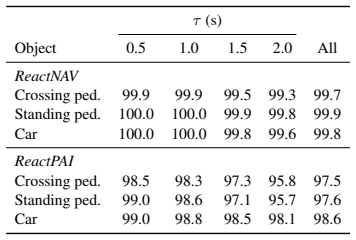
Table 5 . Share of edited samples (%) in which D-FINE-X detects the inserted object at its location, by object and look-ahead time τ.
出典 · CC BY 4.0 · Theodoridis, Nikos, Mohandas, Reenu, Sharma, Sushil, Hogan, Ciarán, Sistu, Ganesh, Scanlan, Anthony, Brophy, Tim, Eising, Ciarán · ReactBench-AD: Do Driving VLAs and World-Action Models React to Imminent Hazards in Their Path? · 論文の図を引用 · 元のPDFの15ページ目から図の部分を抽出しています。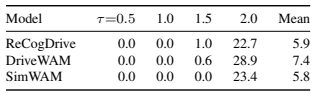
Table 6 . P (in percent) on the 308 real scenes with a stationary vehicle ahead, by look-ahead timeτ(s).
出典 · CC BY 4.0 · Theodoridis, Nikos, Mohandas, Reenu, Sharma, Sushil, Hogan, Ciarán, Sistu, Ganesh, Scanlan, Anthony, Brophy, Tim, Eising, Ciarán · ReactBench-AD: Do Driving VLAs and World-Action Models React to Imminent Hazards in Their Path? · 論文の図を引用 · 元のPDFの15ページ目から図の部分を抽出しています。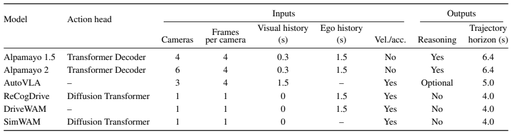
Table 8 . Comparison of the action heads, input configurations, and outputs of the evaluated models. Visual and ego history denote the temporal spans of camera observations and past ego states, respectively; a visual history of 0 s indicates a single current frame.
出典 · CC BY 4.0 · Theodoridis, Nikos, Mohandas, Reenu, Sharma, Sushil, Hogan, Ciarán, Sistu, Ganesh, Scanlan, Anthony, Brophy, Tim, Eising, Ciarán · ReactBench-AD: Do Driving VLAs and World-Action Models React to Imminent Hazards in Their Path? · 論文の図を引用 · 元のPDFの17ページ目から図の部分を抽出しています。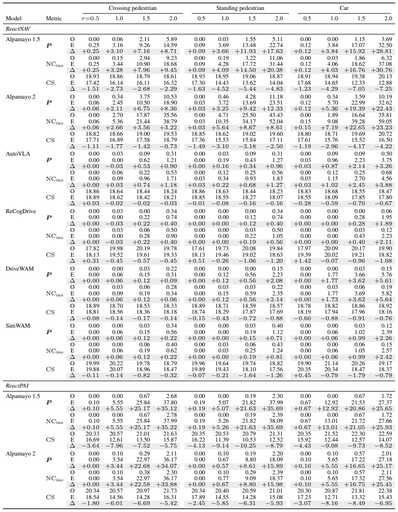
Table 9 . Detailed results on ReactNA V and ReactPAI by model, inserted object, and look-ahead timeτ (s). O and E denote the trajectories predicted from the original and edited scene, respectively, both evaluated in the edited scene, and ∆ = E−O . P and NCins are in percent and their deltas in percentage points (higher is better). CS is the mean contact speed in km/h over the samples for which both trajectories result in an at-fault collision (lower is better). Deltas are computed before rounding.
出典 · CC BY 4.0 · Theodoridis, Nikos, Mohandas, Reenu, Sharma, Sushil, Hogan, Ciarán, Sistu, Ganesh, Scanlan, Anthony, Brophy, Tim, Eising, Ciarán · ReactBench-AD: Do Driving VLAs and World-Action Models React to Imminent Hazards in Their Path? · 論文の図を引用 · 元のPDFの18ページ目から図の部分を抽出しています。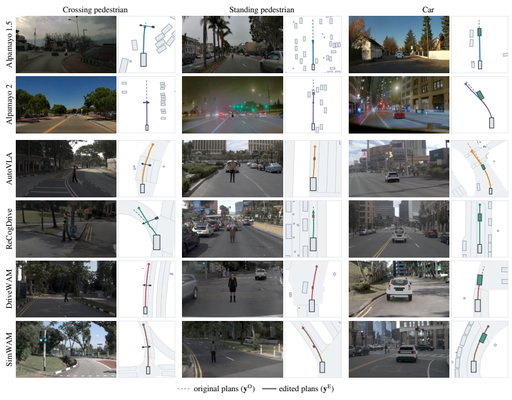
Figure 9 . Example predictions at a look-ahead time of τ= 2.0 s , one for each model and inserted object: Alpamayo 1.5 and Alpamayo 2 on ReactPAI, and the other four models on ReactNA V. Each example shows the edited front-camera image at the current frame, cropped around the inserted object, next to a bird’s-eye view of the edited scene. The arrow marks the crossing pedestrian’s motion over the 4 s horizon. Dashed and solid lines show the model’s plans for the original (yO) and edited (yE) scenes, respectively, as front-bumper paths over the first 4 s. Examples are drawn at random from the samples whose original plan collides with the inserted object.
出典 · CC BY 4.0 · Theodoridis, Nikos, Mohandas, Reenu, Sharma, Sushil, Hogan, Ciarán, Sistu, Ganesh, Scanlan, Anthony, Brophy, Tim, Eising, Ciarán · ReactBench-AD: Do Driving VLAs and World-Action Models React to Imminent Hazards in Their Path? · 論文の図を引用 · 元のPDFの19ページ目から図の部分を抽出しています。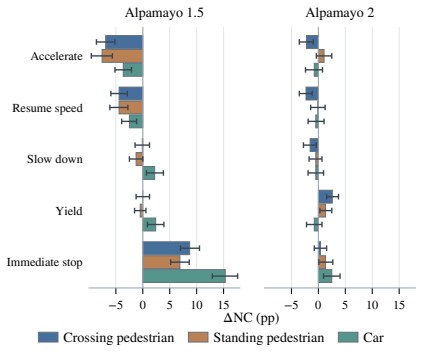
Figure 10 . Change in the no-collision rate, NC, of Alpamayo 1.5 and Alpamayo 2 on edited ReactPAI scenes atτ= 2.0 s when their CoT is replaced by a fixed one, relative to their own generated CoT. Whiskers indicate 95% bootstrap CIs.
出典 · CC BY 4.0 · Theodoridis, Nikos, Mohandas, Reenu, Sharma, Sushil, Hogan, Ciarán, Sistu, Ganesh, Scanlan, Anthony, Brophy, Tim, Eising, Ciarán · ReactBench-AD: Do Driving VLAs and World-Action Models React to Imminent Hazards in Their Path? · 論文の図を引用 · 元のPDFの20ページ目から図の部分を抽出しています。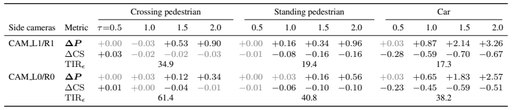
Table 12 . Fixed CoTs used in Fig. 10. Each fixed CoT replaces the model’s generated CoT verbatim, and⟨reason⟩ is filled in according to the inserted object (bottom).
出典 · CC BY 4.0 · Theodoridis, Nikos, Mohandas, Reenu, Sharma, Sushil, Hogan, Ciarán, Sistu, Ganesh, Scanlan, Anthony, Brophy, Tim, Eising, Ciarán · ReactBench-AD: Do Driving VLAs and World-Action Models React to Imminent Hazards in Their Path? · 論文の図を引用 · 元のPDFの21ページ目から図の部分を抽出しています。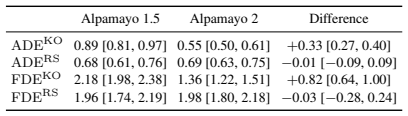
Table 13 . Attention knockout on 300 original ReactPAI samples, measured over the first 4 s. KO: CoT hidden from the action expert, with the same initial noise as the natural rollout. RS: initial noise resampled, CoT unchanged. All values are in meters; means with 95% bootstrap CIs.
出典 · CC BY 4.0 · Theodoridis, Nikos, Mohandas, Reenu, Sharma, Sushil, Hogan, Ciarán, Sistu, Ganesh, Scanlan, Anthony, Brophy, Tim, Eising, Ciarán · ReactBench-AD: Do Driving VLAs and World-Action Models React to Imminent Hazards in Their Path? · 論文の図を引用 · 元のPDFの21ページ目から図の部分を抽出しています。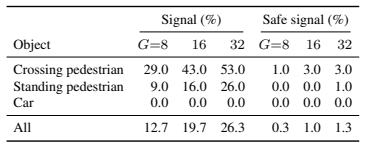
Table 14 . Percentage of GRPO groups with a non-zero gradient (Signal) and with at least one safe trajectory above the group mean reward (Safe signal) for ReCogDrive’s IL checkpoint on 300 haz- ardous scenes, as a function of group sizeG.
出典 · CC BY 4.0 · Theodoridis, Nikos, Mohandas, Reenu, Sharma, Sushil, Hogan, Ciarán, Sistu, Ganesh, Scanlan, Anthony, Brophy, Tim, Eising, Ciarán · ReactBench-AD: Do Driving VLAs and World-Action Models React to Imminent Hazards in Their Path? · 論文の図を引用 · 元のPDFの21ページ目から図の部分を抽出しています。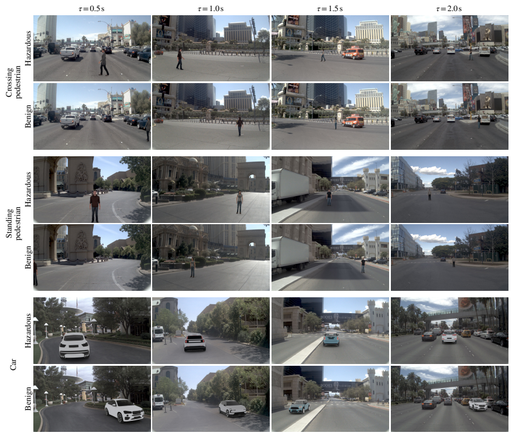
Figure 11 . Randomly selected ReactTrain samples for each inserted object and look-ahead time τ, shown in the edited front-camera image at the current frame t. Each column shows a different source sample, with its hazardous variant in the top row and its benign variant in the bottom row; both use the same asset.
出典 · CC BY 4.0 · Theodoridis, Nikos, Mohandas, Reenu, Sharma, Sushil, Hogan, Ciarán, Sistu, Ganesh, Scanlan, Anthony, Brophy, Tim, Eising, Ciarán · ReactBench-AD: Do Driving VLAs and World-Action Models React to Imminent Hazards in Their Path? · 論文の図を引用 · 元のPDFの23ページ目から図の部分を抽出しています。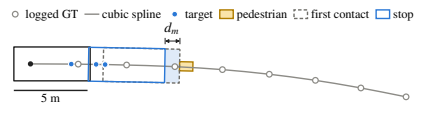
Figure 12 . Artificial target trajectory for a ReactTrain sample with a standing pedestrian (orange box) inserted at τ= 1.0 s . The ego vehicle (black box) decelerates along a cubic spline fitted to the logged ground-truth waypoints and stops (blue box) a margin dm before the pose at which it would first contact the pedestrian (dashed box).
出典 · CC BY 4.0 · Theodoridis, Nikos, Mohandas, Reenu, Sharma, Sushil, Hogan, Ciarán, Sistu, Ganesh, Scanlan, Anthony, Brophy, Tim, Eising, Ciarán · ReactBench-AD: Do Driving VLAs and World-Action Models React to Imminent Hazards in Their Path? · 論文の図を引用 · 元のPDFの24ページ目から図の部分を抽出しています。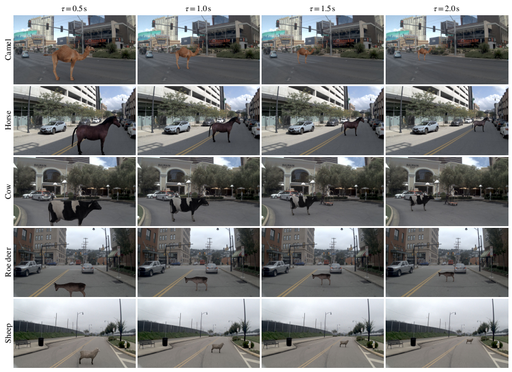
Figure 13 . Randomly selected samples of the unseen-objects test set, one per animal, for each look-ahead time τ, shown in the edited front-camera image at the current framet.
出典 · CC BY 4.0 · Theodoridis, Nikos, Mohandas, Reenu, Sharma, Sushil, Hogan, Ciarán, Sistu, Ganesh, Scanlan, Anthony, Brophy, Tim, Eising, Ciarán · ReactBench-AD: Do Driving VLAs and World-Action Models React to Imminent Hazards in Their Path? · 論文の図を引用 · 元のPDFの25ページ目から図の部分を抽出しています。
Figure 14 . Randomly selected samples of the real-scenes test set, shown in the unedited front-camera image at the current frame t. The target is the nearest vehicle ahead in the ego lane.
出典 · CC BY 4.0 · Theodoridis, Nikos, Mohandas, Reenu, Sharma, Sushil, Hogan, Ciarán, Sistu, Ganesh, Scanlan, Anthony, Brophy, Tim, Eising, Ciarán · ReactBench-AD: Do Driving VLAs and World-Action Models React to Imminent Hazards in Their Path? · 論文の図を引用 · 元のPDFの25ページ目から図の部分を抽出しています。この論文を引用
Theodoridis, Nikos, Mohandas, Reenu, Sharma, Sushil, Hogan, Ciarán, Sistu, Ganesh, Scanlan, Anthony, Brophy, Tim, Eising, Ciarán (2026). ReactBench-AD: Do Driving VLAs and World-Action Models React to Imminent Hazards in Their Path?. arXiv:2611.20011v1. https://arxiv.org/abs/2611.20011v1
BibTeX
@misc{nikos2026reactbench,
  title = {{ReactBench-AD: Do Driving VLAs and World-Action Models React to Imminent Hazards in Their Path?}},
  author = {Theodoridis, Nikos and Mohandas, Reenu and Sharma, Sushil and Hogan, Ciarán and Sistu, Ganesh and Scanlan, Anthony and Brophy, Tim and Eising, Ciarán},
  year = {2026},
  eprint = {2611.20011},
  archivePrefix = {arXiv},
  url = {https://arxiv.org/abs/2611.20011v1}
}