論文解説
Your Hypergradient is Skewed: Antithetic Neumann Estimation for Bilevel Optimization
ハイパーグラディエントの偏り:二段階最適化のためのAntithetic Neumann推定
- 課題 Neumann級数に基づくハイパーグラディエントの推定には、偏りと分散のほかに、積の構造から生じる歪度の誤差があります。
- 手法 確率的Hessianの標本を基準Hessianの周りで鏡写しに対応させ、2つの積を平均することで、奇数次の摂動項を打ち消します。
- 結果 Housingのロバスト回帰では、ANE法のR2が0.60でした。Fashion-MNISTのデータ精製では、ANE-SGDの精度が89.6%でした。
Neumann逆近似の第3の誤差
ハイパーグラディエントを計算するには内部Hessianの逆行列が必要で、実際には打ち切ったNeumann級数でこれを近似します。既存の解析は、この推定値の偏りと分散を中心に扱ってきました。本論文は、Neumann級数が確率的Hessian因子の積から成るため、第3の誤差源である歪度が生じると主張しています。ミニバッチ平均は独立な寄与の平均なので、歪度はバッチサイズに応じて小さくなります。一方、積構造のNeumann項は、項ごとにそのように平均されません。そこで本論文は、偏りと分散に加えて、奇数次の摂動項が生む非対称な誤差を減らすことを目標としています。
鏡対称Neumann推定量
ANEでは、各確率的Hessian標本を、基準Hessianの周りにある鏡像の対応物と組にし、2つの積を平均します。鏡像標本は式(6)のとおり、基準Hessianからの偏差の逆方向に作られ、順方向と鏡像の積の平均である式(7)を逆Hessian-ベクトル推定値として用います。基準Hessianが正確でτ=1の場合、Proposition 3.4により、奇数個の摂動因子を含む項が消え、偶数次の項のみが残ると述べられています。著者らは、この条件でANEの最も低次の線形摂動が取り除かれることを、理論的な根拠として示しています。基準Hessianが近似にすぎない場合、残る奇数次の寄与は基準の誤差に対して線形に抑えられます。
この対称な構成は代数的な打ち消しであり、ハイパーグラディエント全体の歪度が0であることを証明するものではありません。
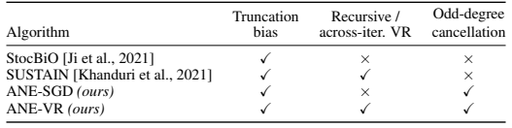
Table 1 :Neumann-based bilevel methods.All methods inherit truncation bias from the Neu- mann inverse approximation. SUSTAIN applies recursive variance reduction across outer iterations. ANE modifies the within-estimate Neumann product by antithetic mirroring, which cancels odd perturbation-degree terms under an exact reference. These mechanisms act at different stages and can be combined; ANE may also affect variance because it removes the linear perturbation term.
出典 · CC BY 4.0 · Jason Bohne, Pawel Polak, Gary Kazantsev, David Rosenberg · Your Hypergradient is Skewed: Antithetic Neumann Estimation for Bilevel Optimization · 論文の図を引用 · 元のPDFの2ページ目から図の部分を抽出しています。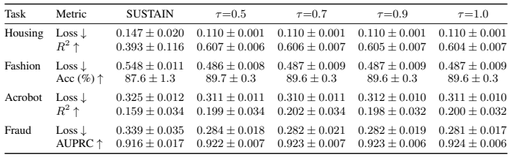
Table 5 :ANE-SGD sensitivity to mirror strengthτ(mean±SD over 20 seeds for every column). SUSTAIN is shown for reference.
出典 · CC BY 4.0 · Jason Bohne, Pawel Polak, Gary Kazantsev, David Rosenberg · Your Hypergradient is Skewed: Antithetic Neumann Estimation for Bilevel Optimization · 論文の図を引用 · 元のPDFの21ページ目から図の部分を抽出しています。スカラー積モデルと理論的根拠
理論の検証は、確率的Hessianがある1つの固有方向に対して乗法的に作用するスカラー積モデルから始めます。Theorem 3.1は、因子ノイズの3次中心モーメントが奇数次の項に比例することを示しています。標準化した歪度は概ね1/√mの割合で小さくなりますが、弱い収縮条件のもとでは、正規化されていない3次モーメント項が大きくなりうると説明されています。Lemma A.2は、同じ積モデルで打ち切られた総和の3次モーメントの下界を示しています。この下界は、弱い収縮の下で打ち切り深さと条件数に応じて大きくなる方向を示しています。これらの結果はスカラーモデルと指定された仮定に関するものであり、すべてのハイパーグラディエント推定量に一般化されたものではありません。
4つの二段階タスクの結果
実験では、ロバスト回帰、データ精製、オフライン強化学習、不均衡分類の4つのタスクで、ANE-SGDとANE-VRをStocBiOおよびSUSTAINと比べました。Housingのロバスト回帰では、ANE法のR2が0.60で、SUSTAINは0.39でした。Fashion-MNISTのデータ精製では、ANE-SGDとANE-VRの精度がそれぞれ89.6%と89.5%で、ベースラインは87.5%と87.6%でした。本文の表にある損失の指標も同じ方向の改善を示していますが、タスクごとの設定とシード条件とあわせて読む必要があります。この比較は同じ深さ・バッチ・シード条件で得たものであり、他のモデルやデータセットへの拡張は検証していません。
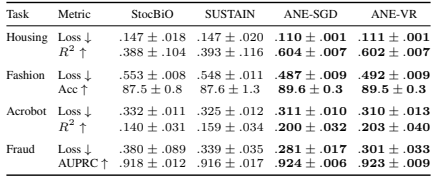
Table 3 :Final test metrics (mean±SD over 20 seeds per task).For Fraud, Loss is the class- balanced validation (outer) objective (Appendix C.3). Best per task inbold. In Acrobot, SUSTAIN beats StocBiO (R 2 = 0.16vs.0.14) but ANE-VR matches ANE-SGD, consistent with across- iteration VR adding little on top of ANE.
出典 · CC BY 4.0 · Jason Bohne, Pawel Polak, Gary Kazantsev, David Rosenberg · Your Hypergradient is Skewed: Antithetic Neumann Estimation for Bilevel Optimization · 論文の図を引用 · 元のPDFの10ページ目から図の部分を抽出しています。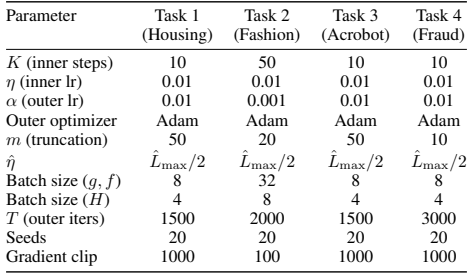
Table 4 : Full hyperparameter settings for each real task.
出典 · CC BY 4.0 · Jason Bohne, Pawel Polak, Gary Kazantsev, David Rosenberg · Your Hypergradient is Skewed: Antithetic Neumann Estimation for Bilevel Optimization · 論文の図を引用 · 元のPDFの20ページ目から図の部分を抽出しています。打ち消し理論の適用範囲とコスト
著者らは、奇数次の打ち消しは、ハイパーグラディエントの歪度を完全に扱う理論ではないと述べています。近似基準Hessianに対する上界は、実際のタスクが仮定できない収縮条件を前提としているため、実験で得られた改善を歪度の補正だけで説明することはできません。コストの面では、ANEは鏡像の分岐と基準Hessianの適用があるため、標準のNeumannハイパーグラディエントのステップより約3倍のコストがかかると報告されています。壁時計時間をそろえた比較は、今後の課題として残されています。
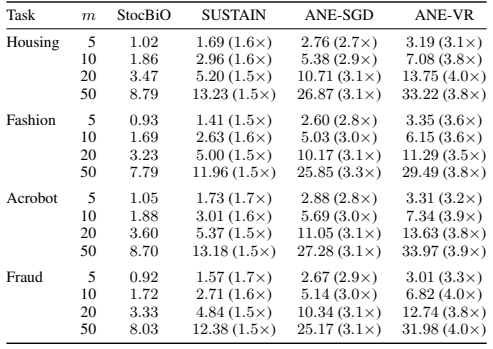
Table 11 : Hypergradient-step wall-clock time (ms per call; ratio to StocBiO in parentheses).
出典 · CC BY 4.0 · Jason Bohne, Pawel Polak, Gary Kazantsev, David Rosenberg · Your Hypergradient is Skewed: Antithetic Neumann Estimation for Bilevel Optimization · 論文の図を引用 · 元のPDFの24ページ目から図の部分を抽出しています。論文情報
- 著者
- Jason Bohne, Pawel Polak, Gary Kazantsev, David Rosenberg
- 学会・ジャーナル
- arXiv · プレプリント
- 公開日
- 2026年11月11日
- 登録日
- 2026年11月13日
- 更新日
- 2026年11月11日
- バージョン
- v1
- arXiv
- 2611.15895
- カテゴリ
- cs.LG · math.OC
- ライセンス
- CC BY 4.0
- 掲載内容
- 論文情報・解説・論文の図
この解説は、Refivuの韓国語解説をAIで翻訳したものです。不正確な翻訳や誤りが含まれる可能性があります。論文と図の利用条件は各出典に従います。
アブストラクト
Bilevel optimization is a core tool in practical machine learning workflows, including hyperparameter tuning, data reweighting, robust learning, reinforcement learning, and imbalanced classification. Hypergradient computation requires the inverse of the inner Hessian, typically estimated via a truncated Neumann series. While existing analyses focus on bias and variance, we show that the product structure of the Neumann series introduces a third source of error: skewness. We identify that, unlike ordinary gradients, whose asymmetry is suppressed by mini-batch averaging, the Neumann estimator amplifies skewness across factors, with the third-moment error growing, under weak contraction, with truncation depth, inner condition number, and per-factor noise asymmetry. This arises in many practical settings such as corrupted labels, outliers, heterogeneous or class-imbalanced datasets. To address this, we introduce the Antithetic Neumann Estimator (ANE), which pairs each Hessian sample with a mirrored counterpart around a reference Hessian and averages the resulting inverse-Hessian estimates. With an exact reference, the antithetic product retains only even-order noise, eliminating all odd-order perturbation terms; with an approximate reference, the residual odd-order contribution is bounded linearly in the reference error. ANE requires only a modification of the Hessian vector step and combines with existing stochastic or variance-reduced bilevel methods. We instantiate ANE-SGD and ANE-VR, the latter adding recursive variance reduction. Across robust regression, data cleaning, offline reinforcement learning, and imbalanced classification, ANE-based methods improve on stochastic and variance-reduced baselines on every task (20 seeds each), lowering loss by 4 to 25% relative to the best baseline; the largest gains, on robust regression, are a 25% lower test loss and a 54% higher test r-squared.
この論文を引用
Jason Bohne, Pawel Polak, Gary Kazantsev, David Rosenberg (2026). Your Hypergradient is Skewed: Antithetic Neumann Estimation for Bilevel Optimization. arXiv:2611.15895v1. https://arxiv.org/abs/2611.15895v1
BibTeX
@misc{bohne2026your,
  title = {{Your Hypergradient is Skewed: Antithetic Neumann Estimation for Bilevel Optimization}},
  author = {Jason Bohne and Pawel Polak and Gary Kazantsev and David Rosenberg},
  year = {2026},
  eprint = {2611.15895},
  archivePrefix = {arXiv},
  url = {https://arxiv.org/abs/2611.15895v1}
}