論文解説
Transformer-FSQ: Discrete Latents for Extreme KV-Cache Compression
Transformer-FSQ:極端なKVキャッシュ圧縮のための離散潜在表現
- 課題 長い文脈をローカル機器で保持するには、KVキャッシュがモデルの重みとメモリを取り合うため、16倍を超える極端な圧縮でも検索精度を保てる方法が必要です。
- 手法 事前学習済みTransformerのキーと値の射影を、FSQエンコーダと共有デコーダに置き換えます。トークンごとにビットパッキングされた整数コードを保存し、バックボーンは固定したまま、挿入した部分だけをファインチューニングします。
- 結果 8,192トークンのRULERでは、12倍から97.5倍の範囲で検索精度がベースラインを上回りました。LongBenchのgov_report要約でも高い圧縮率で優位でした。デコード処理量は32倍でネイティブSDPAと同程度で、より深い圧縮では高くなりました。
長い文脈とKVキャッシュのメモリ問題
ローカル機器で個人向けの言語モデルを動かす際の最大の制約は、モデルの重みとともに増えるKVキャッシュです。KVキャッシュは処理したトークンごとにキーと値を保存するため、文脈長に比例して大きくなります。また論文では、測定した既存のKVキャッシュ圧縮手法が中程度の圧縮率を超えると失敗すると述べられています。この論文は、こうした極端な圧縮の領域、つまり16倍を超える圧縮を目標としています。
FSQボトルネックでキーと値を置き換える方法
Transformer-FSQは、事前学習済みTransformerのキーと値の射影を、FSQエンコーダと共有線形デコーダに置き換えます。入力の残差状態x_tを、学習された線形エンコーダEでG次元の潜在ベクトルに写像し、各座標をL個の固定レベルに丸めて、整数コードz_tを保存します。論文によると、L=16なので座標あたり4ビットが使われます。デコーダW_kvは、このコードからすべてのKVヘッドのキーと値を再構成します。値はアテンションがコードを重み付き加算した後に一度だけW_vで復元されますが、キーは位置回転のため、キャッシュされた位置ごとに再構成する必要があります。この点が、キー側の追加の演算の原因です。
FSQの離散化方式とコードブックのない格子
ベクトル量子化は、明示的に保存されたコードブックから最も近い項目を探すため、コードブックのメモリ、最近傍探索、コードブックの崩壊という問題が生じます。一方、FSQは各座標を独立に、固定されたスカラーレベルに丸めます。式(2)によると、座標uはtanhベースの境界の後に丸められ、逆伝播では、ストップグラディエントによって丸めを恒等写像として扱う直線推定器(STE)が使われます。表現の全体集合は各座標のレベルの直積集合で、コード空間がL^dだけ大きくなっても、実際には保存も探索もしません。このため、メタデータなしで座標あたり⌈log2 L⌉ビットだけでキャッシュを構成できます。
閉形式の初期化とバックボーン固定のファインチューニング
この変換は、事前学習済みモデルを再学習せず、挿入したエンコーダとデコーダだけを調整する方法です。補正サンプル32,768個の残差状態から主成分方向を求めてエンコーダの行を初期化し、デコーダは量子化された潜在値から残差状態を再構成するリッジ回帰で合わせます。その後、バックボーンを固定したまま、ClimbMixで0.25トークン/パラメータ分の挿入されたエンコーダとデコーダだけを学習します。ただし論文は、GがCより大きくなる中程度の圧縮率では、エンコーダの基底が主成分方向を繰り返すため、一部の座標が重複した情報を持つと述べています。
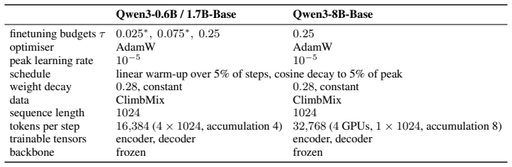
Table 4 :Finetuning hyperparameters.τ: finetuning tokens per parameter;τ= 0is conversion without finetuning. All methods at a model scale share data, optimiser and budget. The released models’ results (§5.2) useτ= 0.25; Figure 7 shows the effect ofτon Qwen3-0.6B-Base. ∗Qwen3- 0.6B-Base only.
出典 · CC BY 4.0 · Andras Szecsenyi, Thomas L. Lee, Vaisakh Shaj, Elliot J. Crowley, Amos Storkey · Transformer-FSQ: Discrete Latents for Extreme KV-Cache Compression · 論文の図を引用 · 元のPDFの23ページ目から図の部分を抽出しています。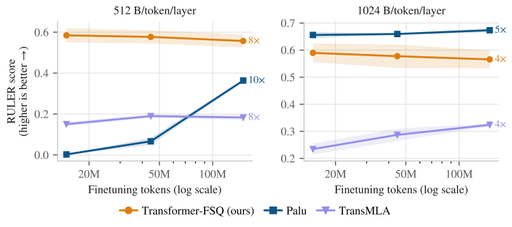
Figure 7 :RULER against finetuning tokenson Qwen3-0.6B-Base (0.025,0.075and0.25per parameter) at nominal512and1,024B per token per layer. Labels give achieved ratios (Palu stores 400and784B). Transformer-FSQ plateaus with fewer finetuning tokens than the baselines.
出典 · CC BY 4.0 · Andras Szecsenyi, Thomas L. Lee, Vaisakh Shaj, Elliot J. Crowley, Amos Storkey · Transformer-FSQ: Discrete Latents for Extreme KV-Cache Compression · 論文の図を引用 · 元のPDFの23ページ目から図の部分を抽出しています。RULERの長文脈検索結果
検証の中心的な問いは、極端な圧縮でも長文脈の検索精度が保たれるかどうかです。RULERを8,192トークンで13個のタスクにわたって評価しました。12倍から97.5倍の範囲では、Transformer-FSQがすべてのベースラインより高い検索精度となりました。論文では、Qwen3-8B-Baseで32倍のとき0.49、97.5倍のとき0.23だったと述べられています。この8B結果は1シードで測定されたものなので、3シードの結果と同じ信頼区間の条件で読むべきではありません。
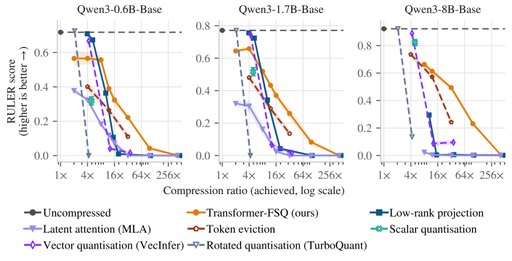
Figure 2 :RULER at8,192tokens against achieved compressionon Qwen3-0.6B, 1.7B and 8B. Solid: finetuned; dashed: training-free; grey horizontal line: uncompressed. Points average up to three seeds (one on 8B), with 95% bootstrap intervals over seeds and then items stratified by task. Beyond about12×, Transformer-FSQ scores highest on all three models.
出典 · CC BY 4.0 · Andras Szecsenyi, Thomas L. Lee, Vaisakh Shaj, Elliot J. Crowley, Amos Storkey · Transformer-FSQ: Discrete Latents for Extreme KV-Cache Compression · 論文の図を引用 · 元のPDFの2ページ目から図の部分を抽出しています。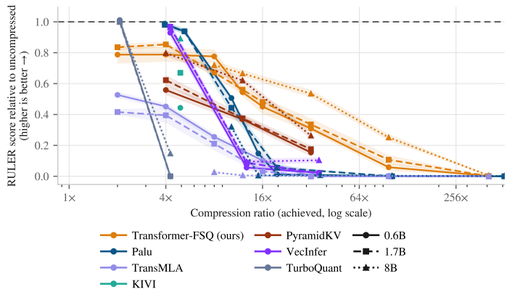
Figure 8 :RULER relative to the uncompressed model:score at8,192tokens divided by the same model’s uncompressed score; bands as in Figure 2. Below about5×, VecInfer and Palu keep the most; from32×to97.5×, Transformer-FSQ does.
出典 · CC BY 4.0 · Andras Szecsenyi, Thomas L. Lee, Vaisakh Shaj, Elliot J. Crowley, Amos Storkey · Transformer-FSQ: Discrete Latents for Extreme KV-Cache Compression · 論文の図を引用 · 元のPDFの26ページ目から図の部分を抽出しています。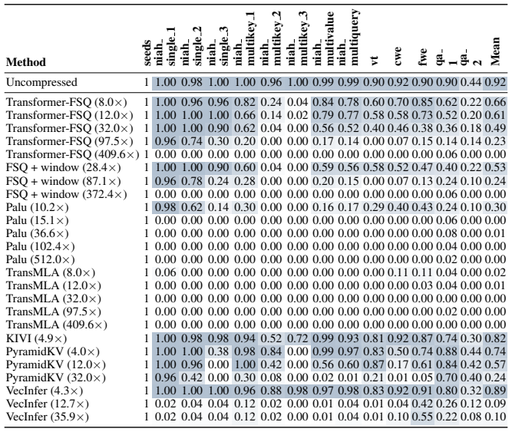
Table 11 : Per-task RULER on Qwen3-8B-Base (13 tasks of 50 items,8,192tokens, bfloat16). Finetuned methods use0.25tokens per parameter; KIVI, PyramidKV and VecInfer are training- free. Rows give achieved compression ratios; scores average complete seeds. Shading encodes the task score.
出典 · CC BY 4.0 · Andras Szecsenyi, Thomas L. Lee, Vaisakh Shaj, Elliot J. Crowley, Amos Storkey · Transformer-FSQ: Discrete Latents for Extreme KV-Cache Compression · 論文の図を引用 · 元のPDFの39ページ目から図の部分を抽出しています。LongBenchの要約への転移結果
合成検索の性能が実際の文書要約にもつながるかも確認しました。LongBenchのgov_reportタスクでROUGE-Lにより測定したところ、ベースラインは中程度の圧縮では非圧縮のスコアに追随しますが、高い圧縮率では崩れると論文は報告しています。論文は、Paluの高圧縮スコアの上昇が、反復されるストップワードを高く評価してしまう指標の効果である可能性を提起しています。これは著者らの解釈であり、直接測定された原因ではありません。
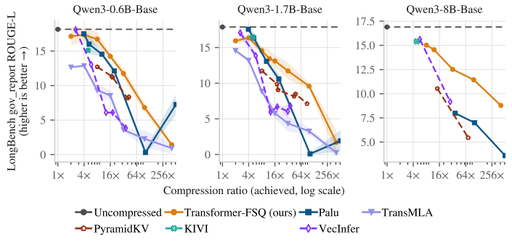
Figure 5 :LongBenchgov reportROUGE-L against achieved compressionon Qwen3-0.6B, 1.7B and 8B. Solid: finetuned; dashed: training-free; grey horizontal line: uncompressed; bands: one standard deviation over seeds.
出典 · CC BY 4.0 · Andras Szecsenyi, Thomas L. Lee, Vaisakh Shaj, Elliot J. Crowley, Amos Storkey · Transformer-FSQ: Discrete Latents for Extreme KV-Cache Compression · 論文の図を引用 · 元のPDFの9ページ目から図の部分を抽出しています。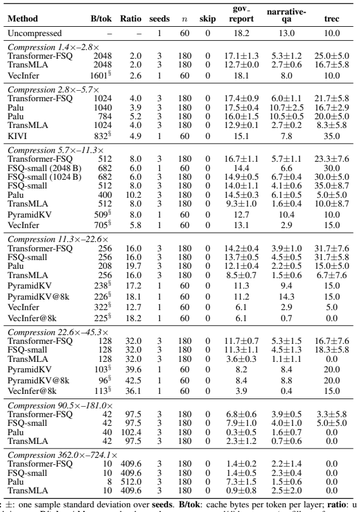
Table 12 : Per-task LongBench on Qwen3-0.6B-Base, each task in its own metric (over-length prompts truncated), over the 20 documents per task that every configuration scored. Finetuned meth- ods use0.25tokens per parameter; KIVI, PyramidKV and VecInfer are training-free. Transformer- FSQ and uncompressed rows run in bfloat16, all other rows in float32.
出典 · CC BY 4.0 · Andras Szecsenyi, Thomas L. Lee, Vaisakh Shaj, Elliot J. Crowley, Amos Storkey · Transformer-FSQ: Discrete Latents for Extreme KV-Cache Compression · 論文の図を引用 · 元のPDFの40ページ目から図の部分を抽出しています。固定バイト予算での離散性の比較
離散FSQボトルネックの効果を確認するため、同じバイト予算でいくつかの潜在構造を比較しました。連続潜在を16ビットで保存すると、幅が40に減り、0.001にとどまったと論文は報告しています。
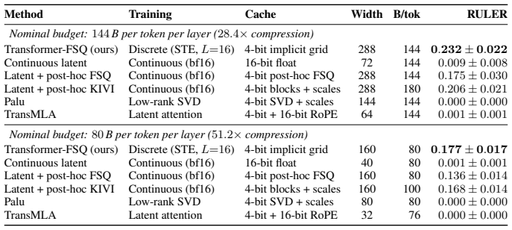
Table 2 :Discreteness at matched byte budgets:RULER at8,192tokens on Qwen3-0.6B-Base (three seeds,0.25tokens per parameter) at nominal144and80B per token per layer; mean±95% bootstrap half-width. The uncompressed model (4,096B) scores0.718±0.023. Continuous latents are4×narrower to fit the budget; post-hoc variants quantise a wide continuous latent at evaluation. KIVI’s per-block scales add36and20B; TransMLA spends32B on rotary keys. Training through the 4-bit grid (STE,L=16) scores highest at both budgets.
出典 · CC BY 4.0 · Andras Szecsenyi, Thomas L. Lee, Vaisakh Shaj, Elliot J. Crowley, Amos Storkey · Transformer-FSQ: Discrete Latents for Extreme KV-Cache Compression · 論文の図を引用 · 元のPDFの10ページ目から図の部分を抽出しています。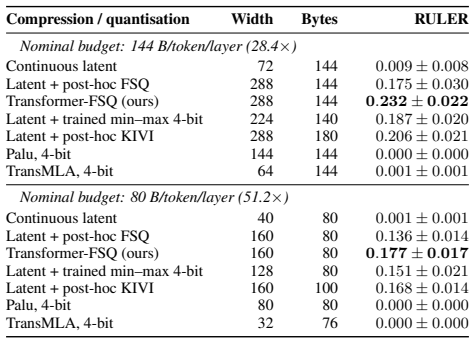
Table 7 :Cache width, precision and when quantisation is applied.RULER at8,192tokens on Qwen3-0.6B-Base (three seeds,0.25tokens per parameter); the uncompressed cache (4,096B per token per layer) scores0.718±0.023. Scores: mean±95% bootstrap half-width; bold: best. Bytes: actual storage per token per layer, metadata included; Width: bottleneck dimension.Trained FSQ rounds during training (straight-through estimator);post-hocFSQ and KIVI quantise a continuously trained latent only at evaluation. KIVI adds fp16 scales and offsets (25%over budget); Palu stores 4-bit SVD codes with scales; TransMLA stores 4-bit content codes plus 16-bit rotary keys.
出典 · CC BY 4.0 · Andras Szecsenyi, Thomas L. Lee, Vaisakh Shaj, Elliot J. Crowley, Amos Storkey · Transformer-FSQ: Discrete Latents for Extreme KV-Cache Compression · 論文の図を引用 · 元のPDFの34ページ目から図の部分を抽出しています。デコード処理量と実行時コスト
圧縮されたキャッシュを実際に高速に読み出せるかを、デコードのスループットで測定しました。ただし論文は、キーの再構成が各デコードステップで追加の演算になると述べており、これはRoPEとの相互作用から生じるコストだと説明しています。このスループットは、Qwen3-8Bなど特定のモデルとL40Sハードウェアの条件で測定された結果です。
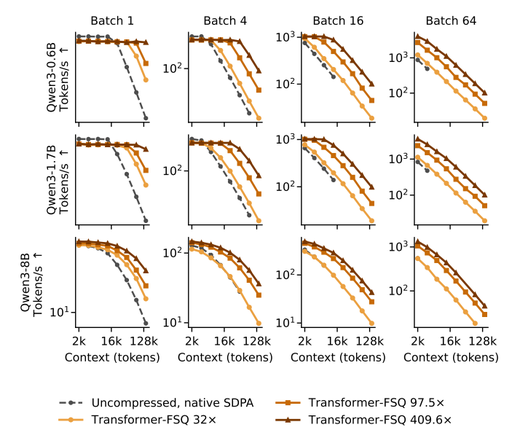
Figure 6 :Decode throughput against context lengthon NVIDIA L40S in bfloat16; rows: model, columns: batch size, both axes logarithmic. Grey dashed: the uncompressed model with native SDPA, timed in the same process. Orange: Transformer-FSQ at32×,97.5×and409.6×, darker for deeper compression; a line that ends early ran out of memory. Protocol: Appendix D.5.
出典 · CC BY 4.0 · Andras Szecsenyi, Thomas L. Lee, Vaisakh Shaj, Elliot J. Crowley, Amos Storkey · Transformer-FSQ: Discrete Latents for Extreme KV-Cache Compression · 論文の図を引用 · 元のPDFの11ページ目から図の部分を抽出しています。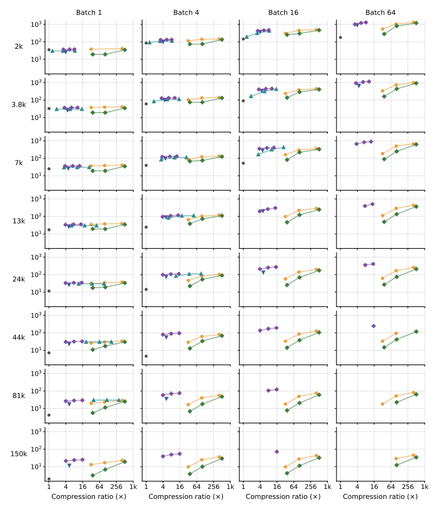
Figure 16 :Decode throughput against compression ratio, Qwen3-8B-Base;layout as in Fig- ure 14.
出典 · CC BY 4.0 · Andras Szecsenyi, Thomas L. Lee, Vaisakh Shaj, Elliot J. Crowley, Amos Storkey · Transformer-FSQ: Discrete Latents for Extreme KV-Cache Compression · 論文の図を引用 · 元のPDFの33ページ目から図の部分を抽出しています。検証の範囲と限界
論文では、いくつかの限界が挙げられています。また、算術推論、コード生成、マルチショット学習は測定していません。16レベルの格子は幅16から4,096まで適用されましたが、中程度の圧縮率で、より少ない座標とより精密なレベルを使う設定は検証されていません。キャッシュのメモリは解析的計算とGPUメモリ測定で確認しましたが、これは特定のプロンプトと設定での確認です。
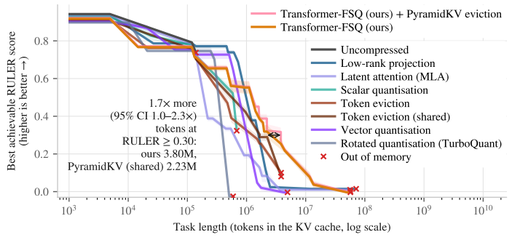
Figure 11 :Tokens held on a 16 GiB GPU against RULER at8,192tokens.Crosses: out of memory. The stacked line includes only stacks in which Transformer-FSQ supplies at least half the compression in log terms. At matched RULER thresholds, Transformer-FSQ and its eviction stacks hold up to 1.7×more tokens than the baselines.
出典 · CC BY 4.0 · Andras Szecsenyi, Thomas L. Lee, Vaisakh Shaj, Elliot J. Crowley, Amos Storkey · Transformer-FSQ: Discrete Latents for Extreme KV-Cache Compression · 論文の図を引用 · 元のPDFの28ページ目から図の部分を抽出しています。論文情報
- 著者
- Andras Szecsenyi, Thomas L. Lee, Vaisakh Shaj, Elliot J. Crowley, Amos Storkey
- 学会・ジャーナル
- arXiv · プレプリント
- 公開日
- 2026年11月6日
- 登録日
- 2026年11月9日
- 更新日
- 2026年11月6日
- バージョン
- v1
- arXiv
- 2611.09598
- カテゴリ
- cs.LG
- ライセンス
- CC BY 4.0
- 掲載内容
- 論文情報・解説・論文の図
この解説は、Refivuの韓国語解説をAIで翻訳したものです。不正確な翻訳や誤りが含まれる可能性があります。論文と図の利用条件は各出典に従います。
アブストラクト
Private, personalised language models must run on local consumer devices, where large, frontier models cannot fit, and retaining long contexts is non-trivial. Sequential memory---the key-value (KV) cache---grows linearly with context length, quickly dwarfing the model itself: for Qwen3-1.7B-Base, 200,000 retained entries require 21 GiB, 6.6 times more than the model weights. Yet the KV-cache compression methods we measured fail beyond moderate compression ratios. We introduce Transformer-FSQ, addressing extreme KV-cache compression by replacing standard key and value projections with a finite scalar quantisation bottleneck. Our cache stores a packed vector of discrete integer codes per token, with no per-token quantisation metadata. Converting a pretrained transformer trains only these projections on 0.25 tokens per original parameter. We evaluate Transformer-FSQ against five baseline families on models from 0.6B to 8B parameters. On long-context retrieval (RULER), from 12$\times$ to 97.5$\times$ Transformer-FSQ is the most accurate method we evaluate, across scales. A fused Triton kernel decodes directly from the integer codes; with baselines given their authors' kernels where available, it decodes at $1.01\times$ (95% interval $0.98$--$1.05$) the throughput of native SDPA attention on the uncompressed Qwen3-8B-Base at $32\times$ and $1.54\times$ at $97.5\times$. Extreme KV-cache compression is therefore a practical way to extend how much context a fixed device can hold.
この論文を引用
Andras Szecsenyi, Thomas L. Lee, Vaisakh Shaj, Elliot J. Crowley, Amos Storkey (2026). Transformer-FSQ: Discrete Latents for Extreme KV-Cache Compression. arXiv:2611.09598v1. https://arxiv.org/abs/2611.09598v1
BibTeX
@misc{szecsenyi2026transformer,
  title = {{Transformer-FSQ: Discrete Latents for Extreme KV-Cache Compression}},
  author = {Andras Szecsenyi and Thomas L. Lee and Vaisakh Shaj and Elliot J. Crowley and Amos Storkey},
  year = {2026},
  eprint = {2611.09598},
  archivePrefix = {arXiv},
  url = {https://arxiv.org/abs/2611.09598v1}
}