論文解説
BEHRT: Transformer for Electronic Health Records
BEHRT:電子健康記録のためのTransformer
- 課題 BEHRTは、CPRDの診断シーケンスをTransformer構造で学習し、将来の疾患発生を予測するモデルです。
- 手法 患者の受診記録をCLSとSEPを含むシーケンスにまとめ、疾患、位置、年齢、セグメントの4つの埋め込みを結合します。MLMによる事前学習の後、複数疾患の予測にファインチューニングします。
- 結果 表1では、次の受診の課題でBEHRTがAPS 0.462、AUROC 0.954を示し、DeeprとRETAINを上回ったと報告されています。
疾患発生予測の課題とBEHRTの目的
多くの疾患は、患者に明確な症状が現れてから診断されます。BEHRTは、この問題を減らすために、患者の過去の診療記録から将来の疾患発生を予測するモデルとして提案されています。この論文は、EHRデータを特徴量エンジニアリングで加工してきた従来の方法とは異なり、診断シーケンスをTransformer構造に直接入力する方法を取っています。既存の深層EHRモデルとしてはRETAINとDeeprが比較対象に使われ、BEHRTはこの2つのモデルより高いAPSとAUROCを報告しています。この研究の範囲は、CPRDの診断記録を中心とした複数疾患の予測です。疾患ごとに個別のモデルを学習させる代わりに、1つのモデルで複数の疾患を同時に予測するよう設計されています。
診断シーケンスと4種類の埋め込みの結合
BEHRTは、患者ごとの受診記録を時間順に並べ、開始を示すCLSトークンと受診の区切りを示すSEPトークンを入れて1つのシーケンスにします。このとき各受診は診断のリストであり、診断は単語、1回の受診の内容は文、患者の診療履歴全体は文書に対応します。入力表現は、疾患埋め込み、位置埋め込み、年齢埋め込み、セグメント埋め込みの和で構成されます。位置埋め込みは事前に定義されたエンコーディングを使い、フィードフォワード構造に欠けている順序情報を補います。年齢埋め込みは各診断が発生した年齢を示し、セグメント埋め込みは受診の始まりと終わりを区別します。この構造の重要な違いは、元のBERTのNLP入力になかった年齢とセグメントを加えた点です。
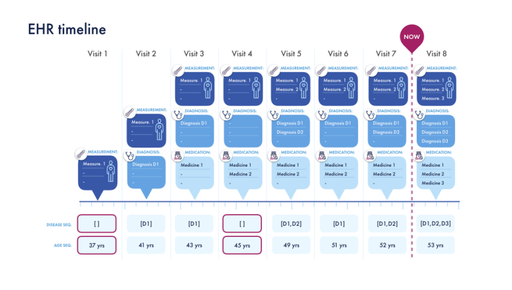
Figure 2 : Preparation of CPRD data for BEHRT. An example patient’s EHR sequence can be seen in (a), which consists of 8 visits. In each visit, the record can consist of concepts such as diagnoses, medications and measurements; all these values are artificial and for illustration purposes. For this study, we are only interested in age and diagnoses. Therefore, as shown in at the bottom of the figure, we have taken only the diagnosis and age subset of the record to form the necessary sequences. This resulting sequence is what we represent every patient’s EHR as to our modelling process. Note that, the visits shown in purple boxes are not going to be represented to the model, due to them lacking diagnoses.
出典 · CC BY 4.0 · Yikuan Li, Shishir Rao, Jose Roberto Ayala Solares, Abdelaali Hassaine, Dexter Canoy, Yajie Zhu, Kazem Rahimi, Gholamreza Salimi-Khorshidi · BEHRT: Transformer for Electronic Health Records · 論文の図を引用 · 元のPDFの4ページ目から図の部分を抽出しています。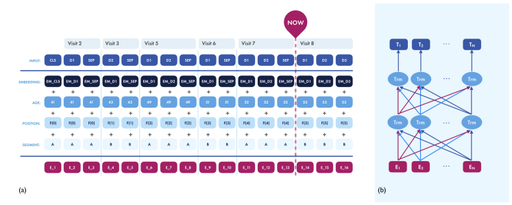
Figure 3 : BEHRT architecture. Using the artificial data shown in Figure 2, (a) shows how BEHRT sees one’s EHR. In addition to diagnosis and age, BEHRT also employs an encoding for event’s positions (shown as POSITION) to help it understand each event’s place in the sequence, and a visit separator (shown as SEGMENT) to help it understand the start and end of a visit. The combination of all these results is a final embedding shown at the bottom of (a), which will be the latent contextual representation of one’s EHR at a given visit. Using this pre-trained embedding, BEHRT’s deep Transformer-based model – shown in (b) – learns to predict the diseases in one’s future.
出典 · CC BY 4.0 · Yikuan Li, Shishir Rao, Jose Roberto Ayala Solares, Abdelaali Hassaine, Dexter Canoy, Yajie Zhu, Kazem Rahimi, Gholamreza Salimi-Khorshidi · BEHRT: Transformer for Electronic Health Records · 論文の図を引用 · 元のPDFの5ページ目から図の部分を抽出しています。MLMによる事前学習とフィードフォワード構造の選択
BEHRTは、BERTと同じ方法でマスク言語モデルの事前学習を行います。疾患の単語の15%をランダムに選び、そのうち80%はマスクトークンに置き換え、10%は別のランダムな疾患に置き換え、残りの10%はそのまま残します。モデルはどの単語が隠されたかを知ることができないため、すべての疾患単語について文脈表現を学習することになります。この設定は、次の疾患を直接当てる学習の前に、疾患どうしの双方向の文脈を学ばせる役割を果たします。構造の探索では、6個の層、12個のアテンションヘッド、中間層サイズ512、隠れサイズ288が選ばれ、そのときのMLM精度は0.6597です。この値は事前学習課題の精度であり、後の予測課題の性能と同じ指標ではありません。
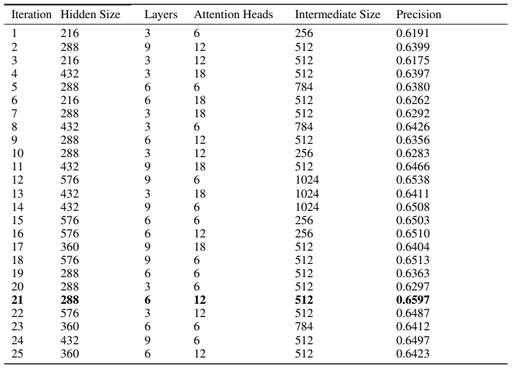
Table 2 : MLM Hyperparameter Tuning
出典 · CC BY 4.0 · Yikuan Li, Shishir Rao, Jose Roberto Ayala Solares, Abdelaali Hassaine, Dexter Canoy, Yajie Zhu, Kazem Rahimi, Gholamreza Salimi-Khorshidi · BEHRT: Transformer for Electronic Health Records · 論文の図を引用 · 元のPDFの13ページ目から図の部分を抽出しています。CPRDデータの構築と疾患の定義
BEHRTのデータは、英国の一次診療データであるCPRDから作られ、病院記録であるHESと連結されたGP診療所のみを使用しています。前処理は約800万人の患者から始まり、HESの連結条件とCPRDの品質基準を満たし、最低5回以上の受診記録を持つ患者だけを残す過程を経ています。その結果、最終的に学習と評価に使われた患者は160万人です。疾患は、一次診療のMed CodeをRead Codeに変換し、病院のICD-10コードとあわせてCaliberコードにマッピングして定義します。この過程でCaliber辞書は301個の診断コードを構成し、これがモデルの出力となる疾患の集合になります。
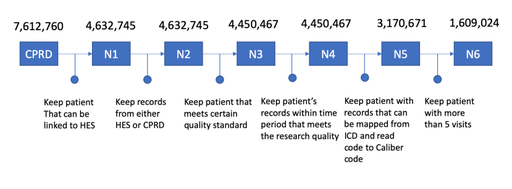
Figure 1 : Linkage and filtering of CPRD data. This flow lists all the key steps of our data cleaning and linkage procedure. At each step, the number of patients that are included is shown.
出典 · CC BY 4.0 · Yikuan Li, Shishir Rao, Jose Roberto Ayala Solares, Abdelaali Hassaine, Dexter Canoy, Yajie Zhu, Kazem Rahimi, Gholamreza Salimi-Khorshidi · BEHRT: Transformer for Electronic Health Records · 論文の図を引用 · 元のPDFの3ページ目から図の部分を抽出しています。予測課題と評価指標
BEHRTは3つの予測課題を扱います。次の受診の概念を予測するT1、今後6か月以内の疾患発生を予測するT2、今後12か月以内の疾患発生を予測するT3です。患者は学習、検証、テストのセットに80%、10%、10%ずつランダムに分けられ、課題ごとに最終フィルタリング後、699K、391K、342K人が使われます。主指標は、患者ごとに計算したのち全患者について平均する平均精度スコアであるAPSです。補助指標としてAUROCも同じ方法で計算します。ハイパーパラメータは、BEHRTの事前学習についてベイズ最適化で探索され、RETAINとDeeprについても同様の方法で探索が行われたと説明されています。
既存モデルとの予測性能の比較
表1では、次の受診の課題におけるBEHRTのAPSは0.462、AUROCは0.954と報告されています。同じ課題で、DeeprのAPSは0.360、AUROCは0.942であり、RETAINのAPSは0.382、AUROCは0.921です。今後6か月の課題では、BEHRTがAPS 0.525、AUROC 0.958で、Deeprは0.393と0.943、RETAINは0.417と0.927です。今後12か月の課題では、BEHRTのAPSは0.506、AUROCは0.955で、Deeprは0.393と0.943、RETAINは0.413と0.928でした。論文本文は、複数疾患の予測においてBEHRTが既存の最高水準の深層EHRモデルより約8%の絶対的な向上を示したと記述しており、これは著者らが報告した結果です。
この比較は、CPRDで同じ課題と分割により測定された3つのモデルについてのものであり、別のデータセットや別の疾患集合にそのまま当てはめられる結果ではありません。

Table 1 : Next Visit Prediction Task
出典 · CC BY 4.0 · Yikuan Li, Shishir Rao, Jose Roberto Ayala Solares, Abdelaali Hassaine, Dexter Canoy, Yajie Zhu, Kazem Rahimi, Gholamreza Salimi-Khorshidi · BEHRT: Transformer for Electronic Health Records · 論文の図を引用 · 元のPDFの8ページ目から図の部分を抽出しています。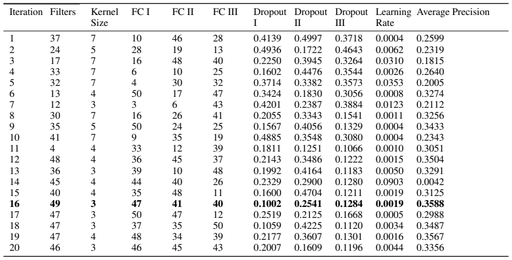
Table 3 : Deepr Best Model - Subsequent Visit Prediction Task
出典 · CC BY 4.0 · Yikuan Li, Shishir Rao, Jose Roberto Ayala Solares, Abdelaali Hassaine, Dexter Canoy, Yajie Zhu, Kazem Rahimi, Gholamreza Salimi-Khorshidi · BEHRT: Transformer for Electronic Health Records · 論文の図を引用 · 元のPDFの14ページ目から図の部分を抽出しています。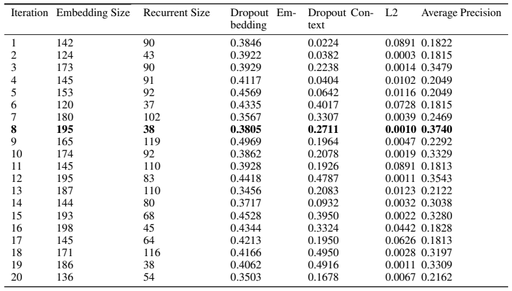
Table 4 : RETAIN Best Model - Subsequent Visit Prediction Task
出典 · CC BY 4.0 · Yikuan Li, Shishir Rao, Jose Roberto Ayala Solares, Abdelaali Hassaine, Dexter Canoy, Yajie Zhu, Kazem Rahimi, Gholamreza Salimi-Khorshidi · BEHRT: Transformer for Electronic Health Records · 論文の図を引用 · 元のPDFの14ページ目から図の部分を抽出しています。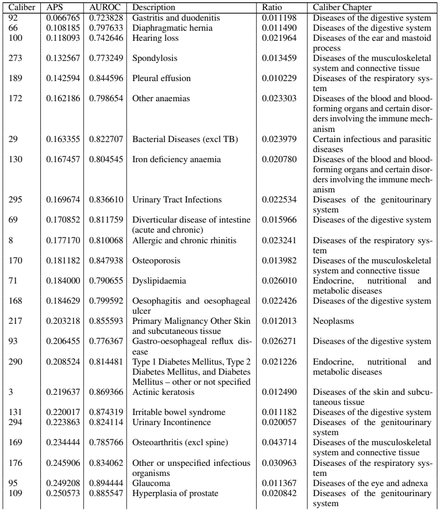
Table 5 : Diseases Prediction Performance
出典 · CC BY 4.0 · Yikuan Li, Shishir Rao, Jose Roberto Ayala Solares, Abdelaali Hassaine, Dexter Canoy, Yajie Zhu, Kazem Rahimi, Gholamreza Salimi-Khorshidi · BEHRT: Transformer for Electronic Health Records · 論文の図を引用 · 元のPDFの15ページ目から図の部分を抽出しています。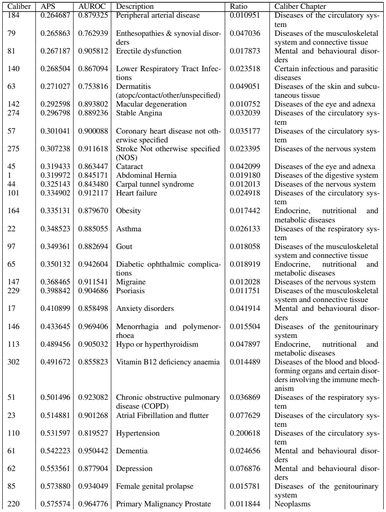
Table 5 : Diseases Prediction Performance
出典 · CC BY 4.0 · Yikuan Li, Shishir Rao, Jose Roberto Ayala Solares, Abdelaali Hassaine, Dexter Canoy, Yajie Zhu, Kazem Rahimi, Gholamreza Salimi-Khorshidi · BEHRT: Transformer for Electronic Health Records · 論文の図を引用 · 元のPDFの16ページ目から図の部分を抽出しています。
Table 5 : Diseases Prediction Performance
出典 · CC BY 4.0 · Yikuan Li, Shishir Rao, Jose Roberto Ayala Solares, Abdelaali Hassaine, Dexter Canoy, Yajie Zhu, Kazem Rahimi, Gholamreza Salimi-Khorshidi · BEHRT: Transformer for Electronic Health Records · 論文の図を引用 · 元のPDFの17ページ目から図の部分を抽出しています。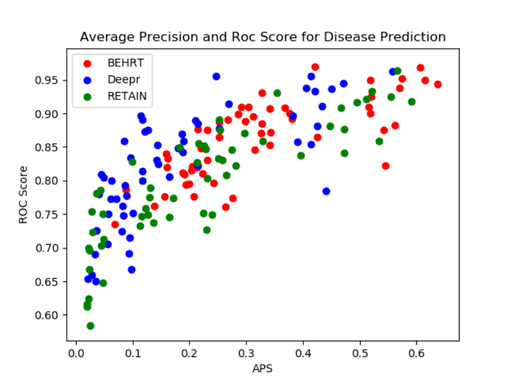
Figure 7 : Disease-wise precision comparison for BEHRT, Deepr and RETAIN, all models trained on same dataset and trained on the same task (next 6 months), each point represents the precision/AUROC of one disease on corresponding model.
出典 · CC BY 4.0 · Yikuan Li, Shishir Rao, Jose Roberto Ayala Solares, Abdelaali Hassaine, Dexter Canoy, Yajie Zhu, Kazem Rahimi, Gholamreza Salimi-Khorshidi · BEHRT: Transformer for Electronic Health Records · 論文の図を引用 · 元のPDFの17ページ目から図の部分を抽出しています。埋め込みとアテンションの定性的分析
著者らは、疾患埋め込みをt-SNEで2次元に射影し、同じ臨床群の疾患が近くに集まるかを確認しています。この分析は視覚的な検討であり、疾患埋め込みが実際の臨床知識をどれだけ正確に含んでいるかについての定量的な証明ではありません。アテンション分析では、患者の履歴を自分自身と比較し、ある診断が他の診断とどのようなアテンションスコアで結びついているかを示します。例の患者では、関節リウマチと腱症および滑膜疾患の間に遠い将来の結びつきが現れたと記述されています。著者らは、事前学習された表現が少ない追加学習で複数の下流タスクに使えると解釈していますが、この論文の実験は主に複数疾患の予測課題に限られています。
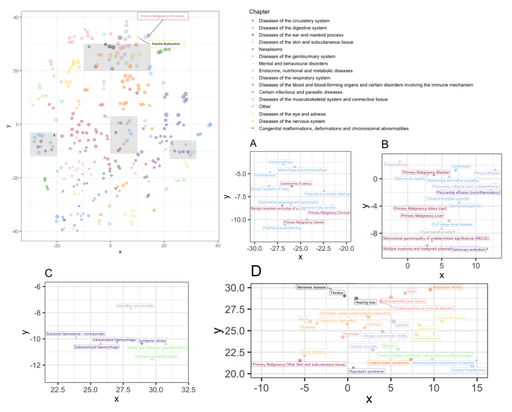
Figure 4 : Disease Embedding Analysis. In this image we see a graph of disease embeddings projected in two dimensions where distance represents closeness of contextual association. Most associations are accepted by medical experts and maintain the gender-based divisions in illnesses, among other things. We zoom in and profile four clusters in this plot – shown in subfigures A-D.
出典 · CC BY 4.0 · Yikuan Li, Shishir Rao, Jose Roberto Ayala Solares, Abdelaali Hassaine, Dexter Canoy, Yajie Zhu, Kazem Rahimi, Gholamreza Salimi-Khorshidi · BEHRT: Transformer for Electronic Health Records · 論文の図を引用 · 元のPDFの7ページ目から図の部分を抽出しています。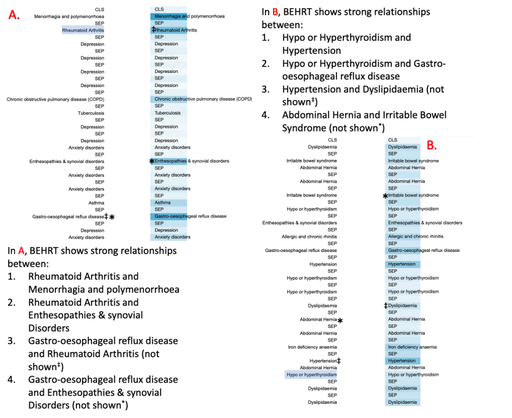
Figure 5 : Disease Self-Attention Analysis. This figure shows the EHR history (shown chronologically, going down- wards) of two patients A and B, each presented as two identical columns for the convenience of association analyses. The left side of the column represents the disease of interest and the right column indicates the corresponding associations to the highlighted disease on the left. The intensity of the blue on the right column represents the strength of the attention score – the stronger the intensity, the stronger the association and hence the stronger the attention score. The attention scores are specifically retrieved from the attention component of the last layer of BEHRT network.
出典 · CC BY 4.0 · Yikuan Li, Shishir Rao, Jose Roberto Ayala Solares, Abdelaali Hassaine, Dexter Canoy, Yajie Zhu, Kazem Rahimi, Gholamreza Salimi-Khorshidi · BEHRT: Transformer for Electronic Health Records · 論文の図を引用 · 元のPDFの9ページ目から図の部分を抽出しています。適用範囲と限界
この研究の結果は、CPRDとHESの連結データから得られたものであり、疾患の定義はCaliberマッピングに依存しています。著者らは、Caliberが特定のコードを301個の疾患コードに統合し、多くの他のコードはマッピングできないと明らかにしており、より安定したマッピングが必要だと述べています。本研究は診断のみを使用し、薬剤、検査、治療などの他の概念は今後の研究に残されています。アテンションと埋め込みの分析は定性的な例に基づくため、臨床的な解釈は確定していません。性能向上の大きさは著者らが報告した条件から得られた値であるため、他の医療体系や別の疾患リストにそのまま一般化することは難しいです。
論文情報
- 著者
- Yikuan Li, Shishir Rao, Jose Roberto Ayala Solares, Abdelaali Hassaine, Dexter Canoy, Yajie Zhu, Kazem Rahimi, Gholamreza Salimi-Khorshidi
- 学会・ジャーナル
- arXiv · プレプリント
- 公開日
- 2019年7月22日
- 登録日
- 2026年11月6日
- 更新日
- 2019年7月22日
- バージョン
- v1
- arXiv
- 1907.09538
- カテゴリ
- cs.LG · stat.ML
- ライセンス
- CC BY 4.0
- 掲載内容
- 論文情報・解説・論文の図
この解説は、Refivuの韓国語解説をAIで翻訳したものです。不正確な翻訳や誤りが含まれる可能性があります。論文と図の利用条件は各出典に従います。
アブストラクト
Today, despite decades of developments in medicine and the growing interest in precision healthcare, vast majority of diagnoses happen once patients begin to show noticeable signs of illness. Early indication and detection of diseases, however, can provide patients and carers with the chance of early intervention, better disease management, and efficient allocation of healthcare resources. The latest developments in machine learning (more specifically, deep learning) provides a great opportunity to address this unmet need. In this study, we introduce BEHRT: A deep neural sequence transduction model for EHR (electronic health records), capable of multitask prediction and disease trajectory mapping. When trained and evaluated on the data from nearly 1.6 million individuals, BEHRT shows a striking absolute improvement of 8.0-10.8%, in terms of Average Precision Score, compared to the existing state-of-the-art deep EHR models (in terms of average precision, when predicting for the onset of 301 conditions). In addition to its superior prediction power, BEHRT provides a personalised view of disease trajectories through its attention mechanism; its flexible architecture enables it to incorporate multiple heterogeneous concepts (e.g., diagnosis, medication, measurements, and more) to improve the accuracy of its predictions; and its (pre-)training results in disease and patient representations that can help us get a step closer to interpretable predictions.
この論文を引用
Yikuan Li, Shishir Rao, Jose Roberto Ayala Solares, Abdelaali Hassaine, Dexter Canoy, Yajie Zhu, Kazem Rahimi, Gholamreza Salimi-Khorshidi (2019). BEHRT: Transformer for Electronic Health Records. arXiv:1907.09538v1. https://arxiv.org/abs/1907.09538v1
BibTeX
@misc{li2019behrt,
  title = {{BEHRT: Transformer for Electronic Health Records}},
  author = {Yikuan Li and Shishir Rao and Jose Roberto Ayala Solares and Abdelaali Hassaine and Dexter Canoy and Yajie Zhu and Kazem Rahimi and Gholamreza Salimi-Khorshidi},
  year = {2019},
  eprint = {1907.09538},
  archivePrefix = {arXiv},
  url = {https://arxiv.org/abs/1907.09538v1}
}