論文解説
A Survey on Offline Reinforcement Learning: Taxonomy, Review, and Open Problems
オフライン強化学習に関するサーベイ:分類、レビュー、そして未解決問題
- 課題 静的データセットだけで方策を学習するとき、分布シフトによって既存のオンラインRL手法が失敗しやすい問題を扱います。
- 手法 方策制約、重点サンプリング、正則化、モデルベース、ワンステップ、模倣、軌道最適化を含む分類体系で、オフラインRL手法を分類します。
- 結果 D4RLではTTとIQLが高い性能でした。複数のOPE研究では、FQEが比較的良い性能だと報告されています。
静的データだけで方策を学習する問題
オフラインRLは、行動方策が事前に集めた静的データセットDだけを使って、新しい方策を学習する枠組みです。オンラインでの試行が高コストだったり危険だったりする、ロボティクス、教育、医療、自動運転などの分野で既存データを活用できる点が動機として挙げられています。ただし、オンラインRLのアルゴリズムは、追加の試行で誤った行動を修正できる前提で設計されています。そのため、静的データにそのまま適用すると失敗することが多くなります。学習した方策がデータの分布の外にある行動を選ぶと、Q値が過大評価されます。この分布シフトが、オフラインRLの中心的な問題として扱われています。この論文では、この問題を軸に手法を統一した表記で分類し、ベンチマークと未解決の問題をあわせて検討しています。
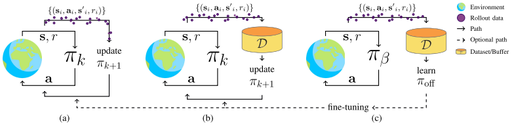
Fig. 1 . Illustration of the different RL paradigms, including (a) online RL, (b) off-policy RL, and (c) offline RL. In online RL new experiences must be collected with the latest policy before making an update. In off-policy RL, we reuse previous experiences but still rely on a continuous collection of new experiences. In contrast, offline RL only uses previous experiences collected with a behavior policy πβ and stored in a static dataset D to learn a policy πoff. After learning πoff, one can opt to fine-tune it using online or off-policy RL methods. This image is largely based on Levine et al.’s [8] pictorial illustration of RL paradigms. Earth image made by Freepik from www.flaticon.com.
出典 · CC BY 4.0 · Rafael Figueiredo Prudencio, Marcos R. O. A. Maximo, Esther Luna Colombini · A Survey on Offline Reinforcement Learning: Taxonomy, Review, and Open Problems · 論文の図を引用 · 元のPDFの2ページ目から図の部分を抽出しています。分布シフトを扱う手法の分類
論文は、方策制約、重点サンプリング、正則化、不確実性推定、モデルベース、ワンステップ、模倣学習、軌道最適化を分類の軸として挙げています。直接的な方策制約では、行動方策πβを推定し、学習方策をその近くに制限します。代表例としてBCQが紹介されています。価値の正則化は、OODの行動に対するQ値を下げて、価値関数が下限に近づくようにする手法です。その例はCQLです。ワンステップ法は、反復的な方策評価を何度も行う代わりに、方策評価と方策改善を1回ずつ行います。IQLは、データ内の行動だけを使って期待値回帰を行うワンステップ法として説明されています。この分類は、手法ごとに入れ替え可能な損失項をどこに付けるかで区別する枠組みです。
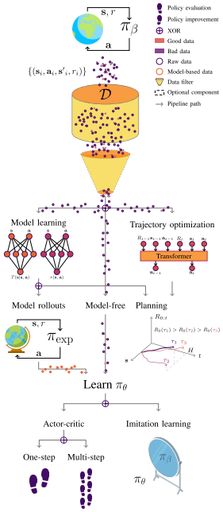
Fig. 2 . Illustration of the general structure of an offline RL algorithm, where different paths represent possible algorithm design choices. Initially, the behavior policy πβ interacts with the environment to collect experiences for dataset D. The data are then optionally filtered to retain only experiences from high-return trajectories. The remaining samples can then be used to either directly learn a policy πθ , learn a dynamics model TψT (s|s, a), or a model of the trajectory distribution pπβ (τ ). Trajectory distributions are used for planning, while dynamics models can be used either for planning or to generate synthetic samples to learn a policy. To learn πθ , we can opt between actor–critic and imitation learning methods. In the former, one can opt to use single or multiple steps of policy evaluation and policy improvement, while the latter typically relies on a good filtering process. Earth and globe images made by Freepik from www.flaticon.com.
出典 · CC BY 4.0 · Rafael Figueiredo Prudencio, Marcos R. O. A. Maximo, Esther Luna Colombini · A Survey on Offline Reinforcement Learning: Taxonomy, Review, and Open Problems · 論文の図を引用 · 元のPDFの5ページ目から図の部分を抽出しています。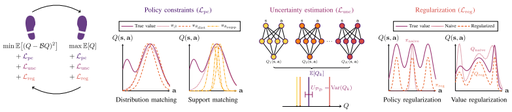
Fig. 3 . Policy evaluation and policy improvement loss terms, including the policy constraints loss Lpc, uncertainty estimation loss Lunc, and regularization loss Lreg. The policy constraints diagram showcases the difference between distribution and support matching constraints. Distribution constraints restrict πθ ’s distribution to match πβ. In contrast, support constraints only restrict the actions selected from πθ to be within the support of the actions selected by πβ. In the uncertainty estimation diagram, we show how an uncertainty measure can be extracted from the variance of predictions from an ensemble of Q functions. In the regularization diagram, we illustrate how policy regularization can improve the stochasticity of the learned policy (e.g., entropy regularization), and value regularization can ensure we do not overestimate Q-values.
出典 · CC BY 4.0 · Rafael Figueiredo Prudencio, Marcos R. O. A. Maximo, Esther Luna Colombini · A Survey on Offline Reinforcement Learning: Taxonomy, Review, and Open Problems · 論文の図を引用 · 元のPDFの7ページ目から図の部分を抽出しています。ベンチマークと評価指標
D4RLは、Gym-MuJoCo、迷路、Adroit、FrankaKitchen、CARLA、flowなど、複数の環境向けのオフラインデータセットを提供するベンチマークとして紹介されています。RL Unpluggedには、オンラインで学習した行動方策から得たデータセットが含まれています。オフライン方策評価のベンチマークであるDOPEでは、オフラインでの方策選択の指標としてRegret@kが使われます。これは、推定された上位k個の方策のうち最良の方策と、実際に最良の方策との価値の差を測るものです。本文で報告されたD4RLの性能比較は、正規化されたスコアの相対値としてまとめられており、その結果はこのベンチマークのスコアに限られたものです。
手法別の結果と適用範囲
論文では、D4RLの平均正規化スコアで手法どうしの相対性能を比べています。最近の手法のうち、TTとimplicit Q-learningが現在最も高い性能を発揮する手法として挙げられています。この結果は、そのベンチマークと正規化スコアという条件での観察であり、どの実応用でも成り立つとは保証されません。オフライン方策評価では、複数の研究の報告をもとに、FQEが単純な手法でありながら比較的良い性能を発揮するとまとめられています。ただし、この主張は複数のOPE研究で報告された結果を総合したものであり、ひとつの共通のプロトコルで測定した結果として解釈すべきではありません。
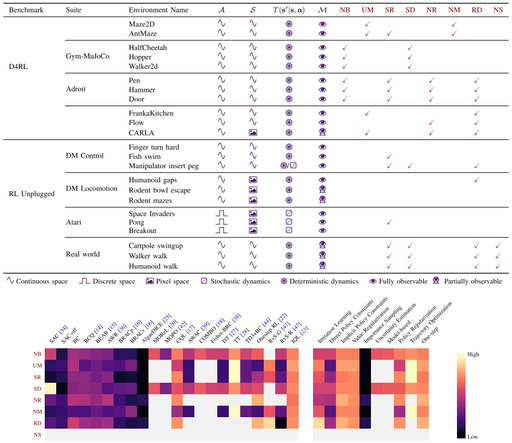
Fig. 5 . Relative performance of different offline RL methods (left) and offline RL taxonomy classes (right) on the dataset properties outlined in Section VI-A1. Brighter colors signify a higher performance. Light gray indicates the method was not evaluated on any datasets that satisfy the given property. On the right, the taxonomy classes show the aggregated performance of each classification from Table II. The class score on a given dataset property is given by the maximum score of any algorithm belonging to that class on the same property. The relative score for a dataset property is computed based on the average normalized D4RL scores on all datasets that satisfy such property. The normalized D4RL score is on a relative scale ∈ [0,1], where these are lowest and highest scores among all algorithms evaluated on a given dataset. Refer to the Supplementary Materials ( ) for more details on the raw scores used to generate this figure.
出典 · CC BY 4.0 · Rafael Figueiredo Prudencio, Marcos R. O. A. Maximo, Esther Luna Colombini · A Survey on Offline Reinforcement Learning: Taxonomy, Review, and Open Problems · 論文の図を引用 · 元のPDFの18ページ目から図の部分を抽出しています。残された問題と限界
論文は、ハイパーパラメータのチューニングとオフライン方策評価が、まだ十分な解決策のない問題だとしています。現在は、不正確なOPE手法でチューニングする方法や、固定したステップ数だけ学習する方法が使われています。どちらの方法も、過学習した最適化になりやすいと説明されています。ベンチマークの面でも、確率的な動力学、非定常性、マルチエージェント環境のデータセットが不足していると報告されています。したがって、この論文の分類と結果の比較は、現在のベンチマークと報告されたスコアの範囲内で読む必要があります。
論文情報
- 著者
- Rafael Figueiredo Prudencio, Marcos R. O. A. Maximo, Esther Luna Colombini
- 学会・ジャーナル
- arXiv · プレプリント
- 公開日
- 2022年3月2日
- 登録日
- 2026年11月6日
- 更新日
- 2023年4月19日
- バージョン
- v3
- arXiv
- 2203.01387
- DOI
- 10.1109/tnnls.2023.3250269
- カテゴリ
- cs.LG · cs.AI · stat.ML
- ライセンス
- CC BY 4.0
- 掲載内容
- 論文情報・解説・論文の図
この解説は、Refivuの韓国語解説をAIで翻訳したものです。不正確な翻訳や誤りが含まれる可能性があります。論文と図の利用条件は各出典に従います。
アブストラクト
With the widespread adoption of deep learning, reinforcement learning (RL) has experienced a dramatic increase in popularity, scaling to previously intractable problems, such as playing complex games from pixel observations, sustaining conversations with humans, and controlling robotic agents. However, there is still a wide range of domains inaccessible to RL due to the high cost and danger of interacting with the environment. Offline RL is a paradigm that learns exclusively from static datasets of previously collected interactions, making it feasible to extract policies from large and diverse training datasets. Effective offline RL algorithms have a much wider range of applications than online RL, being particularly appealing for real-world applications, such as education, healthcare, and robotics. In this work, we contribute with a unifying taxonomy to classify offline RL methods. Furthermore, we provide a comprehensive review of the latest algorithmic breakthroughs in the field using a unified notation as well as a review of existing benchmarks' properties and shortcomings. Additionally, we provide a figure that summarizes the performance of each method and class of methods on different dataset properties, equipping researchers with the tools to decide which type of algorithm is best suited for the problem at hand and identify which classes of algorithms look the most promising. Finally, we provide our perspective on open problems and propose future research directions for this rapidly growing field.
この論文を引用
Rafael Figueiredo Prudencio, Marcos R. O. A. Maximo, Esther Luna Colombini (2022). A Survey on Offline Reinforcement Learning: Taxonomy, Review, and Open Problems. arXiv:2203.01387v3. https://doi.org/10.1109/tnnls.2023.3250269
BibTeX
@article{prudencio2022survey,
  title = {{A Survey on Offline Reinforcement Learning: Taxonomy, Review, and Open Problems}},
  author = {Rafael Figueiredo Prudencio and Marcos R. O. A. Maximo and Esther Luna Colombini},
  year = {2022},
  eprint = {2203.01387},
  archivePrefix = {arXiv},
  doi = {10.1109/tnnls.2023.3250269},
  url = {https://arxiv.org/abs/2203.01387v3}
}