論文解説
Uncovering near-wall blood flow from sparse data with physics-informed neural networks
物理情報ニューラルネットワーク(PINN)を用いた疎なデータからの壁近傍血流の推定
- 課題 患者ごとに境界条件が不完全な血流で、壁から離れた疎な速度測定だけから、壁近傍の血流とWSSを復元できるかを検討します。
- 手法 速度と圧力をニューラルネットワークで近似し、Navier-Stokes方程式の残差、既知の一部の境界条件、疎な測定データを組み合わせた損失を最小化します。
- 結果 2Dの狭窄と2D・3Dの動脈瘤の事例では、PINNのWSSがCFDの基準とよく一致しました。1Dの検証と粘性の同定も基準解に収束しています。
疎な測定と不完全な境界条件の問題
この論文が扱うのは、壁近傍の血流と壁面せん断応力(WSS)を臨床的に正確に定量化する問題です。論文では、WSSは血管疾患と関連する一方、患者ごとのCFDや実験測定には不確かさ、低い解像度、ノイズという問題があると説明されています。特に患者ごとのモデルでは流入と流出の境界条件が分かりにくく、支配方程式だけでは問題が十分に定まりません。著者らは、この状況を、Navier-Stokes方程式、部分的にしか分かっていない境界条件、関心領域内の疎な速度測定を併用する問題として捉え直します。この研究の範囲は、壁から離れた疎な速度測定から、壁近傍の速度とWSSを復元することです。
PINNの損失の構成と学習手順
提案手法では、速度成分と圧力をそれぞれ別の全結合ニューラルネットワークで近似します。各層は前の層の出力に重みとバイアスを適用し、その後Swish活性化関数に通します。論文では、この活性化関数はx×Sigmoid(βx)でβ=1に設定されたと説明されています。学習の目的関数は、Navier-Stokes方程式の残差を二乗ノルムで測る物理損失Lphys、既知の一部の境界条件を課す損失LBC、疎な測定点で予測値と測定値の差を計算するデータ損失Ldataを線形結合して構成されます。全体の損失はLphys + λb·LBC + λd·Ldataで、これを最小化するように重みとバイアスをADAM系の最適化で更新します。
論文では、損失の計算に平均二乗誤差を用いたと述べられています。境界条件は完全ではないため、学習中はLBCを境界の一部にのみ課し、データ損失は解の選択を助ける役割を果たします。
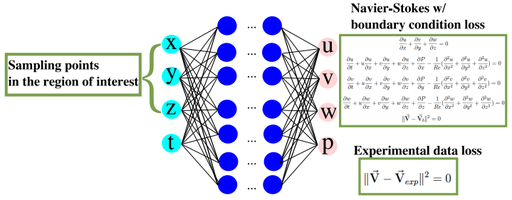
Figure 1 : Physics-informed neural networks (PINN) could be used for solving Navier-Stokes equa- tions. PINN could be augmented with experimental measurement data to improve the predicted solution and/or eliminate the necessity of fully defining boundary conditions or parameters. The spatial input points in PINN represent a flexible and meshfree representation of the domain.
出典 · CC BY 4.0 · Amirhossein Arzani, Jian-Xun Wang, Roshan M. D'Souza · Uncovering near-wall blood flow from sparse data with physics-informed neural networks · 論文の図を引用 · 元のPDFの6ページ目から図の部分を抽出しています。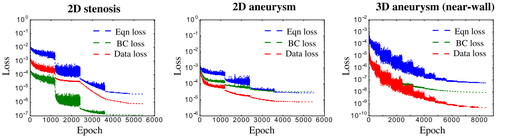
Figure 7 : The mean squared error (MSE) loss versus the epoch (iteration) number is plotted for the 2D stenosis, 2D aneurysm, and 3D aneurysm models. The equation loss, boundary condition loss, and data loss are plotted. The total loss is composed of a weighted sum of these losses. The loss in the 3D model is based on the near-wall region where PINN modeling was performed.
出典 · CC BY 4.0 · Amirhossein Arzani, Jian-Xun Wang, Roshan M. D'Souza · Uncovering near-wall blood flow from sparse data with physics-informed neural networks · 論文の図を引用 · 元のPDFの11ページ目から図の部分を抽出しています。2D狭窄・動脈瘤と3D動脈瘤のWSS検証
2Dの狭窄問題では、放物線状の流入プロファイルとRe=150の条件でのCFD結果を基準としました。PINNでは流入と流出の境界条件を未知としています。論文では、PINNは正しい流入境界条件を特定できなかったものの、センサーを配置した狭窄領域の速度はCFDと一致すると報告されています。センサーが少ない条件でも、WSSの予測は基準CFDにきわめて近い値を保ちました。2Dの動脈瘤問題はRe=320の条件で、切り出した領域を対象に行われました。論文では、動脈瘤の袋の中の流れを正確に再構成し、WSSの結果がCFDとよく一致すると報告されています。3Dの動脈瘤は、近壁領域の内部でPINNを実行し、センサーは外側境界の赤い表面に配置されました。
この場合、PINNとCFDの一致は良好でしたが、一部の位置では小さな誤差が見られました。
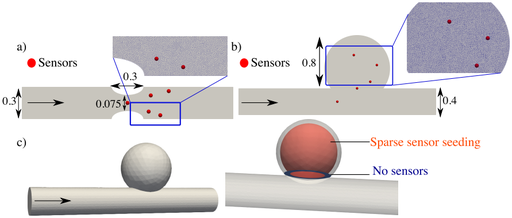
Figure 2 : The 2D and 3D models used in this study are shown. The red dots show the sensor locations (5 point measurements) in the 2D problems and the sensors in the 3D problem were selected on the red surface shown. Zoomed-in view of the computational mesh is used to compare the resolution in the high-resolution CFD models and the sparse measurements used by PINN. The arrows show the direction of the incoming flow. a) The 2D stenosis, c) 2D aneurysm, and c) 3D aneurysm models are shown. In the 3D model, no boundary condition was applied at the blue plane marked as “No sensors”. All geometric lengths are dimensionless. The 3D aneurysm model had the same dimensions as the 2D aneurysm model.
出典 · CC BY 4.0 · Amirhossein Arzani, Jian-Xun Wang, Roshan M. D'Souza · Uncovering near-wall blood flow from sparse data with physics-informed neural networks · 論文の図を引用 · 元のPDFの7ページ目から図の部分を抽出しています。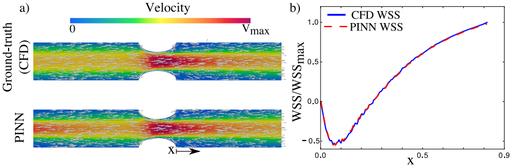
Figure 4 : a) The ground truth (CFD) and PINN velocity results in the 2D stenosis model are shown. Normalized velocity vectors are plotted to show the flow direction. b) The wall shear stress (WSS) results in the region distal to the stenosis are compared between the CFD and PINN models. The inlet and outlet boundary conditions were not specified in the PINN problem.
出典 · CC BY 4.0 · Amirhossein Arzani, Jian-Xun Wang, Roshan M. D'Souza · Uncovering near-wall blood flow from sparse data with physics-informed neural networks · 論文の図を引用 · 元のPDFの9ページ目から図の部分を抽出しています。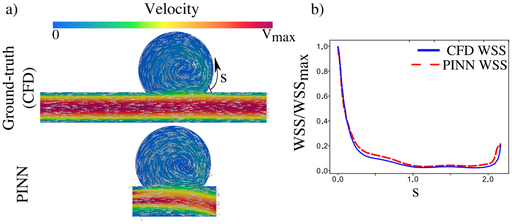
Figure 5 : a) The ground truth (CFD) and PINN velocity results in the 2D aneurysm model are shown. Normalized velocity vectors are plotted to show the flow direction. b) The wall shear stress (WSS) results in the aneurysmal region are compared between the CFD and PINN models. The inlet and outlet boundary conditions were not specified in the PINN problem.
出典 · CC BY 4.0 · Amirhossein Arzani, Jian-Xun Wang, Roshan M. D'Souza · Uncovering near-wall blood flow from sparse data with physics-informed neural networks · 論文の図を引用 · 元のPDFの10ページ目から図の部分を抽出しています。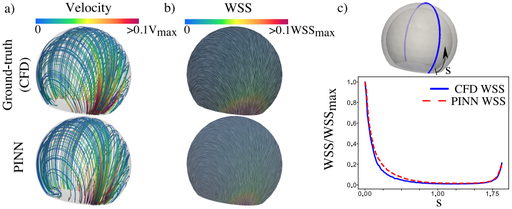
Figure 6 : a) The ground truth (CFD) and PINN velocity streamlines colored by their magnitude are shown for the 3D aneurysm model. b) The wall shear stress (WSS) streamlines (limiting streamlines, skin friction lines) colored by their magnitude are shown for the CFD and PINN models. c) WSS is plotted on the shown blue line and compared between the CFD and PINN models. The inlet and outlet boundary conditions were not specified in the PINN problem.
出典 · CC BY 4.0 · Amirhossein Arzani, Jian-Xun Wang, Roshan M. D'Souza · Uncovering near-wall blood flow from sparse data with physics-informed neural networks · 論文の図を引用 · 元のPDFの11ページ目から図の部分を抽出しています。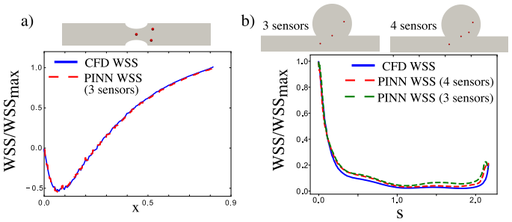
Figure 9 : The effect of reducing the number of sensors on the 2D results is shown. The sensor locations are shown with red dots. a) Three sensors are used in the 2D stenosis model and the predicted WSS results are compared with the reference CFD data. b) Four and three sensors are used in the 2D aneurysm model and the predicted WSS results are compared with the reference CFD data.
出典 · CC BY 4.0 · Amirhossein Arzani, Jian-Xun Wang, Roshan M. D'Souza · Uncovering near-wall blood flow from sparse data with physics-informed neural networks · 論文の図を引用 · 元のPDFの12ページ目から図の部分を抽出しています。1D検証と粘性の同定
1D移流拡散問題は、解析解が存在する単純な検証事例です。著者らは測定点を3つ用い、そのうち1つを薄い境界層の内部に置きました。境界条件c1とc2を未知としても、PINNの解は解析解とよく一致したと報告しています。粘性の同定実験では、2D狭窄問題を繰り返し解き、粘性µを空間的に一定の未知の定数として扱いました。この同定は、反復が十分に進んだあと、基準粘性µ = 0.001に収束しました。この結果は、想定したNewtonian流体の仮定のもとで得られたものです。
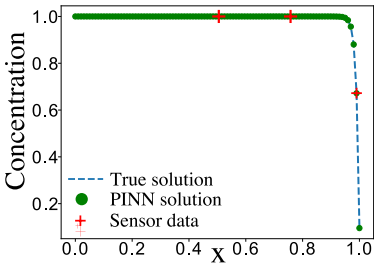
Figure 3 : The 1D advection-diffusion results are plotted. The three red crosses show the loca- tions where data sampling was performed. The true solution (analytical solution) and the PINN prediction (with unknown boundary conditions) match very well.
出典 · CC BY 4.0 · Amirhossein Arzani, Jian-Xun Wang, Roshan M. D'Souza · Uncovering near-wall blood flow from sparse data with physics-informed neural networks · 論文の図を引用 · 元のPDFの9ページ目から図の部分を抽出しています。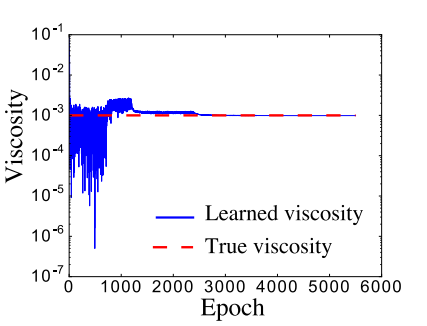
Figure 8 : Identification of viscosity using PINN is shown for the stenosis model. The learned viscosity by PINN is plotted versus the number of epochs (iterations). PINN converges to the ground truth viscosity (µ = 0.001) after sufficient epochs.
出典 · CC BY 4.0 · Amirhossein Arzani, Jian-Xun Wang, Roshan M. D'Souza · Uncovering near-wall blood flow from sparse data with physics-informed neural networks · 論文の図を引用 · 元のPDFの12ページ目から図の部分を抽出しています。逆問題の一意性と適用の限界
著者らは、PINNを逆問題の観点から捉えるべきだと説明しています。2D問題では流入境界条件は正しく同定されませんでしたが、センサーのある領域と下流の流れは再構成されました。著者らは、同じ流量でも異なる流入プロファイルが十分に下流では同じ解を与えうるため、逆問題の解は一般に一意ではないと解釈しています。また論文では、最適なセンサー配置は厳密には調べていないと明記され、拍動流、患者ごとの形状、実際の実験データでの成功の可否は今後の課題として残されたと説明されています。したがって、本結果は提示された理想化された事例と設定で確認された範囲として読むべきです。
論文情報
- 著者
- Amirhossein Arzani, Jian-Xun Wang, Roshan M. D'Souza
- 学会・ジャーナル
- arXiv · プレプリント
- 公開日
- 2021年4月16日
- 登録日
- 2026年11月6日
- 更新日
- 2021年6月7日
- バージョン
- v2
- arXiv
- 2104.08249
- DOI
- 10.1063/5.0055600
- カテゴリ
- physics.flu-dyn · physics.comp-ph
- ライセンス
- CC BY 4.0
- 掲載内容
- 論文情報・解説・論文の図
この解説は、Refivuの韓国語解説をAIで翻訳したものです。不正確な翻訳や誤りが含まれる可能性があります。論文と図の利用条件は各出典に従います。
アブストラクト
Near-wall blood flow and wall shear stress (WSS) regulate major forms of cardiovascular disease, yet they are challenging to quantify with high fidelity. Patient-specific computational and experimental measurement of WSS suffers from uncertainty, low resolution, and noise issues. Physics-informed neural networks (PINN) provide a flexible deep learning framework to integrate mathematical equations governing blood flow with measurement data. By leveraging knowledge about the governing equations (herein, Navier-Stokes), PINN overcomes the large data requirement in deep learning. In this study, it was shown how PINN could be used to improve WSS quantification in diseased arterial flows. Specifically, blood flow problems where the inlet and outlet boundary conditions were not known were solved by assimilating very few measurement points. Uncertainty in boundary conditions is a common feature in patient-specific computational fluid dynamics models. It was shown that PINN could use sparse velocity measurements away from the wall to quantify WSS with very high accuracy even without full knowledge of the boundary conditions. Examples in idealized stenosis and aneurysm models were considered demonstrating how partial knowledge about the flow physics could be combined with partial measurements to obtain accurate near-wall blood flow data. The proposed hybrid data-driven and physics-based deep learning framework has high potential in transforming high-fidelity near-wall hemodynamics modeling in cardiovascular disease.
この論文を引用
Amirhossein Arzani, Jian-Xun Wang, Roshan M. D'Souza (2021). Uncovering near-wall blood flow from sparse data with physics-informed neural networks. arXiv:2104.08249v2. https://doi.org/10.1063/5.0055600
BibTeX
@article{arzani2021uncovering,
  title = {{Uncovering near-wall blood flow from sparse data with physics-informed neural networks}},
  author = {Amirhossein Arzani and Jian-Xun Wang and Roshan M. D'Souza},
  year = {2021},
  eprint = {2104.08249},
  archivePrefix = {arXiv},
  doi = {10.1063/5.0055600},
  url = {https://arxiv.org/abs/2104.08249v2}
}