논문 해설
Uncovering near-wall blood flow from sparse data with physics-informed neural networks
물리 정보 신경망을 이용해 희소 데이터로부터 벽 근처 혈류를 밝혀내기
- 연구 문제 경계조건이 불완전한 환자별 혈류에서 벽에서 떨어진 희소 속도 측정만으로 근벽 혈류와 WSS를 복원할 수 있는지 검토합니다.
- 연구 방법 속도와 압력을 신경망으로 근사하고, Navier-Stokes 잔차, 알려진 부분 경계조건, 희소 측정 데이터를 결합한 손실을 최소화합니다.
- 주요 결과 2D 협착과 2D·3D 동맥류 사례에서 PINN의 WSS는 CFD 기준과 높은 일치를 보였고, 1D 검증과 점성도 식별도 기준 해에 수렴했습니다.
희소 측정과 불완전한 경계조건의 문제
이 논문이 다루는 문제는 근벽 혈류와 벽면 전단응력(WSS)을 임상적으로 정확히 정량화하는 것입니다. 원문은 WSS가 혈관 질환과 연관되지만 환자별 CFD나 실험 측정은 불확실성, 낮은 해상도, 잡음 문제를 갖는다고 설명합니다. 특히 환자별 모델에서는 유입과 유출 경계조건을 알기 어려워, 지배 방정식만으로는 문제가 잘 정의되지 않습니다. 저자들은 이 상황을 Navier-Stokes 방정식과 부분적으로 알려진 경계조건, 그리고 관심 영역 안의 희소 속도 측정을 함께 사용하는 문제로 재구성합니다. 이 연구의 범위는 벽에서 떨어진 희소 속도 측정으로 벽 근처의 속도와 WSS를 복원하는 것입니다.
PINN의 손실 구성과 학습 절차
제안 방법은 속도 성분과 압력을 각각 별도의 완전연결 신경망으로 근사합니다. 각 층은 이전 층의 출력에 가중치와 편향을 적용한 뒤 Swish 활성화 함수를 통과시키며, 이 활성화 함수는 x×Sigmoid(βx)에서 β=1로 설정되었다고 원문은 설명합니다. 학습 목적 함수는 Navier-Stokes 잔차를 제곱 노름으로 측정하는 물리 손실 Lphys, 알려진 부분의 경계조건을 강제하는 손실 LBC, 희소 측정 점에서 예측값과 측정값의 차이를 계산하는 데이터 손실 Ldata를 선형 결합하여 구성됩니다. 전체 손실은 Lphys + λb·LBC + λd·Ldata이며, 이를 최소화하도록 가중치와 편향을 ADAM 계열 최적화로 갱신합니다.
원문은 손실 계산에 평균제곱오차를 사용한다고 밝힙니다. 학습 중에는 경계조건이 완전하지 않으므로 LBC는 경계의 일부에만 강제되며, 데이터 손실이 해의 선택을 돕는 역할을 합니다.
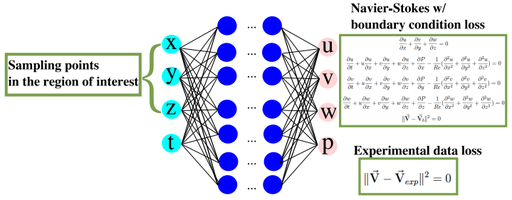
Figure 1 : Physics-informed neural networks (PINN) could be used for solving Navier-Stokes equa- tions. PINN could be augmented with experimental measurement data to improve the predicted solution and/or eliminate the necessity of fully defining boundary conditions or parameters. The spatial input points in PINN represent a flexible and meshfree representation of the domain.
원문 · CC BY 4.0 · Amirhossein Arzani, Jian-Xun Wang, Roshan M. D'Souza · Uncovering near-wall blood flow from sparse data with physics-informed neural networks · 원문 그림 인용 · 원본 PDF 6쪽에서 그림 영역을 추출했습니다.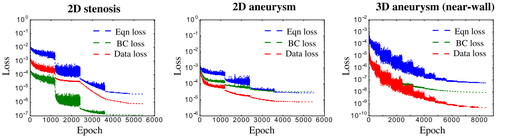
Figure 7 : The mean squared error (MSE) loss versus the epoch (iteration) number is plotted for the 2D stenosis, 2D aneurysm, and 3D aneurysm models. The equation loss, boundary condition loss, and data loss are plotted. The total loss is composed of a weighted sum of these losses. The loss in the 3D model is based on the near-wall region where PINN modeling was performed.
원문 · CC BY 4.0 · Amirhossein Arzani, Jian-Xun Wang, Roshan M. D'Souza · Uncovering near-wall blood flow from sparse data with physics-informed neural networks · 원문 그림 인용 · 원본 PDF 11쪽에서 그림 영역을 추출했습니다.2D 협착·동맥류와 3D 동맥류의 WSS 검증
2D 협착 문제에서는 파라볼릭 유입 프로파일과 Re=150 조건의 CFD 결과를 기준으로 삼았고, PINN에서는 유입과 유출 경계조건을 미지로 두었습니다. 원문은 PINN이 올바른 유입 경계조건을 식별하지 못했지만, 센서가 배치된 협착 영역의 속도는 CFD와 일치한다고 보고합니다. 센서가 적은 조건에서도 WSS 예측은 기준 CFD에 매우 가깝게 유지되었습니다. 2D 동맥류 문제는 Re=320 조건에서 잘린 영역으로 수행되었고, 동맥류 주머니에서 유동을 정확히 재구성하며 WSS 결과가 CFD와 매우 잘 일치한다고 보고합니다. 3D 동맥류는 근벽 영역 내부에서 PINN을 수행했고 센서는 외부 경계의 붉은 표면에 배치되었습니다.
이 경우 PINN과 CFD의 일치는 매우 좋았지만 일부 위치에서 작은 오차가 관찰되었습니다.
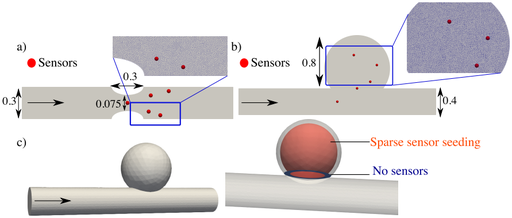
Figure 2 : The 2D and 3D models used in this study are shown. The red dots show the sensor locations (5 point measurements) in the 2D problems and the sensors in the 3D problem were selected on the red surface shown. Zoomed-in view of the computational mesh is used to compare the resolution in the high-resolution CFD models and the sparse measurements used by PINN. The arrows show the direction of the incoming flow. a) The 2D stenosis, c) 2D aneurysm, and c) 3D aneurysm models are shown. In the 3D model, no boundary condition was applied at the blue plane marked as “No sensors”. All geometric lengths are dimensionless. The 3D aneurysm model had the same dimensions as the 2D aneurysm model.
원문 · CC BY 4.0 · Amirhossein Arzani, Jian-Xun Wang, Roshan M. D'Souza · Uncovering near-wall blood flow from sparse data with physics-informed neural networks · 원문 그림 인용 · 원본 PDF 7쪽에서 그림 영역을 추출했습니다.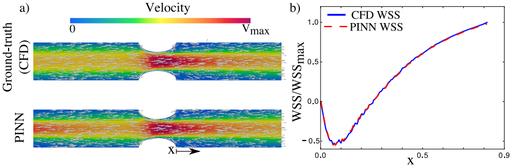
Figure 4 : a) The ground truth (CFD) and PINN velocity results in the 2D stenosis model are shown. Normalized velocity vectors are plotted to show the flow direction. b) The wall shear stress (WSS) results in the region distal to the stenosis are compared between the CFD and PINN models. The inlet and outlet boundary conditions were not specified in the PINN problem.
원문 · CC BY 4.0 · Amirhossein Arzani, Jian-Xun Wang, Roshan M. D'Souza · Uncovering near-wall blood flow from sparse data with physics-informed neural networks · 원문 그림 인용 · 원본 PDF 9쪽에서 그림 영역을 추출했습니다.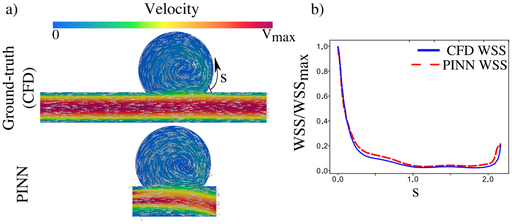
Figure 5 : a) The ground truth (CFD) and PINN velocity results in the 2D aneurysm model are shown. Normalized velocity vectors are plotted to show the flow direction. b) The wall shear stress (WSS) results in the aneurysmal region are compared between the CFD and PINN models. The inlet and outlet boundary conditions were not specified in the PINN problem.
원문 · CC BY 4.0 · Amirhossein Arzani, Jian-Xun Wang, Roshan M. D'Souza · Uncovering near-wall blood flow from sparse data with physics-informed neural networks · 원문 그림 인용 · 원본 PDF 10쪽에서 그림 영역을 추출했습니다.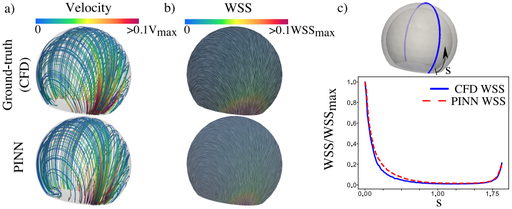
Figure 6 : a) The ground truth (CFD) and PINN velocity streamlines colored by their magnitude are shown for the 3D aneurysm model. b) The wall shear stress (WSS) streamlines (limiting streamlines, skin friction lines) colored by their magnitude are shown for the CFD and PINN models. c) WSS is plotted on the shown blue line and compared between the CFD and PINN models. The inlet and outlet boundary conditions were not specified in the PINN problem.
원문 · CC BY 4.0 · Amirhossein Arzani, Jian-Xun Wang, Roshan M. D'Souza · Uncovering near-wall blood flow from sparse data with physics-informed neural networks · 원문 그림 인용 · 원본 PDF 11쪽에서 그림 영역을 추출했습니다.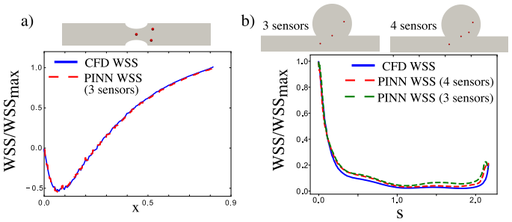
Figure 9 : The effect of reducing the number of sensors on the 2D results is shown. The sensor locations are shown with red dots. a) Three sensors are used in the 2D stenosis model and the predicted WSS results are compared with the reference CFD data. b) Four and three sensors are used in the 2D aneurysm model and the predicted WSS results are compared with the reference CFD data.
원문 · CC BY 4.0 · Amirhossein Arzani, Jian-Xun Wang, Roshan M. D'Souza · Uncovering near-wall blood flow from sparse data with physics-informed neural networks · 원문 그림 인용 · 원본 PDF 12쪽에서 그림 영역을 추출했습니다.1D 검증과 점성도 식별
1D 이류-확산 문제는 해석해가 있는 단순한 검증 사례입니다. 저자들은 세 개의 측정점을 사용했고 그중 하나는 얇은 경계층 안에 두었으며, 경계조건 c1과 c2를 미지로 두고도 PINN 해가 해석해와 매우 잘 일치한다고 보고합니다. 점성도 식별 실험에서는 2D 협착 문제를 반복하여 점성도 µ를 공간적으로 일정한 미지의 상수로 취급했습니다. 이 식별은 반복이 충분히 진행된 뒤 기준 점성도 µ = 0.001에 수렴했습니다. 이 결과는 해당 Newtonian 가정 아래에서 얻은 것입니다.
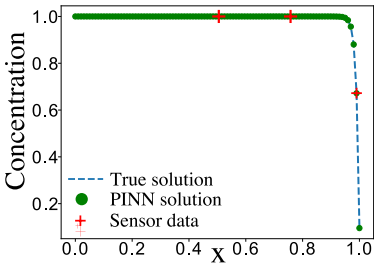
Figure 3 : The 1D advection-diffusion results are plotted. The three red crosses show the loca- tions where data sampling was performed. The true solution (analytical solution) and the PINN prediction (with unknown boundary conditions) match very well.
원문 · CC BY 4.0 · Amirhossein Arzani, Jian-Xun Wang, Roshan M. D'Souza · Uncovering near-wall blood flow from sparse data with physics-informed neural networks · 원문 그림 인용 · 원본 PDF 9쪽에서 그림 영역을 추출했습니다.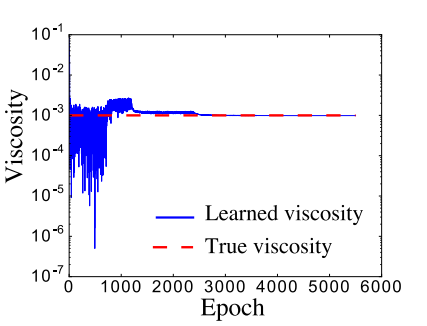
Figure 8 : Identification of viscosity using PINN is shown for the stenosis model. The learned viscosity by PINN is plotted versus the number of epochs (iterations). PINN converges to the ground truth viscosity (µ = 0.001) after sufficient epochs.
원문 · CC BY 4.0 · Amirhossein Arzani, Jian-Xun Wang, Roshan M. D'Souza · Uncovering near-wall blood flow from sparse data with physics-informed neural networks · 원문 그림 인용 · 원본 PDF 12쪽에서 그림 영역을 추출했습니다.역문제의 유일성과 적용 한계
저자들은 PINN을 역문제 관점에서 봐야 한다고 설명합니다. 2D 문제에서 유입 경계조건은 올바르게 식별되지 않았지만, 센서가 있는 영역과 하류 영역의 흐름은 재구성되었습니다. 저자들은 같은 유량이라도 서로 다른 유입 프로파일이 충분히 하류에서는 같은 해를 줄 수 있기 때문에 역문제의 해가 일반적으로 유일하지 않다고 해석합니다. 또한 원문은 최적 센서 배치를 엄밀히 조사하지 않았다고 밝히며, 맥동 혈류, 환자별 형상, 실제 실험 자료에서의 성공 여부는 향후 과제로 남았다고 설명합니다. 따라서 본 결과는 제시된 이상화 사례와 설정에서 확인된 범위로 읽어야 합니다.
논문 정보
- 저자
- Amirhossein Arzani, Jian-Xun Wang, Roshan M. D'Souza
- 학회·저널
- arXiv · 프리프린트
- 최초 공개일
- 2021년 4월 16일
- 등록일
- 2026년 11월 6일
- 수정일
- 2021년 6월 7일
- 버전
- v2
- arXiv
- 2104.08249
- DOI
- 10.1063/5.0055600
- 분류
- physics.flu-dyn · physics.comp-ph
- 원문 이용 조건
- CC BY 4.0
- 제공 범위
- 논문 정보, 해설, 허용된 원문 그림
AI 해설은 논문 원문과 별개의 설명이며 오류가 있을 수 있습니다. 원문과 그림은 각 출처의 이용 조건과 따로 표시된 권리를 따릅니다.
초록
Near-wall blood flow and wall shear stress (WSS) regulate major forms of cardiovascular disease, yet they are challenging to quantify with high fidelity. Patient-specific computational and experimental measurement of WSS suffers from uncertainty, low resolution, and noise issues. Physics-informed neural networks (PINN) provide a flexible deep learning framework to integrate mathematical equations governing blood flow with measurement data. By leveraging knowledge about the governing equations (herein, Navier-Stokes), PINN overcomes the large data requirement in deep learning. In this study, it was shown how PINN could be used to improve WSS quantification in diseased arterial flows. Specifically, blood flow problems where the inlet and outlet boundary conditions were not known were solved by assimilating very few measurement points. Uncertainty in boundary conditions is a common feature in patient-specific computational fluid dynamics models. It was shown that PINN could use sparse velocity measurements away from the wall to quantify WSS with very high accuracy even without full knowledge of the boundary conditions. Examples in idealized stenosis and aneurysm models were considered demonstrating how partial knowledge about the flow physics could be combined with partial measurements to obtain accurate near-wall blood flow data. The proposed hybrid data-driven and physics-based deep learning framework has high potential in transforming high-fidelity near-wall hemodynamics modeling in cardiovascular disease.
원문 인용
Amirhossein Arzani, Jian-Xun Wang, Roshan M. D'Souza (2021). Uncovering near-wall blood flow from sparse data with physics-informed neural networks. arXiv:2104.08249v2. https://doi.org/10.1063/5.0055600
BibTeX
@article{arzani2021uncovering,
  title = {{Uncovering near-wall blood flow from sparse data with physics-informed neural networks}},
  author = {Amirhossein Arzani and Jian-Xun Wang and Roshan M. D'Souza},
  year = {2021},
  eprint = {2104.08249},
  archivePrefix = {arXiv},
  doi = {10.1063/5.0055600},
  url = {https://arxiv.org/abs/2104.08249v2}
}