論文解説
Mastering the Game of Stratego with Model-Free Multiagent Reinforcement Learning
Model-Free Multiagent Reinforcement LearningによるStrategoの攻略
- 課題 Strategoは、大規模な状態空間と非公開の配置情報をもつ不完全情報ゲームです。DeepNashは、探索を使わず、自己対局によるモデルフリーの強化学習で、このゲームを専門家レベルでプレイできるよう学習することを目標としています。
- 手法 DeepNashは、R-NaDアルゴリズムを深層ニューラルネットワークに拡張し、配置とゲームプレイを同時に学習します。学習中のファインチューニングと、テスト時の後処理も加えています。
- 結果 DeepNashは既存のStrategoボットに対して、最低でも97%以上の勝率を記録しました。Gravonの人間の専門家との50回の順位戦では84%の勝率を収め、2022年の順位と全期間の記録順位のどちらでも3位に入ったと報告しています。
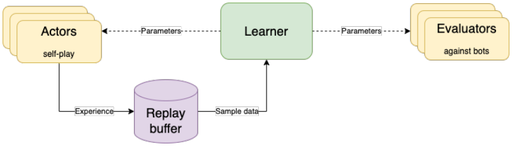
Figure 8 : Agent decomposition. Learner samples games/trajectories from Replay Buffer, improves weights, and periodically distributes these to actors and evaluators. Actors self-play and write experience into Replay Buffer. Evaluators play against other bots to assess performance.
出典 · CC BY 4.0 · 元のPDFの41ページ目から図の部分を抽出しています。Strategoが難しい問題である理由
Strategoは、2人のプレイヤーが40個の駒を秘密裏に配置したのち、相手の旗を取り合う不完全情報のボードゲームです。ゲーム木の規模は約10^535ノードで、囲碁より10^175倍大きく、配置段階だけでも約10^66通りの配置を考慮する必要があります。論文では、このため既存の完全情報の探索手法や不完全情報の探索手法をそのまま適用するのは難しいと述べられています。特に、相手の非公開の駒配置を公開状態から推定しなければならず、探索空間が扱いにくくなります。
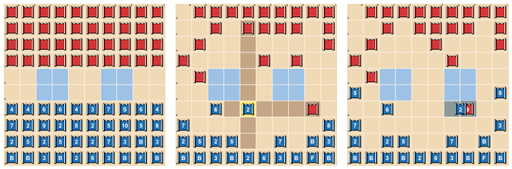
Figure 6 : The phases of a Stratego game: (a) the deployment phase during which players put their pieces on the board in a private configuration. (b) the game phase, where players alternate turns in moving pieces. Here a player chose to attack an opponent piece with the Scout (2), taking advantage of the long-range Scout action (c). As a result, both pieces are revealed; the Scout (2) is defeated by the General (9) and removed from the board.
出典 · CC BY 4.0 · 元のPDFの33ページ目から図の部分を抽出しています。この論文では、探索を使わず、自己対局(self-play)に基づくモデルフリーの強化学習でこの問題に取り組みます。著者らは、この手法が人間の専門家レベルに到達できるかどうかを主要な問いとして設定しています。
R-NaDとDeepNashの学習構造
DeepNashの中心となるのは、Regularized Nash Dynamics(R-NaD)アルゴリズムです。R-NaDは、正則化方策π_regを基準に報酬を変換する段階、変換後のゲームで複製子動力学を実行して不動点を求める段階、そしてその不動点を次の反復の正則化方策とする更新段階を繰り返します。論文では、この過程で学習中にリアプノフ関数が減少し、不動点への収束が保証されると説明されています。
報酬の変換では、各プレイヤーの行動確率を正則化方策と比べる対数項で報酬を修正し、正則化係数ηは0.2に設定されています。DeepNashでは、この手順を深層畳み込みニューラルネットワークに拡張し、価値関数と、配置・駒選択・駒移動の3つの方策ヘッドを学習します。価値の推定には、2プレイヤー設定に合わせて改良したv-traceの推定器が使われ、方策の更新にはNeuRDが使われています。
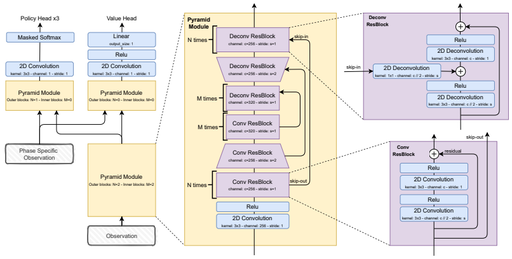
Figure 7 : Network implementation details. When applying striding, residual connections are also processed by a convolution layer with 1× 1 kernel (hidden for clarity).
出典 · CC BY 4.0 · 元のPDFの38ページ目から図の部分を抽出しています。学習中のファインチューニングでは、softmax射影がすべての行動に0でない確率を残す問題を和らげるため、閾値処理と離散化を適用します。テスト時には、方策のきわめて低い確率の行動を取り除く後処理、繰り返しの脅威を制限するヒューリスティック、価値の上限を使って明らかなミスを除外するヒューリスティックが追加されます。
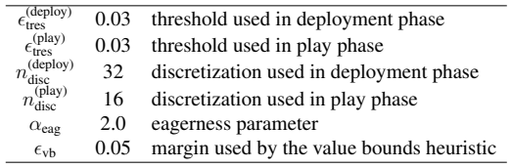
Table 4 : Test time improvement settings.
出典 · CC BY 4.0 · 元のPDFの49ページ目から図の部分を抽出しています。既存ボットとGravonの人間の専門家に対する評価
DeepNashは、Probe、Master of the Flag、Demon of Ignoranceなどの既存のStrategoボットや、Gravonプラットフォームの人間の専門家を相手に評価されました。ボットの評価表(Table 1)では、DeepNashはProbeとMaster of the Flagに対してそれぞれ30試合、残りのボットに対してそれぞれ800試合を行った結果を報告しています。論文では、このうち最低の勝率は97%だったとまとめられています。
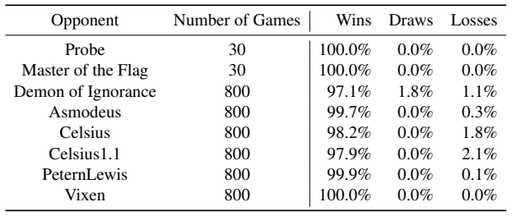
Table 1 : Evaluation of DeepNash against existing Stratego bots. The numbers are reported from Deep- Nash’s point of view. More games (800) were played against bots which we could run automatically. The same number of matches were played as Red and Blue, except against Master of the Flag which only plays as Blue.
出典 · CC BY 4.0 · 元のPDFの14ページ目から図の部分を抽出しています。人間の評価は2022年4月初旬に約2週間行われ、上位の人間のプレイヤーと50回の順位戦を行い、そのうち42試合(84%)に勝ちました。この結果は、Kleierのレーティングシステムで2022年の順位では3位(レーティング1799)、全期間の記録順位でも3位(レーティング1778)に換算されました。この評価は、Gravonプラットフォームの順位戦の条件と、その期間の対局に限られます。
結果の適用範囲と限界
Table 1の結果は、DeepNashの観点から報告された勝・引き分け・敗の割合で、ボットごとに対局数が異なります。ProbeとMaster of the Flagは30試合、残りのボットは800試合のため、ボット同士の勝率を同じ条件での比較に広げることはできません。論文では、Celsius1.1に対する一部の敗北は高リスク戦略に由来すると説明されていますが、これは著者の解釈であり、すべての敗北の原因として一般化されるものではありません。
人間の評価は、Gravonの特定の期間と順位規則に基づくものです。一部の対局は、以前の学習スナップショットや時間切れのため、レーティング計算から除外されました。テスト時のヒューリスティックは人間の相手との対局の質を高めたと報告されていますが、自分自身のヒューリスティックを取り除いた版との勝率の差は大きくないと論文には記されています。
論文情報
- 著者
- Julien Perolat, Bart de Vylder, Daniel Hennes, Eugene Tarassov, Florian Strub, Vincent de Boer, Paul Muller, Jerome T. Connor, Neil Burch, Thomas Anthony, Stephen McAleer, Romuald Elie, Sarah H. Cen, Zhe Wang, Audrunas Gruslys, Aleksandra Malysheva, Mina Khan, Sherjil Ozair, Finbarr Timbers, Toby Pohlen, Tom Eccles, Mark Rowland, Marc Lanctot, Jean-Baptiste Lespiau, Bilal Piot, Shayegan Omidshafiei, Edward Lockhart, Laurent Sifre, Nathalie Beauguerlange, Remi Munos, David Silver, Satinder Singh, Demis Hassabis, Karl Tuyls
- 学会・ジャーナル
- arXiv · プレプリント
- 公開日
- 2022年6月30日
- 登録日
- 2026年11月6日
- 更新日
- 2022年6月30日
- バージョン
- v1
- arXiv
- 2206.15378
- DOI
- 10.1126/science.add4679
- カテゴリ
- cs.AI · cs.GT · cs.MA
- ライセンス
- CC BY 4.0
- 掲載内容
- 論文情報・解説・論文の図
この解説は、Refivuの韓国語解説をAIで翻訳したものです。不正確な翻訳や誤りが含まれる可能性があります。論文と図の利用条件は各出典に従います。
アブストラクト
We introduce DeepNash, an autonomous agent capable of learning to play the imperfect information game Stratego from scratch, up to a human expert level. Stratego is one of the few iconic board games that Artificial Intelligence (AI) has not yet mastered. This popular game has an enormous game tree on the order of $10^{535}$ nodes, i.e., $10^{175}$ times larger than that of Go. It has the additional complexity of requiring decision-making under imperfect information, similar to Texas hold'em poker, which has a significantly smaller game tree (on the order of $10^{164}$ nodes). Decisions in Stratego are made over a large number of discrete actions with no obvious link between action and outcome. Episodes are long, with often hundreds of moves before a player wins, and situations in Stratego can not easily be broken down into manageably-sized sub-problems as in poker. For these reasons, Stratego has been a grand challenge for the field of AI for decades, and existing AI methods barely reach an amateur level of play. DeepNash uses a game-theoretic, model-free deep reinforcement learning method, without search, that learns to master Stratego via self-play. The Regularised Nash Dynamics (R-NaD) algorithm, a key component of DeepNash, converges to an approximate Nash equilibrium, instead of 'cycling' around it, by directly modifying the underlying multi-agent learning dynamics. DeepNash beats existing state-of-the-art AI methods in Stratego and achieved a yearly (2022) and all-time top-3 rank on the Gravon games platform, competing with human expert players.
この論文を引用
Julien Perolat, Bart de Vylder, Daniel Hennes, Eugene Tarassov, Florian Strub, Vincent de Boer, Paul Muller, Jerome T. Connor, Neil Burch, Thomas Anthony, Stephen McAleer, Romuald Elie, Sarah H. Cen, Zhe Wang, Audrunas Gruslys, Aleksandra Malysheva, Mina Khan, Sherjil Ozair, Finbarr Timbers, Toby Pohlen et al. (2022). Mastering the Game of Stratego with Model-Free Multiagent Reinforcement Learning. arXiv:2206.15378v1. https://doi.org/10.1126/science.add4679
BibTeX
@article{perolat2022mastering,
  title = {{Mastering the Game of Stratego with Model-Free Multiagent Reinforcement Learning}},
  author = {Julien Perolat and Bart de Vylder and Daniel Hennes and Eugene Tarassov and Florian Strub and Vincent de Boer and Paul Muller and Jerome T. Connor and Neil Burch and Thomas Anthony and Stephen McAleer and Romuald Elie and Sarah H. Cen and Zhe Wang and Audrunas Gruslys and Aleksandra Malysheva and Mina Khan and Sherjil Ozair and Finbarr Timbers and Toby Pohlen and Tom Eccles and Mark Rowland and Marc Lanctot and Jean-Baptiste Lespiau and Bilal Piot and Shayegan Omidshafiei and Edward Lockhart and Laurent Sifre and Nathalie Beauguerlange and Remi Munos and David Silver and Satinder Singh and Demis Hassabis and Karl Tuyls},
  year = {2022},
  eprint = {2206.15378},
  archivePrefix = {arXiv},
  doi = {10.1126/science.add4679},
  url = {https://arxiv.org/abs/2206.15378v1}
}