論文解説
Real-World Humanoid Locomotion with Reinforcement Learning
強化学習を用いた実世界ヒューマノイドの歩行
- 課題 ヒューマノイドロボットは多様な環境で使えることが求められますが、古典的な制御器は新しい環境への一般化や適応が難しいです。この研究では、観測と行動の履歴を入力とする因果的Transformerポリシーをシミュレーションで学習し、実機の歩行にゼロショットで適用します。
- 手法 制御器は、観測と行動の履歴からなるコンテキストウィンドウを入力として、次の行動を予測する因果的Transformerです。まず教師ポリシーを学習し、その後、教師蒸留項と強化学習損失を併用する観測ポリシーを学習します。
- 結果 屋外試験では一週間にわたり転倒が観察されませんでした。Transformer構造は比較設定で他のニューラルネットワークより高い成功率を記録し、ポリシーは地形に応じて歩き方を変えます。ただし、これは示された条件での観察と解釈すべきです。
研究課題と既存手法の限界
ヒューマノイドロボットは工場、家庭、屋外のような多様な環境で作業できる必要がありますが、古典的な制御器は新しい環境への一般化や適応が難しいと論文では指摘されています。この研究はこの問題を学習ベースの手法で扱い、観測情報が限られた実機で歩行を安定して行えるかを中心となる問いとしています。対象はDigitヒューマノイドロボットで、カメラなどの外部センサーを使わず、固有受容性の観測と行動の履歴だけで制御されます。したがって、この論文が扱う範囲は、地形を直接見ない盲目的な歩行と、学習後に文脈情報に応じて行動が調整されるかの検証に限られます。
因果的Transformer制御器と学習手順
提案手法のポリシーは、観測と行動のペアからなる長さlのコンテキストウィンドウを入力として、次の行動を出力する因果的Transformerです。論文では、各観測と行動のペアを1つのトークンとして扱い、セルフアテンションが過去のトークンのみを参照するよう制限していると説明されています。学習は2段階で進みます。まず環境が完全に観測可能だと仮定し、シミュレーションで教師ポリシーを学習します。続いて観測ポリシーは、教師ポリシーとのKLダイバージェンス項と強化学習の損失を同時に最適化します。式(2)では、この重みλが学習の中盤に0まで減少します。著者らは、この目的関数は初期には教師からすばやく学び、後には強化学習によって教師を超えられるように設計されていると説明しています。
モデルは埋め込み次元192、ヘッド数4、ブロック数4の構成で、パラメータ数は約1.4Mです。
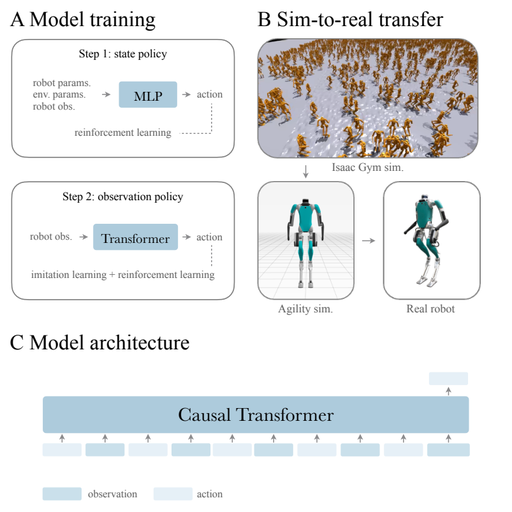
Figure 7 : Overview of the method. (A) Our training consists of two steps. First, we assume that the environment is fully observable and train a teacher state policy πs(at|st). Second, we train a student observation policy using a combination of teacher imitation and reinforcement learning. ( B) We leverage fast GPU simulation powered by Isaac Gym and parallelize training across four A100 GPUs and thousands of randomized environments. Once a policy is trained in Isaac Gym, we validate it in the high-fidelity simulator provided by the robot manufacturer. Finally, we transfer it to the real robot. (C) Our neural network controller is a causal transformer model trained by autoregressive prediction of the next action from the history of observations and actions. We hypothesize that the observation-action history contains useful information about the world that a powerful transformer model can leverage to adjust its actions in-context.
出典 · CC BY 4.0 · Ilija Radosavovic, Tete Xiao, Bike Zhang, Trevor Darrell, Jitendra Malik, Koushil Sreenath · Real-World Humanoid Locomotion with Reinforcement Learning · 論文の図を引用 · 元のPDFの17ページ目から図の部分を抽出しています。シミュレーションとドメインランダム化
学習にはIsaac Gymを使い、論文では閉じた運動学的連鎖や低駆動関節を正確にモデル化するのは難しいという限界が明かされています。これを補うため、著者らはロッドを表す高剛性の仮想バネモデルと、交差部分のサブステップ法を導入しました。さらに、ロボットの動力学、制御パラメータ、環境の物理、観測ノイズと遅延をランダム化し、地形には平地、粗い平地、緩やかな傾斜を含めています。実機へ移す前に、Agilityシミュレーターでポリシーを評価して危険なポリシーを除外しますが、ニューラルネットワークのパラメータは変更しません。
屋外配備と実験の範囲
論文では、制御器をシミュレーションでのみ学習したあと、屋外環境にゼロショットで配備したと報告されています。配備先は歩道、広場、トラック、芝生で、この地形は学習中には現れませんでした。一週間、毎日一日中行った屋外試験では転倒は観察されなかったと報告されています。ただし、この結果は該当する屋外環境と試験期間に限られた観察であり、すべての地形や外乱での安全性を保証するものではありません。室内実験では、外乱、粗い地形と傾斜、積載荷重をそれぞれ個別に試験しました。
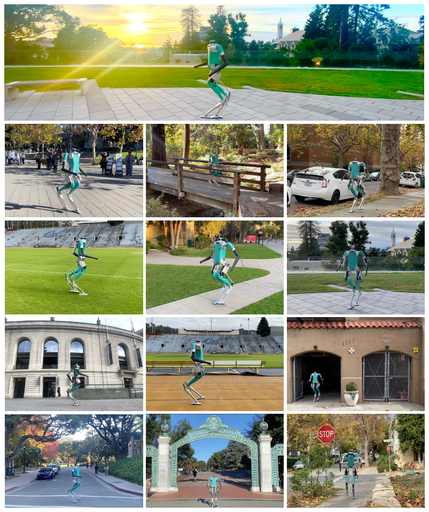
Figure 1 : Deployment to outdoor environments. We deploy our model to a number of outdoor environments. Example videos are shown in Movie 1. We find that our controller is able to traverse a range of everyday environments including plazas, side walks, tracks, and grass fields.
出典 · CC BY 4.0 · Ilija Radosavovic, Tete Xiao, Bike Zhang, Trevor Darrell, Jitendra Malik, Koushil Sreenath · Real-World Humanoid Locomotion with Reinforcement Learning · 論文の図を引用 · 元のPDFの4ページ目から図の部分を抽出しています。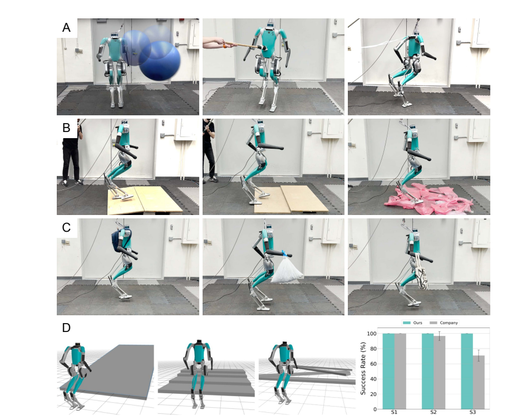
Figure 2 : Indoor and simulation experiments. We test the robustness of our controller to (A) external disturbances, ( B) different terrains, and ( C) payloads. Videos are shown in Movie 7. We find that our controller is able to tackle of the scenarios successfully, including those that are considerably out of the training distribution. (D) We find that our controller outperforms the state-of-the-art company controller across three different settings in simulation. The gains are larger for harder terrains, like steps and unstable ground. We replicate a subset of the scenarios on hardware and observe consistent behaviors, which can be seen in examples from Movie 2.
出典 · CC BY 4.0 · Ilija Radosavovic, Tete Xiao, Bike Zhang, Trevor Darrell, Jitendra Malik, Koushil Sreenath · Real-World Humanoid Locomotion with Reinforcement Learning · 論文の図を引用 · 元のPDFの6ページ目から図の部分を抽出しています。ニューラルネットワーク構造の比較と文脈長
ニューラルネットワーク構造の比較では、著者らはMLP、TCN、LSTM、Transformerを同じ学習フレームワークで学習し、生徒ポリシーの構造だけを変えました。各構造はハイパーパラメータとネットワークサイズをそれぞれ調整し、最良の設定を選びました。評価は2Dの3つのシナリオで、30回の試行の平均成功率と95%信頼区間で計算され、Transformerが他の選択肢を大きな差で上回ったと報告されています。文脈長の実験では、2つの傾斜条件で1 m/sの指令により20回試行した平均前進速度と95%信頼区間を用い、より長い文脈がどちらの設定でも役立つと報告しています。この結果は該当するシミュレーション設定に限られ、他のモデルや実機全体に一般化されるわけではありません。
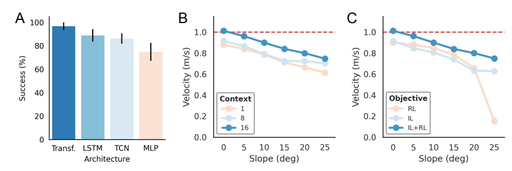
Figure 8 : Ablation studies. We perform ablation studies to understand the impact of key design choices. For fair comparisons, we keep everything fixed except for the varied component and follow the same hyper-parameter tuning procedure. ( A) We find that the transformer models outperform the alternate neural network choices. (B) Our transformer-based controller benefits from larger context lengths. (C) Training with the joint objective consisting of both the imitation and reinforcement learning terms outperforms training with either of the two alone.
出典 · CC BY 4.0 · Ilija Radosavovic, Tete Xiao, Bike Zhang, Trevor Darrell, Jitendra Malik, Koushil Sreenath · Real-World Humanoid Locomotion with Reinforcement Learning · 論文の図を引用 · 元のPDFの22ページ目から図の部分を抽出しています。高速歩行と腕振りの特徴
高速歩行実験では、ロボットは指令された1 m/sの速度に、静止状態から1 s以内に到達し、その後の過程で速度を正確に追従したと報告されています。論文では、この速度追従が実際のハードウェアで行われたと説明されています。また学習では、腕の振りを報酬や参照軌道として指定していませんが、脚と反対方向に動く自然な腕振りが現れたと報告されています。著者らは、報酬のエネルギー最小化項がこの現象に関係している可能性があると推測していますが、エネルギー削減を直接測定したとは主張していません。
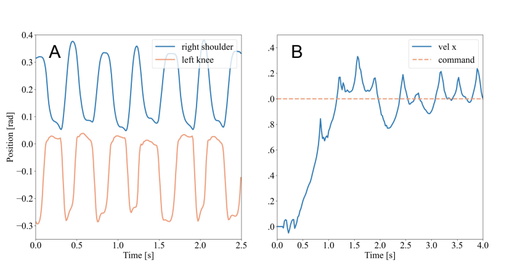
Figure 4 : Arm swing and fast walking. (A) The learned humanoid locomotion in our exper- iments exhibits human-like arm swing behaviors in coordination with leg movements, i.e., a contralateral relationship between the arms and the legs. ( B) Our controller is able to perform fast walking on hardware. The video is shown in Movie 4.
出典 · CC BY 4.0 · Ilija Radosavovic, Tete Xiao, Bike Zhang, Trevor Darrell, Jitendra Malik, Koushil Sreenath · Real-World Humanoid Locomotion with Reinforcement Learning · 論文の図を引用 · 元のPDFの10ページ目から図の部分を抽出しています。文脈内適応と隠れ状態の分析
論文では、ポリシーが地形の変化に応じて歩き方を変える現象が報告されています。平地、下り傾斜、平地からなるコースでは、ロボットは平地では通常の歩行を、傾斜では足をあまり上げない小さな歩幅を使いました。著者らは、この変化を学習中に指定していない創発的な適応として解釈しています。隠れ状態の分析では、一部のニューロンが歩行パターンや地形の種類と相関があると報告されており、PCAとt-SNEで192次元の隠れ状態を次元削減すると地形ごとのクラスタが現れると説明されています。これは表現が地形に関する情報を含むという観察であり、それがポリシーの因果的な原因であることを証明するものではありません。
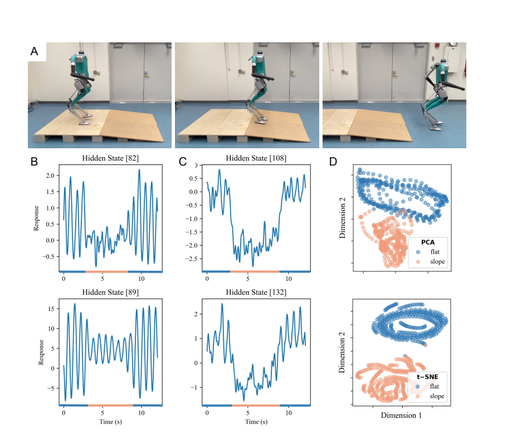
Figure 5 : Gait changes based on terrain type. (A) We command the robot to walk forward over a course consisting of three sections: flat, downward slope, and flat again. We observe that our controller adapts its behavior based on terrain, changing the gait from natural walking on flat terrain, to small steps on downward slope, to natural walking on flat terrain again. Video is shown in Movie 5. This type of adaptation based on context is emergent and has not been pre- specified during training. (B) We analyze the hidden state of the last layer of our neural network controller and find that certain neuron responses correlate with the gait patterns observed over different terrain sections. ( C) In addition, some of the neuron responses correlate changes in the terrain and are high for flat sections and low for the slope section. (D) To analyze the neural responses in aggregate, we project the 192-dimensional hidden states to two dimensions using PCA and t-SNE. Each data point corresponds to one timestep and is color-coded by the terrain section. We see that the hidden states get grouped into clear clusters based on the terrain type.
出典 · CC BY 4.0 · Ilija Radosavovic, Tete Xiao, Bike Zhang, Trevor Darrell, Jitendra Malik, Koushil Sreenath · Real-World Humanoid Locomotion with Reinforcement Learning · 論文の図を引用 · 元のPDFの12ページ目から図の部分を抽出しています。限界と残された課題
著者は、ポリシーが完全には対称ではないと明かしています。両側のモーターが同じ軌道を生まないため、左側への横移動は右側より良く見え、速度指令も完璧には追従できません。また、非常に強いケーブル牽引のような過度の外乱では、ロボットが転倒することがあります。この評価と結論は示された実験条件に限られ、他の外乱の大きさや地形での安定性は確認されていません。
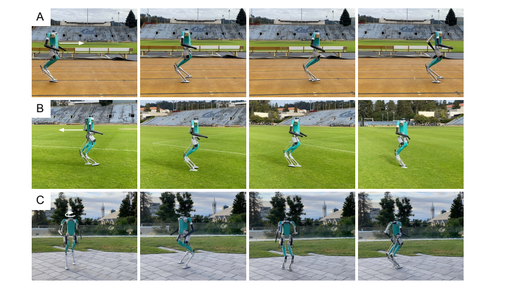
Figure 3 : Omnidirectional walking. Our learning-based controller is able to accurately follow a range of velocity commands to perform omni-directional locomotion, including ( A) walking forward, (B) backward, and (C) turning. Video examples are shown in Movie 3.
出典 · CC BY 4.0 · Ilija Radosavovic, Tete Xiao, Bike Zhang, Trevor Darrell, Jitendra Malik, Koushil Sreenath · Real-World Humanoid Locomotion with Reinforcement Learning · 論文の図を引用 · 元のPDFの9ページ目から図の部分を抽出しています。論文情報
- 著者
- Ilija Radosavovic, Tete Xiao, Bike Zhang, Trevor Darrell, Jitendra Malik, Koushil Sreenath
- 学会・ジャーナル
- arXiv · プレプリント
- 公開日
- 2023年3月6日
- 登録日
- 2026年11月6日
- 更新日
- 2023年12月14日
- バージョン
- v2
- arXiv
- 2303.03381
- カテゴリ
- cs.RO · cs.LG
- ライセンス
- CC BY 4.0
- 掲載内容
- 論文情報・解説・論文の図
この解説は、Refivuの韓国語解説をAIで翻訳したものです。不正確な翻訳や誤りが含まれる可能性があります。論文と図の利用条件は各出典に従います。
アブストラクト
Humanoid robots that can autonomously operate in diverse environments have the potential to help address labour shortages in factories, assist elderly at homes, and colonize new planets. While classical controllers for humanoid robots have shown impressive results in a number of settings, they are challenging to generalize and adapt to new environments. Here, we present a fully learning-based approach for real-world humanoid locomotion. Our controller is a causal transformer that takes the history of proprioceptive observations and actions as input and predicts the next action. We hypothesize that the observation-action history contains useful information about the world that a powerful transformer model can use to adapt its behavior in-context, without updating its weights. We train our model with large-scale model-free reinforcement learning on an ensemble of randomized environments in simulation and deploy it to the real world zero-shot. Our controller can walk over various outdoor terrains, is robust to external disturbances, and can adapt in context.
この論文を引用
Ilija Radosavovic, Tete Xiao, Bike Zhang, Trevor Darrell, Jitendra Malik, Koushil Sreenath (2023). Real-World Humanoid Locomotion with Reinforcement Learning. arXiv:2303.03381v2. https://arxiv.org/abs/2303.03381v2
BibTeX
@misc{radosavovic2023real,
  title = {{Real-World Humanoid Locomotion with Reinforcement Learning}},
  author = {Ilija Radosavovic and Tete Xiao and Bike Zhang and Trevor Darrell and Jitendra Malik and Koushil Sreenath},
  year = {2023},
  eprint = {2303.03381},
  archivePrefix = {arXiv},
  url = {https://arxiv.org/abs/2303.03381v2}
}