논문 해설
Real-World Humanoid Locomotion with Reinforcement Learning
강화학습을 이용한 실세계 휴머노이드 보행
- 연구 문제 휴머노이드 로봇은 다양한 환경에서 쓰일 수 있어야 하지만 고전적 제어기는 새 환경에 일반화하고 적응하기 어렵습니다. 이 연구는 관측과 행동의 이력을 입력받는 인과적 트랜스포머 정책을 시뮬레이션에서 학습해 실제 로봇 보행에 제로샷으로 적용합니다.
- 연구 방법 제어기는 관측-행동 이력의 문맥 윈도우를 입력받아 다음 행동을 예측하는 인과적 트랜스포머입니다. 교사 상태 정책을 먼저 학습한 뒤, 교사 증류 항과 강화학습 손실을 함께 쓰는 관측 정책을 학습합니다.
- 주요 결과 야외 시험에서 일주일 동안 넘어짐이 관찰되지 않았고, 트랜스포머 구조는 비교 설정에서 다른 신경망 선택지보다 높은 성공률을 보였습니다. 정책은 지형에 따라 걸음을 바꾸며, 이는 제시된 조건의 관찰로 읽어야 합니다.
연구 문제와 기존 방식의 한계
휴머노이드 로봇은 공장, 가정, 야외처럼 다양한 환경에서 작업할 수 있어야 하지만, 고전적 제어기는 새로운 환경에 일반화하고 적응하기 어렵다고 원문은 짚습니다. 이 연구는 이 문제를 학습 기반 방법으로 다루며, 관측 정보가 제한된 실제 로봇에서 보행을 안정적으로 수행하는지를 핵심 질문으로 삼습니다. 대상은 Digit 휴머노이드 로봇이며, 로봇은 카메라 같은 외부 감지 장치 없이 고유수용성 관측과 행동의 이력만으로 제어됩니다. 따라서 이 논문이 다루는 범위는 지형을 직접 보지 않는 맹목적 보행과, 학습 후 문맥 정보에 따라 행동이 조정되는지에 대한 검증으로 제한됩니다.
인과적 트랜스포머 제어기와 학습 절차
제안 방법의 정책은 관측과 행동의 쌍으로 이루어진 길이 l의 문맥 윈도우를 입력받아 다음 행동을 출력하는 인과적 트랜스포머입니다. 원문은 각 관측-행동 쌍을 하나의 토큰으로 두고, 자기주의가 이전 토큰만 참조하도록 제한한다고 설명합니다. 학습은 두 단계로 진행됩니다. 먼저 환경을 완전 관측 가능하다고 가정하고 시뮬레이션에서 교사 상태 정책을 학습합니다. 그다음 관측 정책은 교사 정책과의 KL 발산 항과 강화학습 손실을 함께 최적화하며, 식 (2)에서 이 가중치 λ는 학습 중반에 0으로 감소합니다. 이 목적은 초기에는 교사로부터 빠르게 배우고 나중에는 강화학습으로 교사를 넘어서도록 설계되었다고 저자는 설명합니다.
모델은 임베딩 차원 192, 4개 헤드, 4개 블록의 구성이며 파라미터는 약 1.4M입니다.
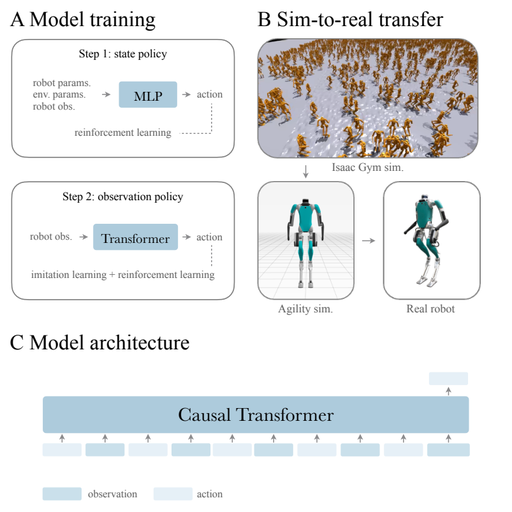
Figure 7 : Overview of the method. (A) Our training consists of two steps. First, we assume that the environment is fully observable and train a teacher state policy πs(at|st). Second, we train a student observation policy using a combination of teacher imitation and reinforcement learning. ( B) We leverage fast GPU simulation powered by Isaac Gym and parallelize training across four A100 GPUs and thousands of randomized environments. Once a policy is trained in Isaac Gym, we validate it in the high-fidelity simulator provided by the robot manufacturer. Finally, we transfer it to the real robot. (C) Our neural network controller is a causal transformer model trained by autoregressive prediction of the next action from the history of observations and actions. We hypothesize that the observation-action history contains useful information about the world that a powerful transformer model can leverage to adjust its actions in-context.
원문 · CC BY 4.0 · Ilija Radosavovic, Tete Xiao, Bike Zhang, Trevor Darrell, Jitendra Malik, Koushil Sreenath · Real-World Humanoid Locomotion with Reinforcement Learning · 원문 그림 인용 · 원본 PDF 17쪽에서 그림 영역을 추출했습니다.시뮬레이션과 도메인 무작위화
학습은 Isaac Gym에서 수행되며, 원문은 폐쇄 운동학 사슬과 저구동 관절을 정확히 모사하기 어렵다는 한계를 밝힙니다. 이를 보완하기 위해 저자는 로드를 나타내는 높은 강성의 가상 스프링 모델과 교차 부분 스텝 방법을 도입했습니다. 또한 로봇 동역학, 제어 파라미터, 환경 물리, 관측 잡음과 지연을 무작위화하고, 지형은 평면, 거친 평면, 완만한 경사를 포함합니다. 실제 이전 전에는 Agility 시뮬레이터에서 정책을 평가하여 위험한 정책을 거르지만 신경망 파라미터는 바꾸지 않습니다.
야외 배포와 실험 범위
원문은 제어기를 시뮬레이션에서만 학습한 뒤 야외 환경에 제로샷으로 배포했다고 보고합니다. 배포 환경은 보도, 광장, 트랙, 잔디밭이며 이 지형은 학습 중에 등장하지 않았습니다. 일주일 동안 매일 종일 진행한 야외 시험에서는 넘어짐이 관찰되지 않았다고 보고됩니다. 다만 이 결과는 해당 야외 환경과 시험 기간에 한정된 관찰이며, 모든 지형이나 외부 교란에서의 안전성을 보증하지 않습니다. 실내 실험에서는 외란, 거친 지형과 경사, 적재 하중을 따로 시험했습니다.
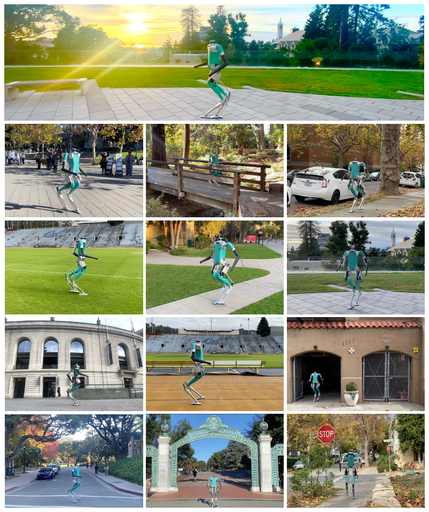
Figure 1 : Deployment to outdoor environments. We deploy our model to a number of outdoor environments. Example videos are shown in Movie 1. We find that our controller is able to traverse a range of everyday environments including plazas, side walks, tracks, and grass fields.
원문 · CC BY 4.0 · Ilija Radosavovic, Tete Xiao, Bike Zhang, Trevor Darrell, Jitendra Malik, Koushil Sreenath · Real-World Humanoid Locomotion with Reinforcement Learning · 원문 그림 인용 · 원본 PDF 4쪽에서 그림 영역을 추출했습니다.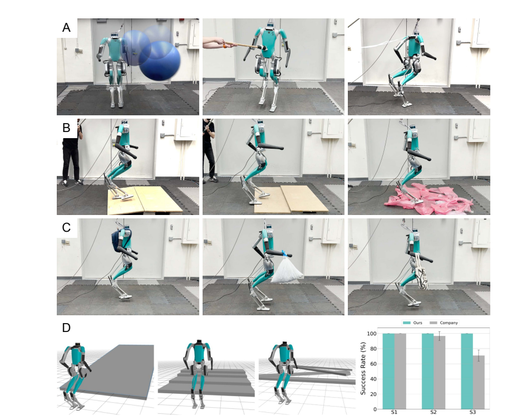
Figure 2 : Indoor and simulation experiments. We test the robustness of our controller to (A) external disturbances, ( B) different terrains, and ( C) payloads. Videos are shown in Movie 7. We find that our controller is able to tackle of the scenarios successfully, including those that are considerably out of the training distribution. (D) We find that our controller outperforms the state-of-the-art company controller across three different settings in simulation. The gains are larger for harder terrains, like steps and unstable ground. We replicate a subset of the scenarios on hardware and observe consistent behaviors, which can be seen in examples from Movie 2.
원문 · CC BY 4.0 · Ilija Radosavovic, Tete Xiao, Bike Zhang, Trevor Darrell, Jitendra Malik, Koushil Sreenath · Real-World Humanoid Locomotion with Reinforcement Learning · 원문 그림 인용 · 원본 PDF 6쪽에서 그림 영역을 추출했습니다.신경망 구조 비교와 문맥 길이
신경망 구조 비교에서 저자는 MLP, TCN, LSTM, 트랜스포머를 같은 학습 프레임워크에서 학습하고 학생 정책의 구조만 바꾸었습니다. 각 구조는 하이퍼파라미터와 네트워크 크기를 따로 맞춰 최선의 설정을 골랐습니다. 평가는 도 2D의 3개 시나리오에서 30회 시행의 평균 성공률과 95% 신뢰구간으로 계산되었고, 트랜스포머가 다른 선택지를 상당한 차이로 앞선다고 보고됩니다. 문맥 길이 실험은 두 경사 조건에서 1 m/s 명령으로 20회 시행한 평균 선속도와 95% 신뢰구간을 사용하며, 더 긴 문맥이 두 설정 모두에서 도움이 된다고 보고합니다. 이 결과는 해당 시뮬레이션 설정에 한정되며 다른 모델이나 실제 로봇 전체로 일반화되지 않습니다.
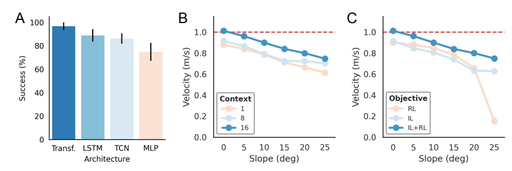
Figure 8 : Ablation studies. We perform ablation studies to understand the impact of key design choices. For fair comparisons, we keep everything fixed except for the varied component and follow the same hyper-parameter tuning procedure. ( A) We find that the transformer models outperform the alternate neural network choices. (B) Our transformer-based controller benefits from larger context lengths. (C) Training with the joint objective consisting of both the imitation and reinforcement learning terms outperforms training with either of the two alone.
원문 · CC BY 4.0 · Ilija Radosavovic, Tete Xiao, Bike Zhang, Trevor Darrell, Jitendra Malik, Koushil Sreenath · Real-World Humanoid Locomotion with Reinforcement Learning · 원문 그림 인용 · 원본 PDF 22쪽에서 그림 영역을 추출했습니다.빠른 보행과 자세 특징
빠른 보행 실험에서 로봇은 명령된 1 m/s 속도에 정지 상태에서 1 s 이내에 도달하고, 이후 과정 동안 속도를 정확히 추종한다고 보고됩니다. 원문은 이 속도 추종이 실제 하드웨어에서 이루어졌다고 설명합니다. 또한 학습에서는 팔 스윙을 보상이나 참조 궤적으로 지정하지 않았지만, 다리와 반대쪽으로 움직이는 자연스러운 팔 스윙이 나타났다고 보고합니다. 원문은 보상의 에너지 최소화 항이 이 현상과 관련될 수 있다고 추정하지만, 에너지 절감을 직접 측정했다고 주장하지는 않습니다.
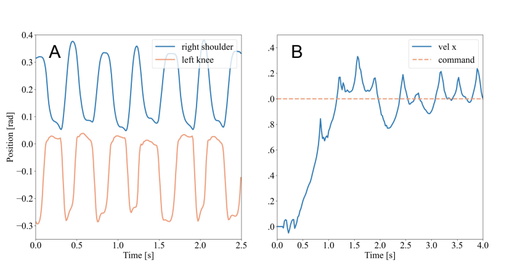
Figure 4 : Arm swing and fast walking. (A) The learned humanoid locomotion in our exper- iments exhibits human-like arm swing behaviors in coordination with leg movements, i.e., a contralateral relationship between the arms and the legs. ( B) Our controller is able to perform fast walking on hardware. The video is shown in Movie 4.
원문 · CC BY 4.0 · Ilija Radosavovic, Tete Xiao, Bike Zhang, Trevor Darrell, Jitendra Malik, Koushil Sreenath · Real-World Humanoid Locomotion with Reinforcement Learning · 원문 그림 인용 · 원본 PDF 10쪽에서 그림 영역을 추출했습니다.문맥 내 적응과 은닉 상태 분석
원문은 정책이 지형 변화에 따라 걸음을 바꾸는 현상을 보고합니다. 평지, 하향 경사, 평지로 이루어진 코스에서 로봇은 평지에서는 정상 보행을, 경사에서는 발을 많이 들지 않는 작은 걸음을 사용했습니다. 저자들은 이 변화를 학습 중 지정하지 않은 창발적 적응으로 해석합니다. 은닉 상태 분석에서는 일부 뉴런이 보행 패턴이나 지형 유형과 상관이 있다고 보고되며, PCA와 t-SNE로 192차원 은닉 상태를 줄였을 때 지형별 군집이 나타난다고 설명됩니다. 이는 표현이 지형 관련 정보를 담는다는 관찰이며, 그것이 정책의 인과적 원인임을 증명하지는 않습니다.
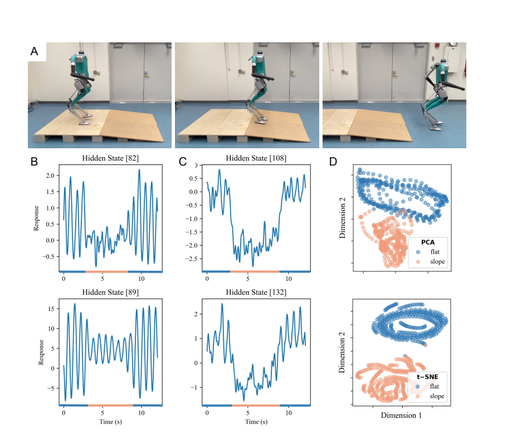
Figure 5 : Gait changes based on terrain type. (A) We command the robot to walk forward over a course consisting of three sections: flat, downward slope, and flat again. We observe that our controller adapts its behavior based on terrain, changing the gait from natural walking on flat terrain, to small steps on downward slope, to natural walking on flat terrain again. Video is shown in Movie 5. This type of adaptation based on context is emergent and has not been pre- specified during training. (B) We analyze the hidden state of the last layer of our neural network controller and find that certain neuron responses correlate with the gait patterns observed over different terrain sections. ( C) In addition, some of the neuron responses correlate changes in the terrain and are high for flat sections and low for the slope section. (D) To analyze the neural responses in aggregate, we project the 192-dimensional hidden states to two dimensions using PCA and t-SNE. Each data point corresponds to one timestep and is color-coded by the terrain section. We see that the hidden states get grouped into clear clusters based on the terrain type.
원문 · CC BY 4.0 · Ilija Radosavovic, Tete Xiao, Bike Zhang, Trevor Darrell, Jitendra Malik, Koushil Sreenath · Real-World Humanoid Locomotion with Reinforcement Learning · 원문 그림 인용 · 원본 PDF 12쪽에서 그림 영역을 추출했습니다.한계와 남은 질문
저자는 정책이 완전히 대칭적이지 않다고 밝힙니다. 양쪽 모터가 동일한 궤적을 만들지 않아 왼쪽 측면 이동이 오른쪽보다 낫게 나타나며, 속도 명령을 완벽하게 추적하지도 못합니다. 또한 매우 강한 케이블 당김 같은 과도한 외란에서는 로봇이 넘어질 수 있습니다. 이 평가와 결론은 제시된 실험 조건에 한정되며, 다른 외란 크기나 지형에서의 안정성은 확인되지 않았습니다.
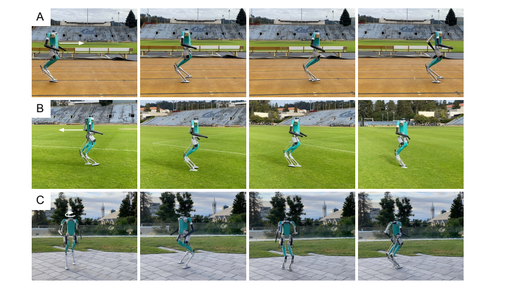
Figure 3 : Omnidirectional walking. Our learning-based controller is able to accurately follow a range of velocity commands to perform omni-directional locomotion, including ( A) walking forward, (B) backward, and (C) turning. Video examples are shown in Movie 3.
원문 · CC BY 4.0 · Ilija Radosavovic, Tete Xiao, Bike Zhang, Trevor Darrell, Jitendra Malik, Koushil Sreenath · Real-World Humanoid Locomotion with Reinforcement Learning · 원문 그림 인용 · 원본 PDF 9쪽에서 그림 영역을 추출했습니다.논문 정보
- 저자
- Ilija Radosavovic, Tete Xiao, Bike Zhang, Trevor Darrell, Jitendra Malik, Koushil Sreenath
- 학회·저널
- arXiv · 프리프린트
- 최초 공개일
- 2023년 3월 6일
- 등록일
- 2026년 11월 6일
- 수정일
- 2023년 12월 14일
- 버전
- v2
- arXiv
- 2303.03381
- 분류
- cs.RO · cs.LG
- 원문 이용 조건
- CC BY 4.0
- 제공 범위
- 논문 정보, 해설, 허용된 원문 그림
AI 해설은 논문 원문과 별개의 설명이며 오류가 있을 수 있습니다. 원문과 그림은 각 출처의 이용 조건과 따로 표시된 권리를 따릅니다.
초록
Humanoid robots that can autonomously operate in diverse environments have the potential to help address labour shortages in factories, assist elderly at homes, and colonize new planets. While classical controllers for humanoid robots have shown impressive results in a number of settings, they are challenging to generalize and adapt to new environments. Here, we present a fully learning-based approach for real-world humanoid locomotion. Our controller is a causal transformer that takes the history of proprioceptive observations and actions as input and predicts the next action. We hypothesize that the observation-action history contains useful information about the world that a powerful transformer model can use to adapt its behavior in-context, without updating its weights. We train our model with large-scale model-free reinforcement learning on an ensemble of randomized environments in simulation and deploy it to the real world zero-shot. Our controller can walk over various outdoor terrains, is robust to external disturbances, and can adapt in context.
원문 인용
Ilija Radosavovic, Tete Xiao, Bike Zhang, Trevor Darrell, Jitendra Malik, Koushil Sreenath (2023). Real-World Humanoid Locomotion with Reinforcement Learning. arXiv:2303.03381v2. https://arxiv.org/abs/2303.03381v2
BibTeX
@misc{radosavovic2023real,
  title = {{Real-World Humanoid Locomotion with Reinforcement Learning}},
  author = {Ilija Radosavovic and Tete Xiao and Bike Zhang and Trevor Darrell and Jitendra Malik and Koushil Sreenath},
  year = {2023},
  eprint = {2303.03381},
  archivePrefix = {arXiv},
  url = {https://arxiv.org/abs/2303.03381v2}
}