論文解説
PDO Drug Screening Data for Evaluating and Training AI Drug Response Prediction Models
AI薬剤反応予測モデルの評価と学習のためのPDO薬剤スクリーニングデータ
- 課題 患者の腫瘍反応を予測するには、細胞株ベースのDRPモデルがPDOでも機能する必要がありますが、細胞株とPDOの違いにより、この適用は難しいです。
- 手法 この論文では、PDOのスクリーニングデータを新たに作成し、CCL単独、CCLとPDOの結合、CCLで事前学習した後にPDOでファインチューニングする3つの戦略で、6つのDRPモデルを学習して比較しています。
CCLデータとPDOの間のギャップ
多くの薬剤反応予測(DRP)モデルは、CCLEやGDSCといった不死化したがん細胞株のデータで学習されます。細胞株は長期間の2次元培養を経ることで分子特性が変化し、患者腫瘍の細胞不均一性や3次元の組織構造をうまく再現できません。実際に予測したいのは患者腫瘍の反応なので、この差がモデル適用の妨げになります。この論文では、患者由来オルガノイド(PDO)で薬剤スクリーニングデータを新たに作成し、既存のDRPモデルがPDOの反応をどの程度予測できるかを確認しています。著者らは、DRP研究においてPDOのデータがまだ限られていることを問題として捉えています。
PDOスクリーニングデータの構築
4つのPDOスクリーニング研究が、大腸がん、頭頸部がん、肉腫のPDOを対象に実施されました。IMPROVEデータセット1から3は共通実験を共有するよう設計されており、実験プラットフォーム間の再現性を比較できます。Pilot 1データセットには、大腸がんPDOが27個、頭頸部がんPDOが20個含まれます。反応値は用量反応曲線下面積を正規化したAUCとして記録され、測定方法は3D高コンテントイメージング、ATP放出に基づく生存率測定、細胞生存率イメージングで、研究ごとに異なります。細胞株データは、IMPROVEベンチマークから取得したCCLE、CTRPv2、GDSCv1、GDSCv2、gCSIです。
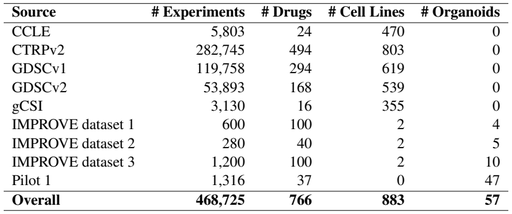
Table 1 : Summary of datasets and experimental sources. The final row reports the total number of unique experiments, drugs, cell lines, and organoids across all sources.
出典 · CC BY 4.0 · Y. Zhu, K. Marlor, V. Lavelle, T. S. Brettin, M. Sacco, C. Siniscalchi, H. W. Raeder, M. R. Weil, R. L. Stevens · PDO Drug Screening Data for Evaluating and Training AI Drug Response Prediction Models · 論文の図を引用 · 元のPDFの3ページ目から図の部分を抽出しています。3つの学習戦略と分割方法
モデルへの入力は遺伝子発現と薬剤特性で、6つの公開DRPモデル(UNO、IGTD、GraphDRP、HiDRA、DeepTTC、LGBM)を使用しました。1つ目は、CCLデータだけで学習し、そのままPDOに適用する方法です。2つ目は、CCLデータとPDOの学習分割を合わせて学習する結合学習です。3つ目は、CCLで事前学習した後、PDOデータでファインチューニングする転移学習です。分割は、ランダム分割と、がんの症例を分けるcancer-blind分割の2つです。cancer-blind分割では、学習、検証、テストの各セットががん症例を共有しません。転移学習は、GraphDRPとLGBMに適用されました。
GraphDRPでは、前側の層を固定し、後ろ側の層を更新します。学習可能な層の数はdifferential evolutionで最適化しました。LGBMでは、事前学習済みモデルにブースティング段階を追加しました。
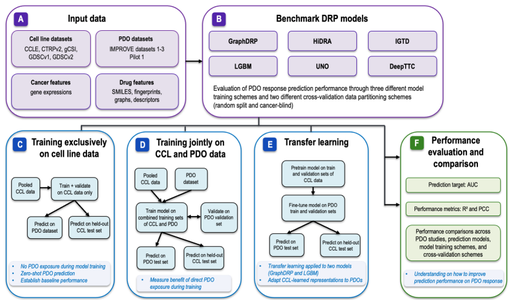
Figure 2 : Overview of the DRP analysis framework. Six DRP models were used to predict PDO drug response using three learning strategies: cell line-only training, joint cell line and PDO training, and transfer learning with pretraining on cell lines followed by fine-tuning on PDOs. Random splits performed 10-fold cross-validations, whereas cancer-blind splits usedN-fold data partitioning, where on IMPROVE datasets Nis the number of PDO lines in the dataset and on Pilot 1 datasetNis 10.
出典 · CC BY 4.0 · Y. Zhu, K. Marlor, V. Lavelle, T. S. Brettin, M. Sacco, C. Siniscalchi, H. W. Raeder, M. R. Weil, R. L. Stevens · PDO Drug Screening Data for Evaluating and Training AI Drug Response Prediction Models · 論文の図を引用 · 元のPDFの8ページ目から図の部分を抽出しています。CCL単独学習によるPDO予測性能
CCLのみで学習したモデルは、ランダム分割でのCCLテストセットにおける平均R2が0.77でした。同じモデルをPDOに適用すると、平均PDO R2はIMPROVEデータセット1で0.25、データセット2で−0.26、データセット3で0.24、Pilot 1で0.07まで低下しました。データセット2では負のR2が現れ、これは平均値のみを予測する基準よりも悪いことを意味します。著者らは、細胞株とPDOの生物学的な違いと、実験プロトコルの違いが同時に影響していると解釈しています。モデル構造による差は、CCLテストセットよりもPDOで大きく表れました。
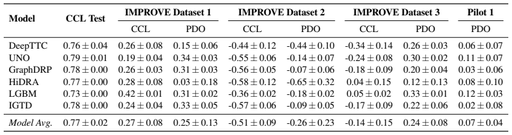
Table 2 : Prediction performance (R 2, mean±s.d.) of models trained exclusively on CCL data in random split cross-validations. CCL Test indicates the test set of CCL data. Prediction performance on CCL exper- iments and PDO experiments in IMPROVE datasets 1-3 are listed separately.
出典 · CC BY 4.0 · Y. Zhu, K. Marlor, V. Lavelle, T. S. Brettin, M. Sacco, C. Siniscalchi, H. W. Raeder, M. R. Weil, R. L. Stevens · PDO Drug Screening Data for Evaluating and Training AI Drug Response Prediction Models · 論文の図を引用 · 元のPDFの11ページ目から図の部分を抽出しています。転移学習の効果とCCL性能の低下
ランダム分割では、結合学習と比べて転移学習によりGraphDRPとLGBMのPDO予測性能が0.03から0.11の範囲で向上しました。一方、CCLテストセットの性能は結合学習より大きく低下しました。著者らは、これを転移学習が以前に学習したCCLの薬剤反応パターンを忘れることの代償として解釈しています。cancer-blind分割でも、転移学習によりPDO性能は向上し、CCL性能は低下しました。この結果はGraphDRPとLGBMに限ったもので、残りの4モデルに転移学習を適用した結果は本文にはありません。

Table 4 : Prediction performance (R 2, mean±s.d.) of models trained using CCL and PDO data jointly in random split cross-validations. CCL Test indicates the test set of CCL data. Study CCL and Study PDO indicate the CCL experiments and the test set of PDO experiments in a PDO drug screening study, respectively.
出典 · CC BY 4.0 · Y. Zhu, K. Marlor, V. Lavelle, T. S. Brettin, M. Sacco, C. Siniscalchi, H. W. Raeder, M. R. Weil, R. L. Stevens · PDO Drug Screening Data for Evaluating and Training AI Drug Response Prediction Models · 論文の図を引用 · 元のPDFの12ページ目から図の部分を抽出しています。
Table 12 : Transfer learning prediction performance (PCC, mean±s.d.) of models in random split cross- validations. CCL Test indicates the test set of CCL data. Study CCL and Study PDO indicate the CCL experiments and the test set of PDO experiments in a PDO drug screening study, respectively. Pilot 1 study does not include Study CCL experiments.
出典 · CC BY 4.0 · Y. Zhu, K. Marlor, V. Lavelle, T. S. Brettin, M. Sacco, C. Siniscalchi, H. W. Raeder, M. R. Weil, R. L. Stevens · PDO Drug Screening Data for Evaluating and Training AI Drug Response Prediction Models · 論文の図を引用 · 元のPDFの22ページ目から図の部分を抽出しています。IMPROVE研究間の再現性
IMPROVE研究は共通実験を共有しているため、正規化AUCの研究間相関を比較できました。相関は、データセット1と3の間でPCC 0.645(n=594)、データセット1と2の間で0.547(n=240)、データセット2と3の間で0.371(n=280)でした。3つの値はいずれも中程度で、研究間の測定のばらつきがまだ大きいと解釈されます。著者らは、この結果を薬剤スクリーニング実験の再現性を改善する必要性の根拠と見ています。
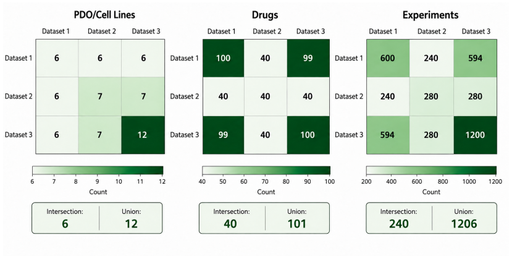
Figure 1 : Overlap of samples, experiments, and drugs across the three IMPROVE datasets. Diagonal entries indicate the total number of elements in each set, while off-diagonal entries indicate pairwise intersections. The intersection and union across all three sets are shown below each matrix.
出典 · CC BY 4.0 · Y. Zhu, K. Marlor, V. Lavelle, T. S. Brettin, M. Sacco, C. Siniscalchi, H. W. Raeder, M. R. Weil, R. L. Stevens · PDO Drug Screening Data for Evaluating and Training AI Drug Response Prediction Models · 論文の図を引用 · 元のPDFの4ページ目から図の部分を抽出しています。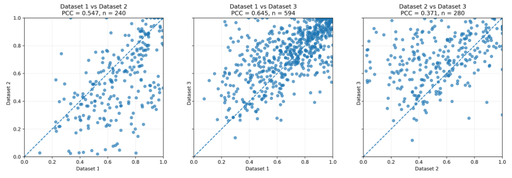
Figure 3 : Pairwise comparison of drug response measurements across the three IMPROVE studies. Scatter- plots show the normalized AUC values of matched experiments between a pair of IMPROVE datasets. Each point represents an experiment measured in both studies. PCC and the number of matched experiments are reported for each comparison.
出典 · CC BY 4.0 · Y. Zhu, K. Marlor, V. Lavelle, T. S. Brettin, M. Sacco, C. Siniscalchi, H. W. Raeder, M. R. Weil, R. L. Stevens · PDO Drug Screening Data for Evaluating and Training AI Drug Response Prediction Models · 論文の図を引用 · 元のPDFの10ページ目から図の部分を抽出しています。未知のがん症例での限界
cancer-blind分割でのCCLテストセットの平均R2は0.68で、ランダム分割の0.77より低い値でした。PDO予測性能も全体的にランダム分割より低くなりました。著者らは、これを未知のがん症例への汎化がより難しい課題という意味に解釈しています。結合学習はPDO性能を高めたものの、cancer-blind分割の性能はランダム分割より低いままでした。

Table 5 : Prediction performance (R 2, mean±s.d.) of models trained using CCL and PDO data jointly in cancer-blind cross-validations. CCL Test indicates the test set of CCL data. Study CCL and Study PDO indicate the CCL experiments and the test set of PDO experiments in a PDO drug screening study, respectively.
出典 · CC BY 4.0 · Y. Zhu, K. Marlor, V. Lavelle, T. S. Brettin, M. Sacco, C. Siniscalchi, H. W. Raeder, M. R. Weil, R. L. Stevens · PDO Drug Screening Data for Evaluating and Training AI Drug Response Prediction Models · 論文の図を引用 · 元のPDFの12ページ目から図の部分を抽出しています。IMPROVEデータセット2の低い性能
データセット2は、複数のモデルでPDO予測性能が最も低く、一部のR2は負の値でした。著者らは、培地の混合が不十分だったためウェルごとに細胞の播種が均一でなく、その結果データにかなりのノイズが入ったと判断しています。この場合でもPCCは中程度から高い値を示しており、モデルは相対的な順位の一部は捉えられたものの、大きさは正確に予測できなかったと解釈できます。
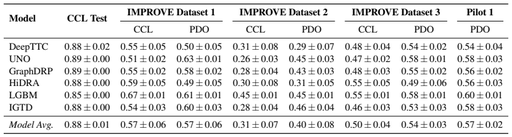
Table 8 : Prediction performance (PCC, mean±s.d.) of models trained exclusively on CCL data in random split cross-validations. CCL Test indicates the test set of CCL data. Prediction performance on CCL exper- iments and PDO experiments in IMPROVE datasets 1-3 are listed separately.
出典 · CC BY 4.0 · Y. Zhu, K. Marlor, V. Lavelle, T. S. Brettin, M. Sacco, C. Siniscalchi, H. W. Raeder, M. R. Weil, R. L. Stevens · PDO Drug Screening Data for Evaluating and Training AI Drug Response Prediction Models · 論文の図を引用 · 元のPDFの21ページ目から図の部分を抽出しています。論文情報
- 著者
- Y. Zhu, K. Marlor, V. Lavelle, T. S. Brettin, M. Sacco, C. Siniscalchi, H. W. Raeder, M. R. Weil, R. L. Stevens
- 学会・ジャーナル
- arXiv · プレプリント
- 公開日
- 2026年11月11日
- 登録日
- 2026年11月13日
- 更新日
- 2026年11月11日
- バージョン
- v1
- arXiv
- 2611.15769
- カテゴリ
- q-bio.QM · cs.AI
- ライセンス
- CC BY 4.0
- 掲載内容
- 論文情報・解説・論文の図
この解説は、Refivuの韓国語解説をAIで翻訳したものです。不正確な翻訳や誤りが含まれる可能性があります。論文と図の利用条件は各出典に従います。
アブストラクト
Anti-cancer drug response prediction (DRP) is critically important for precision oncology and therapeutic development. Currently, most DRP models are developed using drug screening data from immortalized cancer cell lines, which can differ substantially from patient tumors at the genomic and molecular levels, even though patient tumor response is the ultimate prediction target. To help bridge this gap and bring DRP models closer to their intended clinical application, we conducted four drug screening studies using patient-derived organoids (PDOs), which more faithfully recapitulate patient tumors than immortalized cell lines. These studies generated data for improving and evaluating DRP models, including multi-omics profiles of PDO lines, drug feature data, and treatment response measurements. Using these data, we retrained and evaluated multiple publicly available DRP models under three model-building scenarios: training models using cell line data only, training models using combined cell line and PDO data, and pretraining models on cell line data followed by fine-tuning on PDO data. We then evaluated and compared model prediction performance on PDOs across these analysis scenarios. In addition, we also assessed the consistency of drug screening viability data generated by different laboratories using different assay technologies and/or experimental protocols.
この論文を引用
Y. Zhu, K. Marlor, V. Lavelle, T. S. Brettin, M. Sacco, C. Siniscalchi, H. W. Raeder, M. R. Weil, R. L. Stevens (2026). PDO Drug Screening Data for Evaluating and Training AI Drug Response Prediction Models. arXiv:2611.15769v1. https://arxiv.org/abs/2611.15769v1
BibTeX
@misc{zhu2026drug,
  title = {{PDO Drug Screening Data for Evaluating and Training AI Drug Response Prediction Models}},
  author = {Y. Zhu and K. Marlor and V. Lavelle and T. S. Brettin and M. Sacco and C. Siniscalchi and H. W. Raeder and M. R. Weil and R. L. Stevens},
  year = {2026},
  eprint = {2611.15769},
  archivePrefix = {arXiv},
  url = {https://arxiv.org/abs/2611.15769v1}
}