論文解説
Where the Error Lives: Separating Lid-Edge and Body-Induced Error in Neural Pressure Prediction for 3D Cavity Flow
誤差はどこにあるのか:3D空洞流れのニューラル圧力予測における蓋縁部誤差と本体起因誤差の分離
- 課題 全体の相対誤差を1つの数値にまとめると、蓋縁部の特異性に支配されて、物体周辺の圧力精度が見えなくなることがあります。
- 手法 凍結した代理モデルに、本体のない空の空洞を参照する残差を加え、学習項と参照項の効果を領域ごとに分離します。
全体誤差1つでは物体周辺の精度がわからない理由
3次元空洞流れの圧力を学習済みの代理モデルで予測する際、通常は流体体積全体に対する相対L2誤差1つで精度を要約します。この論文は、その要約では物体周辺の圧力応答をどの程度正確に捉えているかはわからないと問題提起しています。特に蓋縁部(lid-edge)では速度境界条件が不連続で連続体の圧力が特異になるため、格子上でこの部分の大きな圧力が全体誤差を支配しうるとされています。
そこで論文は、誤差がどこにあるのかを領域ごとに分離することを目標としています。
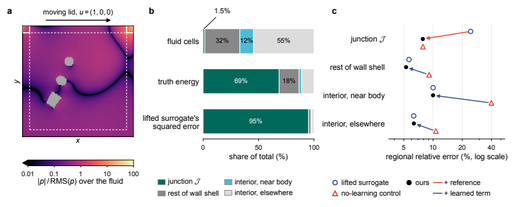
Figure 1 : Where the error lives (cohort A, 60 native1283 cases). a, Centered CFD pressure magnitude relative to the case’s fluid RMS on thexyplanez= 43.5/128of cohort-A heterogeneous triplet-03 atRe = 300(log scale; grey, solid). The lid moves in+x. White boxes mark the junction cellsJwhere this plane crosses the two lid edges perpendicular to the motion; the dashed line bounds the 8-cell wall shell. Black curves are sign changes of the centered pressure, where|p|falls below 1% of the RMS.b, Shares of fluid cells, truth pressure energy and the lifted surrogate’s squared error by region (case means; segments below 12% are unlabelled except the 1.5% junction cell share; values in Table 7).c, Regional relative error of three compositions. A marker’s colour names the component it contains (blue, learned; red, reference); an arrow’s colour names the component added on the way to ours (black dot). Where no arrow is drawn, the component changes that regional error by less than a marker width. All regional results arepost hoc; the no-learning control isretrospective. Region definitions are in Section 3.3.
出典 · CC BY 4.0 · Zirun Zhou, Zhi-Qian Zhang, Yixuan Hong, Guang Liu, Zhigang Liu, Lili Zhang · Where the Error Lives: Separating Lid-Edge and Body-Induced Error in Neural Pressure Prediction for 3D Cavity Flow · 論文の図を引用 · 元のPDFの2ページ目から図の部分を抽出しています。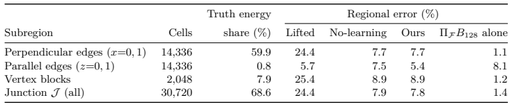
Table 9 : Junction anatomy(cohort A,post hoc; case means; cells are counts, all other values in %). Blocks along the two edges perpendicular to the lid motion (excluding the vertex blocks), along the two parallel edges, and the four8 3 vertex blocks. The last column evaluates the body-free referenceΠFB128(Re)alone against the truth.
出典 · CC BY 4.0 · Zirun Zhou, Zhi-Qian Zhang, Yixuan Hong, Guang Liu, Zhigang Liu, Lili Zhang · Where the Error Lives: Separating Lid-Edge and Body-Induced Error in Neural Pressure Prediction for 3D Cavity Flow · 論文の図を引用 · 元のPDFの12ページ目から図の部分を抽出しています。凍結した代理モデルと参照補正
この方法は、学習済みの代理モデルを再学習せずにそのまま凍結し、本体のない空の空洞の参照場を加える構造です。代理モデルは幾何入力(SDF、座標、外壁距離)とlog Reを受け取り、64³格子で、Reynolds数に基づく背景に対して中心化された補正を予測します。
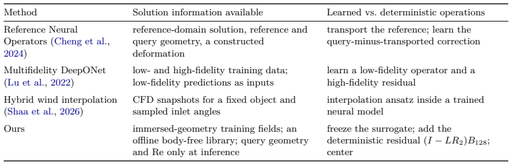
Table 1 : Information used by reference-informed approaches.These are methodological distinctions, not numerical comparisons.
出典 · CC BY 4.0 · Zirun Zhou, Zhi-Qian Zhang, Yixuan Hong, Guang Liu, Zhigang Liu, Lili Zhang · Where the Error Lives: Separating Lid-Edge and Body-Induced Error in Neural Pressure Prediction for 3D Cavity Flow · 論文の図を引用 · 元のPDFの5ページ目から図の部分を抽出しています。参照補正δB128(Re)は、空の空洞の圧力B128から、2×2×2ブロック平均と、リフト演算Lで元に戻した値を引いた残差です。ブロック平均で失われる部分を復元する項で、17個のnative格子による空洞の解からrank-8 SVDで構成され、Reに対して補間されます。最終予測は、リフトされた代理モデルの出力にこの残差を加え、流体マスクで中心化して求めます。推論時には再学習もCFDも必要ありません。

Table 3 : Held-out-Reynolds fidelity of the empty-cavity reference(obstacle-free; 16 held-out values). Rel- ative errors in %;1−ρin units of10 −6 (ρ: correlation between the reference and the held-out CFD field). The last column splits the 16 values into low, middle and high Reynolds numbers (5/6/5 values).
出典 · CC BY 4.0 · Zirun Zhou, Zhi-Qian Zhang, Yixuan Hong, Guang Liu, Zhigang Liu, Lili Zhang · Where the Error Lives: Separating Lid-Edge and Body-Induced Error in Neural Pressure Prediction for 3D Cavity Flow · 論文の図を引用 · 元のPDFの8ページ目から図の部分を抽出しています。この手法では、代理モデルが学習した物体応答はそのまま残し、参照補正は格子レベルの境界場の損失を埋める役割だけを担います。同じ凍結代理モデルについて参照項を取り除くと、リフトされた代理モデルになり、2つの結果の差から参照補正の効果を分離できます。
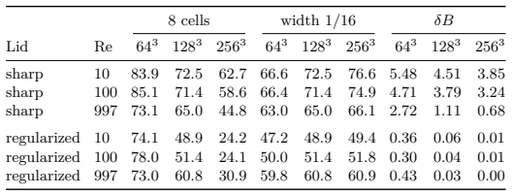
Table 14 : Grid dependence of the empty cavity(retrospective; shares of the centered pressure energy, %). “8 cells”: share of the cells within eight cells of a lid edge at each resolution. “Width1/16”: share of the band of that physical width, the same region at every resolution and equal to the 8-cell band at1283. “δB”: energy of the restriction–prolongation residualδB= (I−LR 2)Brelative to that ofB.
出典 · CC BY 4.0 · Zirun Zhou, Zhi-Qian Zhang, Yixuan Hong, Guang Liu, Zhigang Liu, Lili Zhang · Where the Error Lives: Separating Lid-Edge and Body-Induced Error in Neural Pressure Prediction for 3D Cavity Flow · 論文の図を引用 · 元のPDFの19ページ目から図の部分を抽出しています。参照補正の全体効果と領域別の分解
勾配誤差と全体のピーク誤差も大きく減りました。同じ条件で、物体局所指標のEobjと再現率Robjはほとんど変わらず、近接体誤差Enearは倒れたカプセル1つ(capsule-02)の影響を受け、平均で比べた判定では非超過条件を満たせませんでした。

Table 2 : Predeclared case metrics(details and tie handling in Section A). All are dimensionless. The near-body bandN={0<SDF≤0.2}is 25.6 cells thick at128 3 and overlaps the wall shell for most bodies; onlyEobj andR obj exclude cells at the outer walls.
出典 · CC BY 4.0 · Zirun Zhou, Zhi-Qian Zhang, Yixuan Hong, Guang Liu, Zhigang Liu, Lili Zhang · Where the Error Lives: Separating Lid-Edge and Body-Induced Error in Neural Pressure Prediction for 3D Cavity Flow · 論文の図を引用 · 元のPDFの6ページ目から図の部分を抽出しています。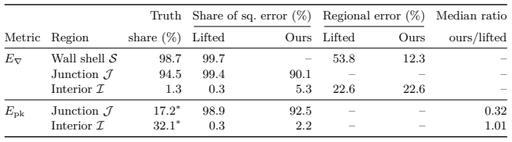
Table 8 : Gradient and global-peak errors by region(cohort A,post hoc).∗Share of the global top-5% peak support rather than of energy. The last column is the median over cases of our regional error divided by the lifted one; forE pk theJmask is the audit’s lid-edge band, whose per-case errors coincide with those onJ.
出典 · CC BY 4.0 · Zirun Zhou, Zhi-Qian Zhang, Yixuan Hong, Guang Liu, Zhigang Liu, Lili Zhang · Where the Error Lives: Separating Lid-Edge and Body-Induced Error in Neural Pressure Prediction for 3D Cavity Flow · 論文の図を引用 · 元のPDFの11ページ目から図の部分を抽出しています。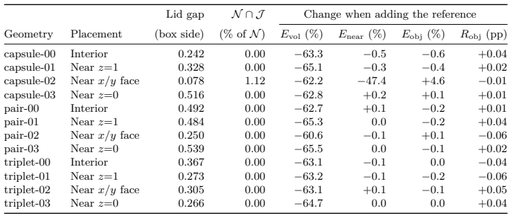
Table 13 : Per-geometry effect of adding the reference(cohort A, means over five Reynolds numbers). “Lid gap” is the solid-to-lid distance in units of the box side;N∩Jis the share of the near-body band inside the lid-edge junction. Placement strata refer to the generator’s target faces;z=1is not the lid.
出典 · CC BY 4.0 · Zirun Zhou, Zhi-Qian Zhang, Yixuan Hong, Guang Liu, Zhigang Liu, Lili Zhang · Where the Error Lives: Separating Lid-Edge and Body-Induced Error in Neural Pressure Prediction for 3D Cavity Flow · 論文の図を引用 · 元のPDFの17ページ目から図の部分を抽出しています。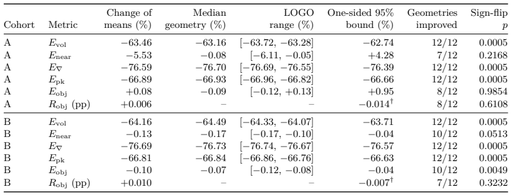
Table 21 : Geometry-level statistics for adding the reference(n= 12geometries per cohort; cohort-B contrast post hoc). LOGO: range of the arithmetic-mean change over leave-one-geometry-out subsets. The one-sided bound is the upper 95% bound on the geometric-mean ratio of geometry-mean errors, expressed as a relative increase (ton log ratios);†lower 95% bound on the mean paired recall change. Non-inferiority margins are+2%forE near,E obj and−1pp forR obj. In cohort A, theE near bound exceeds its margin because of the favourable capsule-02 outlier (Section 5.5); excluding it post hoc, the bound is below+0.1%, which does not establish non-inferiority for the full cohort.
出典 · CC BY 4.0 · Zirun Zhou, Zhi-Qian Zhang, Yixuan Hong, Guang Liu, Zhigang Liu, Lili Zhang · Where the Error Lives: Separating Lid-Edge and Body-Induced Error in Neural Pressure Prediction for 3D Cavity Flow · 論文の図を引用 · 元のPDFの34ページ目から図の部分を抽出しています。コホートBでも、全体の減少パターンは似ていました。この分解は事後(post hoc)分析であるため、全体の改善が主に共有された境界場補正によるという解釈を裏づける根拠として見るべきです。
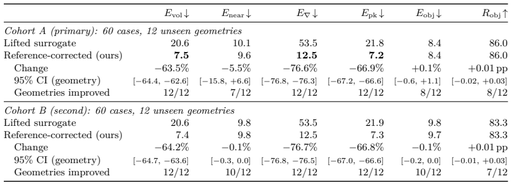
Table 4 : Adding the body-free reference to the frozen surrogate(cohort-mean relative errors, %). Cohort A isprospective: both arms were sealed before truth. In cohort B our predictor was sealed, and the lifted arm is its deterministic reconstruction (post hoc; storage-level agreement checked on five cohort-A cases). Error changes are ratios of cohort means; recall changes are percentage-point differences. For errors, the 95%tintervals concern the geometric-mean ratio over the 12 geometries; for recall they concern the mean paired geometry-level difference. “Improved” counts geometries with a lower (recall: higher) mean. Bold marks cohort-A metrics whose reduction exceeds the predeclared 10% requirement; the requirement applied to cohort A only.
出典 · CC BY 4.0 · Zirun Zhou, Zhi-Qian Zhang, Yixuan Hong, Guang Liu, Zhigang Liu, Lili Zhang · Where the Error Lives: Separating Lid-Edge and Body-Induced Error in Neural Pressure Prediction for 3D Cavity Flow · 論文の図を引用 · 元のPDFの9ページ目から図の部分を抽出しています。学習項の除去と参照単独の比較
学習された補正項だけを取り除いたno-learning対照群と比べると、学習項は近接体誤差Enearを74.8%、物体局所誤差Eobjを76.9%、全体誤差Evolを25.0%下げました。この対照群は、コホートAを検討した後に構成された回顧的な比較です。領域別にみると、学習項は内部誤差の59.9%と内部近接体誤差の75.0%を減らしましたが、接合部誤差には0.3%しか影響しませんでした。参照項は反対に、接合部誤差を主に減らしました。
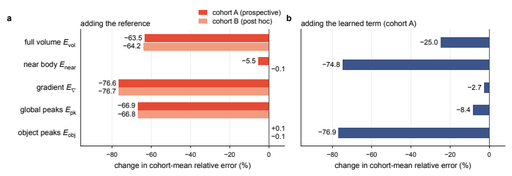
Figure 3 : Metric-level effect of each component: signed change of the cohort-mean relative error, negative is better, as in Table 4.a, Adding the reference to the frozen surrogate (lifted surrogate→ours; cohort Aprospective, cohort Bpost hoc). Bars are ratios of arithmetic cohort means; no confidence intervals are attached to them. Table 4 separately reports intervals for geometry-level geometric-mean ratios, a different estimand. Each cohort has 12 independent geometry groups; capsule-02 dominates the cohort-A near-body mean change, and near-body non- inferiority is not established.b, Adding the learned correction (no-learning control→ours; cohort A,retrospective; cohort means only). Peak-region recall changes by+0.01points in (a) and by+24.1points in (b).
出典 · CC BY 4.0 · Zirun Zhou, Zhi-Qian Zhang, Yixuan Hong, Guang Liu, Zhigang Liu, Lili Zhang · Where the Error Lives: Separating Lid-Edge and Body-Induced Error in Neural Pressure Prediction for 3D Cavity Flow · 論文の図を引用 · 元のPDFの11ページ目から図の部分を抽出しています。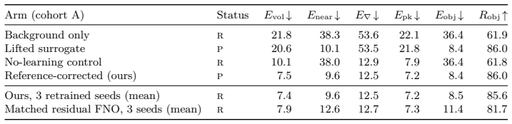
Table 11 : Four compositions and two retrospective comparisons(cohort A, cohort-mean relative errors in %).p: prospective;r: retrospective, an arm or retraining created after the cohort had been inspected. The seed replication and the matched FNO use the same data, inputs, background, 40,500 updates, lift, reference and evaluator. The FNO has 96.8% of the surrogate’s real-valued parameters.
出典 · CC BY 4.0 · Zirun Zhou, Zhi-Qian Zhang, Yixuan Hong, Guang Liu, Zhigang Liu, Lili Zhang · Where the Error Lives: Separating Lid-Edge and Body-Induced Error in Neural Pressure Prediction for 3D Cavity Flow · 論文の図を引用 · 元のPDFの15ページ目から図の部分を抽出しています。空の空洞参照場だけを使うと、全体誤差は8.9%で、補正済み代理モデル(7.5%)と同程度ですが、近接体誤差は43.9%と大きくなります。これは、全体のスコアが近くても、物体周辺の精度は大きく異なりうることを示しています。再基準化代理モデルは全体誤差を3.2%まで下げましたが、これも回顧的な診断用ベースラインであり、近接体指標はほとんど変わりませんでした。
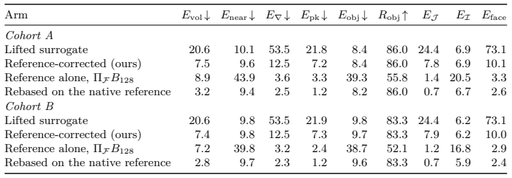
Table 5 : Diagnostic baselines(cohort-mean relative errors and recall, %). Reference alone and rebase are retrospective; the original cohort-A comparison remainsprospective, and the cohort-B lifted contrast ispost hoc(Table 4). The rebased surrogate is Equation (8); the reference alone is the body-freeΠFB128(Re).E J andEI are the junction and interior errors of Table 7;Eface is the relative error of differences across interior faces between fluid cells.
出典 · CC BY 4.0 · Zirun Zhou, Zhi-Qian Zhang, Yixuan Hong, Guang Liu, Zhigang Liu, Lili Zhang · Where the Error Lives: Separating Lid-Edge and Body-Induced Error in Neural Pressure Prediction for 3D Cavity Flow · 論文の図を引用 · 元のPDFの10ページ目から図の部分を抽出しています。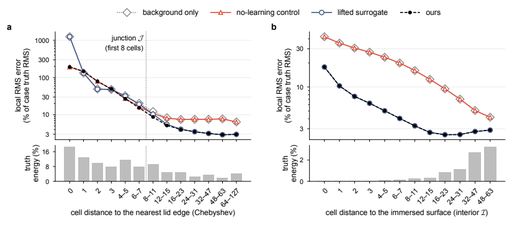
Figure 4 : Error profiles(cohort A, 60 cases;post hoc; the two arms without the learned term areretrospec- tive). Local RMS error per distance bin as a percentage of the case’s full-fluid truth RMS, averaged over cases (log scale). Bins widen with distance but are drawn at equal spacing. The upper curves are per-bin RMS values, not quantities that accumulate linearly with the number of cells; their values can still change with bin boundaries and widths; the lower strips give each bin’s share of truth energy, which grows with the number of cells in the bin. “Background only” is the lifted Reynolds-only background (Section 4), with neither the learned correction nor the reference; away from the lid edges it coincides with the no-learning control.a, Chebyshev cell distance to the nearest lid edge; the dotted line bounds the 8-cell junction. Near the edges our predictor (black) follows the no-learning con- trol (red); far from them it follows the lifted surrogate (blue). Markers follow Figure 1c: open circle, lifted; triangle, no-learning control; filled dot, ours.b, Cell distance to the immersed surface within the interiorI. The lifted and reference-corrected curves agree to within 0.2% (the blue curve lies under the black one), and the arms without the learned term are 1.4–4.9×worse.
出典 · CC BY 4.0 · Zirun Zhou, Zhi-Qian Zhang, Yixuan Hong, Guang Liu, Zhigang Liu, Lili Zhang · Where the Error Lives: Separating Lid-Edge and Body-Induced Error in Neural Pressure Prediction for 3D Cavity Flow · 論文の図を引用 · 元のPDFの12ページ目から図の部分を抽出しています。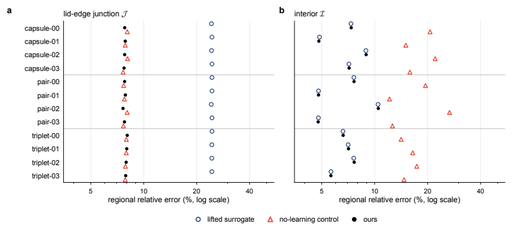
Figure 5 : Separable roles in every geometry(cohort A;post hocregional analysis,retrospectiveno- learning control). Per-geometry mean regional error in the lid-edge junction (a) and in the interior (b): lifted surrogate (upper lane), ours (middle) and no-learning control (lower lane). Horizontal rules separate the capsule, pair and triplet families. In every geometry, adding the reference changes the junction error by−68.5%to−67.0% and the interior error by−0.8%to+0.6%; adding the learned term changes the interior error by−68.0%to−53.2% and the junction error by−5.3%to+1.4%.
出典 · CC BY 4.0 · Zirun Zhou, Zhi-Qian Zhang, Yixuan Hong, Guang Liu, Zhigang Liu, Lili Zhang · Where the Error Lives: Separating Lid-Edge and Body-Induced Error in Neural Pressure Prediction for 3D Cavity Flow · 論文の図を引用 · 元のPDFの15ページ目から図の部分を抽出しています。高レイノルズ数での物体局所誤差と適用範囲の限界
物体局所誤差は、高レイノルズ数では未解決の問題として残っています。コホートAでは、Re=900の平均再現率が69.9%で、Re=10の90%を超える値と大きく異なります。最悪の物体最大ピーク誤差は22.8%でした。この結果は、全体誤差が最も低いレイノルズ数の範囲でも、物体周辺の圧力構造は合っていない可能性があることを示しています。
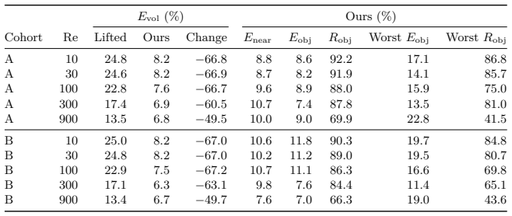
Table 6 : Reynolds-number groups(12 geometries each; the same geometries recur across rows). Errors and recall are cohort means in %; “change” is the relative change ofEvol when adding the reference; “worst” is the largest error or smallest recall among the 12 cases.
出典 · CC BY 4.0 · Zirun Zhou, Zhi-Qian Zhang, Yixuan Hong, Guang Liu, Zhigang Liu, Lili Zhang · Where the Error Lives: Separating Lid-Edge and Body-Induced Error in Neural Pressure Prediction for 3D Cavity Flow · 論文の図を引用 · 元のPDFの10ページ目から図の部分を抽出しています。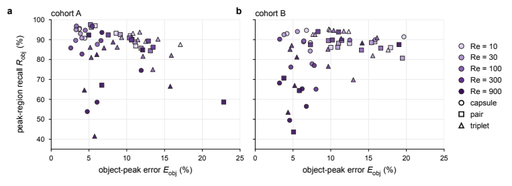
Figure 6 : Object-local accuracy per caseof our predictor (a, cohort A;b, cohort B; both prospective absolute scores): object-peak error against peak-region recall. Colour encodes the Reynolds number (darker is higher) and marker shape the family. Low recall concentrates atRe≥300, where the full-volume error is lowest (Table 6).
出典 · CC BY 4.0 · Zirun Zhou, Zhi-Qian Zhang, Yixuan Hong, Guang Liu, Zhigang Liu, Lili Zhang · Where the Error Lives: Separating Lid-Edge and Body-Induced Error in Neural Pressure Prediction for 3D Cavity Flow · 論文の図を引用 · 元のPDFの17ページ目から図の部分を抽出しています。また、この研究は1つの空洞構成、1つのOpenFOAMソルバと格子ペア、5つの学習Reynolds数でのみ検証されています。蓋を正規化した感度分析では、接合部の真エネルギー比率が51.5%に下がり、シャープな蓋で学習した代理モデルに対して参照補正はEvolを31.4%から32.6%に高めました。したがって、参照補正の効果は、測定したシャープな蓋の組み合わせと格子ペアに限った結果と捉えるべきです。

Table 15 : Regularized lid, cohort A(60 cases at1283; cohort-mean relative errors and recall, %;retrospec- tive).s J: truth energy share of the junction. “+ reference” addsΠFδB128 from a reference refitted to regularized empty-cavity solutions.e J: the junction’s share of the arm’s squared error. The surrogate is unchanged and was trained on unregularized-lid data.
出典 · CC BY 4.0 · Zirun Zhou, Zhi-Qian Zhang, Yixuan Hong, Guang Liu, Zhigang Liu, Lili Zhang · Where the Error Lives: Separating Lid-Edge and Body-Induced Error in Neural Pressure Prediction for 3D Cavity Flow · 論文の図を引用 · 元のPDFの20ページ目から図の部分を抽出しています。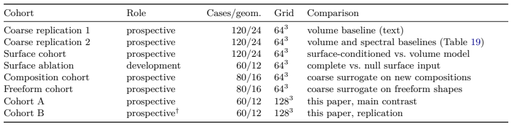
Table 18 : Evaluation cohorts.Cases are CFD solutions; geometries are independent units. “Prospective” means predictions were fixed before the reference pressure was generated.†For our predictor’s absolute scores; the lifted contrast ispost hoc.
出典 · CC BY 4.0 · Zirun Zhou, Zhi-Qian Zhang, Yixuan Hong, Guang Liu, Zhigang Liu, Lili Zhang · Where the Error Lives: Separating Lid-Edge and Body-Induced Error in Neural Pressure Prediction for 3D Cavity Flow · 論文の図を引用 · 元のPDFの32ページ目から図の部分を抽出しています。論文情報
- 著者
- Zirun Zhou, Zhi-Qian Zhang, Yixuan Hong, Guang Liu, Zhigang Liu, Lili Zhang
- 学会・ジャーナル
- arXiv · プレプリント
- 公開日
- 2026年11月15日
- 登録日
- 2026年11月17日
- 更新日
- 2026年11月15日
- バージョン
- v1
- arXiv
- 2611.19741
- カテゴリ
- physics.flu-dyn · cs.LG
- ライセンス
- CC BY 4.0
- 掲載内容
- 論文情報・解説・論文の図
この解説は、Refivuの韓国語解説をAIで翻訳したものです。不正確な翻訳や誤りが含まれる可能性があります。論文と図の利用条件は各出典に従います。
アブストラクト
Can a pressure surrogate score much better globally without better resolving the pressure around immersed bodies? We test this in a three-dimensional lid-driven cavity with an unregularized lid and centered pressure at native $128^3$ resolution. On 60 cases from 12 unseen geometries, with predictions sealed before the CFD truth existed, adding a body-free, Reynolds-conditioned reference correction to the same frozen $64^3$ surrogate lifted to $128^3$ lowers the mean full-volume relative $L_2$ error from 20.6% to 7.5%. In the post hoc regional analysis, the lid-edge junction occupies 1.5% of the fluid but holds 69% of the truth pressure energy and 95% of the uncorrected surrogate's squared error. Interior error changes by just +0.16% relative, and object-local peak error and recall change little on average. Retrospective ablations locate the learned term's contribution in the interior and near the bodies; rebasing on the reference lowers global error further with little change in cohort-mean near-body metrics. Reference-relative body-response error remains about 25% in the interior near-body band. Grid-refinement, lid-regularization and convergence checks delimit the numerical scope. In this benchmark, a large global gain chiefly reflects correction of a shared boundary field, not better resolution of the body response. We recommend reporting regional truth-energy and model-error shares alongside near-body and reference-relative body-response errors.
この論文を引用
Zirun Zhou, Zhi-Qian Zhang, Yixuan Hong, Guang Liu, Zhigang Liu, Lili Zhang (2026). Where the Error Lives: Separating Lid-Edge and Body-Induced Error in Neural Pressure Prediction for 3D Cavity Flow. arXiv:2611.19741v1. https://arxiv.org/abs/2611.19741v1
BibTeX
@misc{zhou2026where,
  title = {{Where the Error Lives: Separating Lid-Edge and Body-Induced Error in Neural Pressure Prediction for 3D Cavity Flow}},
  author = {Zirun Zhou and Zhi-Qian Zhang and Yixuan Hong and Guang Liu and Zhigang Liu and Lili Zhang},
  year = {2026},
  eprint = {2611.19741},
  archivePrefix = {arXiv},
  url = {https://arxiv.org/abs/2611.19741v1}
}