論文解説
Making Preemption Productive in Long-Output LLM Serving
長出力LLMサービングにおけるプリエンプションの生産的な活用
- 課題 長出力の推論では、プリエンプトされた要求がKV状態を繰り返し失って復元し、長時間停止してしまいます。
- 手法 予測された残り長で犠牲を選び、固定長のKVスナップショットを連続したCPU領域に保存します。さらに、長時間停止した要求は復元後の新しいトークン64個の間プリエンプトされないよう保護します。
- 結果 IMO-AnswerBenchでQwen3-32BをH200 DP4/TP2で実行したところ、recomputeと比べて処理量は11.99%向上し、p99 TPOTは50.69%低下しました。
長出力サービングでプリエンプトが生む問題
推論LLMは長い出力を生成するため、その出力のKVキャッシュがGPUメモリを数分間占有します。メモリが埋まると、サーバーは実行中の要求をプリエンプトする必要があります。論文では、プリエンプトされた要求が状態を失って復元を繰り返し、新しい出力をほとんど生成できない現象をKV thrashingと呼んでいます。プリエンプトを避けるには受け入れ自体を遅らせる必要があるため、著者らはプリエンプトを生産的にする方法を問題として取り上げています。
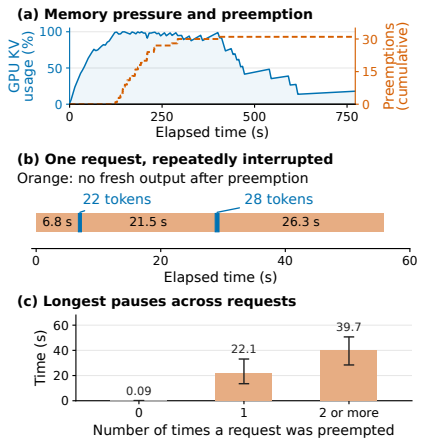
Figure 2 .KV thrashing with Qwen3-32B on 200 program- ming requests from LiveCodeBench (LCB) [ 14], denoted LCB200. GPU KV capacity is reduced and recovery is dis- abled. (a) GPU KV usage and cumulative preemptions over time. (b) One request’s repeated pauses (orange) and fresh decoding (blue). (c) Median longest generation pause by pre- emption count across three replays; whiskers show the mid- dle 50%.
出典 · CC BY 4.0 · Ziji Shi, Xinyi Wan, Chaoyi Ruan, Guangxing Huang, Min Lin, Jialin Li · Making Preemption Productive in Long-Output LLM Serving · 論文の図を引用 · 元のPDFの2ページ目から図の部分を抽出しています。Stintの犠牲選択と復元の流れ
Stintは、プリエンプトされた要求の作業を保存し、復元後に新しい出力を生成するよう設計されたサービングシステムです。犠牲の選択では、デコード中の隠れ状態から残りの出力長を推定し、予測された残り長が最も長い要求を選ぶSRJFポリシーを使います。予測情報がない場合は、解放されるブロックが多い要求を選ぶphysical-largest規則に置き換えます。KVスナップショットは固定長なので、連続extentを優先して割り当てるCPUプールに保存します。割り当てに失敗した場合は、再計算に切り替えます。転送では、K/V gather・scatterカーネルを融合し、2つのステージングペアを交互に使うことで、コピーとgather/scatterを重ねています。
復元段階では、5秒以上停止している最も古い要求をGPUに戻し、KV復元後に新しいトークン64個を生成する間はプリエンプトを防ぎます。復元中のKV再ロードや再計算は進捗としては数えず、新しいトークンだけを数えます。
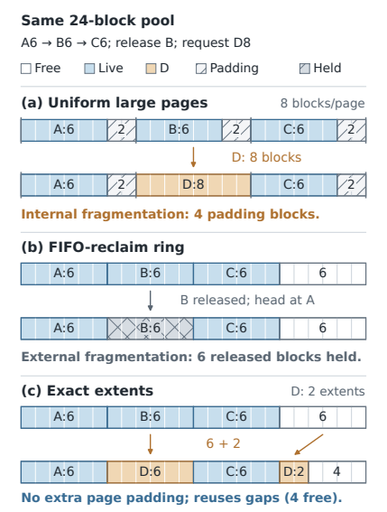
Figure 6 .Allocation in the same 24-block pool: A, B and C each need six blocks; release B, then request eight blocks for D. (a) Uniform eight-block chunks admit D but retain four padding blocks (internal fragmentation). (b) The FIFO- reclaim ring holds B’s released gap behind A (external frag- mentation under this policy), so D waits. (c) Exact extents admit D using6+ 2blocks and leave four free. All sizes are illustrative KV-block counts.
出典 · CC BY 4.0 · Ziji Shi, Xinyi Wan, Chaoyi Ruan, Guangxing Huang, Min Lin, Jialin Li · Making Preemption Productive in Long-Output LLM Serving · 論文の図を引用 · 元のPDFの8ページ目から図の部分を抽出しています。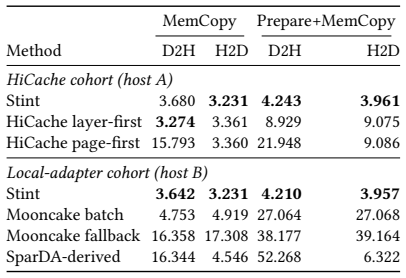
Table 6 .Local KV transfer latency (ms), averaged over three repetitions. Each operation moves 160 MiB of K/V (one layer, 2560 scattered GPU pages). The two cohorts run on different hosts, each with its own Stint control; compare within a cohort. Mooncake adapters are local; SparDA uses 16 CTAs. Standard deviations are in Appendix D.
出典 · CC BY 4.0 · Ziji Shi, Xinyi Wan, Chaoyi Ruan, Guangxing Huang, Min Lin, Jialin Li · Making Preemption Productive in Long-Output LLM Serving · 論文の図を引用 · 元のPDFの15ページ目から図の部分を抽出しています。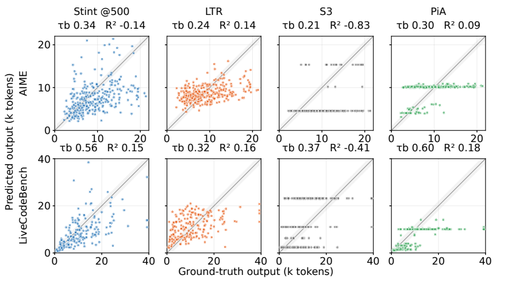
Figure 12 .Output-length predictions on common step-500 survivors: 300 AIME requests (top), and 199 of 200 LiveCodeBench requests (bottom). Stint predicts at step 500; LTR, S3 and PiA use prompts. Kendall’s 𝜏𝑏 measures ordering;𝑅2 measures numerical fit. Higher is better for both; 1 is perfect. DSMN results are in Appendix E.
出典 · CC BY 4.0 · Ziji Shi, Xinyi Wan, Chaoyi Ruan, Guangxing Huang, Min Lin, Jialin Li · Making Preemption Productive in Long-Output LLM Serving · 論文の図を引用 · 元のPDFの16ページ目から図の部分を抽出しています。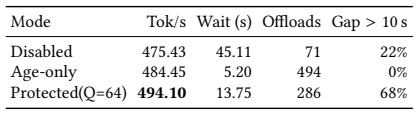
Table 8 .Qwen/LCB recovery controls, one run per mode. Wait is p99 eviction-to-next-fresh-output time. Gap > 10s is the fraction of requests whose longest client chunk gap exceeds 10 s.
出典 · CC BY 4.0 · Ziji Shi, Xinyi Wan, Chaoyi Ruan, Guangxing Huang, Min Lin, Jialin Li · Making Preemption Productive in Long-Output LLM Serving · 論文の図を引用 · 元のPDFの16ページ目から図の部分を抽出しています。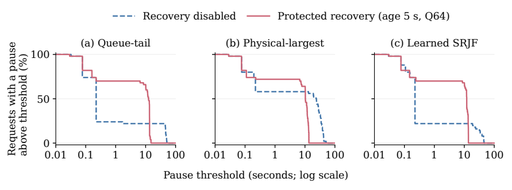
Figure 17 .Longest client-chunk gaps in the six LCB recovery controls. Each curve is one complete run of 50 requests; the x-axis is logarithmic. Protected recovery uses age 5 s and a 64-fresh-token quantum. A lower curve means fewer requests exceed that pause threshold. In these runs, protected recovery reduces the longest pauses while increasing the fraction of requests with moderate pauses.
出典 · CC BY 4.0 · Ziji Shi, Xinyi Wan, Chaoyi Ruan, Guangxing Huang, Min Lin, Jialin Li · Making Preemption Productive in Long-Output LLM Serving · 論文の図を引用 · 元のPDFの29ページ目から図の部分を抽出しています。IMO-AnswerBenchでのサービング比較
主な比較は、Qwen3-32B BF16をH200 DP4/TP2で、毎秒4要求の有限ポアソン到着により実行し、同じ出力タスクを3回繰り返した結果です。Stintは、recomputeと比べて処理量を11.99%向上させ、p99 TPOTを50.69%低下させました。LMCacheとSGLang with HiCacheと比べても処理量は高くなりました。一方で、長出力の要求はより頻繁に短時間停止するため、中間のTPOTとTTFTのテールは悪化し、プリエンプトの回数は約2.7倍になりました。停止が50秒を超えた要求はありませんでしたが、この値は同じIMO-AnswerBenchの再生条件で測定されたものです。
論文で確認できるAIMEとLiveCodeBenchの結果では、p99 TPOTの改善と処理量の変化の方向が異なりました。
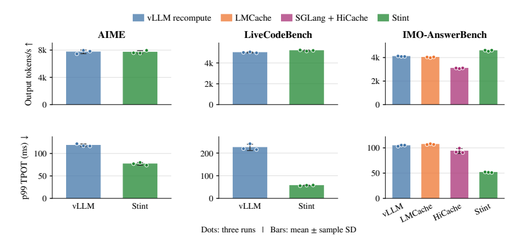
Figure 8 .Long-output fixed replays on Qwen3-32B, H200 DP4/TP2, at 4 requests/s. Higher throughput and lower p99 TPOT are better. Dots are three runs; bars and whiskers show mean and sample SD. AIME and LiveCodeBench compare recompute with Stint; IMO-AnswerBench adds LMCache and HiCache. All systems complete the same prescribed output per workload.
出典 · CC BY 4.0 · Ziji Shi, Xinyi Wan, Chaoyi Ruan, Guangxing Huang, Min Lin, Jialin Li · Making Preemption Productive in Long-Output LLM Serving · 論文の図を引用 · 元のPDFの11ページ目から図の部分を抽出しています。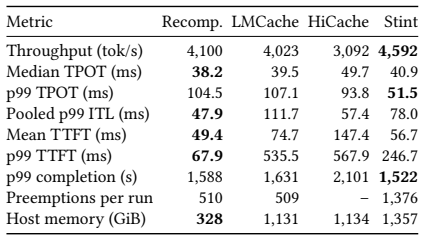
Table 2 .IMO-AnswerBench serving metrics, mean of three matched runs (Qwen3-32B, H200 DP4/TP2, 4 requests/s). Lower is better except throughput. HiCache does not re- port preemption events. Host memory is the sampled node/cgroup peak, not process RSS.
出典 · CC BY 4.0 · Ziji Shi, Xinyi Wan, Chaoyi Ruan, Guangxing Huang, Min Lin, Jialin Li · Making Preemption Productive in Long-Output LLM Serving · 論文の図を引用 · 元のPDFの11ページ目から図の部分を抽出しています。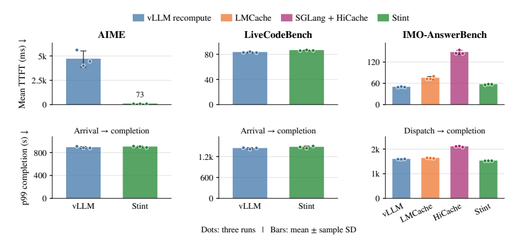
Figure 9 .Latency tradeoffs in the same runs as Figure 8; lower is better. TTFT starts at HTTP dispatch. Completion time starts at scheduled arrival for AIME and LiveCodeBench, and at HTTP dispatch for IMO-AnswerBench; comparisons are within each workload. Dots show three runs, with mean and sample SD.
出典 · CC BY 4.0 · Ziji Shi, Xinyi Wan, Chaoyi Ruan, Guangxing Huang, Min Lin, Jialin Li · Making Preemption Productive in Long-Output LLM Serving · 論文の図を引用 · 元のPDFの12ページ目から図の部分を抽出しています。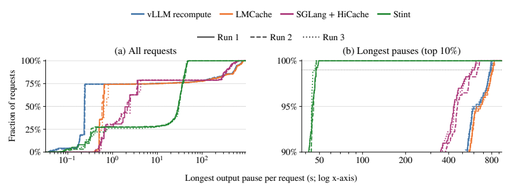
Figure 10 .Longest output pause per request in the IMO-AnswerBench replays. Each request contributes one maximum inter-chunk gap, excluding time before its first output. Curves retain the three runs separately. Stint removes the multi-minute stalls while making the typical request’s longest pause larger.
出典 · CC BY 4.0 · Ziji Shi, Xinyi Wan, Chaoyi Ruan, Guangxing Huang, Min Lin, Jialin Li · Making Preemption Productive in Long-Output LLM Serving · 論文の図を引用 · 元のPDFの12ページ目から図の部分を抽出しています。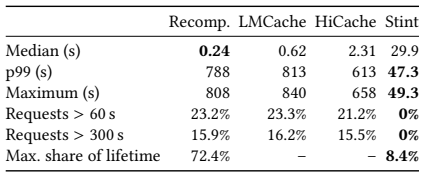
Table 3 .Longest output pause per IMO-AnswerBench re- quest, pooled over three runs (1,197 requests per system). Share of lifetime divides the pause by the request’s dispatch- to-completion time.
出典 · CC BY 4.0 · Ziji Shi, Xinyi Wan, Chaoyi Ruan, Guangxing Huang, Min Lin, Jialin Li · Making Preemption Productive in Long-Output LLM Serving · 論文の図を引用 · 元のPDFの13ページ目から図の部分を抽出しています。
Table 11 .IMO-AnswerBench subgroup changes with Stint relative to recompute. Percentages average three within-block ratios; negative latency changes are better. Both groups share each full 399-request replay.
出典 · CC BY 4.0 · Ziji Shi, Xinyi Wan, Chaoyi Ruan, Guangxing Huang, Min Lin, Jialin Li · Making Preemption Productive in Long-Output LLM Serving · 論文の図を引用 · 元のPDFの24ページ目から図の部分を抽出しています。長出力での利点の範囲とコスト
Stintの利点は長出力のワークロードに集中しています。短い出力の要約やBurstGPTの再生では、目立った利点はありませんでした。また、固定出力の再生では応答品質は測定されておらず、予測器の学習タスクがサービングのワークロードと重なっています。ホストメモリの使用量も増え、現在の実装のアロケータの丸めにより、800 GiBのペイロードは1,024 GiBのバッキングとして確保されます。著者らは、正確なサイズでの割り当てによってこのオーバーヘッドを減らせると考えています。
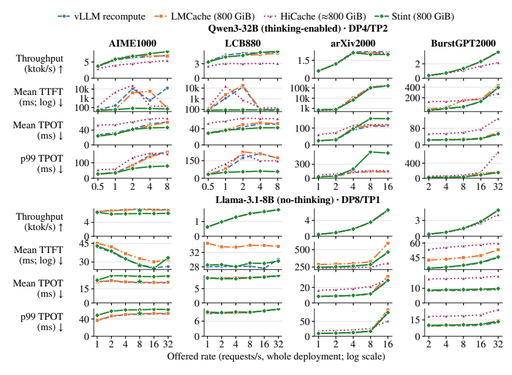
Figure 11 .Earlier end-to-end fixed-output load sweeps, one run per curve point. Stint curves use Q64; the Llama/AIME star at 8 requests/s uses Q1024 (mean± population SD, two runs). arXiv and BurstGPT use 2,000-request sweeps. TTFT uses a logarithmic scale. Llama/HiCache on AIME and LCB is unmeasured. LMCache curves predate the resume-path repair.
出典 · CC BY 4.0 · Ziji Shi, Xinyi Wan, Chaoyi Ruan, Guangxing Huang, Min Lin, Jialin Li · Making Preemption Productive in Long-Output LLM Serving · 論文の図を引用 · 元のPDFの14ページ目から図の部分を抽出しています。論文情報
- 著者
- Ziji Shi, Xinyi Wan, Chaoyi Ruan, Guangxing Huang, Min Lin, Jialin Li
- 学会・ジャーナル
- arXiv · プレプリント
- 公開日
- 2026年11月15日
- 登録日
- 2026年11月17日
- 更新日
- 2026年11月15日
- バージョン
- v1
- arXiv
- 2611.20106
- カテゴリ
- cs.DC · cs.AI · cs.OS
- ライセンス
- CC BY 4.0
- 掲載内容
- 論文情報・解説・論文の図
この解説は、Refivuの韓国語解説をAIで翻訳したものです。不正確な翻訳や誤りが含まれる可能性があります。論文と図の利用条件は各出典に従います。
アブストラクト
Reasoning LLMs generate long outputs whose key--value (KV) caches occupy GPU memory for minutes. When memory fills, the server preempts requests, and a preempted request can repeatedly lose and recover its state while producing little new output. We call this behavior KV thrashing. In certain cases, existing systems leave more than a fifth of requests stalled for over a minute. Because preemption cannot be avoided without delaying admission, we ask how to make it productive. We present Stint, a serving system that preserves a preempted request's work, bounds how long it waits, and gives it fresh output after it returns. Stint stores fixed-length KV snapshots in a contiguity-first CPU pool with an exact-extent allocator, and moves them with fused K/V gather/scatter kernels and double buffering. Age-based readmission brings stalled requests back, and protection gives them a turn of fresh decoding before another preemption. Remaining-length estimates from decoding hidden states guide victim selection. On olympiad-math replays with Qwen3-32B on H200 GPUs, no request pauses for more than 50 seconds under Stint and p99 time per output token falls by 50.7\% relative to recomputation in the same engine. The replay as a whole finishes 10.7\% sooner (12.0\% higher throughput), because the requests that baselines starve no longer finish last.
この論文を引用
Ziji Shi, Xinyi Wan, Chaoyi Ruan, Guangxing Huang, Min Lin, Jialin Li (2026). Making Preemption Productive in Long-Output LLM Serving. arXiv:2611.20106v1. https://arxiv.org/abs/2611.20106v1
BibTeX
@misc{shi2026making,
  title = {{Making Preemption Productive in Long-Output LLM Serving}},
  author = {Ziji Shi and Xinyi Wan and Chaoyi Ruan and Guangxing Huang and Min Lin and Jialin Li},
  year = {2026},
  eprint = {2611.20106},
  archivePrefix = {arXiv},
  url = {https://arxiv.org/abs/2611.20106v1}
}