논문 해설
Making Preemption Productive in Long-Output LLM Serving
긴 출력 LLM 서빙에서 선점을 생산적으로 만들기
- 연구 문제 장출력 추론에서 선점된 요청이 KV 상태를 반복해서 잃고 복구하며 오래 멈추는 문제를 다룹니다.
- 연구 방법 예측된 남은 길이로 희생자를 고르고, 고정 길이 KV 스냅샷을 연속 CPU 영역에 저장한 뒤, 오래 멈춘 요청을 복구 후 새 토큰 64개 동안 보호합니다.
- 주요 결과 IMO-AnswerBench에서 Qwen3-32B를 H200 DP4/TP2로 실행했을 때 recompute 대비 처리량을 11.99% 높이고 p99 TPOT를 50.69% 낮췄습니다.
장출력 서빙에서 선점이 낳는 문제
추론 LLM은 긴 출력을 만들며, 그 출력의 KV 캐시가 GPU 메모리를 수 분 동안 차지합니다. 메모리가 가득 차면 서버는 실행 중인 요청을 선점해야 합니다. 이 논문은 선점된 요청이 상태를 잃고 복구하기를 반복하면서 새 출력을 거의 만들지 못하는 현상을 KV thrashing이라고 부릅니다. 선점을 피하려면 입장 자체를 늦춰야 하므로, 저자들은 선점을 생산적으로 만드는 방법을 묻습니다.
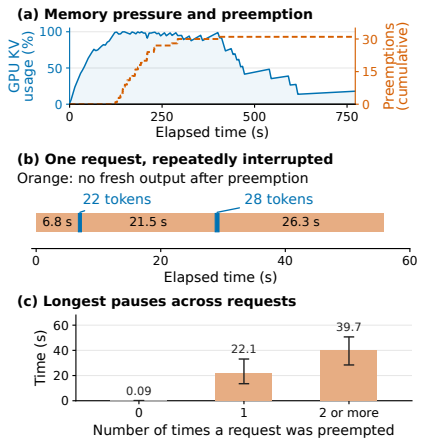
Figure 2 .KV thrashing with Qwen3-32B on 200 program- ming requests from LiveCodeBench (LCB) [ 14], denoted LCB200. GPU KV capacity is reduced and recovery is dis- abled. (a) GPU KV usage and cumulative preemptions over time. (b) One request’s repeated pauses (orange) and fresh decoding (blue). (c) Median longest generation pause by pre- emption count across three replays; whiskers show the mid- dle 50%.
원문 · CC BY 4.0 · Ziji Shi, Xinyi Wan, Chaoyi Ruan, Guangxing Huang, Min Lin, Jialin Li · Making Preemption Productive in Long-Output LLM Serving · 원문 그림 인용 · 원본 PDF 2쪽에서 그림 영역을 추출했습니다.Stint의 희생자 선택과 복구 흐름
Stint는 선점된 요청의 작업을 보존하고 복구 뒤에 새 출력을 만들도록 설계된 서빙 시스템입니다. 희생자 선택에서는 디코딩 중 은닉 상태로 남은 출력 길이를 추정하고, 예측된 남은 길이가 가장 긴 요청을 고르는 SRJF 정책을 씁니다. 예측 정보가 없으면 해제 블록이 많은 요청을 고르는 physical-largest 규칙으로 대체합니다. KV 스냅샷은 고정 길이이므로 연속 extent를 우선 할당하는 CPU 풀에 저장하고, 할당에 실패하면 재계산으로 돌아갑니다. 전송은 K/V gather·scatter 커널을 융합하고 두 스테이징 쌍을 번갈아 써서 복사와 gather/scatter를 겹칩니다. 복구 단계에서는 5초 이상 멈춘 가장 오래된 요청을 GPU로 다시 들이고, KV 복구 뒤 새 토큰 64개를 생성하는 동안 선점을 막습니다.
복구 중 KV 재적재나 재계산은 진행으로 세지 않고 새 토큰만 셉니다.
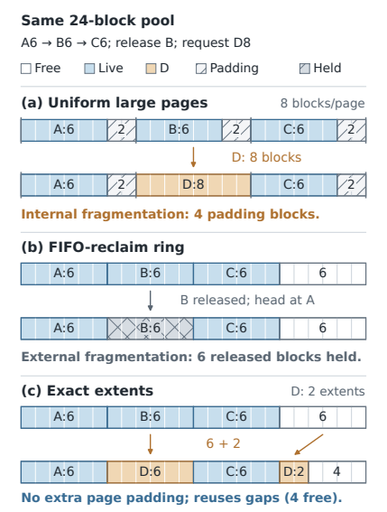
Figure 6 .Allocation in the same 24-block pool: A, B and C each need six blocks; release B, then request eight blocks for D. (a) Uniform eight-block chunks admit D but retain four padding blocks (internal fragmentation). (b) The FIFO- reclaim ring holds B’s released gap behind A (external frag- mentation under this policy), so D waits. (c) Exact extents admit D using6+ 2blocks and leave four free. All sizes are illustrative KV-block counts.
원문 · CC BY 4.0 · Ziji Shi, Xinyi Wan, Chaoyi Ruan, Guangxing Huang, Min Lin, Jialin Li · Making Preemption Productive in Long-Output LLM Serving · 원문 그림 인용 · 원본 PDF 8쪽에서 그림 영역을 추출했습니다.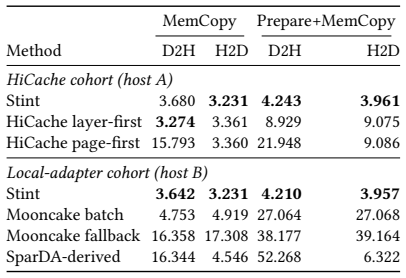
Table 6 .Local KV transfer latency (ms), averaged over three repetitions. Each operation moves 160 MiB of K/V (one layer, 2560 scattered GPU pages). The two cohorts run on different hosts, each with its own Stint control; compare within a cohort. Mooncake adapters are local; SparDA uses 16 CTAs. Standard deviations are in Appendix D.
원문 · CC BY 4.0 · Ziji Shi, Xinyi Wan, Chaoyi Ruan, Guangxing Huang, Min Lin, Jialin Li · Making Preemption Productive in Long-Output LLM Serving · 원문 그림 인용 · 원본 PDF 15쪽에서 그림 영역을 추출했습니다.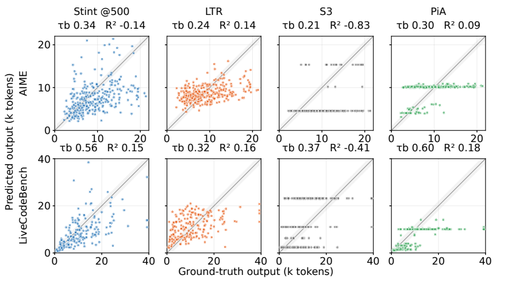
Figure 12 .Output-length predictions on common step-500 survivors: 300 AIME requests (top), and 199 of 200 LiveCodeBench requests (bottom). Stint predicts at step 500; LTR, S3 and PiA use prompts. Kendall’s 𝜏𝑏 measures ordering;𝑅2 measures numerical fit. Higher is better for both; 1 is perfect. DSMN results are in Appendix E.
원문 · CC BY 4.0 · Ziji Shi, Xinyi Wan, Chaoyi Ruan, Guangxing Huang, Min Lin, Jialin Li · Making Preemption Productive in Long-Output LLM Serving · 원문 그림 인용 · 원본 PDF 16쪽에서 그림 영역을 추출했습니다.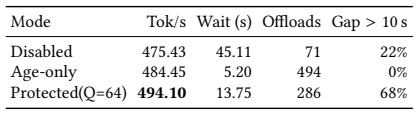
Table 8 .Qwen/LCB recovery controls, one run per mode. Wait is p99 eviction-to-next-fresh-output time. Gap > 10s is the fraction of requests whose longest client chunk gap exceeds 10 s.
원문 · CC BY 4.0 · Ziji Shi, Xinyi Wan, Chaoyi Ruan, Guangxing Huang, Min Lin, Jialin Li · Making Preemption Productive in Long-Output LLM Serving · 원문 그림 인용 · 원본 PDF 16쪽에서 그림 영역을 추출했습니다.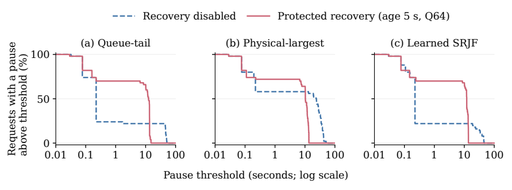
Figure 17 .Longest client-chunk gaps in the six LCB recovery controls. Each curve is one complete run of 50 requests; the x-axis is logarithmic. Protected recovery uses age 5 s and a 64-fresh-token quantum. A lower curve means fewer requests exceed that pause threshold. In these runs, protected recovery reduces the longest pauses while increasing the fraction of requests with moderate pauses.
원문 · CC BY 4.0 · Ziji Shi, Xinyi Wan, Chaoyi Ruan, Guangxing Huang, Min Lin, Jialin Li · Making Preemption Productive in Long-Output LLM Serving · 원문 그림 인용 · 원본 PDF 29쪽에서 그림 영역을 추출했습니다.IMO-AnswerBench에서의 서빙 비교
주요 비교는 Qwen3-32B BF16을 H200 DP4/TP2에서 초당 4 요청의 유한 포아송 도착으로 실행하고, 같은 출력 작업을 세 번 반복한 결과입니다. Stint는 recompute 대비 처리량을 11.99% 높이고 p99 TPOT를 50.69% 낮췄으며, LMCache와 SGLang with HiCache 대비 처리량도 높았습니다. 한편 장출력 요청이 더 자주 짧게 멈추므로 중간 TPOT와 TTFT 꼬리가 나빠졌고 선점 횟수는 약 2.7배가 되었습니다. 어떤 요청도 50초를 넘게 멈추지 않았지만, 이 값은 같은 IMO-AnswerBench 재생 조건에서 측정된 것입니다. 원문에서 확인되는 AIME와 LiveCodeBench 결과는 p99 TPOT 개선과 처리량 변화의 방향이 달랐습니다.
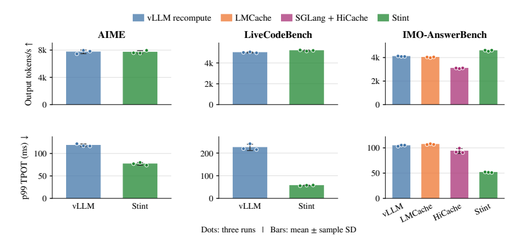
Figure 8 .Long-output fixed replays on Qwen3-32B, H200 DP4/TP2, at 4 requests/s. Higher throughput and lower p99 TPOT are better. Dots are three runs; bars and whiskers show mean and sample SD. AIME and LiveCodeBench compare recompute with Stint; IMO-AnswerBench adds LMCache and HiCache. All systems complete the same prescribed output per workload.
원문 · CC BY 4.0 · Ziji Shi, Xinyi Wan, Chaoyi Ruan, Guangxing Huang, Min Lin, Jialin Li · Making Preemption Productive in Long-Output LLM Serving · 원문 그림 인용 · 원본 PDF 11쪽에서 그림 영역을 추출했습니다.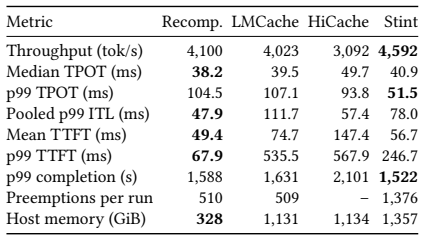
Table 2 .IMO-AnswerBench serving metrics, mean of three matched runs (Qwen3-32B, H200 DP4/TP2, 4 requests/s). Lower is better except throughput. HiCache does not re- port preemption events. Host memory is the sampled node/cgroup peak, not process RSS.
원문 · CC BY 4.0 · Ziji Shi, Xinyi Wan, Chaoyi Ruan, Guangxing Huang, Min Lin, Jialin Li · Making Preemption Productive in Long-Output LLM Serving · 원문 그림 인용 · 원본 PDF 11쪽에서 그림 영역을 추출했습니다.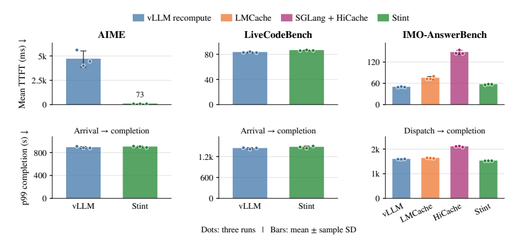
Figure 9 .Latency tradeoffs in the same runs as Figure 8; lower is better. TTFT starts at HTTP dispatch. Completion time starts at scheduled arrival for AIME and LiveCodeBench, and at HTTP dispatch for IMO-AnswerBench; comparisons are within each workload. Dots show three runs, with mean and sample SD.
원문 · CC BY 4.0 · Ziji Shi, Xinyi Wan, Chaoyi Ruan, Guangxing Huang, Min Lin, Jialin Li · Making Preemption Productive in Long-Output LLM Serving · 원문 그림 인용 · 원본 PDF 12쪽에서 그림 영역을 추출했습니다.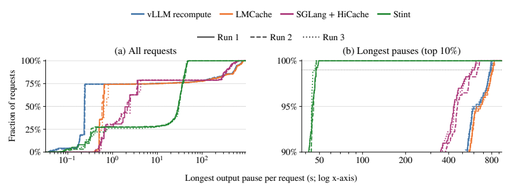
Figure 10 .Longest output pause per request in the IMO-AnswerBench replays. Each request contributes one maximum inter-chunk gap, excluding time before its first output. Curves retain the three runs separately. Stint removes the multi-minute stalls while making the typical request’s longest pause larger.
원문 · CC BY 4.0 · Ziji Shi, Xinyi Wan, Chaoyi Ruan, Guangxing Huang, Min Lin, Jialin Li · Making Preemption Productive in Long-Output LLM Serving · 원문 그림 인용 · 원본 PDF 12쪽에서 그림 영역을 추출했습니다.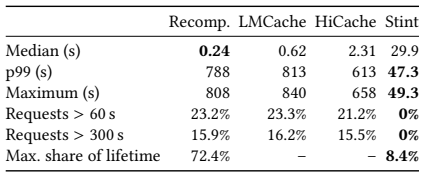
Table 3 .Longest output pause per IMO-AnswerBench re- quest, pooled over three runs (1,197 requests per system). Share of lifetime divides the pause by the request’s dispatch- to-completion time.
원문 · CC BY 4.0 · Ziji Shi, Xinyi Wan, Chaoyi Ruan, Guangxing Huang, Min Lin, Jialin Li · Making Preemption Productive in Long-Output LLM Serving · 원문 그림 인용 · 원본 PDF 13쪽에서 그림 영역을 추출했습니다.
Table 11 .IMO-AnswerBench subgroup changes with Stint relative to recompute. Percentages average three within-block ratios; negative latency changes are better. Both groups share each full 399-request replay.
원문 · CC BY 4.0 · Ziji Shi, Xinyi Wan, Chaoyi Ruan, Guangxing Huang, Min Lin, Jialin Li · Making Preemption Productive in Long-Output LLM Serving · 원문 그림 인용 · 원본 PDF 24쪽에서 그림 영역을 추출했습니다.장출력 이득의 범위와 비용
Stint의 이득은 장출력 워크로드에 집중됩니다. 짧은 출력 요약이나 BurstGPT 재생에서는 뚜렷한 이득이 없었습니다. 또한 고정 출력 재생은 응답 품질을 측정하지 않았고, 예측기 학습 과제가 서빙 워크로드와 겹칩니다. 호스트 메모리 사용도 늘어나며, 현재 구현의 할당기 반올림 때문에 800 GiB 페이로드가 1,024 GiB 백킹으로 잡힙니다. 저자들은 정확한 크기 할당으로 이 오버헤드를 줄일 수 있다고 봅니다.
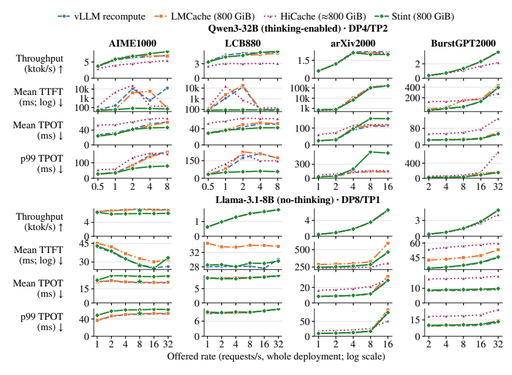
Figure 11 .Earlier end-to-end fixed-output load sweeps, one run per curve point. Stint curves use Q64; the Llama/AIME star at 8 requests/s uses Q1024 (mean± population SD, two runs). arXiv and BurstGPT use 2,000-request sweeps. TTFT uses a logarithmic scale. Llama/HiCache on AIME and LCB is unmeasured. LMCache curves predate the resume-path repair.
원문 · CC BY 4.0 · Ziji Shi, Xinyi Wan, Chaoyi Ruan, Guangxing Huang, Min Lin, Jialin Li · Making Preemption Productive in Long-Output LLM Serving · 원문 그림 인용 · 원본 PDF 14쪽에서 그림 영역을 추출했습니다.논문 정보
- 저자
- Ziji Shi, Xinyi Wan, Chaoyi Ruan, Guangxing Huang, Min Lin, Jialin Li
- 학회·저널
- arXiv · 프리프린트
- 최초 공개일
- 2026년 11월 15일
- 등록일
- 2026년 11월 17일
- 수정일
- 2026년 11월 15일
- 버전
- v1
- arXiv
- 2611.20106
- 분류
- cs.DC · cs.AI · cs.OS
- 원문 이용 조건
- CC BY 4.0
- 제공 범위
- 논문 정보, 해설, 허용된 원문 그림
AI 해설은 논문 원문과 별개의 설명이며 오류가 있을 수 있습니다. 원문과 그림은 각 출처의 이용 조건과 따로 표시된 권리를 따릅니다.
초록
Reasoning LLMs generate long outputs whose key--value (KV) caches occupy GPU memory for minutes. When memory fills, the server preempts requests, and a preempted request can repeatedly lose and recover its state while producing little new output. We call this behavior KV thrashing. In certain cases, existing systems leave more than a fifth of requests stalled for over a minute. Because preemption cannot be avoided without delaying admission, we ask how to make it productive. We present Stint, a serving system that preserves a preempted request's work, bounds how long it waits, and gives it fresh output after it returns. Stint stores fixed-length KV snapshots in a contiguity-first CPU pool with an exact-extent allocator, and moves them with fused K/V gather/scatter kernels and double buffering. Age-based readmission brings stalled requests back, and protection gives them a turn of fresh decoding before another preemption. Remaining-length estimates from decoding hidden states guide victim selection. On olympiad-math replays with Qwen3-32B on H200 GPUs, no request pauses for more than 50 seconds under Stint and p99 time per output token falls by 50.7\% relative to recomputation in the same engine. The replay as a whole finishes 10.7\% sooner (12.0\% higher throughput), because the requests that baselines starve no longer finish last.
원문 인용
Ziji Shi, Xinyi Wan, Chaoyi Ruan, Guangxing Huang, Min Lin, Jialin Li (2026). Making Preemption Productive in Long-Output LLM Serving. arXiv:2611.20106v1. https://arxiv.org/abs/2611.20106v1
BibTeX
@misc{shi2026making,
  title = {{Making Preemption Productive in Long-Output LLM Serving}},
  author = {Ziji Shi and Xinyi Wan and Chaoyi Ruan and Guangxing Huang and Min Lin and Jialin Li},
  year = {2026},
  eprint = {2611.20106},
  archivePrefix = {arXiv},
  url = {https://arxiv.org/abs/2611.20106v1}
}