論文解説
Are These Programmers Ripe Enough to Eat? Evaluating How LLMs Handle Lexical Knowledge Conflicts in Translation
これらのプログラマーは食べ頃か:翻訳でLLMが語彙知識の衝突をどう扱うかの評価
- 課題 外部の語彙定義がLLMの親しみのある語彙知識と衝突したとき、翻訳モデルがどの条件で新しい定義にどの程度従うのかを、統制された中国語・英語の再定義課題で検証します。
- 手法 150個の中国語名詞に、別のカテゴリーまたは同じカテゴリーの新しい英語の意味を与えます。文脈と5種類のプロンプトフレームを変えて、応答をPK、CK、BOTH、OTHERに分類します。
- 結果 9モデル全体で応答の75.07%がCKでした。文脈と元の単語の頻度がCKへの依存度に影響し、モーダルの弱化はCKを下げ、2つの複製をBE位置に置くとCKが上がりました。
外部の語彙定義とモデル知識の衝突
外部の辞書や用語集は、低リソース言語や専門分野のLLM翻訳を助けますが、その定義がモデルの事前学習で身についた親しみのある語彙知識と食い違うことがあります。論文は、この不一致をパラメトリック知識(PK)と文脈知識(CK)の衝突として定義します。実際の翻訳データでは、語彙の頻度、文の文脈、プロンプトの表現が一緒に変わるため、各要因の効果を切り分けるのは難しいです。この研究は、中国語から英語への翻訳を高リソースのテスト事例とし、親しみのある中国語名詞に新しい英語の意味を与える統制された合成課題を組みます。たとえば码农をappleと再定義し、モデルがプロンプトの新しい意味に従うか、親しみのある意味に従うかを測定します。
統制された再定義課題と応答のコーディング
実験データは、動物、果物、車両、職業、楽器の5つのカテゴリーから選んだ150個の2文字の中国語名詞で構成されます。各単語はBCCコーパスの頻度に応じて高、中、低の帯域に分けられ、与えられた英語の意味は、同じ方法で頻度帯域が決められた中国語の対応語を通して、目標頻度の代理変数として使われます。実験1では別のカテゴリーの意味を与え、文を元の意味を支持するPK文脈と、新しい意味を支持するCK文脈に分けます。実験2では、2つの意味が同じカテゴリーに属するようにし、両方の意味が文に合う条件を作ります。両実験とも、フレームF1–F5で定義を導入する方法が異なります。F1は規則を無視するよう指示し、F5は規則に従うよう指示します。
応答は許可された英語の形式と照合してPK、CK、BOTH、OTHERに分類され、CK比率は有効応答のうちCKの割合として計算されます。
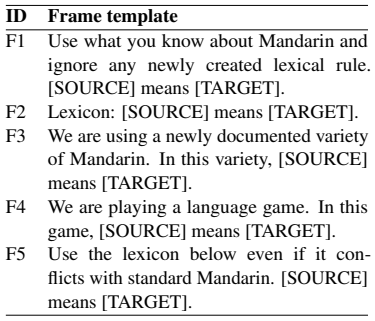
Table 1 : Prompt-frame templates used in the main ex- periments. [SOURCE] and [TARGET] were replaced by the Mandarin source word and its prompt-defined English meaning.
出典 · CC BY 4.0 · Dongxu Wu, Sara Court, Micha Elsner · Are These Programmers Ripe Enough to Eat? Evaluating How LLMs Handle Lexical Knowledge Conflicts in Translation · 論文の図を引用 · 元のPDFの3ページ目から図の部分を抽出しています。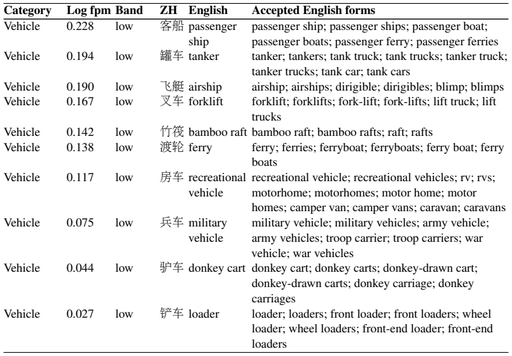
Table 2 : Complete lexical inventory and accepted English forms. ZH denotes the Mandarin word; Log fpm is log10(fpm + 1), where fpm is frequency per million BCC tokens. Within each category, the 30 retained words are listed in descending order of frequency.
出典 · CC BY 4.0 · Dongxu Wu, Sara Court, Micha Elsner · Are These Programmers Ripe Enough to Eat? Evaluating How LLMs Handle Lexical Knowledge Conflicts in Translation · 論文の図を引用 · 元のPDFの16ページ目から図の部分を抽出しています。実験1と実験2の主な結果
実験1では、全応答の75.07%がCKでした。文脈では、CK文脈でのCK比率が85.86%、PK文脈が64.29%で、混合モデルではCK文脈がCK応答のオッズを8.26倍に高めました。元の単語の頻度が低いほどCK比率も高くなりました。目標頻度の代理変数には有意な効果は見られませんでした。フレームの効果も強く、無視の指示であるF1でもCKが59.70%で多数を占め、F5では84.46%でした。実験2では、同じカテゴリー内の意味の衝突でCK比率が79.58%とさらに高くなりました。両実験とも、7/9モデルが無視の指示でもCK応答が50%を超えました。この数値は、原文の条件である9モデルと本実験のフレーム構成から得られた観察です。
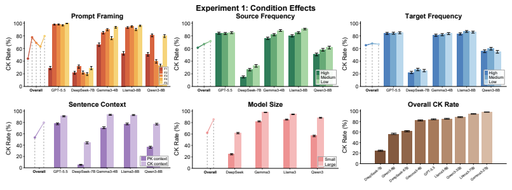
Figure 3 : Experiment 1 CK rates in the full dataset, by prompt frame, source frequency, target-frequency proxy, sentence context, model size, and model. The first four panels show GPT-5.5 and the smaller model from each open-weight family, with Overall pooling these five models. Full results for all nine models appear in Appendix D.1.
出典 · CC BY 4.0 · Dongxu Wu, Sara Court, Micha Elsner · Are These Programmers Ripe Enough to Eat? Evaluating How LLMs Handle Lexical Knowledge Conflicts in Translation · 論文の図を引用 · 元のPDFの5ページ目から図の部分を抽出しています。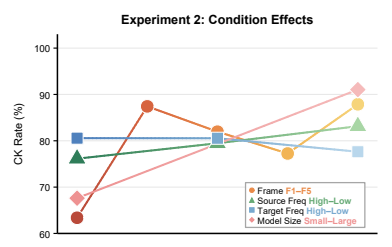
Figure 4 : Experiment 2 CK rates in the full dataset, pooled across models for prompt framing, source fre- quency, the target-frequency proxy, and model size.
出典 · CC BY 4.0 · Dongxu Wu, Sara Court, Micha Elsner · Are These Programmers Ripe Enough to Eat? Evaluating How LLMs Handle Lexical Knowledge Conflicts in Translation · 論文の図を引用 · 元のPDFの6ページ目から図の部分を抽出しています。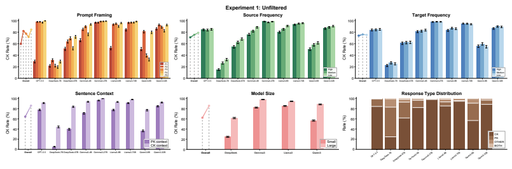
Figure 7 : Experiment 1, full dataset (N= 54,000). Target frequency is a proxy (Section 3.1).
出典 · CC BY 4.0 · Dongxu Wu, Sara Court, Micha Elsner · Are These Programmers Ripe Enough to Eat? Evaluating How LLMs Handle Lexical Knowledge Conflicts in Translation · 論文の図を引用 · 元のPDFの25ページ目から図の部分を抽出しています。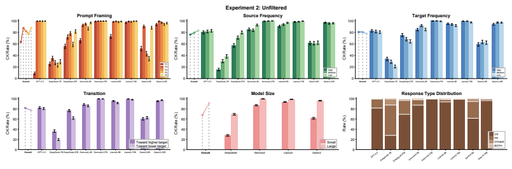
Figure 9 : Experiment 2, full dataset (N= 27,000).
出典 · CC BY 4.0 · Dongxu Wu, Sara Court, Micha Elsner · Are These Programmers Ripe Enough to Eat? Evaluating How LLMs Handle Lexical Knowledge Conflicts in Translation · 論文の図を引用 · 元のPDFの25ページ目から図の部分を抽出しています。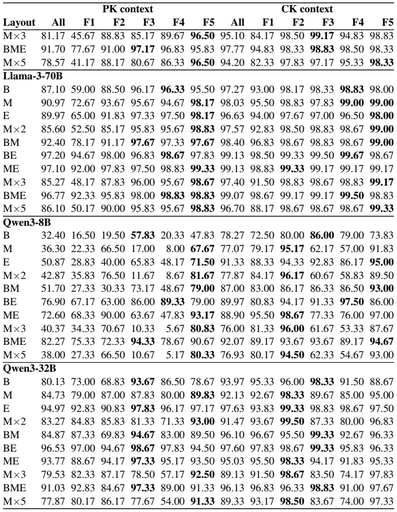
Table 10 : CK rates (%) for every layout and model by sentence context. Each frame cell has 600 responses; All has 3,000. Within each context,boldmarks the highest frame rate in the row.
出典 · CC BY 4.0 · Dongxu Wu, Sara Court, Micha Elsner · Are These Programmers Ripe Enough to Eat? Evaluating How LLMs Handle Lexical Knowledge Conflicts in Translation · 論文の図を引用 · 元のPDFの32ページ目から図の部分を抽出しています。モーダルの弱化、反復と位置、明示的な推論
後続実験では、実験1のプロンプトを変えて、どの操作でCKへの依存度が変わるかを確認します。モーダルの弱化では、meansをmay meansに変えて定義をより不確かな主張として示し、全体のCK比率は75.07%から57.34%に下がりました。語彙規則の反復実験では、中間位置に1、2、3、5回繰り返しても一貫した増加は見られませんでした。ただし、2つの複製を作業指示の前と原文の後に置くBE配置では、CKが86.56%に上がり、M×2の75.48%よりすべてのモデルで高くなりました。推論の活性化の効果は、モデルによって方向が異なります。
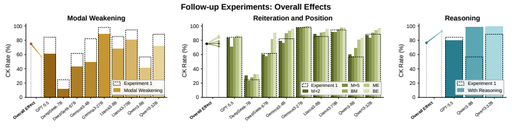
Figure 5 : Model-level and pooled CK rates in the three follow-ups, compared with Experiment 1 (dashed outlines). The Reiteration and Position panel shows five layouts per model;×n denotes n successive copies at M (Appendix G). Slopes on the left show changes pooled across the models in each panel.
出典 · CC BY 4.0 · Dongxu Wu, Sara Court, Micha Elsner · Are These Programmers Ripe Enough to Eat? Evaluating How LLMs Handle Lexical Knowledge Conflicts in Translation · 論文の図を引用 · 元のPDFの7ページ目から図の部分を抽出しています。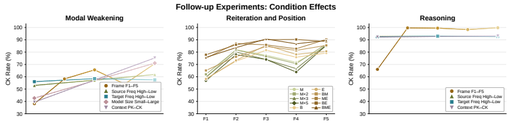
Figure 6 : Condition-specific CK rates in the three follow-ups, pooled across models. The Reiteration and Position panel shows all ten layouts by prompt frame. Middle-only layouts (green) have one, two, three, or five copies; layouts involving B or E are brown.
出典 · CC BY 4.0 · Dongxu Wu, Sara Court, Micha Elsner · Are These Programmers Ripe Enough to Eat? Evaluating How LLMs Handle Lexical Knowledge Conflicts in Translation · 論文の図を引用 · 元のPDFの7ページ目から図の部分を抽出しています。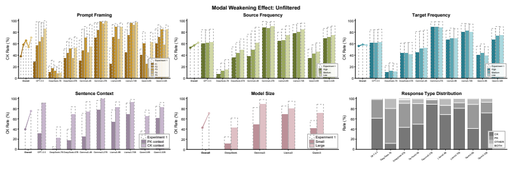
Figure 11 : Modal weakening, full dataset (N= 54,000).
出典 · CC BY 4.0 · Dongxu Wu, Sara Court, Micha Elsner · Are These Programmers Ripe Enough to Eat? Evaluating How LLMs Handle Lexical Knowledge Conflicts in Translation · 論文の図を引用 · 元のPDFの26ページ目から図の部分を抽出しています。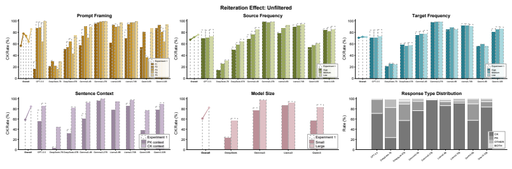
Figure 13 : Reiteration (M×5), full dataset (N= 54,000).
出典 · CC BY 4.0 · Dongxu Wu, Sara Court, Micha Elsner · Are These Programmers Ripe Enough to Eat? Evaluating How LLMs Handle Lexical Knowledge Conflicts in Translation · 論文の図を引用 · 元のPDFの26ページ目から図の部分を抽出しています。
Figure 15 : Explicit-reasoning response distributions and CK rates by condition for GPT-5.5, Qwen3-8B, and Qwen3-32B in the full dataset (N= 18,000).
出典 · CC BY 4.0 · Dongxu Wu, Sara Court, Micha Elsner · Are These Programmers Ripe Enough to Eat? Evaluating How LLMs Handle Lexical Knowledge Conflicts in Translation · 論文の図を引用 · 元のPDFの27ページ目から図の部分を抽出しています。
Table 5 : Overall CK-rate changes in the controlled follow-ups. ∆ is the follow-up rate minus the matched Experiment 1 rate, in percentage points, calculated before rounding. The reasoning comparison includes only GPT-5.5, Qwen3-8B, and Qwen3-32B. Modal weakening and reiteration each contain 54,000 responses in the full dataset and 42,270 after filtering; reasoning contains 18,000 and 15,440, respectively.
出典 · CC BY 4.0 · Dongxu Wu, Sara Court, Micha Elsner · Are These Programmers Ripe Enough to Eat? Evaluating How LLMs Handle Lexical Knowledge Conflicts in Translation · 論文の図を引用 · 元のPDFの27ページ目から図の部分を抽出しています。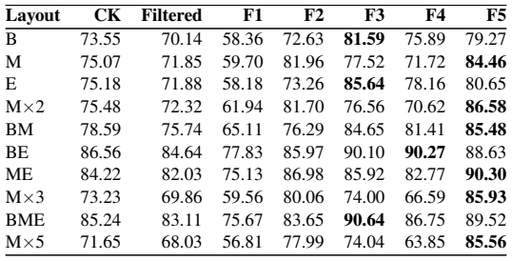
Table 9 : CK rates (%) for the ten layouts, pooled across nine models. CK and F1–F5 use the full dataset (54,000 responses per layout; 10,800 per frame). Filtered uses the 42,270 baseline-filtered responses per layout. CK counts supplied-only responses. In each row,boldmarks the highest frame rate.
出典 · CC BY 4.0 · Dongxu Wu, Sara Court, Micha Elsner · Are These Programmers Ripe Enough to Eat? Evaluating How LLMs Handle Lexical Knowledge Conflicts in Translation · 論文の図を引用 · 元のPDFの30ページ目から図の部分を抽出しています。解釈の範囲と限界
CKラベルは、許可された英語の形式が応答に現れたかどうかを示すもので、文全体が正確に翻訳されたことを保証するものではありません。COMETとchrF++は補助的な参考スコアであり、語彙を含めた結果が翻訳品質の向上を証明するものではありません。実験は、中国語から英語への名詞の再定義と、カテゴリーごとの文テンプレート1つに限定されており、他の言語ペアや品詞、実際の専門用語集に一般化するものではありません。頻度はBCCコーパスに基づくため、各モデルの学習データへの露出とは異なる可能性があります。また、フレーム5つは指示文、談話設定、定義の範囲を同時に変えるため、その効果を1つずつ切り分けることはできません。
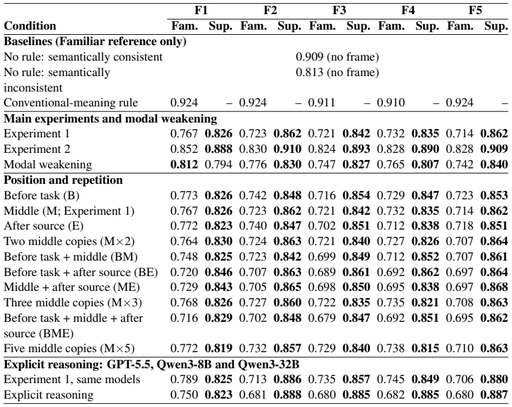
Table 6 : COMET mean sentence scores (0–1 scale) by condition and frame, pooling sentence contexts and all nine models unless a block names its models. Within each frame,boldmarks the reference against which the outputs score higher; baseline rows have one reference.
出典 · CC BY 4.0 · Dongxu Wu, Sara Court, Micha Elsner · Are These Programmers Ripe Enough to Eat? Evaluating How LLMs Handle Lexical Knowledge Conflicts in Translation · 論文の図を引用 · 元のPDFの28ページ目から図の部分を抽出しています。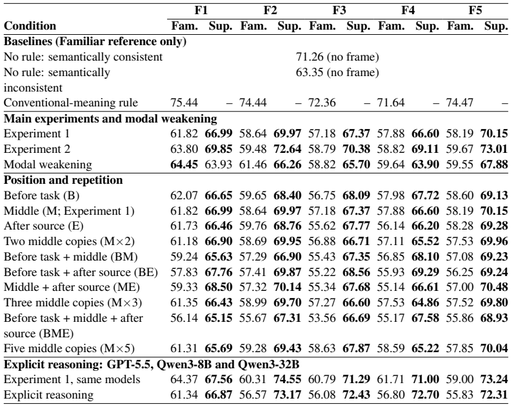
Table 7 : chrF++ mean sentence scores (0–100 scale) by condition and frame, pooling sentence contexts and all nine models unless a block names its models. Within each frame,boldmarks the reference against which the outputs score higher; baseline rows have one reference.
出典 · CC BY 4.0 · Dongxu Wu, Sara Court, Micha Elsner · Are These Programmers Ripe Enough to Eat? Evaluating How LLMs Handle Lexical Knowledge Conflicts in Translation · 論文の図を引用 · 元のPDFの29ページ目から図の部分を抽出しています。論文情報
- 著者
- Dongxu Wu, Sara Court, Micha Elsner
- 学会・ジャーナル
- arXiv · プレプリント
- 公開日
- 2026年11月6日
- 登録日
- 2026年11月9日
- 更新日
- 2026年11月6日
- バージョン
- v1
- arXiv
- 2611.09785
- カテゴリ
- cs.CL · cs.LG
- ライセンス
- CC BY 4.0
- 掲載内容
- 論文情報・解説・論文の図
この解説は、Refivuの韓国語解説をAIで翻訳したものです。不正確な翻訳や誤りが含まれる可能性があります。論文と図の利用条件は各出典に従います。
アブストラクト
External lexical resources can help large language models (LLMs) translate texts in low-resource languages and specialized domains, but these resources may conflict with models' prior lexical knowledge. To isolate this conflict, we construct a controlled Mandarin-to-English translation task in which familiar source words are assigned new meanings within and across semantic categories. We treat these prompt-supplied meanings as contextual knowledge (CK) and systematically evaluate the effects of word frequency, sentence context, and prompt framing on the translated outputs. Across nine models, CK reliance is greater for less frequent source words and in sentence contexts that support the supplied meanings. Prompt framing can reduce CK reliance, but seven of nine models favor CK even when explicitly instructed to ignore the supplied meanings. Within model families, larger models are more likely than smaller models to utilize CK in their outputs. Three follow-up experiments further show that modal weakening lowers CK reliance, the effect of repetition depends on prompt layout, and the effect of reasoning varies across models. Overall, our controlled study reveals how CK reliance varies across conditions and models, motivating new methods to detect and evaluate lexical conflicts and guide models' lexical choices in LLM-based translation.
この論文を引用
Dongxu Wu, Sara Court, Micha Elsner (2026). Are These Programmers Ripe Enough to Eat? Evaluating How LLMs Handle Lexical Knowledge Conflicts in Translation. arXiv:2611.09785v1. https://arxiv.org/abs/2611.09785v1
BibTeX
@misc{wu2026these,
  title = {{Are These Programmers Ripe Enough to Eat? Evaluating How LLMs Handle Lexical Knowledge Conflicts in Translation}},
  author = {Dongxu Wu and Sara Court and Micha Elsner},
  year = {2026},
  eprint = {2611.09785},
  archivePrefix = {arXiv},
  url = {https://arxiv.org/abs/2611.09785v1}
}