論文解説
Martine: Benchmarking Multi-View 3D Surface Reconstruction Across Viewpoint Coverage, Resolution, and Lighting
Martine: 視点範囲、解像度、照明にまたがる多視点3D表面再構成のベンチマーク
- 課題 制御された環境での3D表面再構成の評価は、視点範囲、解像度、照明、参照データの精度をそろえることが難しく、手法間の比較に偏りが生じることがあります。
- 手法 MARTINEは28個の物体を84視点と、単一光・多重光の2つの照明体制で撮影し、物体に依存しないSfM較正と輪郭ベースのスキャン位置合わせにより、参照データの精度を定量化しています。
- 結果 4分の1解像度の全体評価では、ニューラル暗黙表現に基づく方法のF-scoreが最も高くなりました。一方、多重光の方法は対応する単一光の方法より高い全体精度は見られませんでした。
制御された環境で再構成ベンチマークが難しい理由
制御された取得環境では、センサー構成、解像度、視点の分布、照明を明示できるため、高精度な多視点3D表面再構成に広く使われています。しかし再構成の精度は、再構成のパラダイム、物体の性質、取得条件が合わさって決まるため、公正な比較は難しいです。既存のベンチマークは視点範囲、解像度、照明のいずれかを制限していることが多く、特定の設定に合う方法が有利になる可能性があります。また、正確な3D ground truthや、画像と形状の間の定量化された位置合わせ誤差を備えていない場合もあり、表面評価の信頼性が制限されます。MARTINEは、広い視点カバレッジ、高解像度の画像、定量化された参照データという3つの条件を同時に満たすことを目指したベンチマークです。
既存データセットのうち、DTUとSkoltech3Dは密な視点を提供しますが、方位角の範囲が限られています。DiLiGenT-MVは多視点フォトメトリックステレオの標準ベンチマークですが、物体は5個、物体あたりの視点は20個、解像度は612×512です。この論文では、こうした違いが手法間の比較をゆがめる可能性があると述べられています。
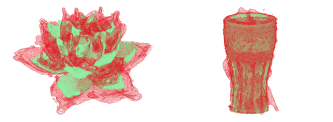
Figure 1 : Examples of image–GT misalignment in OpenSubstance [ 20]. Inaccurate COLMAP reconstructions of an opaque flower (left) and a transparent glass (right) in red. Registered GT scan meshes in green.
出典 · CC BY 4.0 · Robin Bruneau, Baptiste Brument, Frederic Giraud, Bastian Sigrist, Sascha Jecklin, Philipp Fürnstahl, Bjoern Menze, Lilian Calvet · Martine: Benchmarking Multi-View 3D Surface Reconstruction Across Viewpoint Coverage, Resolution, and Lighting · 論文の図を引用 · 元のPDFの2ページ目から図の部分を抽出しています。28個の物体と2つの照明による取得設計
MARTINEでは、28個の物体をターンテーブルに置き、ロボットアームに取り付けた高解像度カメラで撮影します。照明は2つの体制に分かれています。単一光の設定では、120 cm のソフトボックスフラッシュと反射コーンを使い、ターンテーブル軸の周りにほぼ回転対称な環境光をつくります。これは、複数の視点でほとんど変わらない照明を得るための設計です。多重光の設定では、カメラの周囲に固定した30個のLEDを一度に1つずつ順番に点灯します。このため、2つの体制は同じ物体と視点設計を共有しますが、照明の生成方法と撮影枚数が異なります。この設計の目的は、1つのデータセット上で、単一光による再構成と多重光による再構成を、それぞれの条件で比較できるようにすることです。
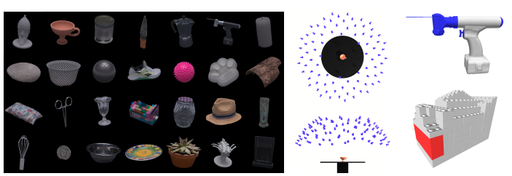
Figure 2 : Dataset overview. (a) All objects in the proposed dataset, showing high geometric and optical diversity, including low-texture regions, fine structures, transparent and specular materials, and high-frequency geometric details. (b) Dense viewpoint sampling with wide angular coverage, obtained by coupling a robotic arm with a turntable. (c) Two examples of ground-truth meshes with manually curated challenge-level 3D masks highlighting specular regions (top, in blue) and transparent regions (bottom, in red) for challenge-level evaluation.
出典 · CC BY 4.0 · Robin Bruneau, Baptiste Brument, Frederic Giraud, Bastian Sigrist, Sascha Jecklin, Philipp Fürnstahl, Bjoern Menze, Lilian Calvet · Martine: Benchmarking Multi-View 3D Surface Reconstruction Across Viewpoint Coverage, Resolution, and Lighting · 論文の図を引用 · 元のPDFの4ページ目から図の部分を抽出しています。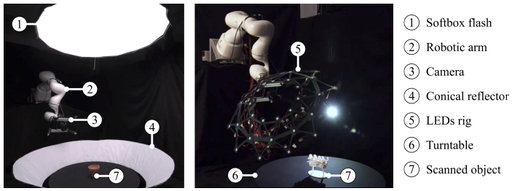
Figure 3 : Acquisition setup. (a) Single-light acquisition regime, using an ambient illumination setup designed to be rotation-invariant around the turntable axis. (b) Multi-light acquisition regime, using a rig of 30 LEDs rigidly mounted around the camera. At each viewpoint, the LEDs are activated sequentially while the camera pose remains fixed.
出典 · CC BY 4.0 · Robin Bruneau, Baptiste Brument, Frederic Giraud, Bastian Sigrist, Sascha Jecklin, Philipp Fürnstahl, Bjoern Menze, Lilian Calvet · Martine: Benchmarking Multi-View 3D Surface Reconstruction Across Viewpoint Coverage, Resolution, and Lighting · 論文の図を引用 · 元のPDFの5ページ目から図の部分を抽出しています。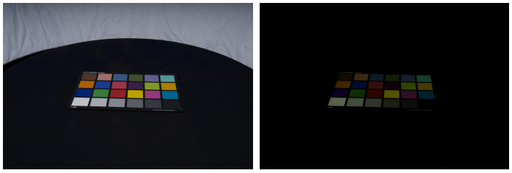
Figure 13 : Colour calibration board seen in the single-light regime (left), and in the multi-light regime with one LED turned on (right).
出典 · CC BY 4.0 · Robin Bruneau, Baptiste Brument, Frederic Giraud, Bastian Sigrist, Sascha Jecklin, Philipp Fürnstahl, Bjoern Menze, Lilian Calvet · Martine: Benchmarking Multi-View 3D Surface Reconstruction Across Viewpoint Coverage, Resolution, and Lighting · 論文の図を引用 · 元のPDFの18ページ目から図の部分を抽出しています。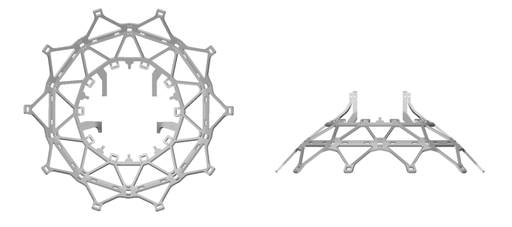
Figure 14 : LED rig. Two views showing the spatial distribution of the LEDs around the camera.
出典 · CC BY 4.0 · Robin Bruneau, Baptiste Brument, Frederic Giraud, Bastian Sigrist, Sascha Jecklin, Philipp Fürnstahl, Bjoern Menze, Lilian Calvet · Martine: Benchmarking Multi-View 3D Surface Reconstruction Across Viewpoint Coverage, Resolution, and Lighting · 論文の図を引用 · 元のPDFの20ページ目から図の部分を抽出しています。物体に依存しないカメラ較正と回転対称照明の検証
カメラ較正は、物体の形状やテクスチャに依存しないように設計されています。特徴点抽出には、ターンテーブルを覆う黒い布のテクスチャだけを使い、物体と背景は分割マスクで除外します。取得したすべての画像は、1回のStructure-from-Motion実行でまとめて較正されます。この過程ではMeshroomとDSP-SIFTが使われます。較正精度は、ターンテーブル上のチェッカーボードのコーナーを評価にだけ使い、較正には使わない方法で測定しました。最大角度の視点20個にある6,480個のコーナーで、SfMベースの方法の再投影誤差は、平均0.542 px、中央値0.524 pxでした。同じ条件で、ArUcoシリンダーは0.666 px、COLMAPは0.809 px、ChArUcoボードは1.086 pxでした。
ただし、この数値はフラッシュの不安定さと回転による照明変化が混ざった観測結果です。

Table 3 : Distribution of the per-corner reprojection residual on the test checkerboard on the 20 frontal views, in pixels at the full9568×6376resolution.
出典 · CC BY 4.0 · Robin Bruneau, Baptiste Brument, Frederic Giraud, Bastian Sigrist, Sascha Jecklin, Philipp Fürnstahl, Bjoern Menze, Lilian Calvet · Martine: Benchmarking Multi-View 3D Surface Reconstruction Across Viewpoint Coverage, Resolution, and Lighting · 論文の図を引用 · 元のPDFの14ページ目から図の部分を抽出しています。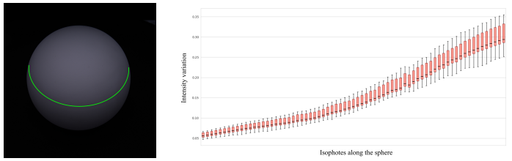
Figure 11 : (Left) A visualisation of a single isophote (green) on the calibration sphere. (Right) Distribution of pixel intensity variations for each isophote across the sphere’s height. The standard deviation ranges from 0.0054 to 0.0267, with an average of 0.0141, confirming consistent illumination across viewpoints.
出典 · CC BY 4.0 · Robin Bruneau, Baptiste Brument, Frederic Giraud, Bastian Sigrist, Sascha Jecklin, Philipp Fürnstahl, Bjoern Menze, Lilian Calvet · Martine: Benchmarking Multi-View 3D Surface Reconstruction Across Viewpoint Coverage, Resolution, and Lighting · 論文の図を引用 · 元のPDFの17ページ目から図の部分を抽出しています。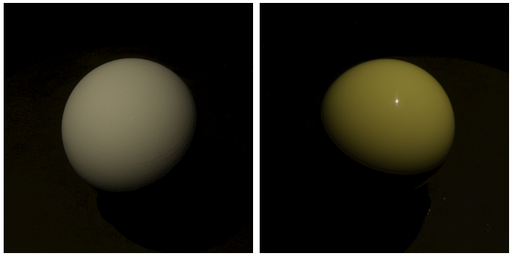
Figure 12 : Light-calibration spheres. (Left) Matte sphere. (Right) Glossy sphere.
出典 · CC BY 4.0 · Robin Bruneau, Baptiste Brument, Frederic Giraud, Bastian Sigrist, Sascha Jecklin, Philipp Fürnstahl, Bjoern Menze, Lilian Calvet · Martine: Benchmarking Multi-View 3D Surface Reconstruction Across Viewpoint Coverage, Resolution, and Lighting · 論文の図を引用 · 元のPDFの18ページ目から図の部分を抽出しています。輪郭ベースのICPでスキャンを画像座標系に合わせる過程
参照スキャンは、Artec Spider光学スキャナーまたはCTスキャンで取得し、メッシュを画像座標系に合わせるために輪郭ベースのICPを使います。この方法では、投影したground truthメッシュのシルエットと、画像から抽出した物体の輪郭を合わせ、回転、平行移動、一様スケールからなる7-DoFの類似変換を推定します。目標の輪郭は、単一光の画像からCannyエッジを検出し、SAMの物体マスク周辺20 pxの探索帯にあるエッジだけを残して得ます。閾値は物体ごとに20個の候補格子から選び、位置合わせの結果を参照シルエットと比較して、F0.5スコアが最も高い設定を使います。位置合わせの最適化にはTrust Region Reflective法とsoft-ℓ1損失が使われます。
この位置合わせが実際に正確かどうかは、学習に使わなかった制御視点で確認します。物体ごとにk-meansで選んだ8個の制御視点を除いて位置合わせを行い、残した視点の再投影残差を測定します。このleave-one-out残差は、26個の物体で平均1.22 pxであり、すべての物体が2 px未満でした。著者らは、IoUではなく再投影残差を使った理由を、IoUはダウンサンプルされたマスク上では小さな輪郭誤差に鈍感になりうるためだと説明しています。
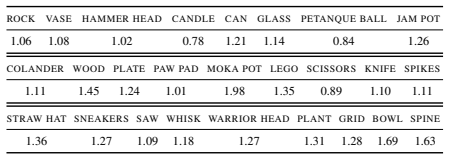
Table 2 : Leave-one-out registration residuals (mean reprojection error in pixels, over 8 control views per object.
出典 · CC BY 4.0 · Robin Bruneau, Baptiste Brument, Frederic Giraud, Bastian Sigrist, Sascha Jecklin, Philipp Fürnstahl, Bjoern Menze, Lilian Calvet · Martine: Benchmarking Multi-View 3D Surface Reconstruction Across Viewpoint Coverage, Resolution, and Lighting · 論文の図を引用 · 元のPDFの7ページ目から図の部分を抽出しています。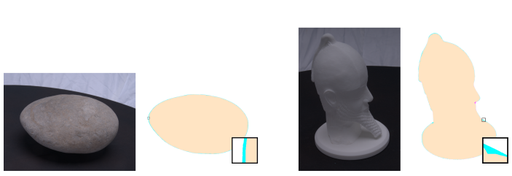
Figure 9 : IoU limitations in assessing boundary precision. Visualisation of the discrepancy between SAM (magenta) and ground-truth (cyan) masks, with their intersection in orange. The boundary analysis reveals systematic contour shifts (4.80 and 4.51 px on average) that are critical for 2D–3D registration accuracy.
出典 · CC BY 4.0 · Robin Bruneau, Baptiste Brument, Frederic Giraud, Bastian Sigrist, Sascha Jecklin, Philipp Fürnstahl, Bjoern Menze, Lilian Calvet · Martine: Benchmarking Multi-View 3D Surface Reconstruction Across Viewpoint Coverage, Resolution, and Lighting · 論文の図を引用 · 元のPDFの16ページ目から図の部分を抽出しています。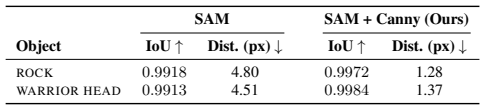
Table 4 :Contour refinement.The proposed Canny-based refinement significantly reduces the mean contour distance (px).
出典 · CC BY 4.0 · Robin Bruneau, Baptiste Brument, Frederic Giraud, Bastian Sigrist, Sascha Jecklin, Philipp Fürnstahl, Bjoern Menze, Lilian Calvet · Martine: Benchmarking Multi-View 3D Surface Reconstruction Across Viewpoint Coverage, Resolution, and Lighting · 論文の図を引用 · 元のPDFの16ページ目から図の部分を抽出しています。表面精度の測定と属性別分析の設計
再構成メッシュは、どのカメラからも見えない頂点を取り除いたあと、ground truthと同じ方法で整理し、再サンプリングします。精度は、距離閾値を0から4 mmまで変えながら、精度、再現率、F-scoreの曲線として測定します。ここで精度とは、再構成点のうち参照表面から閾値以内にある割合です。再現率とは、参照点のうち再構成表面から閾値以内にある割合です。F-scoreは両者の調和平均です。Chamfer distanceは双方向の最近傍距離を平均したもので、4 mmより大きい距離はChamfer distanceの計算から除外されます。2つの点群の密度をそろえるため、各メッシュを0.05 mm間隔でサンプリングしたあと、0.05 mm半径のダウンサンプリングを適用します。
属性別の分析は、ground truthメッシュに割り当てた点単位のラベルを使って行います。Lambertian、specular、transparent、textureless、fine structure、high curvature、low visibilityなどの属性が定義されています。高曲率領域は、VCMで計算した曲率の絶対値が0.75 mm−1より大きい点として定義されます。
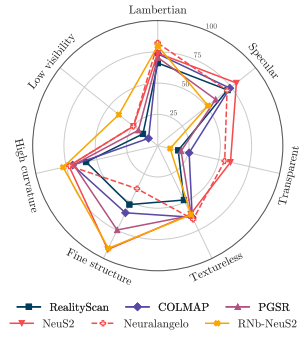
Figure 7 : Radar chart of F-score at 0.5 mm per reconstruction challenge, at quarter resolution, for the five rep- resentative methods and Neuralangelo. Higher is better.
出典 · CC BY 4.0 · Robin Bruneau, Baptiste Brument, Frederic Giraud, Bastian Sigrist, Sascha Jecklin, Philipp Fürnstahl, Bjoern Menze, Lilian Calvet · Martine: Benchmarking Multi-View 3D Surface Reconstruction Across Viewpoint Coverage, Resolution, and Lighting · 論文の図を引用 · 元のPDFの10ページ目から図の部分を抽出しています。再構成パラダイムごとの全体精度と多重光方法の結果
4分の1解像度で集計した全体曲線では、ニューラル暗黙表現に基づく方法のF-scoreが最も高くなっています。Neuralangelo は0.5 mmで77.9%、NeuS2は75.5%でした。古典的なMVSの基準であるCOLMAPは70.6%です。多重光の方法は、同じ条件で対応する単一光の方法より全体精度が高くありませんでした。RNb-NeuS2は66.7%でNeuS2より低く、SuperNormalは60.8%で最も低い結果でした。したがって、多重光画像から得られる測光的な手がかりは、このベンチマークの実装では全体精度の向上にはつながりませんでした。解像度の実験はVASE物体だけに限った分析です。
全解像度ではRealityScanのF-scoreは99.3%でしたが、8分の1解像度では28.0%に下がりました。この結果は、写真測量系の方法が解像度の変化に敏感だという観察であり、すべての物体と方法に対する一般的な結論にまでは広げられません。視点数の実験では、5視点でCOLMAPとPGSRは失敗しましたが、NeuS2とRNb-NeuS2は同じ設定でも再構成を維持しました。
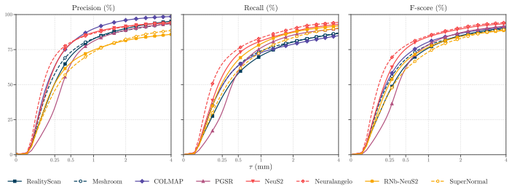
Figure 4 : Global precision, recall, and F-score curves pooled across all evaluated objects at quarter resolution (d4). Each curve aggregates all point-to-surface distances before computing the metric, so larger objects contribute proportionally more.
出典 · CC BY 4.0 · Robin Bruneau, Baptiste Brument, Frederic Giraud, Bastian Sigrist, Sascha Jecklin, Philipp Fürnstahl, Bjoern Menze, Lilian Calvet · Martine: Benchmarking Multi-View 3D Surface Reconstruction Across Viewpoint Coverage, Resolution, and Lighting · 論文の図を引用 · 元のPDFの9ページ目から図の部分を抽出しています。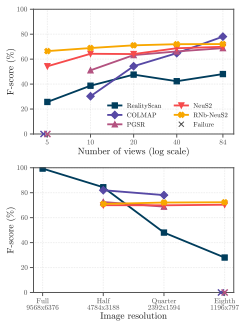
Figure 5 : F-score at 1 mm on the VASEobject versus number of in- put views on a log scale (top) and image resolution (bottom). Crosses plotted at 0% F-score mark failed reconstructions in the 5-view and one-eighth-resolution settings.
出典 · CC BY 4.0 · Robin Bruneau, Baptiste Brument, Frederic Giraud, Bastian Sigrist, Sascha Jecklin, Philipp Fürnstahl, Bjoern Menze, Lilian Calvet · Martine: Benchmarking Multi-View 3D Surface Reconstruction Across Viewpoint Coverage, Resolution, and Lighting · 論文の図を引用 · 元のPDFの9ページ目から図の部分を抽出しています。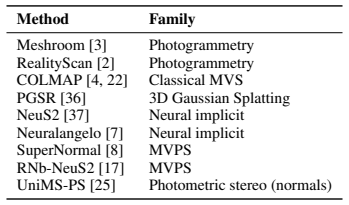
Table 5 :Evaluated methods.
出典 · CC BY 4.0 · Robin Bruneau, Baptiste Brument, Frederic Giraud, Bastian Sigrist, Sascha Jecklin, Philipp Fürnstahl, Bjoern Menze, Lilian Calvet · Martine: Benchmarking Multi-View 3D Surface Reconstruction Across Viewpoint Coverage, Resolution, and Lighting · 論文の図を引用 · 元のPDFの21ページ目から図の部分を抽出しています。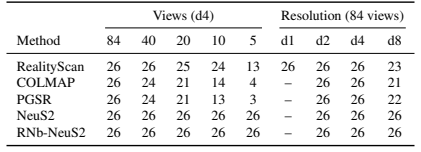
Table 7 : Number of objects reconstructed (out of 26) per method, for each subset of input views at quarter resolution (d4) and for each image resolution with all 84 views. A missing reconstruction is a failure of the method (Table 8). –: configuration not run; at full resolution, the methods other than RealityScan fail for lack of GPU memory (Section 3.2).
出典 · CC BY 4.0 · Robin Bruneau, Baptiste Brument, Frederic Giraud, Bastian Sigrist, Sascha Jecklin, Philipp Fürnstahl, Bjoern Menze, Lilian Calvet · Martine: Benchmarking Multi-View 3D Surface Reconstruction Across Viewpoint Coverage, Resolution, and Lighting · 論文の図を引用 · 元のPDFの22ページ目から図の部分を抽出しています。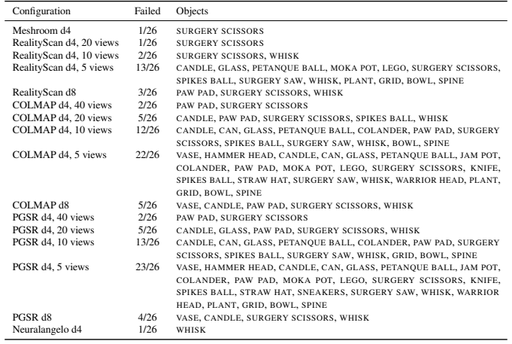
Table 8 : Failed reconstructions per configuration. COLMAP and PGSR fail when structure from motion on the images of the configuration alone yields no usable sparse model (single attempt, default settings, no fallback); the other failures are runs that produced no mesh. Failed objects are excluded from all aggregated scores and declared asn/26in the captions.
出典 · CC BY 4.0 · Robin Bruneau, Baptiste Brument, Frederic Giraud, Bastian Sigrist, Sascha Jecklin, Philipp Fürnstahl, Bjoern Menze, Lilian Calvet · Martine: Benchmarking Multi-View 3D Surface Reconstruction Across Viewpoint Coverage, Resolution, and Lighting · 論文の図を引用 · 元のPDFの23ページ目から図の部分を抽出しています。主要指標の解釈範囲とベンチマークの限界
この論文は、Chamfer distanceとF-scoreでは、高曲率領域と低可視性領域での改善を十分に反映できない可能性があると指摘しています。そのため属性別のマスクを追加しましたが、属性の定義自体は一部が定性的です。手作業で付けたマスクは明確な領域だけにラベルを付け、不確かな領域は評価から除外しています。また、この研究は表面再構成に焦点を当てており、データセットはnovel-view synthesisやrelightingにも使えると述べられていますが、これらの課題は評価していません。物体数の28個は、データ取得と検証にかかる時間のために制限されました。各物体は2,604枚の画像で撮影され、取得、スキャン、位置合わせ、品質管理まで含めると物体あたり約1日かかります。
特定の解像度と視点数で得られた観察は、その条件を超えた一般化を保証するものではありません。
論文情報
- 著者
- Robin Bruneau, Baptiste Brument, Frederic Giraud, Bastian Sigrist, Sascha Jecklin, Philipp Fürnstahl, Bjoern Menze, Lilian Calvet
- 学会・ジャーナル
- arXiv · プレプリント
- 公開日
- 2026年11月8日
- 登録日
- 2026年11月10日
- 更新日
- 2026年11月8日
- バージョン
- v1
- arXiv
- 2611.11602
- カテゴリ
- cs.CV
- ライセンス
- CC BY 4.0
- 掲載内容
- 論文情報・解説・論文の図
この解説は、Refivuの韓国語解説をAIで翻訳したものです。不正確な翻訳や誤りが含まれる可能性があります。論文と図の利用条件は各出典に従います。
アブストラクト
Controlled acquisition setups are widely used for high-accuracy multi-view 3D surface reconstruction, as they allow sensor configuration, image resolution, viewpoint distribution, and illumination to be specified. Yet benchmarking remains difficult, since reconstruction accuracy depends jointly on the reconstruction paradigm, object properties, and acquisition regime. Existing benchmarks often restrict viewpoint coverage, resolution, or illumination, which can bias comparisons towards methods suited to the chosen setting. Others lack accurate 3D ground truth or quantified image-to-geometry alignment, limiting their use for metric surface evaluation. We introduce Martine, a benchmark for controlled 3D object surface reconstruction. Martine comprises 28 objects, including transparent materials and fine structures, captured at 9568 x 6376 pixels from 84 views over a spherical cap under both single-light and multi-light regimes. It provides object-independent camera calibration, accurate 3D ground-truth scans, calibration and image-to-geometry accuracy quantified on test images, and 3D property masks for analysing errors by material properties, visibility, curvature and fine structures. Experiments across photogrammetry, classical multi-view stereo, neural implicit surfaces, Gaussian-splatting-based reconstruction, and multi-view photometric stereo show that Martine enables regime-aware evaluation with explicit control over reference-data accuracy. The benchmark resolves sub-millimetric reconstruction differences, with a best observed Chamfer distance of 0.058 mm over the evaluated visible surface.
この論文を引用
Robin Bruneau, Baptiste Brument, Frederic Giraud, Bastian Sigrist, Sascha Jecklin, Philipp Fürnstahl, Bjoern Menze, Lilian Calvet (2026). Martine: Benchmarking Multi-View 3D Surface Reconstruction Across Viewpoint Coverage, Resolution, and Lighting. arXiv:2611.11602v1. https://arxiv.org/abs/2611.11602v1
BibTeX
@misc{bruneau2026martine,
  title = {{Martine: Benchmarking Multi-View 3D Surface Reconstruction Across Viewpoint Coverage, Resolution, and Lighting}},
  author = {Robin Bruneau and Baptiste Brument and Frederic Giraud and Bastian Sigrist and Sascha Jecklin and Philipp Fürnstahl and Bjoern Menze and Lilian Calvet},
  year = {2026},
  eprint = {2611.11602},
  archivePrefix = {arXiv},
  url = {https://arxiv.org/abs/2611.11602v1}
}