論文解説
AdMem: Expectation-Grounded Procedural Memory for Long-Horizon Task-Solving Agents
AdMem:長期タスクを解くエージェントのための期待ベース手続き的メモリ
- 課題 メモリを管理せずにタスク間の経験を蓄積すると、メモリのないReActより成績が下がる問題です。
- 手法 行動の前に期待結果を記録し、批評器が二値報酬で評価します。項目ごとのユーティリティで検索、統合、削除を管理します。
- 結果 AgentBoardの707課題のうち、AdMemは441課題を解決しました。ReActの388課題、AWMの312課題より多い結果です。
管理なしの手続き記憶の失敗
メモリを使わないReActより、経験を蓄積する場合の方が結果が悪くなることがあります。AgentBoardでは、ワークフロー誘導メモリAWMが8つのドメインのうち7つでReActより少ない課題しか解けませんでした。全体の完了数は312対388で、AWMの方が低くなっています。著者らは原因を2つと見ています。1つ目は、タスク単位の報酬が複数の行動の後に一度だけ与えられるため、どの行動が役立ったかを見分けにくいことです。2つ目は、保存された項目を評価したり削除したりする仕組みがないため、誤った項目が再利用され続けることです。この論文は、この2つの問題を行動ごとのクレジット割り当てと項目ごとのユーティリティで扱います。
期待結果に基づくクレジット割り当てと保存ストアのライフサイクル
AdMemは、行為者、批評器、長期記憶ストアに分かれます。行為者は、各行動を実行する前に期待結果を一緒に記録します。批評器は、その行動を保留キューに入れておき、関連する観測がすべて届いた時点で、実際の結果を期待と比べます。この比較から0か1の二値報酬と内省を作り、手続き記憶の項目として記録します。環境の報酬信号は必要ありません。各項目はnoisy-OR報酬モデルで更新されるユーティリティ値を持ち、検索ではこのユーティリティと文脈類似度の積で順位を付けます。ユーティリティが低く検索されない項目は頻度に基づいて削除され、一緒に検索されることが多い項目は統合されます。保留キューを閉じる条件は、サブゴール範囲のpushとpopが決めます。
AgentBoardの8ドメインでの比較
Claude Haiku 4.5を、行為者、批評器、要約器のバックボーンとして、すべての構成で同じ方法で使いました。AdMemは707課題のうち441課題を解決し、ReActの388課題、AWMの312課題より多くなりました。同じ課題集合を使うため、ペア比較でも、最も不利な対応条件でp=0.03となり、有意でした。ドメインごとに見ると、PDDLでは60課題中46課題を解決し、ReActの20課題を上回りました。Holm–Bonferroni補正の後も有意でした。WebShopとScienceWorldでは完了率の差は統計的に有意ではありませんでしたが、平均進捗率はAdMemの方が高くなりました。
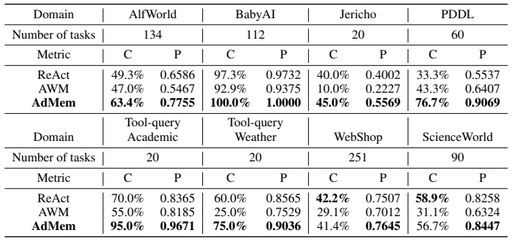
Table 1 : Task completeness (C, the fraction of tasks solved) and average progress (P, the mean of the per-task progress score pi ∈[0,1] ) on the eight AgentBoard domains, using Claude Haiku 4.5 as the backbone for every method. Bold marks the best value in each column. Each domain is a fixed task set of the size given in the second row, so completion counts are recoverable exactly from C (e.g. 63.4% of 134 is 85 tasks); we use those counts for the Fisher exact tests reported in the text. Each configuration is streamed once over the task set in a single lifelong episode. On the three 20-task domains a single task is worth 5.0 points of C, which is why we base per-domain conclusions on the tests rather than on the point differences alone.
出典 · CC BY 4.0 · Runzhe Wang, Huilin Lu, Shengjie Liu, Li Dong, Zhihuai Zhu · AdMem: Expectation-Grounded Procedural Memory for Long-Horizon Task-Solving Agents · 論文の図を引用 · 元のPDFの6ページ目から図の部分を抽出しています。
Table 2 : Aggregate view of Table 1 over all707 tasks. Intervals are Wilson 95% binomial intervals on the pooled completion rate. Macro-avg. C weights the eight domains equally rather than by task count; we report both because WebShop and ScienceWorld together hold48% of the tasks. Against ReAct, the pooled difference is significant for AdMem (+53 tasks, two-sided Fisher exact p= 5×10 −3) and significant in thenegativedirection for AWM ( −76 tasks, p= 7×10 −5). Because all three methods are run over the same 707 tasks, both comparisons are paired; both remain significant under the least favorable exact McNemar test consistent with these margins (p= 0.03 and p= 5×10 −3 respectively, Appendix C).
出典 · CC BY 4.0 · Runzhe Wang, Huilin Lu, Shengjie Liu, Li Dong, Zhihuai Zhu · AdMem: Expectation-Grounded Procedural Memory for Long-Horizon Task-Solving Agents · 論文の図を引用 · 元のPDFの6ページ目から図の部分を抽出しています。計画・範囲構造と長期ストアの役割
Jericho の20課題で、短期計画だけを使うSTP、長期手続きストアだけを使うLTP、全体のAdMemを比較しました。STPはReActと完了数が同じで、平均進捗率は高くなりました。LTPは3エポックで4、5、6課題を解決し、ReActの8課題より少なくなりました。一方、AdMemは9、10、12課題と、エポックごとに増えました。著者らは、手続きストアは計画と範囲構造の中でのみ役立つと解釈しています。ただし20課題では、エポックごとの差一つひとつの検定力は低くなっています。
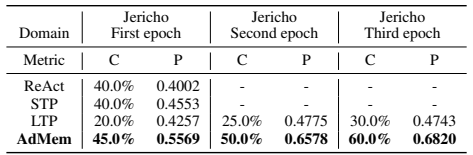
Table 3 : Component ablation on Jericho (20 tasks), Claude Haiku 4.5.STP: short-term planning and context management only, with all long-term recall removed.LTP: the long-term procedural store only — per-step retrieval with critic-generated reflections and the reward-based utility retained — with short-term planning and context management removed.AdMem: all components. STP and ReAct are single-epoch by construction, since neither carries anything across tasks. For LTP and AdMem the task set is streamed again each epoch without resetting the long-term store, so the epoch axis measures accumulation rather than repetition of a fixed store; entry utilities carry over with the store, so an entry that proved unhelpful in an earlier epoch enters the next one already down-weighted.
出典 · CC BY 4.0 · Runzhe Wang, Huilin Lu, Shengjie Liu, Li Dong, Zhihuai Zhu · AdMem: Expectation-Grounded Procedural Memory for Long-Horizon Task-Solving Agents · 論文の図を引用 · 元のPDFの7ページ目から図の部分を抽出しています。限界
実験は構成ごとに1回の実行と1つのバックボーンで行いました。メモリ構成は1本の連続したストリームなので、二項信頼区間が過小評価されるおそれがあります。著者らは、設計効果4.2では否定的な結果が、5.9ではPDDLの利得が有意性を失うと計算しました。20課題の3つのドメインは検定力が低いです。構成要素のアブレーション実験は1つのドメインでのみ行ったため、全体の利得のうちどの仕組みがどの程度寄与するかは明らかにできていません。敵対的評価は行っていません。
論文情報
- 著者
- Runzhe Wang, Huilin Lu, Shengjie Liu, Li Dong, Zhihuai Zhu
- 学会・ジャーナル
- arXiv · プレプリント
- 公開日
- 2026年11月16日
- 登録日
- 2026年11月17日
- 更新日
- 2026年11月16日
- バージョン
- v1
- arXiv
- 2611.20605
- カテゴリ
- cs.AI
- ライセンス
- CC BY 4.0
- 掲載内容
- 論文情報・解説・論文の図
この解説は、Refivuの韓国語解説をAIで翻訳したものです。不正確な翻訳や誤りが含まれる可能性があります。論文と図の利用条件は各出典に従います。
アブストラクト
An agent that carries memory across tasks is only as good as the entries it keeps. We begin from an observation that is easy to reproduce and uncomfortable for the field: naively accumulating cross-task experience can make an agent \emph{worse} than one with no memory at all. On AgentBoard, a workflow-induction memory solves fewer tasks than a memoryless ReAct agent in seven of eight domains, and a per-step procedural store with no surrounding structure loses half of ReAct's completions on Jericho. We argue that the missing ingredients are per-action credit assignment and an explicit life cycle for stored entries, and present AdMem, which supplies both. Before each action the actor commits to an expected outcome; a concurrently running critic scores the realized outcome against that expectation and writes a procedural entry carrying a binary reward and a reflection, so credit lands on the action that earned it and no environment reward is required. Each entry then carries a scalar utility, updated online under a noisy-OR reward model, that ranks retrieval jointly with context similarity and drives eviction and merging, giving the store a forgetting and consolidation policy instead of unbounded growth. Across 707 tasks in eight AgentBoard domains AdMem solves 441 against 388 for ReAct and 312 for the workflow-induction baseline --- a pooled gain significant under a two-sided Fisher exact test, concentrated in the domains that supply transferable cross-task structure. All memory stays human-readable text, which is what makes the failures above diagnosable --- and, as we discuss, also makes the store an auditable but attackable surface.
この論文を引用
Runzhe Wang, Huilin Lu, Shengjie Liu, Li Dong, Zhihuai Zhu (2026). AdMem: Expectation-Grounded Procedural Memory for Long-Horizon Task-Solving Agents. arXiv:2611.20605v1. https://arxiv.org/abs/2611.20605v1
BibTeX
@misc{wang2026admem,
  title = {{AdMem: Expectation-Grounded Procedural Memory for Long-Horizon Task-Solving Agents}},
  author = {Runzhe Wang and Huilin Lu and Shengjie Liu and Li Dong and Zhihuai Zhu},
  year = {2026},
  eprint = {2611.20605},
  archivePrefix = {arXiv},
  url = {https://arxiv.org/abs/2611.20605v1}
}