論文解説
Separating learning from search and feedback in budgeted inverse design of periodic unit cells
周期的単位セルの予算制約付き逆設計における学習の、探索およびフィードバックからの分離
- 課題 周期材料の設計では、学習予測器の寄与を探索手法やフィードバックの効果から切り分けることが難しいです。
- 手法 同じ探索ルールと呼び出し予算のもとで、応答表だけを学習ニューラルネットワークとカタログフィッティングの方法に入れ替えて比較しています。
- 結果 200個の確証目標では、学習表とカタログ表の成功率の差は検出されませんでした。補正された提案は、両方の表で成功を増やしました。
学習予測器の寄与を分離する方法
周期材料を設計するとき、エンジニアは繰り返し単位セルの形状と寸法を選び、目標の物性に合わせる必要があります。シミュレーションの呼び出し回数が少ない場合、学習済み予測器がもたらす利得と、探索がどの設計を試し、シミュレータのフィードバックをどう使うかによる効果が混ざります。この論文では、同じ探索ルールと同じ呼び出し予算のもとで予測表だけを学習ベースの方法とカタログフィッティングの方法の間で入れ替え、この二つの効果を分けようとしています。
応答表と残差補正による探索
各アーキテクチャについて、寸法ごとの予測物性を収めた応答表があります。学習ベースの表は3つの順伝播ニューラルネットワークの平均で、カタログフィッティングの表は保存された設計を区分線形または平面に当てはめたものです。最初のバッチでは、表上で予測誤差が最も小さい設計を選び、シミュレータで確認します。有効な観測が得られると、そのアーキテクチャの表に残差、つまり実際の応答と予測の差を加えて補正し、補正後の表から次の設計を選びます。この補正は、1つのアーキテクチャ内で観測された設計の周辺の表だけを変えるもので、学習モデル自体は再学習しません。

Table 1 :Discrete architectures and continuous parameter bounds. TPMS denotes triply periodic minimal surface
出典 · CC BY 4.0 · Shaoliang Yang, Jun Wang · Separating learning from search and feedback in budgeted inverse design of periodic unit cells · 論文の図を引用 · 元のPDFの3ページ目から図の部分を抽出しています。成功基準と確証比較の設計
設計誤差は3つの物性の対数比の絶対値の最大値で、1で上限を設けます。成功は、この値が2%の許容誤差 τ=log10(1.02) 以下のときです。評価の前に、目標数、シード、対照条件、決定ルールを分析計画として固定したと論文では述べられています。検証は同じ323ボクセルのシミュレータで行われるため、成功は実際の物性の正確さではなく、このモデルとの一致を意味します。

Table 2 :Target sets and their role in the evaluation
出典 · CC BY 4.0 · Shaoliang Yang, Jun Wang · Separating learning from search and feedback in budgeted inverse design of periodic unit cells · 論文の図を引用 · 元のPDFの4ページ目から図の部分を抽出しています。学習表はカタログ表を上回らなかった
200個の確証目標では、学習ベースの探索は2,000回の実行のうち1,687回成功し、カタログ表の探索は200個の目標のうち167個で成功しました。全体の成功率の差は0.0085で、区間は[−0.027, 0.045]となり0を含みます。ブレンド差も0.023で、区間に0が含まれるため、この確証比較では学習表の利得は検出されませんでした。一方、補正された提案を使うと、学習表の探索は補正されていない提案の1,330回より多い1,687回成功し、カタログ表でも同じ方向の改善が見られました。36個のテスト目標では、学習ベースの探索はパターン探索より平均設計誤差が低く、成功率の差は0.565でした。
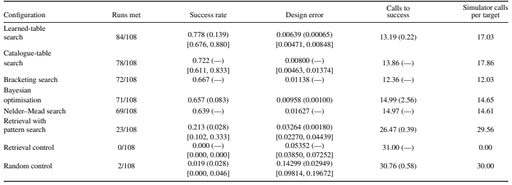
Table 4 :Test comparison over 36 targets × three seeds, with at most 30 simulator calls per target. Means are followed by seed ranges in parentheses. A dash denotes a deterministic configuration. Bracketed entries give 95% target-bootstrap intervals. Deterministic counts correspond to 26/36 catalogue-table, 24/36 bracketing, 23/36 Nelder–Mead and 0/36 retrieval targets. Boundary intervals carry no information about new targets. All configurations use zero language-model calls. Calls to success includes failures at 31. Per-system results are in the Supplementary Information
出典 · CC BY 4.0 · Shaoliang Yang, Jun Wang · Separating learning from search and feedback in budgeted inverse design of periodic unit cells · 論文の図を引用 · 元のPDFの15ページ目から図の部分を抽出しています。単一ライブラリと検証格子の限界
結果は1つのライブラリと粗い323ボクセルのシミュレータに限られ、目標と検証が同じ格子を使うため、他のシミュレータとの結果の一致は検証されていません。解像度を643に変えると、多くの設計の成功数が大きく減りましたが、収束したかどうかは確認していません。目標は同じ生成器から作られ、到達可能と仮定されていますが、補間された目標については到達可能性が確認されていません。また、保存された結果は物理的な物性の正確さを保証しません。
論文情報
- 著者
- Shaoliang Yang, Jun Wang
- 学会・ジャーナル
- arXiv · プレプリント
- 公開日
- 2026年11月16日
- 登録日
- 2026年11月17日
- 更新日
- 2026年11月16日
- バージョン
- v1
- arXiv
- 2611.20480
- カテゴリ
- cs.CE · cs.LG
- ライセンス
- CC BY 4.0
- 掲載内容
- 論文情報・解説・論文の図
この解説は、Refivuの韓国語解説をAIで翻訳したものです。不正確な翻訳や誤りが含まれる可能性があります。論文と図の利用条件は各出典に従います。
アブストラクト
To design a periodic material, engineers choose the shape and dimensions of a repeating cell to meet target properties. With few simulations, the benefit of a learned predictor can be hard to separate from the effect of which designs the search tries and how it uses simulator feedback. We compare two ways to predict properties in a library of 80 cell architectures, with up to 30 simulator calls per target. For each architecture, both searches use a table of predicted properties at different dimensions. One fills the table with predictions from neural networks. The other fits a simple model to the existing simulations for that architecture. Both searches use the difference between the predicted and simulated properties to adjust the next design. We generated 200 targets from simulated designs after fixing the analysis plan. The two searches showed no detectable difference in how often they matched all three properties within 2% or in the mean error of their returned designs. The upper limit of the 95% confidence interval for the gain in overall success rate was 4.5 percentage points. Follow-up controls on these targets changed success from 83.5% to 36.0% with a degraded table and 96.5% with an oracle table. In separate tests, using the simulation result to adjust the next design increased success for both types of table. Results cover one library and a coarse 32^3 voxel simulator. Designers can use this comparison to judge what a learned predictor adds when the search, feedback and budget are the same.
この論文を引用
Shaoliang Yang, Jun Wang (2026). Separating learning from search and feedback in budgeted inverse design of periodic unit cells. arXiv:2611.20480v1. https://arxiv.org/abs/2611.20480v1
BibTeX
@misc{yang2026separating,
  title = {{Separating learning from search and feedback in budgeted inverse design of periodic unit cells}},
  author = {Shaoliang Yang and Jun Wang},
  year = {2026},
  eprint = {2611.20480},
  archivePrefix = {arXiv},
  url = {https://arxiv.org/abs/2611.20480v1}
}