論文解説
Ontology-Compiled Control Barrier Functions for Heterogeneous Robot Teams
異種ロボットチーム向けOntology-Compiled Control Barrier Functions
- 課題 設計時に固定された安全フィルタは、新しいロボット種類、ペイロード、組み合わせが加わると失敗します。失敗の形は、制約の抜け落ち、制動能力の過大評価、制約同士の衝突です。
- 手法 ドメインオントロジーを記述論理で分類して活性安全制約を取り出し、それをエージェントごとのQPベースのCBFフィルタにコンパイルします。
- 結果 W1の未知ロボットシナリオでは、Naive能力割り当てがγ=10のときエピソードの44%で違反を示したのに対し、OntoCBFは同じ条件で21%でした。
異種ロボットチームで安全フィルタが失敗する理由
複数種類のロボットが人と空間を共有すると、各個体の安全要件は個体の種類や互いの関係によって変わります。既存のマルチエージェント安全フィルタは、設計時に知られているロボット種類に合わせて制約の組、最小距離、制動能力を固定します。そのため、新しいロボットモデルや新しいペイロード、新しい組み合わせが入ってくると、制約が抜け落ちたり、実際より大きい制動能力が使われたり、個別には満たせる制約同士が衝突したりします。この論文は、こうした3つの失敗をオントロジーで扱うことを目標としています。
オントロジーから障壁不等式までのコンパイル過程
OntoCBFは、OWL 2 DLオントロジーをHermiTで一度分類し、イベントが起きるたびに規則の飽和によって活性制約を計算します。各活性制約kは、対ごとの制動障壁 h_k = sqrt(2A_k(d−D_σ)) + n^T Δv で表され、これを n^T(ȧ_a − ȧ_b) に関する線形不等式に変換します。フィルタはエージェントごとに、入力集合の中から名目入力 u_nom に最も近い入力を選ぶQPを解きます。制動能力βは設計上の祖先から継承されますが、下位クラスが分類チェックを通過し、速度集合を含む動的サブタイプ条件を満たす場合にだけ継承されます。設計上の祖先と能力条件が合わないクラスは、自身の能力を受け取ります。
制動能力の継承と動的サブタイプ
Theorem 4は、下位クラスが上位クラスと同じ制約を継承し、動的サブタイプ関係が成り立つとき、上位の制動能力も継承できると述べています。ボックス制限付きの二重積分器では、下位クラスの最大加速度 ā_C′ が上位クラスの ā_C 以上であることが、動的サブタイプと同じ条件になります。この条件が成り立たないHeavyDroneが Drone の能力を借りると、障壁不等式が状態空間の一部で入力によって満たされないことがあります。このとき継承条件は、状態空間と入力集合が上記の仮定を満たす範囲でのみ成り立ちます。
対ごとの障壁の衝突不可避性
Proposition 7は、3台のロボットが1台に両側から近づく状況では、すべての対ごとの障壁が正になる状態が存在し、その状態ではどの入力を選んでも、2つの対のうち一方の距離がD未満に下がると示しています。この結果は、オントロジーとは無関係に対ごとの制動障壁の性質として説明され、制動能力をどのような固定比率で下げても、十分に大きいチームでは同じ問題が残ると論文は主張しています。一方、Proposition 6は、連続時間では安全違反が必ず個別QPの衝突の後に始まることを示しています。
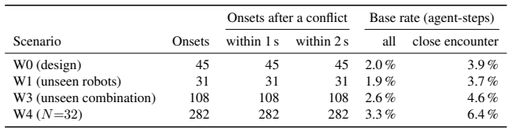
Table 10 : Violation onsets of OntoCBF with PD preceded by a conflict of an agent of the violated
出典 · CC BY 4.0 · Peng Wu, Seyede Fatemeh Ghoreishi, Nathan Bastian, Mohsen Imani, Tian Lan, Mahdi Imani · Ontology-Compiled Control Barrier Functions for Heterogeneous Robot Teams · 論文の図を引用 · 元のPDFの27ページ目から図の部分を抽出しています。未知クラスのウェアハウス実験
実験は12×12mのウェアハウスタイルで、W0からW4までの5つのシナリオで行いました。W0は設計チームで、W1はLightDroneとHeavyDroneを入れ、Forkliftを追加した未知ロボットのシナリオです。各シナリオでは100個のシードを使ってエピソードを評価し、基本制御器はPD制御器です。結果表では、OntoCBFの違反エピソード比率がW0で22%、W1で20%、W4で70%でした。Flatベースラインは W1 で89%でした。W1 では、Naive能力割り当てがγ=1のとき266個の単一制約失敗を、γ=10のときはエピソードの44%で違反を示しました。OntoCBFは同じγ=10で21%を記録しました。

Table 2 : Episodes with a violation (left, 100 % for None everywhere) and single-constraint failures
出典 · CC BY 4.0 · Peng Wu, Seyede Fatemeh Ghoreishi, Nathan Bastian, Mohsen Imani, Tian Lan, Mahdi Imani · Ontology-Compiled Control Barrier Functions for Heterogeneous Robot Teams · 論文の図を引用 · 元のPDFの9ページ目から図の部分を抽出しています。
Table 5 : Episodes with a violation (%) in the warehouse with 95 % Wilson intervals, PD controller,
出典 · CC BY 4.0 · Peng Wu, Seyede Fatemeh Ghoreishi, Nathan Bastian, Mohsen Imani, Tian Lan, Mahdi Imani · Ontology-Compiled Control Barrier Functions for Heterogeneous Robot Teams · 論文の図を引用 · 元のPDFの24ページ目から図の部分を抽出しています。フィルタを組み込んだMAPPOの学習結果
MAPPOの方策は、フィルタを学習ループの中に置き、設計シナリオW0でだけ学習しました。フィルタは方策の出力を名目入力として受け取り、QPで安全入力を計算します。実行不能なQPには罰則を与えます。学習済みの方策をフィルタの後ろに置くと、実行不能QPの比率はシナリオによって18–41%低下し、違反エピソードの比率も20–70%から11–65%に下がりました。この低下は学習シナリオの外でも見られましたが、改善の幅と統計的有意性はシナリオと実行によって異なります。この学習方策の効果はフィルタがある状態での測定であり、フィルタなしで実行すると、すべてのエピソードで違反が現れます。
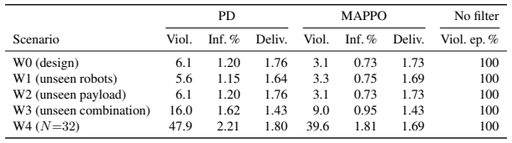
Table 13 : MAPPO minus PD behind OntoCBF for each training run (W2 equals W0), with paired
出典 · CC BY 4.0 · Peng Wu, Seyede Fatemeh Ghoreishi, Nathan Bastian, Mohsen Imani, Tian Lan, Mahdi Imani · Ontology-Compiled Control Barrier Functions for Heterogeneous Robot Teams · 論文の図を引用 · 元のPDFの28ページ目から図の部分を抽出しています。保証の条件と残された前提
論文は、保証が正確なクラスラベルと測定された動力学プロファイルに依存すると明示しています。各個体は自分に含意されるクラスの公理だけを受け取るため、ラベルが間違っていると必要な制約が抜け落ちることがあります。また、定理は連続時間でボックス入力の二重積分器と人間の加速度上限を仮定しており、非線形クラスと検証済み証明書は今後の課題として残されています。状態空間が異なるロボットに拡張するには、追加の条件が必要です。
論文情報
- 著者
- Peng Wu, Seyede Fatemeh Ghoreishi, Nathan Bastian, Mohsen Imani, Tian Lan, Mahdi Imani
- 学会・ジャーナル
- arXiv · プレプリント
- 公開日
- 2026年11月15日
- 登録日
- 2026年11月17日
- 更新日
- 2026年11月15日
- バージョン
- v1
- arXiv
- 2611.20306
- カテゴリ
- cs.RO · cs.LG
- ライセンス
- CC BY 4.0
- 掲載内容
- 論文情報・解説・論文の図
この解説は、Refivuの韓国語解説をAIで翻訳したものです。不正確な翻訳や誤りが含まれる可能性があります。論文と図の利用条件は各出典に従います。
アブストラクト
Safety filters for heterogeneous robot teams fail because of missing constraints, overestimated braking capabilities and conflicts between individually satisfiable constraints. We present OntoCBF, which compiles a domain ontology with a class taxonomy, typed relations, safety axioms and a dynamics profile per robot class into a control barrier function filter with one quadratic program per agent. Description-logic entailment supplies the constraints of any team online, including those that follow from chains of relations and from classes defined by what a robot carries, so the existing safety axioms cover new robot classes, payload classes and combinations. We prove that a subclass may reuse the braking capability of its parent whenever it can produce every velocity of the parent, a property separate from subsumption. For box-bounded double integrators this property is also necessary, and every loss of safety then begins with a conflict. Once three robots interact, the safe set of pairwise barriers contains states from which a collision is unavoidable, and such states persist in larger teams under any fixed capability reduction. In a simulated warehouse where humans ignore the robots, a filter written for the design classes violates safety in 89-100 % of the episodes with unseen classes. In all scenarios, including one with 32 robots, OntoCBF violates safety in 20-70 % of the episodes, each time after a conflict, with a median deepest intrusion of 10-17 % of the keep-out distance. A multi-agent PPO policy trained with the filter in the loop lowers the rate of infeasible quadratic programs, nearly all of them conflicts, by 18-41 %.
この論文を引用
Peng Wu, Seyede Fatemeh Ghoreishi, Nathan Bastian, Mohsen Imani, Tian Lan, Mahdi Imani (2026). Ontology-Compiled Control Barrier Functions for Heterogeneous Robot Teams. arXiv:2611.20306v1. https://arxiv.org/abs/2611.20306v1
BibTeX
@misc{wu2026ontology,
  title = {{Ontology-Compiled Control Barrier Functions for Heterogeneous Robot Teams}},
  author = {Peng Wu and Seyede Fatemeh Ghoreishi and Nathan Bastian and Mohsen Imani and Tian Lan and Mahdi Imani},
  year = {2026},
  eprint = {2611.20306},
  archivePrefix = {arXiv},
  url = {https://arxiv.org/abs/2611.20306v1}
}