論文解説
DETER: Suppression During Pretraining for Tamper Resistance
DETER:事前学習中の抑制による改ざん耐性
- 課題 公開モデルでは、事前学習のフィルタリングや事後アンラーニングを行っても、微調整後に目的の知識が復元されやすいです。
- 手法 事前学習中に、フィルタリング済みのコーパスへ、対象ドメインの文書に対するgradient ascentによる抑制更新を定期的に挿入します。
- 結果 1030Mの設定では、DETERはFILTERINGと比べてPubMedの微調整トークンを20.36倍必要としたと記録されています。
公開モデルで知識の抑制が難しい理由
公開重みのモデルは、重みを受け取った誰もが微調整できるため、事後に特定の知識を消すアンラーニングは簡単に元に戻される可能性があります。この論文では、対象ドメインとして医学知識を用い、事前学習の段階でその知識を得にくくする方法を扱います。既存のフィルタリングは、対象ドメインの文書を事前学習コーパスから取り除きますが、最終モデルがその知識を得るかどうかは間接的にしか制御できません。そのため、フィルタリングだけでは対象の知識を完全には遮断できないという限界が残ります。
事前学習中の抑制更新の仕組み
フィルタリング済みのコーパスD_ρで標準的な事前学習を行いながら、開始ステップt_start以降、Pステップごとに、対象ドメインの文書集合D_Fから抑制更新をS回実行します。抑制の目的関数L_Fは、基本的にはD_Fの負の次トークン損失、すなわちgradient ascentです。抑制更新は、学習率に抑制強度cを掛けた値で同じパラメータを更新します。事前学習と抑制は、オプティマイザの統計量をそれぞれ別に保持します。
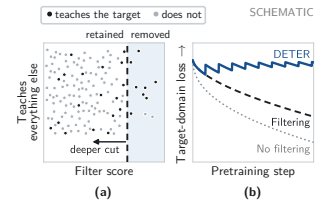
Figure 1 :Conceptual overview.(a) Filtering de- cides before pretraining: its selection still contains data that teach thetarget domainalong withre- tain capabilities, and a deeper cut removes more of both. (b) Adding periodic suppression provides a second layer of defense against target-domain learning.
出典 · CC BY 4.0 · Maria Ios Glarou, Martin Jaggi · DETER: Suppression During Pretraining for Tamper Resistance · 論文の図を引用 · 元のPDFの2ページ目から図の部分を抽出しています。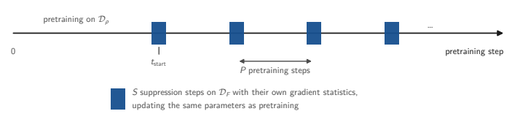
Figure 8 : Schedule of suppression steps during pretraining.
出典 · CC BY 4.0 · Maria Ios Glarou, Martin Jaggi · DETER: Suppression During Pretraining for Tamper Resistance · 論文の図を引用 · 元のPDFの14ページ目から図の部分を抽出しています。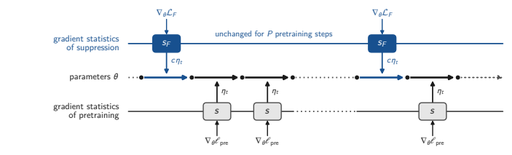
Figure 9 : Optimization states of pretrainer (learner) and suppressor (unlearner) throughout pretraining with interleaved suppression.
出典 · CC BY 4.0 · Maria Ios Glarou, Martin Jaggi · DETER: Suppression During Pretraining for Tamper Resistance · 論文の図を引用 · 元のPDFの15ページ目から図の部分を抽出しています。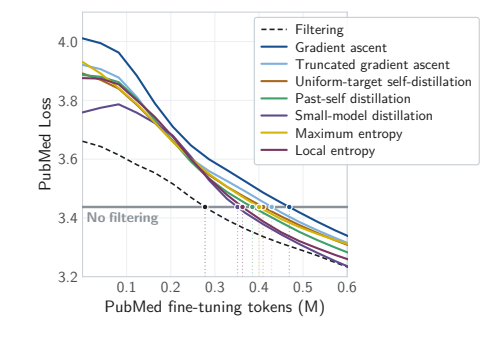
Figure 10 :Gradient ascent slows fine-tuning on PubMed the most among the suppression objectives.We fine-tune each 113MAdamWmodel on PubMed and report held-out PubMed loss. The horizontal line marks the PubMed loss of NO FILTERING. Results are for one fine-tuning seed.
出典 · CC BY 4.0 · Maria Ios Glarou, Martin Jaggi · DETER: Suppression During Pretraining for Tamper Resistance · 論文の図を引用 · 元のPDFの17ページ目から図の部分を抽出しています。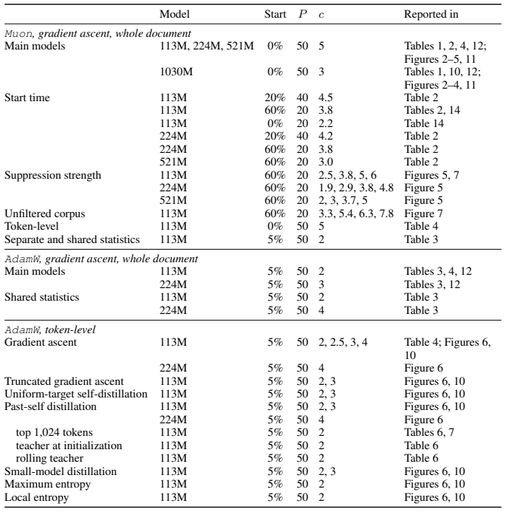
Table 8 : Suppression hyperparameters.
出典 · CC BY 4.0 · Maria Ios Glarou, Martin Jaggi · DETER: Suppression During Pretraining for Tamper Resistance · 論文の図を引用 · 元のPDFの18ページ目から図の部分を抽出しています。FILTERINGと事後アンラーニングとの比較
113M、224M、521M、1030Mのモデルを最初から事前学習し、最終チェックポイントをPubMedで微調整して、NO FILTERINGのPubMed損失に到達するのに必要なトークン数を測定しました。比較対象は、FILTERING、TOKEN FILTERING、FILTERINGの後に適用したRMUです。この測定では、DETERはすべてのモデルサイズで、FILTERINGより多くの微調整トークンを必要としました。
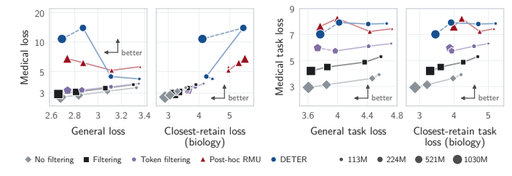
Figure 2 :At larger scale, suppression separates medicine more strongly from retained capabilities.Each panel plots medical loss against retained loss before fine-tuning. The first two panels report corpus loss and the last two task loss. For corpus loss, medical, general, and closest-retain (biology) correspond to PubMed, retained FineWeb-Edu, and bioRxiv; for task loss, they correspond to the medical benchmarks, MMLU STEM and non-STEM, and MMLU biology. Larger markers denote larger models. Upward means stronger sup- pression of medicine; leftward means better preservation of retained capabilities. DETERdenotes suppression during pretraining. Dashed segments mark the 1030M settings (c= 3; 20% token filtering).
出典 · CC BY 4.0 · Maria Ios Glarou, Martin Jaggi · DETER: Suppression During Pretraining for Tamper Resistance · 論文の図を引用 · 元のPDFの4ページ目から図の部分を抽出しています。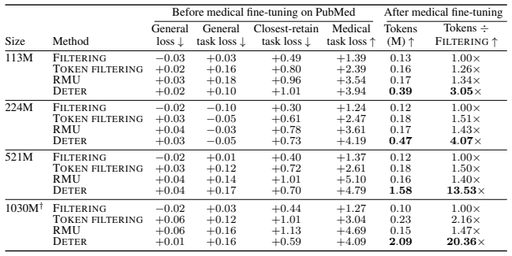
Table 1 :Suppression during pretraining requires substantially more target-domain fine-tuning than fil- tering, token filtering or post-hoc RMU, with little change in general loss.General loss is measured on held-out retained FineWeb-Edu; medical task loss is averaged over MedQuAD, MedMCQA, MedQA-USMLE, and MMLU medicine; general task loss is measured on MMLU STEM and non-STEM; and closest-retain task loss on MMLU biology. All are reported relative to NO FILTERING. The last two columns give the number of PubMed fine-tuning tokens needed to reach the PubMed loss of NO FILTERING, and this number normalized by the corresponding value for FILTERINGat the same model size. Results are averaged over three fine-tuning seeds. DETERdenotes suppression during pretraining. †1030M settings:c= 3; 20% token filtering.
出典 · CC BY 4.0 · Maria Ios Glarou, Martin Jaggi · DETER: Suppression During Pretraining for Tamper Resistance · 論文の図を引用 · 元のPDFの5ページ目から図の部分を抽出しています。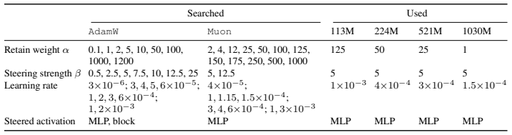
Table 9 : RMU hyperparameters.
出典 · CC BY 4.0 · Maria Ios Glarou, Martin Jaggi · DETER: Suppression During Pretraining for Tamper Resistance · 論文の図を引用 · 元のPDFの20ページ目から図の部分を抽出しています。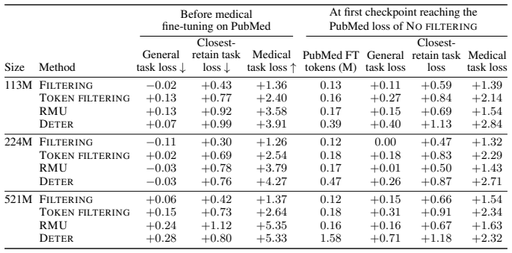
Table 13 :Task losses before fine-tuning and when each method first reaches the PubMed loss of NO FILTERING.We fine-tune each model on PubMed until its held-out PubMed loss first reaches that of NO FILTERING, and report task loss at the final pretraining checkpoint (before) and at that checkpoint (after). All methods in the right block are therefore evaluated at the same PubMed loss, but reach it after different amounts of fine-tuning, reported as PubMed fine-tuning tokens.The right block is not a matched-compute comparison:each method is evaluated at its own checkpoint where PubMed loss first reaches that of NO FILTERING. Figure 12 instead compares task loss after equal amounts of PubMed fine-tuning at 521M. Medical task loss is averaged over MedQuAD, MedMCQA, MedQA-USMLE, and MMLU medicine; general task loss is measured on MMLU STEM and non-STEM; and closest-retain task loss on MMLU biology. All task losses are reported relative to the final checkpoint of NO FILTERING. Results are averaged over three fine-tuning seeds. DETERdenotes suppression during pretraining.
出典 · CC BY 4.0 · Maria Ios Glarou, Martin Jaggi · DETER: Suppression During Pretraining for Tamper Resistance · 論文の図を引用 · 元のPDFの24ページ目から図の部分を抽出しています。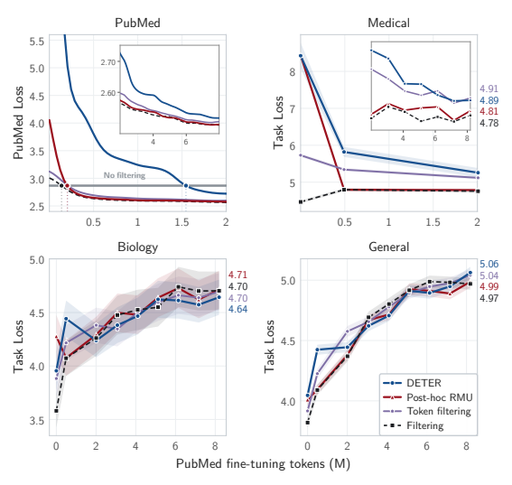
Figure 12 :At 521M, post-hoc RMU returns to the medical task loss of FILTERINGearly in PubMed fine-tuning, while suppression during pretraining keeps medical task loss higher for longer.We fine-tune each model on PubMed and report held-out PubMed loss and task loss on the medical benchmarks (MedQuAD, MedMCQA, MedQA-USMLE, and MMLU medicine), MMLU biology, and MMLU STEM and non-STEM (general). The horizontal line marks the PubMed loss of NO FILTERING. Numbers at the right give the task loss at the end of fine-tuning. Results are for one fine-tuning seed; shaded bands are 95% bootstrap intervals over benchmark items. DETERdenotes suppression during pretraining.
出典 · CC BY 4.0 · Maria Ios Glarou, Martin Jaggi · DETER: Suppression During Pretraining for Tamper Resistance · 論文の図を引用 · 元のPDFの25ページ目から図の部分を抽出しています。代理ドメインと適用範囲の限界
そのため、危険な能力、他のドメイン、より大きなモデルへの一般化は確認していません。対象ドメイン集合D_Fは、分類器スコアで上位5%のトークンとして定義しました。分類器の誤りと抑制集合の構成に対する感度は、体系的には検証していません。微調整攻撃も、単一シードのモデルでPubMed損失のみを用いて測定しました。
論文情報
- 著者
- Maria Ios Glarou, Martin Jaggi
- 学会・ジャーナル
- arXiv · プレプリント
- 公開日
- 2026年11月11日
- 登録日
- 2026年11月13日
- 更新日
- 2026年11月11日
- バージョン
- v1
- arXiv
- 2611.15479
- カテゴリ
- cs.LG
- ライセンス
- CC BY 4.0
- 掲載内容
- 論文情報・解説・論文の図
この解説は、Refivuの韓国語解説をAIで翻訳したものです。不正確な翻訳や誤りが含まれる可能性があります。論文と図の利用条件は各出典に従います。
アブストラクト
Open-weight language models can acquire knowledge that could enable biological, chemical, or cyber misuse. Any attempt to limit such knowledge must remain effective after the model weights are released and can be fine-tuned. Unlearning applied after pretraining can be rapidly undone, whereas filtering the pretraining corpus offers greater resistance. We ask whether actively suppressing knowledge during pretraining can further increase the fine-tuning required to acquire it. Even simple gradient ascent interleaved with standard pretraining on the filtered corpus makes medical knowledge harder to acquire through adversarial fine-tuning than filtering alone or post-hoc unlearning. At 1B parameters, reaching the held-out PubMed loss of an unfiltered model requires over 20$\times$ as many PubMed fine-tuning tokens as after filtering alone. Retained knowledge is evaluated using both held-out data and downstream tasks. Across model sizes, varying suppression strength reveals an increasingly favorable trade-off between fine-tuning difficulty and held-out loss on retained pretraining data. These results point to pretraining as an effective stage for making unwanted capabilities harder to acquire through subsequent fine-tuning. Code is available at \href{https://github.com/MEGlr/DETER}{\texttt{github.com/MEGlr/DETER}}.
この論文を引用
Maria Ios Glarou, Martin Jaggi (2026). DETER: Suppression During Pretraining for Tamper Resistance. arXiv:2611.15479v1. https://arxiv.org/abs/2611.15479v1
BibTeX
@misc{glarou2026deter,
  title = {{DETER: Suppression During Pretraining for Tamper Resistance}},
  author = {Maria Ios Glarou and Martin Jaggi},
  year = {2026},
  eprint = {2611.15479},
  archivePrefix = {arXiv},
  url = {https://arxiv.org/abs/2611.15479v1}
}