論文解説
Calibration and Conformal Prediction for Medical Question Answering in Arabic and English: Evidence from Two Non-Parallel Benchmarks
アラビア語と英語の医療質問応答における較正とconformal prediction:二つの非並列ベンチマークからの根拠
- 課題 正答率だけでは、LLMの確信が信頼できるかどうかを判断しにくいです。
- 手法 選択肢の確率を温度較正し、分割コンフォーマル予測と選択的予測によって、較正と不確実性を測定しました。
- 結果 Qwen2.5-7B-Instructは英語で正答率0.561を記録し、温度較正後のECEは0.035から0.068の間に下がりました。
正答率だけでは不十分な理由
医学の選択式問題では、LLMの正答率が高く見えても、モデルがどの答えをどの程度確信しているかは正答率だけでは分かりにくいです。正解することが多くても、誤った答えにほぼ確信を置くモデルは、利用者が責任をもって使うのが難しいです。この研究は、英語のMedMCQAとアラビア語のMedAraBenchの二つのベンチマークで、Qwen2.5-7B-InstructとJais-adapted-7B-chatの較正(calibration)と不確実性を測定します。著者らが検索した範囲では、アラビア語の医学問題に対して較正とコンフォーマル予測を併せて扱った事例は少ないと述べられています。
選択肢確率と温度較正
各質問は一回の順伝播だけで処理しました。モデルが選択肢の文字トークンに与えた次のトークンの対数確率を読み取り、有効な選択肢に限定したsoftmaxで選択肢確率ベクトルを作りました。予測の答えは最も確率の高い選択肢で、信頼度はその確率です。Jaisではアラビア文字の選択肢文字が多く出力されるため、ラテン文字の確率に対応するアラビア文字の確率を足すunion scoringを使いました。温度較正は、選択肢の対数スコアを単一の温度Tで割り、較正用の集合で負の対数尤度を最小化してTを決める方法です。較正誤差は15個の等間隔の区間によるECEで測定しました。
較正の結果
Qwen2.5-7B-Instructは英語で正答率0.561、アラビア語で0.430を記録しました。Jais-adapted-7B-chatは英語0.369、アラビア語0.308でした。生の確率は4つの設定すべてで過信しており、生のECEは0.242から0.486の間でした。温度較正後にはECEが0.035から0.068の間に下がり、較正誤差の82%から93%が取り除かれました。ただし、Jaisの確率の多くは基本確率の近くに集中しているため、ECEが小さくなっても判別力(AUROC 0.579から0.600)は高くありませんでした。
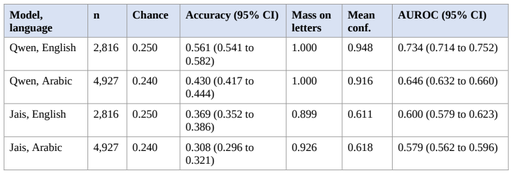
Table 2 . Accuracy, format compliance, mean confidence and AUROC of the top-two margin for correctness.
出典 · CC BY 4.0 · Mariya · Calibration and Conformal Prediction for Medical Question Answering in Arabic and English: Evidence from Two Non-Parallel Benchmarks · 論文の図を引用 · 元のPDFの6ページ目から図の部分を抽出しています。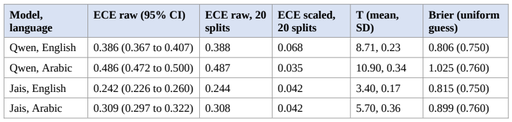
Table 3 . Calibration before and after temperature scaling. The 20-split columns use the same random splits, so raw and scaled values are directly comparable.
出典 · CC BY 4.0 · Mariya · Calibration and Conformal Prediction for Medical Question Answering in Arabic and English: Evidence from Two Non-Parallel Benchmarks · 論文の図を引用 · 元のPDFの6ページ目から図の部分を抽出しています。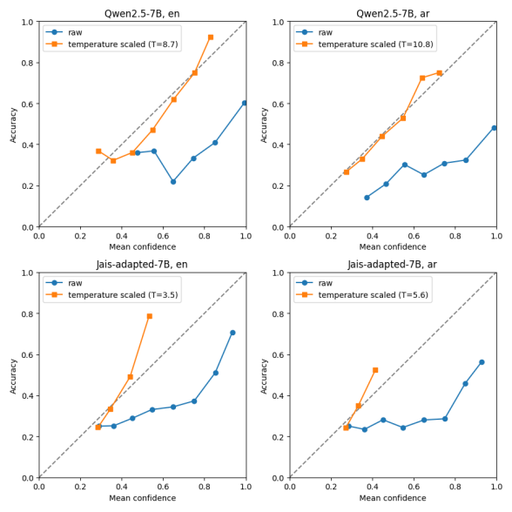
Figure 1 . Reliability diagrams, raw and temperature scaled, for each model and language (one random 50/50 split; the temperatures in the legends come from that split and differ slightly from the 20-split means in Table 3). Questions per bin for the scaled curves are given in Table B1.
出典 · CC BY 4.0 · Mariya · Calibration and Conformal Prediction for Medical Question Answering in Arabic and English: Evidence from Two Non-Parallel Benchmarks · 論文の図を引用 · 元のPDFの7ページ目から図の部分を抽出しています。分割コンフォーマル予測と集合サイズ
分割コンフォーマル予測は、較正用の質問の非適合スコアの分位点を閾値とし、正解を含む確率が目標値以上となる予測集合を作ります。24個の設定すべてで、経験的カバレッジは目標から0.006以内でした。この保証は交換可能性の仮定の下での周辺的な保証であり、トピックや集合サイズごとに成り立つという意味ではありません。正答率が低いほど集合は大きくなり、情報量は下がりました。
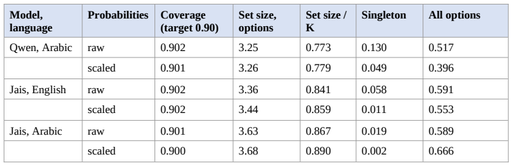
Table 4 . Split conformal prediction at alpha = 0.10, averaged over 100 random splits. Singleton and all-options columns are shares of test questions. Results for alpha = 0.05 and 0.20 are in Appendix A (Tables A1 and A2).
出典 · CC BY 4.0 · Mariya · Calibration and Conformal Prediction for Medical Question Answering in Arabic and English: Evidence from Two Non-Parallel Benchmarks · 論文の図を引用 · 元のPDFの8ページ目から図の部分を抽出しています。選択的予測の効果と偏り
選択的予測では、上位2つの選択肢の対数スコアの差で質問を順位付けし、最も確信している割合cだけに答えたときの誤り率とAURCを測定しました。Qwenは英語で最も確信している20%だけに答えたところ、誤り率が0.439から0.098に下がりました。Jaisでは効果が小さかったです。同じ実験で、Jaisは選択肢Cを強く選好しており、英語の予測の49.0%、アラビア語の予測の59.6%をCと答えました。Latin-only scoringはアラビア語でCの割合を28.5%まで下げましたが、正答率、生のECE、AUROCはほとんど変わりませんでした。
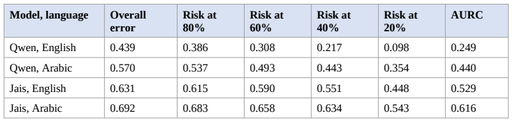
Table 5 . Risk (error rate on answered questions) when answering the most confident 80%, 60%, 40% and 20% of questions, ranked by the top-two margin.
出典 · CC BY 4.0 · Mariya · Calibration and Conformal Prediction for Medical Question Answering in Arabic and English: Evidence from Two Non-Parallel Benchmarks · 論文の図を引用 · 元のPDFの8ページ目から図の部分を抽出しています。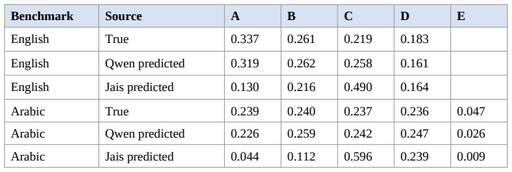
Table 6 . True and predicted answer-letter shares on the full runs (option E exists only for the 5- and 6-option Arabic questions).
出典 · CC BY 4.0 · Mariya · Calibration and Conformal Prediction for Medical Question Answering in Arabic and English: Evidence from Two Non-Parallel Benchmarks · 論文の図を引用 · 元のPDFの9ページ目から図の部分を抽出しています。言語比較の限界
英語とアラビア語のベンチマークは並列の翻訳ではないため、主題、難易度、選択肢数が異なります。そのため、言語の違いはデータセットの違いと混ざっており、著者らは言語そのものの効果とは解釈していません。評価したのは2つのモデル、4ビットの設定が一つ、プロンプトが一つだけで、実験条件は結果ごとに異なる形で適用しました。臨床検証や臨床の意思決定支援を主張するものではありません。
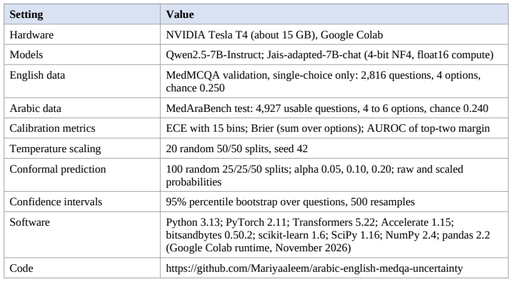
Table 1 . Experimental settings.
出典 · CC BY 4.0 · Mariya · Calibration and Conformal Prediction for Medical Question Answering in Arabic and English: Evidence from Two Non-Parallel Benchmarks · 論文の図を引用 · 元のPDFの5ページ目から図の部分を抽出しています。論文情報
- 著者
- Mariya
- 学会・ジャーナル
- arXiv · プレプリント
- 公開日
- 2026年11月12日
- 登録日
- 2026年11月13日
- 更新日
- 2026年11月12日
- バージョン
- v1
- arXiv
- 2611.16821
- カテゴリ
- cs.LG
- ライセンス
- CC BY 4.0
- 掲載内容
- 論文情報・解説・論文の図
この解説は、Refivuの韓国語解説をAIで翻訳したものです。不正確な翻訳や誤りが含まれる可能性があります。論文と図の利用条件は各出典に従います。
アブストラクト
Large language models (LLMs) are increasingly tested on medical exam questions, but accuracy alone does not show when an answer can be trusted. I study the calibration and uncertainty of two open-weight models, Qwen2.5-7B-Instruct and Jais-adapted-7B-chat (both run in 4-bit precision), on 2,816 English multiple-choice questions from MedMCQA and 4,927 Arabic multiple-choice questions from MedAraBench. Accuracy was 0.561 (English) and 0.430 (Arabic) for Qwen, and 0.369 and 0.308 for Jais. Raw option probabilities were overconfident in all four settings (expected calibration error 0.242 to 0.486), and a single temperature parameter removed 82% to 93% of that error. Split conformal prediction reached its nominal coverage in all 24 settings I tested (within 0.006), but the sets were large when accuracy was low: at 90% coverage, temperature-scaled sets contained on average 63% (Qwen, English), 78% (Qwen, Arabic), 86% (Jais, English) and 89% (Jais, Arabic) of the options. The margin between the top two option probabilities separated correct from incorrect answers best for Qwen on English (AUROC 0.734) and worst for Jais on Arabic (0.579). Answering only the 20% most confident questions lowered Qwen's English error from 0.439 to 0.098. Jais showed a strong prior for option C (49% of English and 60% of Arabic predictions). Scoring Latin letters only cut the Arabic share to 29% but left accuracy, raw ECE and AUROC nearly unchanged. Because the two benchmarks differ in subject, level and number of options, I do not attribute differences between languages to language itself. Code is available at https://github.com/Mariyaaleem/arabic-english-medqa-uncertainty.
この論文を引用
Mariya (2026). Calibration and Conformal Prediction for Medical Question Answering in Arabic and English: Evidence from Two Non-Parallel Benchmarks. arXiv:2611.16821v1. https://arxiv.org/abs/2611.16821v1
BibTeX
@misc{mariya2026calibration,
  title = {{Calibration and Conformal Prediction for Medical Question Answering in Arabic and English: Evidence from Two Non-Parallel Benchmarks}},
  author = {Mariya},
  year = {2026},
  eprint = {2611.16821},
  archivePrefix = {arXiv},
  url = {https://arxiv.org/abs/2611.16821v1}
}