論文解説
Shortcuts or Memorisation? Revisiting Data Corruption in Natural Language Understanding with Large Language Models
近道か、暗記か:大規模言語モデルを用いた自然言語理解におけるデータ汚染の再検討
- 課題 LLMの性能が、ベンチマークの入力を崩しても保たれる理由が暗記によるものか、データセットの手がかりによるものかを見極める必要があります。
- 手法 入力の名詞や動詞だけを残すなどの変形を加え、above-chance維持率で性能の変化を測定します。
- 結果 MNLIでは名詞を除いた後も36–72%、ANLIでは14–29%の性能が維持され、新しい項目ではMNLI形式の項目の維持率が高くなりました。
ベンチマーク点数が意味する理解
ベンチマークの点数は言語理解能力の主な根拠として使われていますが、モデルが課題を意図どおりに解いているかは保証されません。この論文では、入力から人が必要とする単語を取り除いたり語順を混ぜたりした後も、モデルが正解を当てるかを調べます。こうすると、性能が維持される理由が事前学習中の暗記によるものか、データセットに残った表面的な手がかりによるものかを区別できます。著者らは、この問いを大規模言語モデルと、ファインチューニングしたエンコーダの両方で検証しています。
摂動と維持率の測定
摂動は各テキストフィールドに適用されます。drop-NOUNは名詞クラスのすべての単語を削除し、keep-NOUN+VERBは名詞と動詞だけを残して機能語も一緒に取り除きます。shuffle-nkはフィールドを連続するk-gramに分割したうえで、その順序を混ぜます。性能は、above-chance維持率R = 100·(s_pert − c)/(s_clean − c)で計算します。cはラベル数に応じたchance accuracyです。オープンウェイトLLMでは、回答のスコアを使うcentred accuracyでRを求めます。このとき、摂動ごとに各回答の平均スコアを引き、固定された回答バイアスを抑えます。
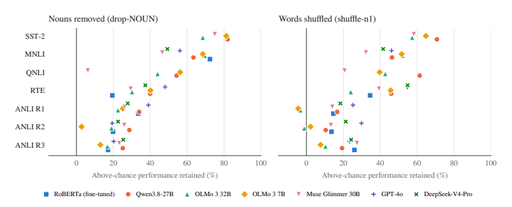
Figure 1 : Share of performance above chance maintained after noun removal (left) and word shuffling (right). Open-weight LLMs are scored zero-shot by centred accuracy, and RoBERTa is scored by accuracy (RoBERTa-large for ANLI, not run with shuffling). Values less than 0 indicate performance below chance.
出典 · CC BY 4.0 · Aarne Talman, Stergios Chatzikyriakidis · Shortcuts or Memorisation? Revisiting Data Corruption in Natural Language Understanding with Large Language Models · 論文の図を引用 · 元のPDFの5ページ目から図の部分を抽出しています。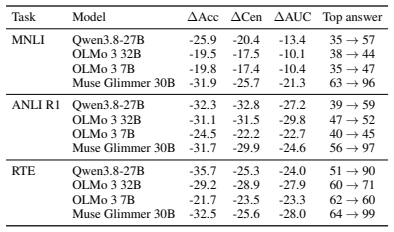
Table 6 : Change (points) under drop-NOUN in raw accu- racy, centred accuracy and AUC, and the share of items (%) given the most frequent answer, clean → perturbed. Zero-shot open LLMs.
出典 · CC BY 4.0 · Aarne Talman, Stergios Chatzikyriakidis · Shortcuts or Memorisation? Revisiting Data Corruption in Natural Language Understanding with Large Language Models · 論文の図を引用 · 元のPDFの13ページ目から図の部分を抽出しています。MNLIとANLIにおける名詞除去の比較
直接回答するシステムは、名詞を取り除いたときもMNLIで36–72%、ANLIで14–29%のabove-chance性能を維持しました。ファインチューニングしたRoBERTaも、MNLIで72%、ANLIで24%を記録しました。推論後に答えるGrok 4.7だけは、このパターンに従いませんでした。そのため著者らは、差はモデルではなくデータセットに由来すると考えています。
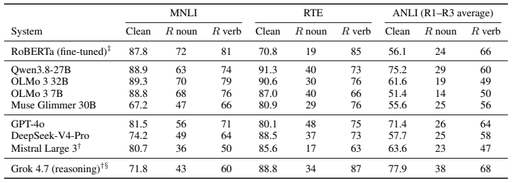
Table 1 : Clean accuracy (%) and share of performance above chance (R, %) maintained under the drop-NOUN and drop-VERB conditions. R is calculated from centred accuracy for open-weight LLMs and from accuracy for others (Section 3.4). ‡For MNLI and RTE, the RoBERTa-base model fine-tuned on clean data is used, and for ANLI, the public RoBERTa-large model from Nie et al. (2020) is used.†Answer scores are unavailable, and MNLI is evaluated on a 2,000-item sample. §Reasoning model, first 400 items per task.
出典 · CC BY 4.0 · Aarne Talman, Stergios Chatzikyriakidis · Shortcuts or Memorisation? Revisiting Data Corruption in Natural Language Understanding with Large Language Models · 論文の図を引用 · 元のPDFの5ページ目から図の部分を抽出しています。汚染指標とhypothesis-only手がかり
汚染の指標として、マスク単語の復元、Min-K%++、infini-gram重複を調べました。ANLIの前提はOLMo 2の事前学習データで72%と71%が見つかりましたが、MNLIの前提は21%しか見つかりませんでした。ただし、汚染指標と維持率の間に関連は見られませんでした。hypothesis-only分類器で分けた易しい項目は、名詞を取り除いたとき、Qwen3.8-27BとOLMo 3では難しい項目より下がり幅が小さくなりました。一方、keep-NOUN+VERBではその方向が逆になりました。これは手がかりが機能語にあるという解釈と整合します。
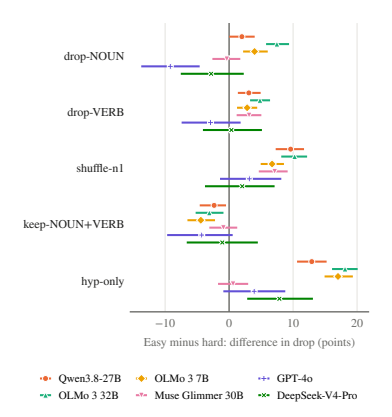
Figure 2 : MNLI degradation for items correctly classi- fied by the hypothesis-only classifier (easy items) minus the degradation for the remaining items (hard items), expressed as centred accuracy points with 95% boot- strap intervals. Positive values indicate less degradation for easy items. GPT-4o and DeepSeek-V4-Pro were evaluated on a sample of 2,000 items.
出典 · CC BY 4.0 · Aarne Talman, Stergios Chatzikyriakidis · Shortcuts or Memorisation? Revisiting Data Corruption in Natural Language Understanding with Large Language Models · 論文の図を引用 · 元のPDFの6ページ目から図の部分を抽出しています。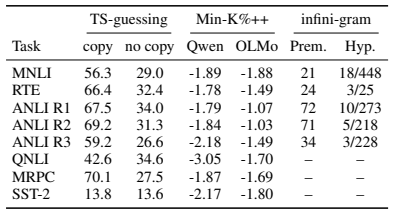
Table 9 : Contamination indicators. TS-guessing: exact- match rate (%) of Qwen3.8-27B filling in a masked word, when the word may also occur in the other field (copy) and when it may not. Min-K%++: mean score (higher suggests seen). infini-gram: premises (or first sentences) found in OLMo’s pre-training data (%), and hypotheses of at least 13 words found / all such hypothe- ses.
出典 · CC BY 4.0 · Aarne Talman, Stergios Chatzikyriakidis · Shortcuts or Memorisation? Revisiting Data Corruption in Natural Language Understanding with Large Language Models · 論文の図を引用 · 元のPDFの15ページ目から図の部分を抽出しています。新しい項目で見た手がかりのパターン
名詞と動詞だけを残した条件では、順序が入れ替わりました。この結果は、新しい項目を2つの方式で作成し、複数の人がラベルを検証した設定で得られたものです。
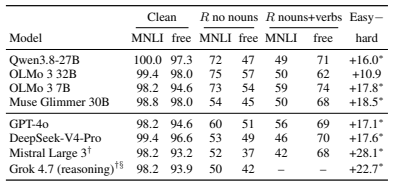
Table 2 : New items written in MNLI style or with- out cues (168 and 148 items): clean accuracy (%, cen- tred where answer scores exist), retention rate of per- formance above chance (R, %) under drop-NOUN and keep-NOUN+VERB conditions, and difference between easy and hard items in drop-NOUN drop for MNLI-style items (points, with ∗ for 95% confidence intervals ex- cluding 0). Symbols are the same as Table 1.
出典 · CC BY 4.0 · Aarne Talman, Stergios Chatzikyriakidis · Shortcuts or Memorisation? Revisiting Data Corruption in Natural Language Understanding with Large Language Models · 論文の図を引用 · 元のPDFの7ページ目から図の部分を抽出しています。汚染チェックと測定の限界
汚染チェックは、OLMo 2の事前学習混合データにおけるverbatim 13-gram重複のみを確認したため、部分的な確認にとどまります。言い換えたものや形式を変えたコピーは検出できません。ホスト型モデルは学習データが分からないため、暗記を排除できません。新しい項目は主に1人のアノテーターが検証しました。
論文情報
- 著者
- Aarne Talman, Stergios Chatzikyriakidis
- 学会・ジャーナル
- arXiv · プレプリント
- 公開日
- 2026年11月12日
- 登録日
- 2026年11月13日
- 更新日
- 2026年11月12日
- バージョン
- v1
- arXiv
- 2611.16843
- カテゴリ
- cs.CL
- ライセンス
- CC BY 4.0
- 掲載内容
- 論文情報・解説・論文の図
この解説は、Refivuの韓国語解説をAIで翻訳したものです。不正確な翻訳や誤りが含まれる可能性があります。論文と図の利用条件は各出典に従います。
アブストラクト
Pre-trained encoders fine-tuned on natural language inference (NLI) and other language understanding tasks keep much of their accuracy after the input is perturbed, e.g. by removing all nouns or shuffling the words. Does the same hold for large language models (LLMs), and if so, is it because they have seen the benchmarks during pre-training? In this paper we revisit these perturbation experiments with eight LLMs alongside fine-tuned encoders on GLUE and the three rounds of ANLI. Regardless of model size, every system that answers directly retains 36-72% of its above-chance performance without nouns on MNLI compared to only 14-29% on ANLI. Only a model that reasons before answering departs from this pattern. We also check contamination indicators (including exact $n$-gram counts in the public pre-training data of two of the models) and find no link between exposure and robustness. Our strongest evidence comes from 368 new, human-validated items that none of the models can have seen. All eight LLMs keep more of their performance without nouns on items written in MNLI's style than on items written without its cues. When the perturbation instead removes the function words carrying such cues, this advantage reverses. In light of these results, we argue that robustness to perturbation on familiar NLI benchmarks reflects dataset shortcuts rather than memorisation, and tells us more about the benchmark than about the model.
この論文を引用
Aarne Talman, Stergios Chatzikyriakidis (2026). Shortcuts or Memorisation? Revisiting Data Corruption in Natural Language Understanding with Large Language Models. arXiv:2611.16843v1. https://arxiv.org/abs/2611.16843v1
BibTeX
@misc{talman2026shortcuts,
  title = {{Shortcuts or Memorisation? Revisiting Data Corruption in Natural Language Understanding with Large Language Models}},
  author = {Aarne Talman and Stergios Chatzikyriakidis},
  year = {2026},
  eprint = {2611.16843},
  archivePrefix = {arXiv},
  url = {https://arxiv.org/abs/2611.16843v1}
}