논문 해설
Shortcuts or Memorisation? Revisiting Data Corruption in Natural Language Understanding with Large Language Models
지름길인가, 암기인가? 대규모 언어 모델을 이용한 자연어 이해에서의 데이터 오염 재검토
- 연구 문제 벤치마크 입력을 망가뜨려도 LLM의 성능이 유지되는 이유가 암기인지 데이터셋 단서인지 가려야 합니다.
- 연구 방법 명사나 동사만 남기는 등 입력을 변형하고 above-chance 유지율로 성능 변화를 측정합니다.
- 주요 결과 MNLI에서는 명사 제거 후 36–72%, ANLI에서는 14–29%의 성능이 유지되었고, 새 항목에서는 MNLI 스타일 항목의 유지율이 더 높았습니다.
벤치마크 점수가 이해를 뜻하는가
벤치마크 점수는 언어 이해 능력의 주된 근거로 쓰이지만, 모델이 과제를 의도대로 푸는지는 보장하지 않습니다. 이 논문은 입력에서 사람이 필요로 하는 단어를 제거하거나 어순을 섞은 뒤에도 모델이 정답을 맞히는지 살펴봅니다. 이렇게 하면 성능 유지가 pre-training 중 암기 때문인지, 데이터셋에 남은 표면적 단서 때문인지를 구분할 수 있습니다. 저자들은 이 질문을 대형 언어 모델과 미세조정된 인코더 양쪽에서 함께 검증합니다.
perturbation과 유지율 측정
perturbation은 각 텍스트 필드에 적용됩니다. drop-NOUN은 명사 클래스의 모든 단어를 지우고, keep-NOUN+VERB는 명사와 동사만 남겨 기능어를 함께 제거합니다. shuffle-nk는 필드를 연속된 k-gram으로 나눈 뒤 그 순서를 섞습니다. 성능은 above-chance 유지율 R = 100·(s_pert − c)/(s_clean − c)로 계산하며, c는 라벨 수에 따른 chance accuracy입니다. 오픈 웨이트 LLM은 답변 점수를 쓰는 centred accuracy로 R을 구하고, 이때 perturbation마다 각 답변의 평균 점수를 빼 고정된 답변 편향을 줄입니다.
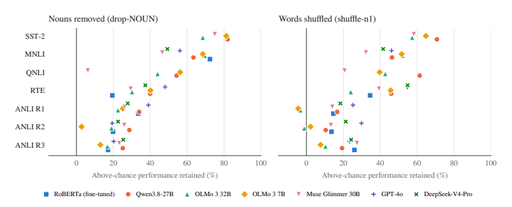
Figure 1 : Share of performance above chance maintained after noun removal (left) and word shuffling (right). Open-weight LLMs are scored zero-shot by centred accuracy, and RoBERTa is scored by accuracy (RoBERTa-large for ANLI, not run with shuffling). Values less than 0 indicate performance below chance.
원문 · CC BY 4.0 · Aarne Talman, Stergios Chatzikyriakidis · Shortcuts or Memorisation? Revisiting Data Corruption in Natural Language Understanding with Large Language Models · 원문 그림 인용 · 원본 PDF 5쪽에서 그림 영역을 추출했습니다.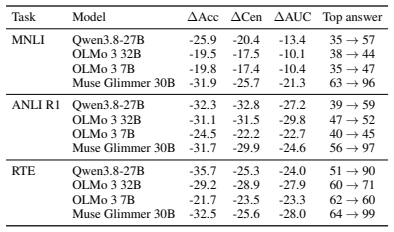
Table 6 : Change (points) under drop-NOUN in raw accu- racy, centred accuracy and AUC, and the share of items (%) given the most frequent answer, clean → perturbed. Zero-shot open LLMs.
원문 · CC BY 4.0 · Aarne Talman, Stergios Chatzikyriakidis · Shortcuts or Memorisation? Revisiting Data Corruption in Natural Language Understanding with Large Language Models · 원문 그림 인용 · 원본 PDF 13쪽에서 그림 영역을 추출했습니다.MNLI와 ANLI의 명사 제거 비교
직접 답변하는 시스템은 명사를 제거했을 때 MNLI에서 36–72%, ANLI에서 14–29%의 above-chance 성능을 유지했습니다. 미세조정된 RoBERTa도 MNLI에서 72%, ANLI에서 24%를 기록했습니다. 추론 후 답하는 Grok 4.7만 이 패턴을 따르지 않았습니다. 그래서 저자들은 차이가 모델보다 데이터셋에서 비롯된다고 봅니다.
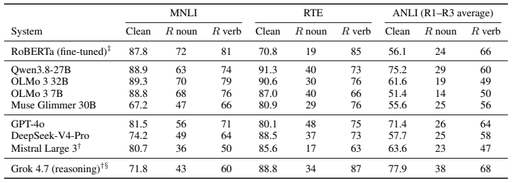
Table 1 : Clean accuracy (%) and share of performance above chance (R, %) maintained under the drop-NOUN and drop-VERB conditions. R is calculated from centred accuracy for open-weight LLMs and from accuracy for others (Section 3.4). ‡For MNLI and RTE, the RoBERTa-base model fine-tuned on clean data is used, and for ANLI, the public RoBERTa-large model from Nie et al. (2020) is used.†Answer scores are unavailable, and MNLI is evaluated on a 2,000-item sample. §Reasoning model, first 400 items per task.
원문 · CC BY 4.0 · Aarne Talman, Stergios Chatzikyriakidis · Shortcuts or Memorisation? Revisiting Data Corruption in Natural Language Understanding with Large Language Models · 원문 그림 인용 · 원본 PDF 5쪽에서 그림 영역을 추출했습니다.오염 지표와 hypothesis-only 단서
오염 지표로 마스킹 단어 복원, Min-K%++, infini-gram 중복을 살폈습니다. ANLI 전제는 OLMo 2 pre-training 데이터에서 72%와 71%가 발견되었지만 MNLI 전제는 21%만 발견되었습니다. 그러나 오염 지표와 유지율 사이에서는 연관이 관찰되지 않았습니다. hypothesis-only 분류기로 나눈 쉬운 항목은 Qwen3.8-27B와 OLMo 3에서 명사 제거 시 어려운 항목보다 적게 떨어졌고, keep-NOUN+VERB에서는 그 방향이 반대로 나타났습니다. 이는 단서가 기능어에 있다는 해석과 맞습니다.
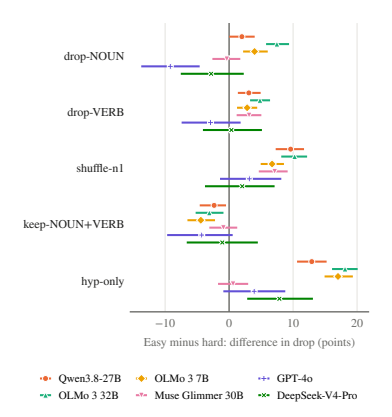
Figure 2 : MNLI degradation for items correctly classi- fied by the hypothesis-only classifier (easy items) minus the degradation for the remaining items (hard items), expressed as centred accuracy points with 95% boot- strap intervals. Positive values indicate less degradation for easy items. GPT-4o and DeepSeek-V4-Pro were evaluated on a sample of 2,000 items.
원문 · CC BY 4.0 · Aarne Talman, Stergios Chatzikyriakidis · Shortcuts or Memorisation? Revisiting Data Corruption in Natural Language Understanding with Large Language Models · 원문 그림 인용 · 원본 PDF 6쪽에서 그림 영역을 추출했습니다.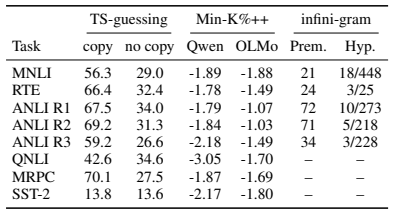
Table 9 : Contamination indicators. TS-guessing: exact- match rate (%) of Qwen3.8-27B filling in a masked word, when the word may also occur in the other field (copy) and when it may not. Min-K%++: mean score (higher suggests seen). infini-gram: premises (or first sentences) found in OLMo’s pre-training data (%), and hypotheses of at least 13 words found / all such hypothe- ses.
원문 · CC BY 4.0 · Aarne Talman, Stergios Chatzikyriakidis · Shortcuts or Memorisation? Revisiting Data Corruption in Natural Language Understanding with Large Language Models · 원문 그림 인용 · 원본 PDF 15쪽에서 그림 영역을 추출했습니다.새 항목으로 본 단서 패턴
명사와 동사만 남긴 조건에서는 순서가 뒤바뀌었습니다. 이 결과는 새 항목을 두 방식으로 작성하고 여러 명이 라벨을 검증한 설정에서 얻었습니다.
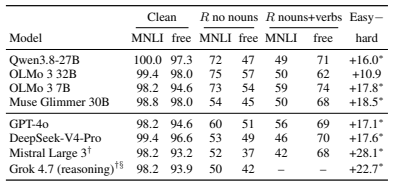
Table 2 : New items written in MNLI style or with- out cues (168 and 148 items): clean accuracy (%, cen- tred where answer scores exist), retention rate of per- formance above chance (R, %) under drop-NOUN and keep-NOUN+VERB conditions, and difference between easy and hard items in drop-NOUN drop for MNLI-style items (points, with ∗ for 95% confidence intervals ex- cluding 0). Symbols are the same as Table 1.
원문 · CC BY 4.0 · Aarne Talman, Stergios Chatzikyriakidis · Shortcuts or Memorisation? Revisiting Data Corruption in Natural Language Understanding with Large Language Models · 원문 그림 인용 · 원본 PDF 7쪽에서 그림 영역을 추출했습니다.오염 점검과 측정의 한계
오염 점검은 OLMo 2 pre-training 혼합물에서 verbatim 13-gram 중복만 확인했으므로 부분적인 확인입니다. 바꿔 쓰거나 형식을 바꾼 사본은 탐지하지 못합니다. 호스팅 모델은 학습 데이터를 알 수 없어 암기를 배제할 수 없습니다. 새 항목은 주로 한 명의 주석자가 검증했습니다.
논문 정보
- 저자
- Aarne Talman, Stergios Chatzikyriakidis
- 학회·저널
- arXiv · 프리프린트
- 최초 공개일
- 2026년 11월 12일
- 등록일
- 2026년 11월 13일
- 수정일
- 2026년 11월 12일
- 버전
- v1
- arXiv
- 2611.16843
- 분류
- cs.CL
- 원문 이용 조건
- CC BY 4.0
- 제공 범위
- 논문 정보, 해설, 허용된 원문 그림
AI 해설은 논문 원문과 별개의 설명이며 오류가 있을 수 있습니다. 원문과 그림은 각 출처의 이용 조건과 따로 표시된 권리를 따릅니다.
초록
Pre-trained encoders fine-tuned on natural language inference (NLI) and other language understanding tasks keep much of their accuracy after the input is perturbed, e.g. by removing all nouns or shuffling the words. Does the same hold for large language models (LLMs), and if so, is it because they have seen the benchmarks during pre-training? In this paper we revisit these perturbation experiments with eight LLMs alongside fine-tuned encoders on GLUE and the three rounds of ANLI. Regardless of model size, every system that answers directly retains 36-72% of its above-chance performance without nouns on MNLI compared to only 14-29% on ANLI. Only a model that reasons before answering departs from this pattern. We also check contamination indicators (including exact $n$-gram counts in the public pre-training data of two of the models) and find no link between exposure and robustness. Our strongest evidence comes from 368 new, human-validated items that none of the models can have seen. All eight LLMs keep more of their performance without nouns on items written in MNLI's style than on items written without its cues. When the perturbation instead removes the function words carrying such cues, this advantage reverses. In light of these results, we argue that robustness to perturbation on familiar NLI benchmarks reflects dataset shortcuts rather than memorisation, and tells us more about the benchmark than about the model.
원문 인용
Aarne Talman, Stergios Chatzikyriakidis (2026). Shortcuts or Memorisation? Revisiting Data Corruption in Natural Language Understanding with Large Language Models. arXiv:2611.16843v1. https://arxiv.org/abs/2611.16843v1
BibTeX
@misc{talman2026shortcuts,
  title = {{Shortcuts or Memorisation? Revisiting Data Corruption in Natural Language Understanding with Large Language Models}},
  author = {Aarne Talman and Stergios Chatzikyriakidis},
  year = {2026},
  eprint = {2611.16843},
  archivePrefix = {arXiv},
  url = {https://arxiv.org/abs/2611.16843v1}
}