논문 해설
Detection Is Not Early Warning: Evaluating Token-Level Alarms on Language Model Failures
탐지는 조기 경보가 아니다: 언어 모델 실패에 대한 토큰 단위 경보 평가
- 연구 문제 응답이 끝난 뒤의 AUROC는 모니터가 실패 전에 경고하는지 드러내지 못합니다.
- 연구 방법 주석된 onset 기준으로 검증 임계값을 고정하고 테스트 알람의 시점을 채점합니다.
- 주요 결과 APERTUS와 LLAMA에서 프로브는 대부분 onset 전에 경고했고, 적응은 워닝 커버리지를 두 배 넘게 높였습니다.
응답 수준 평가가 놓치는 조기 경고
언어 모델의 실패는 흔히 특정 토큰에서 시작합니다. 이 시작점을 onset이라고 부르며, 반복 퇴화에서는 첫 번째 루프의 첫 토큰으로 정의됩니다. 생성 중에 모델을 읽는 모니터는 완성된 응답을 분류하거나, 실패가 진행 중일 때 탐지하거나, 실패가 시작되기 전에 경고할 수 있습니다. 이 가운데 경고만이 생성을 멈추거나 조정할 시간을 남깁니다. 그런데 AUROC 같은 응답 수준 지표는 모니터가 언제 알람을 울리는지를 보지 않습니다. 이 논문은 이 평가 공백을 문제로 삼고, 반복 퇴화를 사례로 하여 onset을 기준으로 알람의 시점을 채점하는 방법을 다룹니다.
PREWARN의 세 단계 평가 절차
PREWARN은 주석된 onset이 있는 어떤 실패에도 적용되는 평가 프로토콜입니다. 먼저 검증 분할에서 건강한 응답 중 알람을 울리는 비율이 예산 β 이하가 되는 가장 낮은 임계값을 고릅니다. 이 임계값은 식 τ*(β)=min{τ: |{r∈H: α_r<∞}| ≤ β|H|}로 정의되며, 테스트 분할에서는 이 값을 고정한 채 모니터를 실행합니다. 각 응답의 첫 알람 α_r은 첫 플래그 위치입니다. 마지막으로 첫 알람을 onset과 비교합니다. 조기 경고 과제에서는 onset 바로 앞 W=256개 위치의 워닝 윈도우를 세고, 조기 경고율은 첫 알람이 onset보다 앞서는 실패 응답의 비율입니다. 무작위 알람과 비교해 읽도록 설계되어 있습니다.
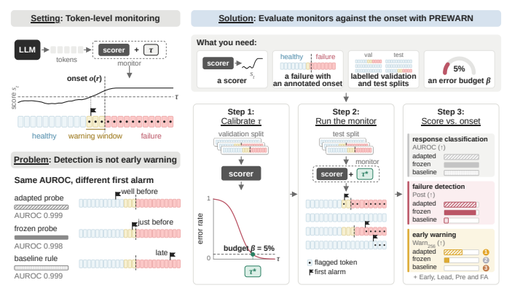
Figure 1 : Overview of PREWARN. Left: a monitor runs a scorer over the generated tokens and alarms where the score crosses τ (dots mark flagged tokens, the flag the first alarm); AUROC rates three such monitors as equal although their first alarms fall well before, just before and after the onset o(r). Right: what PREWARNneeds and its three steps: calibrate the threshold on validation to the budget β, run the monitor on the test split, and score the alarms against the onset on the three tasks.
원문 · CC BY 4.0 · Marco De Negri, Luca Sartori, Lorenzo Baggi, Moritz Reihs, Eduard Frank Ďurech, Mennatallah El-Assady, Valentina Pyatkin, Anna Hedström · Detection Is Not Early Warning: Evaluating Token-Level Alarms on Language Model Failures · 원문 그림 인용 · 원본 PDF 2쪽에서 그림 영역을 추출했습니다.고정 프로브와 적응형 프로브
프로브는 한 레이어의 잔차 스트림을 읽는 선형 모델입니다. 고정 프로브는 가중치와 편향, 그리고 레이어 정규화의 아핀 파라미터만 학습하며 생성기의 활성값을 그대로 씁니다. 적응형 프로브는 여기에 0부터 ℓ 레이어까지 rank-16 LoRA 어댑터를 함께 학습하므로, 적응된 레이어를 지나는 두 번째 순전파가 필요합니다. 학습 목표는 onset보다 K=256토큰 앞부터 양성이 되는 이진 목표이며, 실패가 텍스트에 드러나기 전에 프로브가 발화하도록 설계되었습니다. 레이어와 체크포인트는 검증에서 β=1%일 때 Warn256이 가장 높은 설정을 고르되, 사후 커버리지가 0.3 이상인 것만 후보로 둡니다.
응답 수준 지표와 온셋 기준 지표의 차이
APERTUS 레이어 15에서 토큰 길이 규칙, 적응형 프로브, 두 고정 프로브를 비교했습니다. 응답 분류에서는 네 scorer의 AUROC가 0.998 이상으로 거의 같았고, token-cap 규칙의 best accuracy가 가장 높았습니다. 반면 사후 커버리지와 워닝 커버리지는 scorer마다 크게 달랐습니다. 적응형 프로브의 워닝 커버리지는 두 고정 프로브보다 3배 이상 높게 기록되었습니다. 응답 수준 지표는 응답의 최댓값 토큰만 보기 때문에 알람의 위치를 구분하지 못합니다. 같은 AUROC를 가진 scorer라도 플래그를 워닝 구간으로 옮기면 조기 경고 지표가 크게 달라졌습니다.
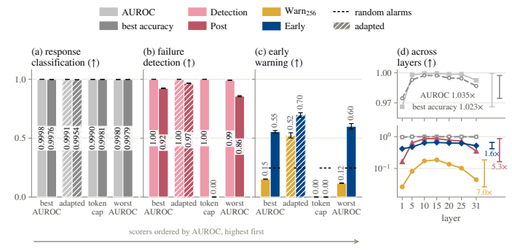
Figure 2 : Response-level metrics rate four scorers as equal, while only the onset-aligned metrics show how differently they perform. Scorers on APERTUSat layer 15: the frozen probes with the highest and lowest validation AUROC (Section A.5), the adapted probe (hatched) and the token-cap rule, which flags only the last token of a capped response. Panels (a)–(c) group the metrics by task (Section 3); dashed lines in (c) are random alarms. (d) The frozen probe with the selected strategy across layers, with each metric’s best-to-worst ratio; lower plot on a log scale. β= 5% , human-verified in-domain test split; error bars and bands are one standard deviation over three seeds.
원문 · CC BY 4.0 · Marco De Negri, Luca Sartori, Lorenzo Baggi, Moritz Reihs, Eduard Frank Ďurech, Mennatallah El-Assady, Valentina Pyatkin, Anna Hedström · Detection Is Not Early Warning: Evaluating Token-Level Alarms on Language Model Failures · 원문 그림 인용 · 원본 PDF 6쪽에서 그림 영역을 추출했습니다.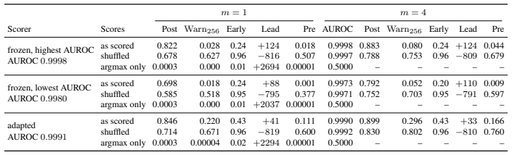
Table 4 : Scorers with the same AUROC range from one that almost never warns to one that warns before almost every loop. From each probe of Figure 2, two transforms keep the highest score of every response, and with it the AUROC and the calibrated threshold at m= 1, but move its other flags. Shuffled: the token scores of each response permuted at random, which spreads the flags over the whole response. Argmax only: every score except the highest set to the minimum, which leaves at most one flag per response. As scored: the original scores. m: number of consecutive flagged tokens needed for an alarm (Equation (3)); at m= 4 the threshold is recalibrated. AUROC is given once per scorer for m= 1. –: no alarm. Lead in tokens, negative for warnings. APERTUS, layer 15, human-verified in-domain test split,β= 1%, mean over three seeds
원문 · CC BY 4.0 · Marco De Negri, Luca Sartori, Lorenzo Baggi, Moritz Reihs, Eduard Frank Ďurech, Mennatallah El-Assady, Valentina Pyatkin, Anna Hedström · Detection Is Not Early Warning: Evaluating Token-Level Alarms on Language Model Failures · 원문 그림 인용 · 원본 PDF 19쪽에서 그림 영역을 추출했습니다.세 모델에서의 프로브 워닝
APERTUS와 LLAMA에서는 고정 프로브와 적응형 프로브의 조기 경고율이 0.5를 넘었고, 무작위 알람보다 높았습니다. 중앙값 첫 알람은 onset보다 137에서 232토큰 앞에 왔습니다. 반면 MISTRAL에서는 모든 프로브의 조기 경고율이 0.5 아래였고, 중앙값 첫 알람은 onset 뒤에 있었습니다. MISTRAL의 탐지율은 0.99였으므로 이 모델에서 프로브는 탐지에는 쓸 수 있지만 조기 경고에는 쓰기 어려웠습니다. 이 결과는 β=5%, 사람이 검증한 도메인 내 테스트 분할에서 얻은 것입니다.
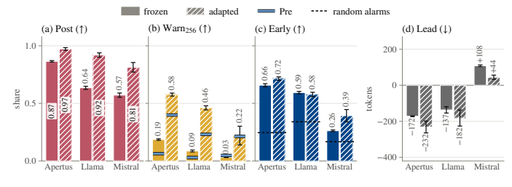
Figure 3 : Probes warn before most loops on APERTUSand LLAMAbut not on MISTRAL. Frozen (solid) and adapted (hatched) probe of each model at its selected layer (Table 1). (a) Post-onset and (b) warning coverage, with pre-window coverage (Pre) as a light-blue tick. (c) Early-warning rate; dashed lines are random alarms. (d) Lead, the median first alarm minus the onset in tokens; negative values are warnings. β= 5% , human-verified in-domain test split; error bars are one standard deviation over three seeds.
원문 · CC BY 4.0 · Marco De Negri, Luca Sartori, Lorenzo Baggi, Moritz Reihs, Eduard Frank Ďurech, Mennatallah El-Assady, Valentina Pyatkin, Anna Hedström · Detection Is Not Early Warning: Evaluating Token-Level Alarms on Language Model Failures · 원문 그림 인용 · 원본 PDF 7쪽에서 그림 영역을 추출했습니다.저랭크 적응이 더하는 플래그
같은 레이어에서 고정 프로브와 적응형 프로브를 비교하면 차이는 LoRA 어댑터뿐입니다. 모든 모델에서 적응은 워닝 커버리지를 두 배 넘게 올렸지만, 조기 경고율은 크게 늘리지 않았습니다. 조기 경고율은 응답당 첫 알람 한 번만 세기 때문에, 이미 온셋 이전에 알람이 있는 응답에 플래그를 더해도 이 지표는 오르지 않습니다. APERTUS와 LLAMA에서 적응형 프로브는 온셋보다 훨씬 전부터 건강한 응답보다 많은 토큰을 플래그했습니다. 이 해석은 저자들이 제시한 것이며, MISTRAL에서는 적응이 온셋 방향으로의 상승 없이 전체 플래그율만 높였습니다.
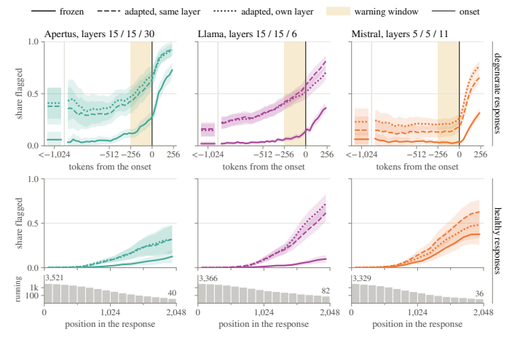
Figure 4 : On APERTUSand LLAMA, probes flag more tokens as the onset approaches, and adaptation adds flags long before it; on MISTRAL, flags rise only after the onset. Top: share of flagged tokens on degenerate responses by distance from the onset (bins of 32 tokens; positions more than 1,024 tokens before the onset pooled on the left). Bottom: the same on healthy responses by position (bins of 128 tokens), where flags also rise with length; the strip below gives the number of responses still running, on a log scale. Panel titles give the layers of the three probes. β= 5%, human-verified in-domain test split; mean over three seeds with95%intervals from leaving out one prompt at a time.
원문 · CC BY 4.0 · Marco De Negri, Luca Sartori, Lorenzo Baggi, Moritz Reihs, Eduard Frank Ďurech, Mennatallah El-Assady, Valentina Pyatkin, Anna Hedström · Detection Is Not Early Warning: Evaluating Token-Level Alarms on Language Model Failures · 원문 그림 인용 · 원본 PDF 8쪽에서 그림 영역을 추출했습니다.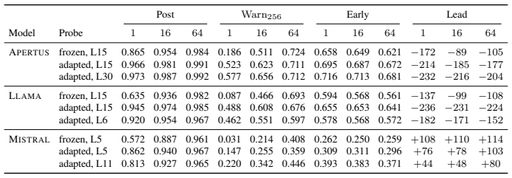
Table 16 : Requiring consecutive flags raises coverage but does not move the first alarm earlier. Probes at persistence m∈ {1,16,64}, the number of consecutive flagged tokens needed for an alarm (Equation (3)), with the threshold recalibrated at each m for β= 5%. Coverage counts every token at or above the threshold, while the first alarm is the token that completes the run. Lead in tokens, negative for warnings. Human-verified in-domain test split, mean over three seeds.
원문 · CC BY 4.0 · Marco De Negri, Luca Sartori, Lorenzo Baggi, Moritz Reihs, Eduard Frank Ďurech, Mennatallah El-Assady, Valentina Pyatkin, Anna Hedström · Detection Is Not Early Warning: Evaluating Token-Level Alarms on Language Model Failures · 원문 그림 인용 · 원본 PDF 29쪽에서 그림 영역을 추출했습니다.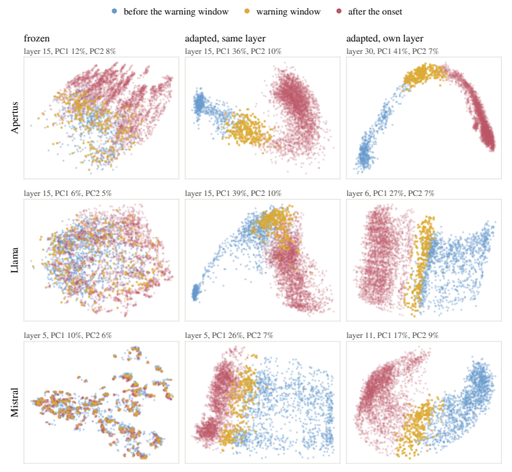
Figure 6 : In the frozen model, the tokens before the warning window, in it and after the on- set overlap; after adaptation they fall in largely separate regions. Residual-stream activations of the tokens of one degenerate response per model (APERTUS: numinamath_1_5_00388, LLAMA: numinamath_1_5_00044, MISTRAL: numinamath_1_5_00517, all from the in-domain test split, projected onto their first two principal components (x: PC1, y: PC2). Columns: the layer read by the frozen probe (left), the adapted probe at the same layer (middle) and the adapted probe at its own selected layer (right). Each panel has its own projection, and its title gives the share of variance each component explains. Blue: before the warning window. Yellow: warning window. Red: after the onset. The adapted panels use the seed with the highest validation warning coverage.
원문 · CC BY 4.0 · Marco De Negri, Luca Sartori, Lorenzo Baggi, Moritz Reihs, Eduard Frank Ďurech, Mennatallah El-Assady, Valentina Pyatkin, Anna Hedström · Detection Is Not Early Warning: Evaluating Token-Level Alarms on Language Model Failures · 원문 그림 인용 · 원본 PDF 30쪽에서 그림 영역을 추출했습니다.학습되지 않은 베이스라인과 비교
학습되지 않은 베이스라인은 토큰 길이, 방출된 토큰, 생성기의 확신도 같은 정보만 읽습니다. 반복 기반 규칙과 엔트로피 규칙은 대부분 온셋 이후에 알람을 울렸습니다. 어떤 베이스라인도 무작위 알람보다 훨씬 자주 워닝하지 않았습니다. 프로브는 모든 모델에서 가장 높은 조기 경고율과 가장 이른 중앙값 첫 알람을 기록했습니다. 다만 MISTRAL에서는 긴 윈도우의 seq-rep-n과 rep/ℓ이 사후 커버리지에서 프로브보다 높았습니다.
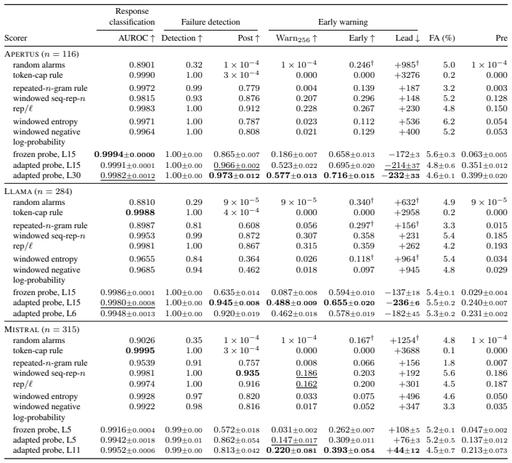
Table 1 : Probes against the baselines on the human-verified in-domain test split at β= 5%. Scorers are grouped, from top to bottom, by what they read: nothing (random alarms, the chance reference), only the length of the response, the emitted tokens, the generator’s confidence in them, or the activations. Each baseline is read at the setting chosen on validation (Section A.6). Probes are labelled with the layer they read; adapted probes also train rank- 16 LoRA adapters in the layers up to it. Metrics as defined in Section 3; Lead is in tokens, negative when the first alarm precedes the onset. n: number of degenerate responses. †: raises an alarm on fewer than 90% of degenerate responses, so its Early and Lead describe only part of them and are left out of the comparison. FA and Pre are not ranked. Best value in each other column and model in bold, values within one standard deviation of it underlined. Mean ± one standard deviation over three seeds for probes; the baselines are deterministic, and random alarms are given in closed form.
원문 · CC BY 4.0 · Marco De Negri, Luca Sartori, Lorenzo Baggi, Moritz Reihs, Eduard Frank Ďurech, Mennatallah El-Assady, Valentina Pyatkin, Anna Hedström · Detection Is Not Early Warning: Evaluating Token-Level Alarms on Language Model Failures · 원문 그림 인용 · 원본 PDF 9쪽에서 그림 영역을 추출했습니다.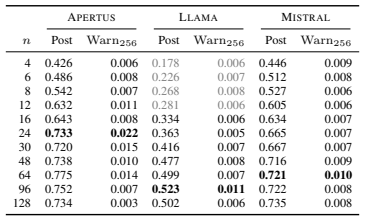
Table 7 : N-gram size n of the repeated-n-gram rule. Validation split, β= 1% . Bold: the setting selected for that model (Section A.6). Grey: below the post-onset floor of 0.3. A coverage near 0 marks a setting on which healthy responses already reach the top of the score range, so the calibrated threshold sits at that top and almost no token is flagged.
원문 · CC BY 4.0 · Marco De Negri, Luca Sartori, Lorenzo Baggi, Moritz Reihs, Eduard Frank Ďurech, Mennatallah El-Assady, Valentina Pyatkin, Anna Hedström · Detection Is Not Early Warning: Evaluating Token-Level Alarms on Language Model Failures · 원문 그림 인용 · 원본 PDF 21쪽에서 그림 영역을 추출했습니다.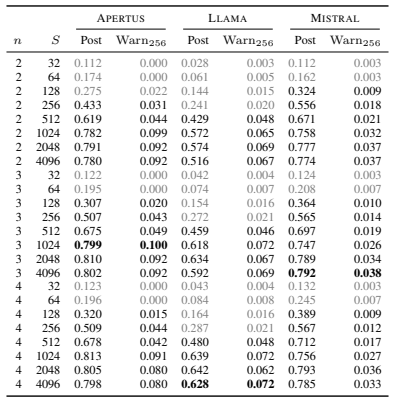
Table 8 : N-gram order n and window S of windowed seq-rep-n. Validation split, β= 1%. Bold: the setting selected for that model (Section A.6). Grey: below the post-onset floor of 0.3. A coverage near 0 marks a setting on which healthy responses already reach the top of the score range, so the calibrated threshold sits at that top and almost no token is flagged.
원문 · CC BY 4.0 · Marco De Negri, Luca Sartori, Lorenzo Baggi, Moritz Reihs, Eduard Frank Ďurech, Mennatallah El-Assady, Valentina Pyatkin, Anna Hedström · Detection Is Not Early Warning: Evaluating Token-Level Alarms on Language Model Failures · 원문 그림 인용 · 원본 PDF 22쪽에서 그림 영역을 추출했습니다.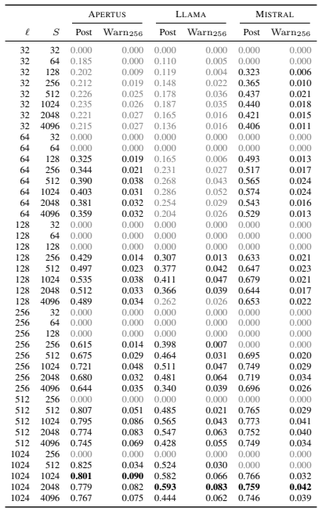
Table 9 : Look-back ℓ and window S of rep/ℓ. Validation split, β= 1%. Bold: the setting selected for that model (Section A.6). Grey: below the post-onset floor of 0.3. A coverage near 0 marks a setting on which healthy responses already reach the top of the score range, so the calibrated threshold sits at that top and almost no token is flagged.
원문 · CC BY 4.0 · Marco De Negri, Luca Sartori, Lorenzo Baggi, Moritz Reihs, Eduard Frank Ďurech, Mennatallah El-Assady, Valentina Pyatkin, Anna Hedström · Detection Is Not Early Warning: Evaluating Token-Level Alarms on Language Model Failures · 원문 그림 인용 · 원본 PDF 23쪽에서 그림 영역을 추출했습니다.onset 정의와 응답 길이의 한계
첫째, 리드 타임은 onset 정의에 따라 달라집니다. 이 논문은 onset을 반복이 텍스트에서 보이기 전인 첫 번째 루프의 첫 토큰에 둡니다. 둘째, 루프 후 종료 토큰을 내는 응답은 건강한 응답으로 분류되므로 오경보율은 보수적으로 계산됩니다. 셋째, 요청된 반복이나 열거처럼 정당한 반복과 퇴화를 구분하는 실험은 하지 않았습니다. 넷째, APERTUS와 LLAMA에서는 온셋이 건강한 응답이 끝난 뒤에 오는 경우가 많아 프로브가 플래그하는 일부가 응답 길이를 반영할 수 있습니다. 다섯째, 학습 전략과 선택 규칙은 반복 퇴화에서만 골랐습니다.
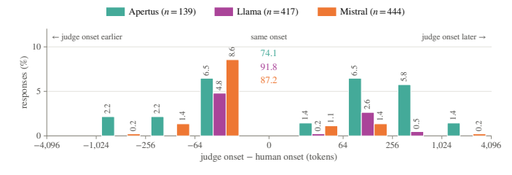
Figure 5 : Signed distance between the judge’s onset and the reviewer’s onset on the capped test responses that both call degenerate, pooled over the two test splits, in log-spaced bins. Negative values mean the judge places the onset earlier than the reviewer. Every number is a percentage of the model’s responses. The bars give the responses whose onset moved and the middle column those whose onset the reviewer kept, so the numbers of one model add up to100.
원문 · CC BY 4.0 · Marco De Negri, Luca Sartori, Lorenzo Baggi, Moritz Reihs, Eduard Frank Ďurech, Mennatallah El-Assady, Valentina Pyatkin, Anna Hedström · Detection Is Not Early Warning: Evaluating Token-Level Alarms on Language Model Failures · 원문 그림 인용 · 원본 PDF 17쪽에서 그림 영역을 추출했습니다.논문 정보
- 저자
- Marco De Negri, Luca Sartori, Lorenzo Baggi, Moritz Reihs, Eduard Frank Ďurech, Mennatallah El-Assady, Valentina Pyatkin, Anna Hedström
- 학회·저널
- arXiv · 프리프린트
- 최초 공개일
- 2026년 11월 12일
- 등록일
- 2026년 11월 13일
- 수정일
- 2026년 11월 12일
- 버전
- v1
- arXiv
- 2611.16803
- 분류
- cs.LG · cs.CL
- 원문 이용 조건
- CC BY 4.0
- 제공 범위
- 논문 정보, 해설, 허용된 원문 그림
AI 해설은 논문 원문과 별개의 설명이며 오류가 있을 수 있습니다. 원문과 그림은 각 출처의 이용 조건과 따로 표시된 권리를 따릅니다.
초록
Many failures of language models begin at a specific token, the onset. A monitor that reads the model during generation can classify the finished response, detect the failure once it is under way, or warn before it begins, and only a warning leaves time to stop or steer the generation. Monitors are usually evaluated with response-level metrics such as AUROC, which ignore when the monitor fires. We introduce PREWARN, an evaluation protocol for any failure with an annotated onset. It calibrates each monitor's threshold on validation data to an error rate chosen for the application, runs the monitor, and scores its alarms relative to the onset on all three tasks. As a case study we apply it to repetitive degeneration in three open language models, with early warning as the main task, using linear probes on activations and six untrained baselines. Response-level metrics saturate on this failure, and a rule that reads only the response length scores almost perfectly, while probes that AUROC ranks as equal warn very differently under PREWARN. Probes warn before the onset on most degenerate responses of two of the three models, low-rank adapters below the probe more than double the share of tokens just before the onset that it flags, largely by flagging degenerate responses long before the onset, and no untrained baseline warns much more often than random alarms. We release the probes with calibrated thresholds at https://huggingface.co/collections/marcodene/prewarn-degeneration-probes
원문 인용
Marco De Negri, Luca Sartori, Lorenzo Baggi, Moritz Reihs, Eduard Frank Ďurech, Mennatallah El-Assady, Valentina Pyatkin, Anna Hedström (2026). Detection Is Not Early Warning: Evaluating Token-Level Alarms on Language Model Failures. arXiv:2611.16803v1. https://arxiv.org/abs/2611.16803v1
BibTeX
@misc{negri2026detection,
  title = {{Detection Is Not Early Warning: Evaluating Token-Level Alarms on Language Model Failures}},
  author = {Marco De Negri and Luca Sartori and Lorenzo Baggi and Moritz Reihs and Eduard Frank Ďurech and Mennatallah El-Assady and Valentina Pyatkin and Anna Hedström},
  year = {2026},
  eprint = {2611.16803},
  archivePrefix = {arXiv},
  url = {https://arxiv.org/abs/2611.16803v1}
}